

Organisations migrating to cloud infrastructure face increasing pressure to protect sensitive data whilst maintaining operational efficiency. Data loss prevention AWS strategies have become essential for businesses seeking to safeguard intellectual property, customer information, and confidential records in cloud environments. Furthermore, with the rise of sophisticated cyber threats and stringent regulatory requirements across Europe, implementing robust data protection measures is no longer optional but mandatory. This comprehensive guide explores how European businesses can leverage AWS security capabilities to prevent data breaches, ensure compliance, and maintain customer trust in an increasingly digital landscape.
Understanding Data Loss Prevention in Cloud Environments
Data loss prevention encompasses technologies, policies, and processes designed to ensure sensitive information remains protected from unauthorised access, accidental exposure, or malicious exfiltration. Moreover, in cloud environments like AWS, DLP strategies must address unique challenges including distributed data storage, multi-tenancy concerns, and dynamic infrastructure scaling.
The fundamental principle behind data loss prevention strategies involves identifying, classifying, and monitoring sensitive data throughout its lifecycle. Therefore, businesses must implement controls that track data from creation through storage, processing, transmission, and eventual deletion. This holistic approach ensures no security gaps emerge during data handling operations.
Key Components of AWS Data Protection
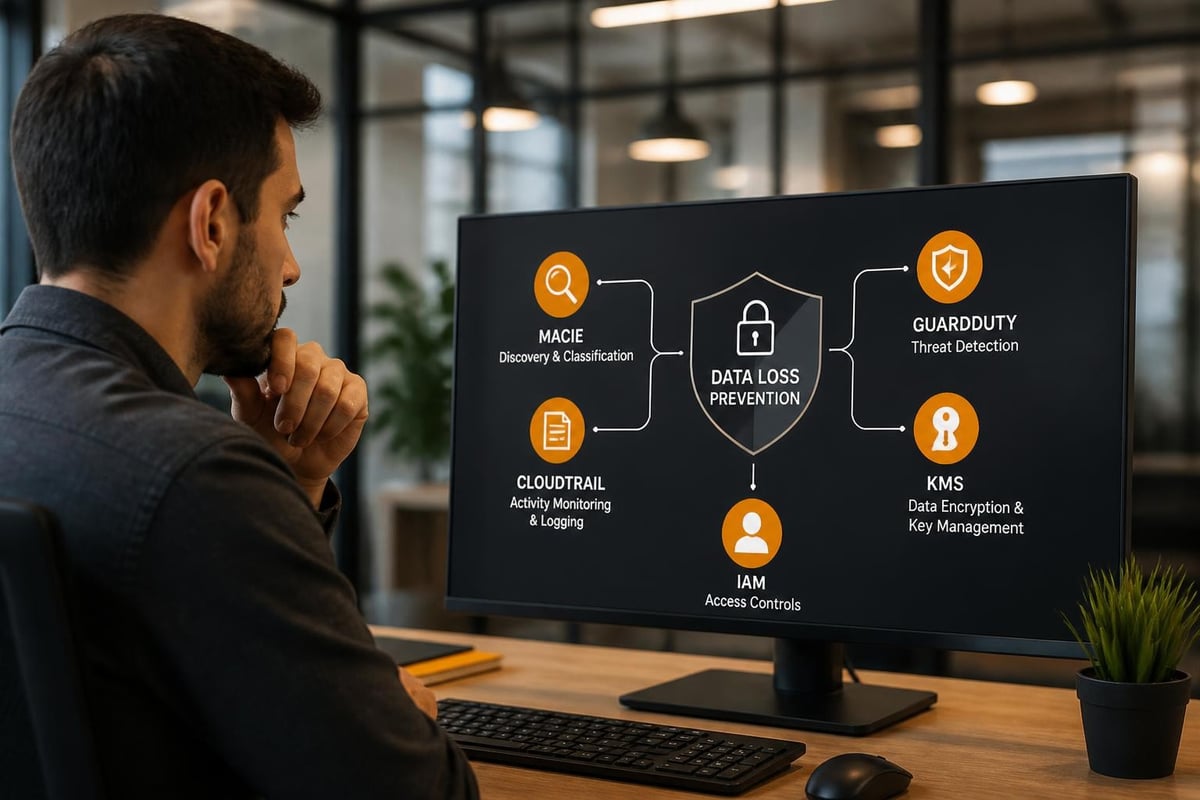
AWS provides multiple native services that work together to create comprehensive data loss prevention capabilities. Nevertheless, effective implementation requires understanding how these components integrate:
- Amazon Macie for automated data discovery and classification
- AWS Key Management Service (KMS) for encryption key management
- AWS CloudTrail for audit logging and activity monitoring
- Amazon GuardDuty for threat detection and anomaly identification
- AWS Identity and Access Management (IAM) for granular permission controls
- AWS Config for configuration compliance tracking
Additionally, these services form the foundation of a layered security approach that addresses multiple threat vectors simultaneously.
Implementing Encryption for Data Protection
Encryption serves as the cornerstone of any data loss prevention AWS strategy. Furthermore, AWS offers both encryption at rest and encryption in transit, ensuring data remains protected regardless of its state or location within the cloud infrastructure.
Encryption at Rest Strategies
Amazon S3, the primary storage service for many AWS deployments, provides server-side encryption options that integrate seamlessly with AWS KMS. Therefore, organisations can automatically encrypt all data stored in S3 buckets using customer-managed keys, AWS-managed keys, or customer-provided keys depending on their specific compliance requirements.
| Encryption Method | Key Management | Compliance Suitability | Implementation Complexity |
|---|---|---|---|
| SSE-S3 | AWS-managed | Standard | Low |
| SSE-KMS | Customer-controlled | High | Medium |
| SSE-C | Customer-provided | Maximum | High |
| Client-side | External systems | Variable | Very High |
Moreover, Amazon EBS volumes supporting EC2 instances can utilise encryption to protect data at the block storage level. This ensures that even if physical storage media were compromised, the encrypted data remains inaccessible without proper authorisation.
Securing Data in Transit
Network-level encryption protects data as it moves between services, regions, or to external destinations. Nevertheless, organisations must configure TLS/SSL certificates properly and enforce encrypted connections across all communication channels. AWS Certificate Manager simplifies this process by providing free SSL/TLS certificates with automatic renewal capabilities.
Access Control and Identity Management
Preventing unauthorised data access requires robust identity and access management policies that follow the principle of least privilege. Furthermore, implementing comprehensive access controls ensures users and applications receive only the permissions necessary to perform their designated functions.
IAM Best Practices for Data Protection
AWS IAM enables granular control over who can access specific resources and what actions they can perform. Therefore, organisations should implement the following practices:
- Create individual IAM users rather than sharing root account credentials
- Enable multi-factor authentication for all privileged accounts
- Utilise IAM roles for applications and services instead of embedding credentials
- Regularly audit and rotate access keys
- Implement service control policies across organisational units
- Apply resource-based policies to sensitive data repositories
Additionally, AWS Organisations allows centralised policy management across multiple AWS accounts, ensuring consistent security postures throughout complex enterprise environments.
Monitoring and Logging Access Patterns
AWS CloudTrail records all API calls and user activities, creating comprehensive audit trails that support forensic investigations and compliance reporting. Moreover, integrating CloudTrail with Amazon CloudWatch enables real-time alerting when suspicious access patterns emerge, allowing security teams to respond rapidly to potential data loss incidents.

Automated Data Discovery and Classification
Understanding what sensitive data exists within your AWS environment represents the critical first step in data loss prevention AWS initiatives. Nevertheless, manual data classification becomes impractical as organisations scale their cloud operations and data volumes grow exponentially.
Leveraging Amazon Macie for Intelligent Discovery
Amazon Macie uses machine learning and pattern matching to automatically discover, classify, and protect sensitive data stored in Amazon S3. Furthermore, it can identify personally identifiable information, financial data, intellectual property, and custom-defined sensitive data types based on regular expressions or keywords.
The service continuously monitors S3 buckets and generates detailed findings when it detects unencrypted sensitive data, publicly accessible sensitive data, or data shared with external entities. Therefore, security teams receive actionable intelligence about potential data exposure risks without manually reviewing millions of files.
Custom Classification Rules
Whilst Macie provides extensive built-in classification capabilities, organisations often need to identify industry-specific or proprietary data types. Moreover, custom data identifiers allow businesses to define precise patterns matching their unique sensitive data formats, ensuring comprehensive coverage aligned with specific regulatory requirements.
- Financial identifiers including custom account numbers or transaction codes
- Healthcare data matching specific patient record formats
- Intellectual property markers such as project codenames or proprietary formulas
- Customer information following organisation-specific data structures
- Compliance tags indicating regulatory sensitivity levels
Additionally, integrating classification metadata into data governance workflows enables automated policy enforcement based on sensitivity levels.
Network Security and Data Loss Prevention
Controlling data movement across network boundaries prevents unauthorised data exfiltration whilst maintaining legitimate business operations. Furthermore, strengthening network security controls creates additional defensive layers that complement encryption and access management strategies.
VPC Security Controls
Amazon Virtual Private Cloud enables organisations to isolate AWS resources within logically segmented network environments. Therefore, implementing proper VPC configurations, security groups, and network access control lists restricts data flows to authorised pathways only.
Network segmentation strategies should separate sensitive workloads into dedicated subnets with restricted internet access. Moreover, utilising VPC endpoints for AWS services eliminates unnecessary data traversal through public internet connections, reducing exposure risks whilst improving performance.
Data Transfer Monitoring
AWS Network Firewall and third-party solutions provide deep packet inspection capabilities that examine data leaving your AWS environment. Nevertheless, organisations must balance security scrutiny with performance requirements, implementing inspection rules that flag suspicious transfers without impeding legitimate business activities.
| Monitoring Approach | Detection Capability | Performance Impact | Cost Consideration |
|---|---|---|---|
| VPC Flow Logs | Connection metadata | Minimal | Low |
| AWS Network Firewall | Deep packet inspection | Moderate | Medium |
| Third-party DLP | Advanced content analysis | Higher | Variable |
| CloudWatch Metrics | Traffic volume patterns | Minimal | Low |
Compliance and Regulatory Considerations
European businesses operating in AWS environments must navigate complex regulatory landscapes including GDPR, NIS2, and industry-specific mandates. Furthermore, data loss prevention AWS implementations must demonstrably satisfy these compliance obligations through documented controls, audit trails, and evidence of effectiveness.
GDPR Data Protection Requirements
The General Data Protection Regulation imposes strict obligations regarding personal data processing, storage, and transfer. Therefore, AWS customers must implement technical and organisational measures ensuring personal data receives appropriate protection throughout its lifecycle.
Data loss prevention strategies supporting GDPR compliance should include:
- Data minimisation through automated retention policies and lifecycle management
- Purpose limitation enforcement via access controls restricting data use to declared purposes
- Encryption as a security measure demonstrating technical safeguards
- Audit capabilities providing evidence of compliance for regulatory inquiries
- Breach notification mechanisms enabling timely incident reporting
Additionally, AWS provides compliance documentation and certifications that support customer compliance efforts, though ultimate responsibility for GDPR adherence rests with data controllers and processors.

Industry-Specific Regulations
Beyond general data protection laws, organisations in regulated industries face additional compliance requirements. Moreover, financial services, healthcare providers, and government entities must implement enhanced controls addressing sector-specific mandates.
For instance, protecting sensitive data in financial services requires consideration of payment card industry standards, anti-money laundering regulations, and customer due diligence obligations. Therefore, data loss prevention implementations must incorporate controls specific to financial data handling whilst maintaining broader security postures.
Incident Response and Remediation
Despite robust preventive measures, organisations must prepare for potential data loss incidents through documented response procedures and automated remediation capabilities. Furthermore, rapid incident response minimises damage, reduces regulatory penalties, and preserves customer trust when security events occur.
Automated Response Workflows
AWS Lambda functions can trigger automatically when CloudWatch alarms detect suspicious activities or policy violations. Therefore, organisations can implement immediate responses including:
- Isolating compromised resources by modifying security group rules
- Revoking suspicious IAM credentials or sessions
- Enabling additional logging and monitoring for affected resources
- Notifying security teams through Amazon SNS or integrated ticketing systems
- Creating forensic snapshots of affected data stores for investigation
Additionally, AWS Systems Manager provides centralised automation capabilities that execute remediation playbooks consistently across multiple accounts and regions.
Post-Incident Analysis
Learning from security incidents strengthens future data loss prevention AWS postures. Nevertheless, organisations must balance thorough investigation with operational continuity, conducting root cause analysis whilst restoring normal business functions.
Documentation of incidents, response actions, and identified improvements creates valuable institutional knowledge. Moreover, regular tabletop exercises testing incident response procedures ensure teams remain prepared for actual security events.
Integration with Third-Party Solutions
Whilst AWS native services provide comprehensive data protection capabilities, many organisations supplement these with specialised third-party tools addressing specific requirements. Furthermore, the AWS Marketplace offers numerous DLP solutions for Amazon S3 and EC2 that enhance native capabilities with advanced features.
Evaluating Third-Party DLP Tools
When considering supplementary solutions, organisations should assess compatibility with existing AWS architectures, performance impact on production workloads, and total cost of ownership including licensing and operational overhead. Therefore, proof-of-concept testing in representative environments provides crucial insights before committing to enterprise deployments.
Key evaluation criteria include:
- Data type coverage matching organisational sensitivity classifications
- Detection accuracy balancing false positives against missed threats
- Integration capabilities with existing security information and event management systems
- Scalability supporting current and projected data volumes
- Compliance reporting generating documentation required for regulatory audits
Additionally, vendor reputation, support quality, and product roadmap alignment with organisational needs warrant careful consideration.
Data Loss Prevention for Hybrid Environments
Many European businesses operate hybrid infrastructure combining on-premises systems with AWS cloud resources. Nevertheless, consistent data protection across these diverse environments presents unique challenges requiring coordinated strategies.
Unified Policy Management
Maintaining consistent DLP policies across hybrid environments prevents security gaps emerging at environment boundaries. Therefore, organisations should establish centralised policy repositories defining data handling rules applicable regardless of infrastructure location.
AWS Direct Connect and VPN connections enabling hybrid connectivity must incorporate appropriate security controls ensuring data traversing these links receives equivalent protection to data remaining within single environments. Moreover, integrating on-premises security tools with AWS services through APIs creates unified visibility across the entire infrastructure landscape.
Emerging Technologies and Future Considerations
The data loss prevention AWS landscape continues evolving as new threats emerge and AWS introduces additional security services. Furthermore, organisations must maintain awareness of developing trends whilst adapting existing strategies to address novel challenges.
Artificial Intelligence and Machine Learning
Machine learning algorithms increasingly enhance data loss prevention capabilities by identifying subtle patterns indicating potential data exfiltration attempts. Additionally, AI-powered classification improves accuracy whilst reducing manual effort required for data discovery initiatives.
Nevertheless, organisations must consider the security implications of AI systems themselves, ensuring that training data and model parameters receive appropriate protection. Moreover, as businesses adopt generative AI services, new DLP considerations emerge around preventing sensitive information leakage through AI interactions.
Understanding how data security for cloud platforms extends beyond basic access controls helps organisations appreciate the comprehensive approach required for effective protection. European businesses particularly benefit from providers emphasising privacy-centric architectures aligned with regional regulatory expectations.
Privacy-Enhancing Technologies
Homomorphic encryption, secure multi-party computation, and differential privacy represent emerging technologies enabling data analysis whilst preserving confidentiality. Therefore, forward-thinking organisations should evaluate how these capabilities might enhance their data loss prevention AWS strategies whilst supporting legitimate business intelligence requirements.
For businesses seeking comprehensive guidance on implementing these advanced security measures, scheduling a demonstration of integrated security solutions provides practical insights into how multiple protection layers work together effectively.
Operational Excellence in Data Protection
Sustaining effective data loss prevention requires ongoing operational commitment beyond initial implementation. Furthermore, organisations must establish processes ensuring security measures adapt as business requirements, threat landscapes, and regulatory environments evolve.
Continuous Monitoring and Improvement
Regular security assessments identify gaps in existing controls and opportunities for enhancement. Therefore, organisations should schedule periodic reviews examining:
- Policy effectiveness through metrics measuring prevented incidents and false positive rates
- Coverage completeness ensuring new data repositories receive appropriate protection
- Compliance alignment verifying controls satisfy current regulatory requirements
- Technology updates evaluating new AWS services or third-party capabilities
- Team competencies through training programmes maintaining security expertise
Additionally, participating in AWS security bulletins and industry forums provides early warning of emerging threats requiring defensive adaptations.
Cost Optimisation Strategies
Whilst security represents a critical investment, organisations must balance protection requirements against budget constraints. Moreover, AWS provides multiple cost optimisation opportunities for data loss prevention implementations:
- Utilising AWS native services reducing third-party licensing costs
- Implementing intelligent tiering for security logging data
- Rightsizing monitoring resources based on actual threat profiles
- Leveraging automation reducing manual security operations overhead
- Consolidating security tools eliminating redundant capabilities
Nevertheless, cost optimisation should never compromise essential security controls protecting sensitive data and supporting compliance obligations.
Implementing robust data loss prevention AWS strategies protects sensitive information whilst enabling European businesses to leverage cloud infrastructure confidently. Furthermore, combining AWS native services with proven security practices creates comprehensive protection addressing regulatory requirements and emerging threats. vBoxx delivers secure cloud solutions emphasising privacy and data protection, helping organisations maintain control over their sensitive information through encrypted storage, robust access controls, and European-hosted infrastructure designed for businesses prioritising security and compliance.