

Cloud computing has fundamentally transformed how businesses operate in the digital age. Understanding this technology is essential for organisations seeking to optimise their IT infrastructure, reduce costs, and improve scalability. Therefore, this comprehensive guide will define the cloud computing concept, explore its various models, and examine how businesses can leverage this technology effectively in 2026.
Understanding Cloud Computing Fundamentals
When we define the cloud computing model, we refer to the delivery of computing services over the internet rather than maintaining physical infrastructure on premises. Furthermore, this includes servers, storage, databases, networking, software, analytics, and intelligence delivered through remote data centres. The National Institute of Standards and Technology (NIST) provides an authoritative framework that outlines five essential characteristics of cloud computing.
The Five Essential Characteristics
Cloud computing differs from traditional IT infrastructure through several key attributes:
- On-demand self-service: Users can provision computing capabilities automatically without requiring human interaction with service providers
- Broad network access: Services are available over the network and accessed through standard mechanisms
- Resource pooling: Provider resources are pooled to serve multiple consumers using a multi-tenant model
- Rapid elasticity: Capabilities can be elastically provisioned and released to scale rapidly with demand
- Measured service: Cloud systems automatically control and optimise resource use through metering capabilities
Moreover, these characteristics enable businesses to move away from capital-intensive IT investments towards operational expenditure models. In addition, organisations gain flexibility to scale resources up or down based on actual requirements rather than projected capacity needs.
Cloud Service Models Explained
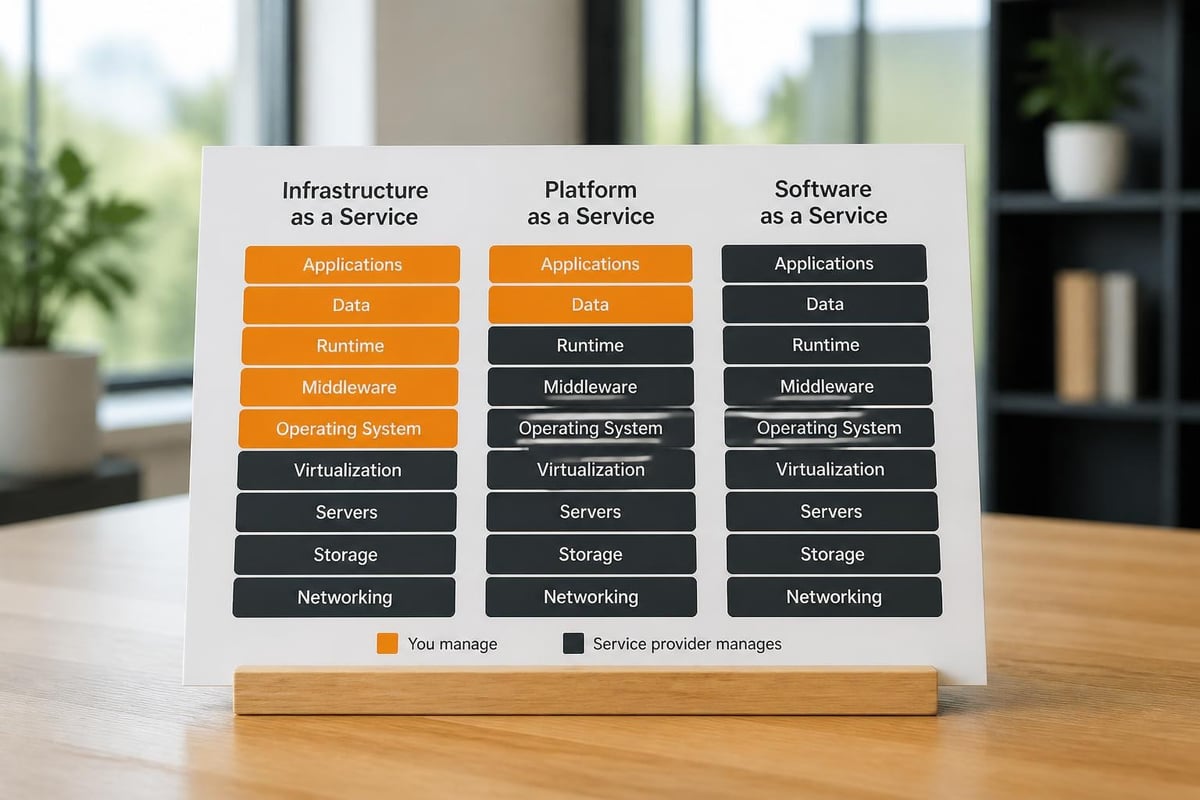
To properly define the cloud computing ecosystem, we must examine the three primary service models that determine how much control organisations retain over their computing resources. Nevertheless, each model serves different business needs and technical requirements.
Infrastructure as a Service (IaaS)
IaaS provides virtualised computing resources over the internet. Consequently, businesses rent IT infrastructure such as servers, virtual machines, storage, networks, and operating systems from cloud providers on a pay-as-you-go basis.
| Feature | Business Benefit | Use Case |
|---|---|---|
| Scalable resources | Pay only for what you use | Development and testing environments |
| No hardware costs | Eliminate capital expenditure | Temporary workload spikes |
| Fast deployment | Provision resources in minutes | Disaster recovery solutions |
Furthermore, IaaS offers maximum flexibility and control over computing resources. Therefore, organisations maintain responsibility for managing operating systems, applications, and data whilst the provider manages the underlying infrastructure.
Platform as a Service (PaaS)
Cloud computing refers to the delivery of computing resources over the internet, a model used to define the cloud computing as an on-demand technology service that eliminates the need for physical infrastructure.
Within this framework, Platform as a Service (PaaS) provides a complete cloud development environment. It includes tools, databases, and middleware, eliminating infrastructure complexity. Consequently, developers can reduce coding time, accelerate deployment, and focus on innovation. However, organizations must ensure application compatibility to maximize these benefits.
Software as a Service (SaaS)
SaaS delivers software applications over the internet on a subscription basis. Consequently, users access applications through web browsers without installing or maintaining software locally. This model has become increasingly popular for business applications, including email, customer relationship management, and collaboration tools.
The provider manages everything from infrastructure to application maintenance and updates. Therefore, businesses can focus on using the software rather than maintaining it. For example, when organisations explore secure communication solutions, they might consider options like those available through a demonstration all-in-one session that showcases cloud-based email and storage capabilities.
Cloud Deployment Models
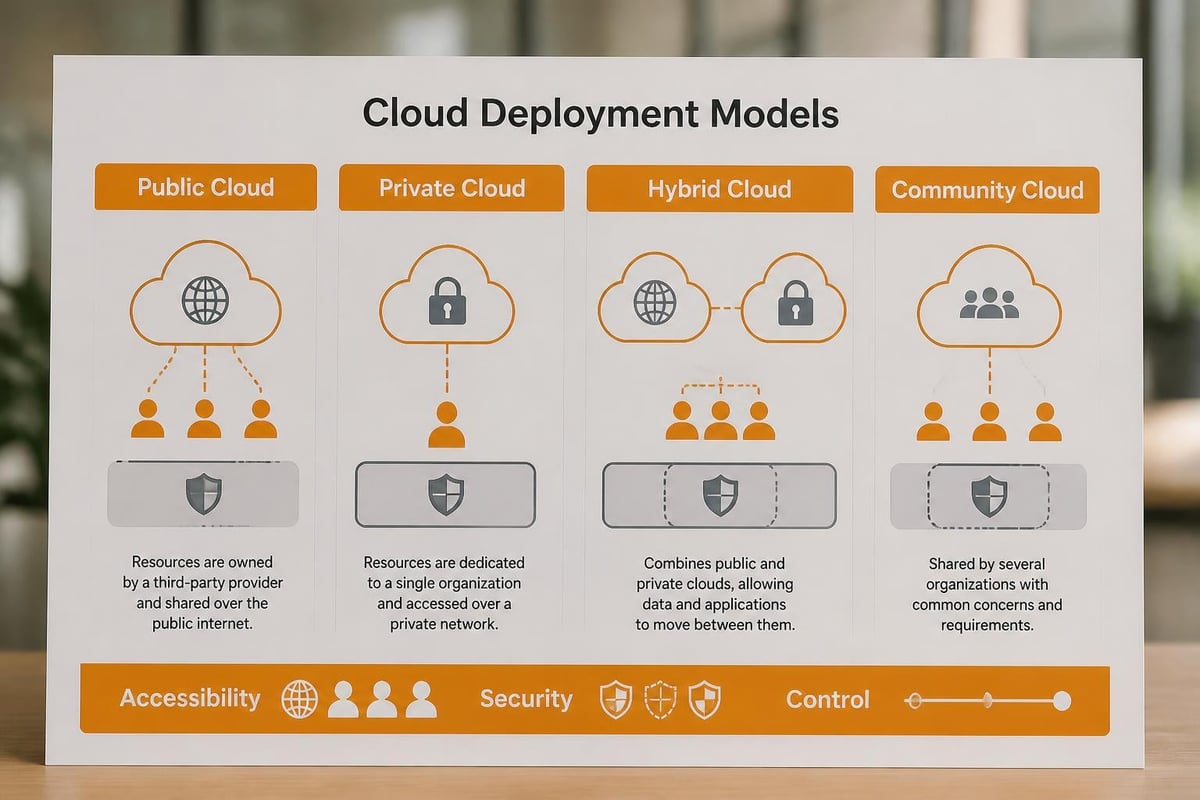
Beyond service models, we must also define the cloud computing deployment options available to organisations. Furthermore, each deployment model offers different levels of control, security, and resource sharing.
Public Cloud
Public clouds deliver services over the public internet and share resources amongst multiple organisations. Moreover, these services are owned and operated by third-party cloud service providers. According to Britannica’s comprehensive definition, public clouds offer the highest level of efficiency in shared resources.
Advantages of public clouds include:
- No capital expenditure on hardware
- High scalability and flexibility
- Pay-per-use pricing models
- No maintenance overhead
- Geographic distribution capabilities
Nevertheless, organisations must carefully evaluate data sovereignty and compliance requirements before migrating sensitive workloads to public clouds.
Private Cloud
Private clouds provide computing resources used exclusively by one organisation. In addition, they can be physically located at the organisation’s on-site data centre or hosted by a third-party service provider. Therefore, private clouds offer greater control over data, security, and quality of service.
| Aspect | Public Cloud | Private Cloud |
|---|---|---|
| Cost | Lower upfront, pay-per-use | Higher upfront, predictable costs |
| Security | Shared responsibility | Greater control |
| Scalability | Virtually unlimited | Limited by infrastructure |
| Compliance | Varies by provider | Full control |
Furthermore, organisations with strict regulatory requirements or specific security needs often prefer private cloud deployments. Moreover, this model allows businesses to customise their infrastructure to meet precise technical and compliance specifications.
Hybrid Cloud
Hybrid cloud environments combine public and private clouds, allowing data and applications to move between them. Consequently, businesses gain greater flexibility and optimisation of existing infrastructure, security, and compliance requirements.
This deployment model has gained significant traction because it addresses multiple business needs simultaneously. Nevertheless, managing hybrid environments requires sophisticated orchestration tools and expertise. In addition, organisations must carefully plan network connectivity and data transfer strategies between environments.
Benefits of Cloud Computing for Modern Businesses
When we define the cloud computing value proposition, several compelling advantages emerge for organisations of all sizes. Therefore, understanding these benefits helps businesses make informed decisions about cloud adoption strategies.
Cost Efficiency and Financial Flexibility
Cloud computing transforms IT spending from capital expenditure to operational expenditure. Furthermore, organisations eliminate costs associated with purchasing, housing, and maintaining physical servers and data centres. This shift provides several financial advantages:
- Reduced hardware acquisition costs
- Lower energy consumption expenses
- Decreased IT staff requirements for infrastructure management
- Predictable monthly operational costs
- Elimination of over-provisioning waste
Moreover, the pay-as-you-go model ensures businesses only pay for resources they actually consume. Nevertheless, organisations must implement proper cost monitoring to prevent unexpected expenses from uncontrolled resource usage.
Scalability and Performance
Cloud platforms enable businesses to scale resources instantaneously based on demand. Consequently, organisations can handle traffic spikes without investing in permanent infrastructure that sits idle during normal periods. This elasticity proves particularly valuable for:
- Seasonal businesses with fluctuating demands
- Growing startups requiring flexible expansion
- Enterprises launching new products or services
- Companies expanding into new geographic markets
In addition, cloud providers maintain multiple data centres globally, enabling better performance through geographic distribution. Therefore, businesses can deliver content and services closer to end users, reducing latency and improving user experience.
Business Continuity and Disaster Recovery
Cloud computing enhances business continuity planning through built-in redundancy and backup capabilities. Furthermore, data stored in the cloud is automatically replicated across multiple locations, providing protection against hardware failures, natural disasters, and other disruptions.
| Traditional DR | Cloud-based DR |
|---|---|
| High upfront costs | Pay-per-use pricing |
| Complex implementation | Simplified setup |
| Manual failover processes | Automated recovery |
| Limited testing capabilities | Regular testing possible |
Moreover, recovery time objectives (RTOs) and recovery point objectives (RPOs) improve significantly with cloud-based disaster recovery solutions. Nevertheless, organisations must properly configure and test their recovery procedures to ensure effectiveness during actual incidents.
Security and Compliance Considerations
As we define the cloud computing landscape in 2026, security remains a paramount concern for organisations. Therefore, understanding the shared responsibility model and implementing appropriate controls is essential for protecting data and applications.
The Shared Responsibility Model
Cloud security operates under a shared responsibility framework where providers and customers each manage specific aspects. Furthermore, the division of responsibilities varies depending on the service model (IaaS, PaaS, or SaaS).
Provider responsibilities typically include:
- Physical security of data centres
- Network infrastructure protection
- Hypervisor and virtualisation security
- Hardware maintenance and patching
Customer responsibilities generally encompass:
- Identity and access management
- Application security
- Data encryption and classification
- Compliance with regulatory requirements
Moreover, organisations must clearly understand where provider responsibility ends and customer responsibility begins. In addition, this understanding should inform security strategy and investment decisions.
Data Privacy and Sovereignty
Data protection regulations continue to evolve globally, creating complexity for cloud deployments. Consequently, businesses must ensure their cloud strategies align with requirements such as GDPR, HIPAA, and industry-specific regulations. According to recent analysis, data sovereignty concerns increasingly influence cloud architecture decisions.
Furthermore, organisations must consider where their data resides physically and which jurisdictions govern that data. Therefore, selecting cloud providers with data centres in appropriate locations becomes crucial for compliance. Nevertheless, some businesses choose secure cloud services that prioritise privacy and offer transparent data handling practices.

Current Trends Shaping Cloud Computing
The cloud computing landscape continues to evolve rapidly as new technologies and business requirements emerge. Therefore, understanding current trends helps organisations plan future-proof cloud strategies. Industry experts identify several key developments shaping the cloud in 2026.
Multi-Cloud and Cloud-Native Approaches
Organisations increasingly adopt multi-cloud strategies, using services from multiple providers to avoid vendor lock-in and optimise capabilities. Furthermore, this approach enables businesses to select the best services from different providers whilst maintaining flexibility.
Key multi-cloud benefits include:
- Reduced dependency on single vendors
- Geographic distribution capabilities
- Cost optimisation through provider comparison
- Resilience through diversification
- Access to best-of-breed services
Moreover, cloud-native development practices have become standard, with organisations building applications specifically designed to leverage cloud capabilities. Nevertheless, multi-cloud environments introduce management complexity requiring sophisticated orchestration tools.
Artificial Intelligence and Machine Learning Integration
Cloud platforms increasingly integrate AI and machine learning capabilities, making these technologies accessible to organisations without extensive data science expertise. Consequently, businesses can implement intelligent automation, predictive analytics, and advanced data processing without massive infrastructure investments.
In addition, cloud providers offer pre-trained models and AutoML services that simplify AI implementation. Therefore, even smaller organisations can leverage artificial intelligence to enhance operations and customer experiences. Furthermore, the computational power required for training complex models becomes available on-demand through cloud resources.
Edge Computing and Distributed Architectures
Edge computing extends cloud capabilities closer to data sources and end users. Moreover, this architecture reduces latency for time-sensitive applications whilst decreasing bandwidth requirements for data transfer to centralised cloud facilities.
| Centralised Cloud | Edge Computing |
|---|---|
| Higher latency | Near-instantaneous response |
| Bandwidth intensive | Reduced data transfer |
| Centralised processing | Distributed processing |
| Simpler architecture | Complex orchestration |
Furthermore, edge computing proves essential for Internet of Things (IoT) applications, autonomous vehicles, and real-time analytics. Nevertheless, organisations must balance the benefits of edge processing against the complexity of managing distributed infrastructure.
Sustainability and Green Cloud Practices
Environmental considerations increasingly influence cloud computing decisions as organisations seek to reduce their carbon footprint. Consequently, cloud providers invest heavily in renewable energy and energy-efficient infrastructure. According to recent industry coverage, sustainability has become a competitive differentiator amongst cloud providers.
Moreover, businesses benefit from the economies of scale that large data centres achieve in energy efficiency. Therefore, migrating to cloud infrastructure often reduces overall environmental impact compared to maintaining on-premises data centres. In addition, some cloud providers offer carbon-neutral or carbon-negative operations, allowing organisations to support their sustainability commitments.
Challenges and Risk Management
Whilst cloud computing offers substantial benefits, organisations must address several challenges to maximise value and minimise risks. Therefore, developing comprehensive cloud governance frameworks becomes essential for successful adoption.
Managing Cloud Costs
Cloud cost management remains a significant challenge as organisations struggle with unexpected expenses. Furthermore, the flexibility that makes cloud attractive also creates opportunities for uncontrolled spending. Consequently, businesses must implement rigorous cost monitoring and optimisation practices:
- Regular review of resource utilisation
- Automated scaling policies to prevent waste
- Reserved instance purchases for predictable workloads
- Cost allocation tags for departmental accountability
- Regular audits of unused or underutilised resources
Moreover, organisations should establish budget alerts and approval workflows for significant resource provisioning. Nevertheless, balancing cost control with the agility that cloud enables requires ongoing attention and refinement.
Skills Gap and Training Requirements
The rapid evolution of cloud technologies creates persistent skills gaps within IT organisations. In addition, traditional infrastructure expertise doesn’t directly translate to cloud architecture and management competencies. Therefore, businesses must invest in training and development:
- Cloud platform certifications for technical staff
- Architecture and design principles training
- Security and compliance specialisation
- Cost optimisation and FinOps practices
- Automation and infrastructure-as-code skills
Furthermore, organisations may need to partner with managed service providers to supplement internal capabilities during transitions. Moreover, fostering a culture of continuous learning helps teams adapt to evolving cloud technologies and best practices.
Vendor Lock-In Concerns
Despite multi-cloud adoption trends, vendor lock-in remains a legitimate concern when organisations deeply integrate with proprietary services. Consequently, businesses should design architectures that maintain portability where feasible whilst accepting some degree of integration for optimal functionality.
Strategies to mitigate vendor lock-in include:
- Prioritising open standards and technologies
- Containerising applications for portability
- Abstracting cloud-specific services where possible
- Maintaining clear migration paths in architecture
- Regular evaluation of alternative providers
Nevertheless, organisations must balance portability concerns against the productivity gains from leveraging provider-specific services. In addition, some degree of integration often proves necessary to realise full cloud benefits.
Implementation Strategies for Cloud Adoption
Successfully implementing cloud computing requires careful planning and phased execution. Therefore, organisations should develop comprehensive cloud adoption strategies aligned with business objectives. Moreover, these strategies must address technical, organisational, and cultural dimensions of transformation.
Assessment and Planning Phase
Before migrating to cloud infrastructure, businesses must thoroughly assess their current environment and requirements. Furthermore, this assessment should identify which workloads are suitable for cloud migration and which deployment models best serve each use case.
Key assessment activities include:
- Application inventory and dependency mapping
- Performance and capacity requirement analysis
- Compliance and regulatory review
- Cost-benefit analysis for each workload
- Risk assessment and mitigation planning
In addition, organisations should define clear success metrics and timelines for cloud adoption. Therefore, stakeholders can track progress and adjust strategies based on actual results and learnings.
Migration Execution
Cloud migration typically follows one of several approaches depending on application characteristics and business requirements. Consequently, organisations often employ multiple strategies across their application portfolio:
| Strategy | Description | Best For |
|---|---|---|
| Rehost (Lift and Shift) | Move applications without changes | Quick migration, time constraints |
| Replatform | Minor optimisations during migration | Balancing speed and cloud benefits |
| Refactor | Redesign for cloud-native architecture | Maximum cloud value, modern applications |
| Retire | Decommission unnecessary applications | Reducing technical debt |
| Retain | Keep on-premises temporarily | Applications not ready for cloud |
Moreover, successful migrations require detailed planning, testing, and validation at each stage. Nevertheless, organisations should expect challenges and maintain flexibility to adjust approaches based on encountered issues.
Ongoing Optimisation
Cloud adoption is not a one-time project but an ongoing journey of optimisation and refinement. Furthermore, organisations must continuously evaluate their cloud usage against evolving business needs and technological capabilities. Therefore, establishing cloud centres of excellence or governance teams helps maintain alignment and drive continuous improvement.
In addition, regular reviews should assess cost efficiency, security posture, performance metrics, and alignment with business objectives. Moreover, staying informed about new cloud services and capabilities enables organisations to leverage innovations that provide competitive advantages.
Understanding how to define the cloud computing model and its various implementations enables organisations to make informed decisions about their IT infrastructure strategies. Furthermore, businesses seeking secure, reliable cloud solutions with emphasis on privacy and sustainability can explore how vBoxx delivers comprehensive cloud services tailored to modern business requirements. By partnering with experienced providers who prioritise security and environmental responsibility, organisations can confidently embrace cloud technologies whilst maintaining control over their critical data and applications.