
Apple's transition to custom silicon has fundamentally transformed the Mac into a capable platform for artificial intelligence workloads. With dedicated neural processing hardware, unified memory architectures, and privacy-first design principles, Mac AI represents a compelling alternative for European businesses seeking to deploy machine learning models whilst maintaining strict data sovereignty and GDPR compliance. Furthermore, the combination of powerful on-device processing and native integration with macOS makes Mac AI particularly attractive for organisations that prioritise security, performance, and regulatory adherence in their AI initiatives.
The Apple Silicon Advantage for Mac AI Deployment
Apple's M-series chips have redefined what professionals can accomplish with artificial intelligence on desktop and laptop computers. The architecture combines high-performance CPU cores, GPU acceleration, and a dedicated Neural Engine specifically designed for machine learning tasks. Moreover, the unified memory architecture allows all processing units to access the same memory pool without copying data, significantly improving throughput for AI workloads.
The Neural Engine, present in every M1, M2, M3, and M4 chip, delivers up to 38 trillion operations per second on the latest M4 models. This dedicated hardware accelerates Core ML inference, enabling real-time processing of computer vision, natural language processing, and audio analysis tasks. In addition, the Metal Performance Shaders framework provides low-level access to GPU compute capabilities, allowing developers to optimise custom AI operations beyond standard Core ML functionality.
On-Device Privacy and Data Sovereignty
One of the most compelling aspects of Mac AI for European businesses involves data privacy. Processing sensitive information on-device eliminates the need to transmit data to third-party cloud services, thereby reducing exposure to jurisdictional uncertainties such as the US CLOUD Act. Nevertheless, organisations must still implement proper security controls around model deployment and data handling.
Apple's implementation of on-device AI processing aligns well with GDPR requirements. The Apple Intelligence Foundation Language Models technical report describes how Apple's engineering choices prioritise privacy whilst maintaining performance on Apple Silicon. Their approach includes secure enclave integration, differential privacy techniques, and strict on-device processing boundaries that prevent unauthorised data access.
For businesses operating under stringent European data protection regulations, Mac AI offers several distinct advantages:
- Complete data locality: All processing occurs on local hardware without cloud dependencies
- Reduced third-party exposure: No need to share sensitive data with external AI service providers
- Audit trail clarity: Processing logs remain within organisational control
- Compliance simplification: Easier to demonstrate GDPR adherence when data never leaves premises
Mac AI Frameworks and Development Tools
Developers building Mac AI applications have access to a mature ecosystem of frameworks and tools specifically optimised for Apple Silicon. The landscape includes both Apple's native frameworks and third-party options that leverage Metal acceleration. Therefore, selecting the appropriate framework depends on specific use cases, model types, and deployment requirements.
Core ML and the Neural Engine
Core ML serves as Apple's native framework for deploying trained machine learning models on Mac, iOS, and other Apple platforms. It automatically routes operations to the most efficient processing unit, whether CPU, GPU, or Neural Engine. Furthermore, the Apple Machine Learning Research guide provides detailed techniques for converting transformer models and optimising them for Neural Engine deployment.
Core ML supports a wide range of model types including neural networks, tree ensembles, support vector machines, and generalised linear models. The framework handles model quantisation, allowing developers to reduce model size and improve inference speed whilst maintaining acceptable accuracy levels.
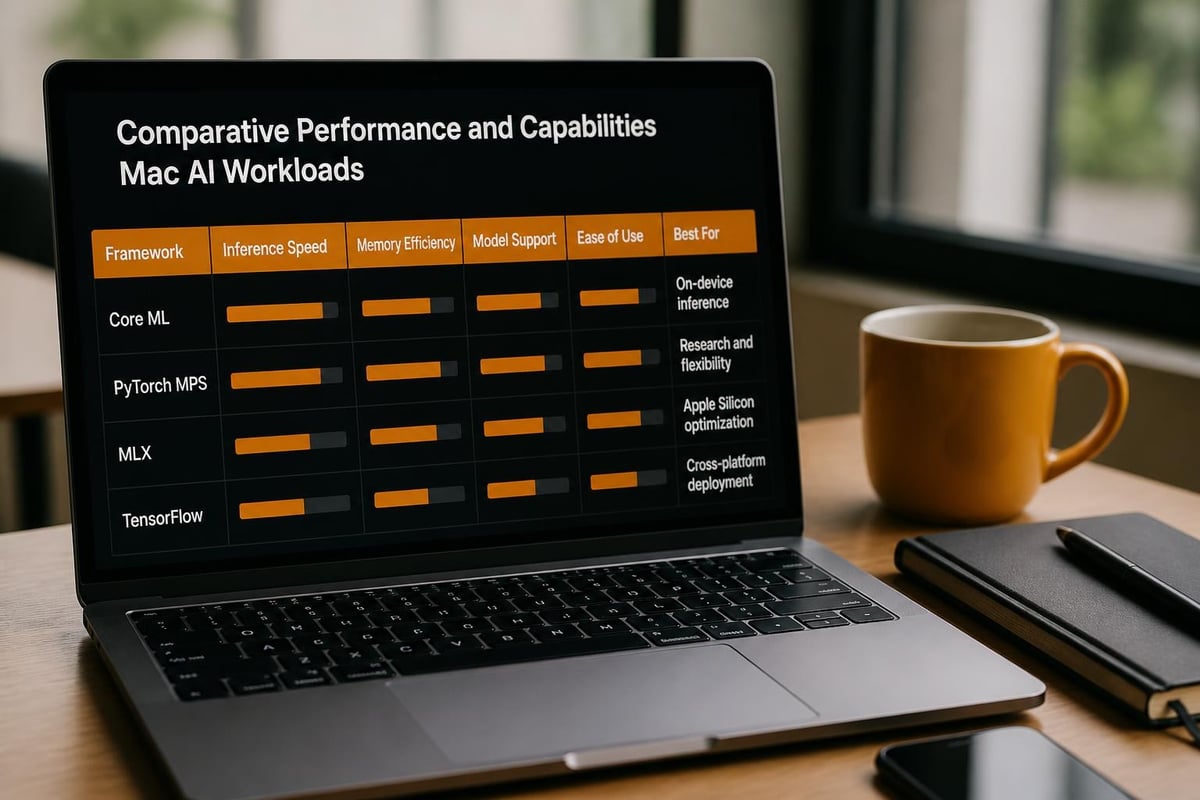
| Framework | Primary Use Case | Hardware Target | Ease of Deployment |
|---|---|---|---|
| Core ML | Production inference | Neural Engine, GPU | High |
| PyTorch MPS | Research, training | GPU (Metal) | Medium |
| TensorFlow | Cross-platform development | CPU, partial GPU | Medium |
| MLX | Local LLM inference | GPU, Neural Engine | Medium-High |
PyTorch and Metal Performance Shaders
PyTorch has emerged as the dominant framework for machine learning research and development. Apple's Metal Performance Shaders (MPS) backend enables PyTorch to leverage GPU acceleration on Apple Silicon. The PyTorch MPS documentation outlines device support, current limitations, and best practices for running workloads on Mac hardware.
Additionally, the Apple Developer guide for PyTorch demonstrates how to accelerate training and inference using Metal. This integration allows data scientists to prototype and train models directly on Mac hardware before deployment, streamlining development workflows and reducing dependency on cloud GPU resources.
For production deployments, PyTorch Serve supports Apple Silicon, providing guidance for serving models efficiently on Mac infrastructure. This capability proves particularly valuable for edge deployment scenarios where organisations need to run inference on distributed Mac systems.
Local Large Language Model Inference on Mac
The rapid advancement of large language models has created new opportunities for on-device AI processing. Mac AI capabilities now extend to running sophisticated language models locally, providing privacy-preserving alternatives to cloud-based AI services. Moreover, recent frameworks have made local LLM deployment increasingly accessible for businesses without extensive machine learning expertise.
Framework Performance and Selection
A comprehensive comparative study evaluated local LLM inference frameworks on Apple Silicon, examining MLX, MLC-LLM, llama.cpp, Ollama, and PyTorch MPS. The research provides empirical benchmarks that help organisations select appropriate tools based on their specific requirements for throughput, latency, and memory efficiency.
The MLC-LLM project has gained significant traction for deploying large language models on Mac hardware. Its compilation approach optimises models specifically for Apple Silicon architecture, delivering performance comparable to cloud services whilst maintaining complete data privacy. In addition, the MLC AI blog offers detailed documentation on cross-platform deployment strategies and optimisation techniques.
Key considerations when deploying local LLMs on Mac include:
- Model size versus available memory: Unified memory architecture allows larger models but requires careful sizing
- Quantisation strategies: 4-bit and 8-bit quantisation enable larger models with acceptable quality trade-offs
- Prompt caching: Efficient KV-cache management improves multi-turn conversation performance
- Batch processing: Throughput optimisation for document analysis and batch inference tasks
Business Applications of Local LLMs
European businesses can leverage Mac AI for numerous applications that benefit from on-device language model processing. Document analysis, contract review, internal knowledge base querying, and customer communication drafting all become feasible without transmitting sensitive information to external services. Consequently, organisations maintain complete control over proprietary data whilst accessing advanced AI capabilities.
For companies utilising vBoxxCloud, the built-in AI assistant demonstrates practical integration of intelligent document processing. The platform's semantic search and summarisation features help teams extract insights from stored documents whilst maintaining GDPR compliance through European data centre hosting. Furthermore, the eIDAS-compliant digital signing integration showcases how AI-assisted workflows can enhance productivity without compromising regulatory adherence.
Deploying Mac AI in Production Environments
Moving from development to production requires careful consideration of infrastructure, scalability, and operational requirements. Mac AI deployments present unique characteristics compared to traditional server-based machine learning infrastructure. Nevertheless, proper planning ensures reliable performance and maintainable systems.
Hosted Mac Infrastructure for AI Workloads
Many organisations lack the internal resources to manage physical Mac hardware at scale. Hosted Mac solutions provide professionally managed infrastructure with guaranteed uptime, security certifications, and European data sovereignty. These platforms deliver the benefits of Mac AI whilst eliminating operational overhead.
Managed Mac hosting services running on Apple M4 hardware in ISO 27001-certified European data centres offer an ideal environment for production Mac AI deployments. Monthly cancellation flexibility allows businesses to scale capacity according to demand without long-term capital commitments. Moreover, expert support ensures that infrastructure issues receive prompt resolution, minimising disruption to AI-dependent workflows.
Performance Optimisation and Monitoring
Successful Mac AI deployments require ongoing performance monitoring and optimisation. Academic research on scaling on-device GPU inference for large generative models provides practical techniques applicable to Mac hardware. These include memory-efficient attention mechanisms, dynamic batching strategies, and thermal management considerations.
Key performance metrics for Mac AI systems include:
- Inference latency: Time required to process individual requests (critical for interactive applications)
- Throughput: Requests processed per second under sustained load
- Memory utilisation: Peak and average unified memory consumption
- Thermal performance: Temperature management under extended workloads
- Model accuracy: Ongoing validation that quantisation and optimisation maintain acceptable quality
TensorFlow Support and Limitations on Mac
Whilst PyTorch has become the preferred framework for many Mac AI developers, TensorFlow remains widely used in enterprise environments. Understanding TensorFlow's capabilities and limitations on macOS helps organisations make informed decisions about framework selection. Therefore, reviewing official TensorFlow installation guidance provides current information on macOS support status and known issues.
TensorFlow on Mac supports CPU acceleration and limited GPU operations through Metal PluggableDevice. However, not all operations currently leverage GPU acceleration, and performance may lag behind PyTorch MPS for certain workloads. In addition, Apple's discontinuation of native TensorFlow builds means developers must compile from source or use community distributions for optimal Apple Silicon support.
Migration Strategies for TensorFlow Models
Organisations with existing TensorFlow investments have several options for Mac AI deployment. Converting TensorFlow models to Core ML format using coremltools enables full Neural Engine acceleration and optimal integration with macOS. Alternatively, running TensorFlow inference within Docker containers provides consistent cross-platform behaviour at the cost of some performance overhead.
For new projects, evaluating whether TensorFlow's specific features justify potential performance trade-offs on Mac hardware makes sense. Many modern architectures achieve better results with PyTorch or direct Core ML implementation on Apple Silicon. Nevertheless, extensive TensorFlow ecosystems and team expertise may favour continued use despite limitations.
Security Considerations for Mac AI Deployments
Implementing Mac AI systems requires comprehensive security planning beyond basic hardware protection. Model security, data protection during inference, and access control all demand careful attention. Furthermore, European businesses must ensure their AI deployments maintain compliance with NIS2, GDPR, and sector-specific regulations.
Model Protection and Intellectual Property
Trained machine learning models represent valuable intellectual property that requires protection from unauthorised access or extraction. Mac AI deployments should implement encryption for stored models, secure model loading procedures, and access logging. Additionally, organisations must consider whether models contain sensitive information learned from training data that could constitute a privacy risk if compromised.
Apple's secure enclave technology provides hardware-backed protection for cryptographic keys and sensitive data. Integrating model decryption and validation with secure enclave operations adds an additional security layer. Moreover, businesses handling particularly sensitive models might implement runtime attestation to verify that inference occurs on authorised, unmodified hardware.
| Security Layer | Implementation Approach | Primary Benefit |
|---|---|---|
| Model encryption | AES-256 at rest | Prevents unauthorised model access |
| Secure model loading | Secure enclave integration | Validates model integrity |
| Access logging | Comprehensive audit trails | Enables compliance demonstration |
| Network isolation | Air-gapped or VPN-only access | Reduces attack surface |
| Update validation | Code signing and attestation | Prevents malicious model substitution |
Data Protection During Inference
Whilst on-device processing inherently protects data from cloud exposure, Mac AI systems must still implement proper controls around input data handling. Sensitive information passed to models should receive the same protection as any other confidential business data. Consequently, implementing proper access controls, audit logging, and data lifecycle management remains essential.
For businesses processing personal data through Mac AI systems, GDPR Article 25 requires privacy by design and by default. This means implementing technical measures such as automatic data minimisation, purpose limitation enforcement, and secure data deletion after processing completion. In addition, maintaining detailed processing records helps demonstrate compliance during regulatory audits.
Future Directions for Mac AI in Enterprise
The trajectory of Mac AI development suggests continued expansion of capabilities and accessibility. Apple's ongoing investment in Neural Engine architecture, unified memory scaling, and developer tooling points toward increasingly powerful on-device AI capabilities. Therefore, organisations planning long-term AI strategies should consider how Mac AI might evolve and influence future deployment options.
Emerging Capabilities and Use Cases
Recent developments in multimodal models, vision-language integration, and agentic AI systems create new opportunities for Mac AI applications. The combination of powerful local processing and tight integration with macOS enables novel workflows that were previously impractical without cloud dependencies. Furthermore, advances in model compression and efficient architectures continue to expand what fits within Mac hardware constraints.
Potential future applications include:
- Real-time video analysis: Processing security camera feeds or quality control systems on-device
- Multilingual communication: Translation and transcription without cloud API dependencies
- Personalised recommendations: Customer-facing systems that maintain complete data privacy
- Automated compliance checking: Document and communication analysis for regulatory adherence
- Scientific computing: Research workflows combining simulation, data analysis, and ML inference
The maturation of Mac AI frameworks and tooling lowers barriers to entry for businesses previously deterred by complexity or cost. Consequently, organisations that establish Mac AI capabilities now position themselves advantageously for future innovations in privacy-preserving artificial intelligence.
Mac AI on Apple Silicon delivers powerful, privacy-respecting intelligence capabilities that align naturally with European business requirements for data sovereignty and regulatory compliance. The combination of dedicated neural processing hardware, mature development frameworks, and on-device processing eliminates many privacy concerns associated with cloud-based AI services. As your organisation explores secure, GDPR-compliant infrastructure for AI and other critical workloads, vBoxx provides European-hosted solutions including managed Mac infrastructure, cloud storage with AI-assisted search, and comprehensive business platforms-all running in ISO 27001-certified Dutch data centres beyond the reach of the US CLOUD Act.