

Managing security updates and patches in cloud environments has become a critical responsibility for organisations operating in AWS. As cyber threats continue to evolve and regulatory requirements become more stringent, effective aws patch management ensures your infrastructure remains secure, compliant, and operationally sound. Furthermore, the complexity of modern cloud deployments demands systematic approaches to patch deployment, testing, and monitoring across diverse workloads and environments.
Understanding AWS Patch Management Fundamentals
AWS patch management encompasses the systematic process of identifying, acquiring, testing, and installing updates to operating systems and applications running on AWS infrastructure. Moreover, this process extends beyond simple security fixes to include feature enhancements, bug corrections, and performance improvements that maintain system reliability and compliance.
The core challenge lies in balancing security requirements with operational stability. Therefore, organisations must develop comprehensive strategies that address vulnerability remediation without disrupting business-critical services. In addition, the distributed nature of cloud infrastructure requires automated tools and centralised oversight to manage patches effectively across multiple accounts, regions, and resource types.
Key Components of Effective Patch Management
A robust aws patch management strategy incorporates several essential elements:
- Inventory management to maintain accurate records of all instances and their software configurations
- Vulnerability assessment to identify systems requiring updates and prioritise critical patches
- Testing protocols to validate patches before production deployment
- Automated deployment workflows that reduce manual intervention and human error
- Compliance monitoring to ensure patch levels meet regulatory and security standards
- Rollback capabilities for quickly reverting problematic updates
Furthermore, cloud patch management differs significantly from traditional on-premises approaches. The dynamic nature of cloud environments requires continuous monitoring and adaptation, whilst the shared responsibility model necessitates clear understanding of which components AWS manages and which remain under customer control.

AWS Systems Manager for Patch Operations
AWS Systems Manager serves as the primary tool for implementing aws patch management across your infrastructure. This integrated service provides comprehensive capabilities for managing patches at scale, eliminating the need for third-party solutions in many scenarios. Nevertheless, successful implementation requires careful planning and configuration.
Patch Manager Configuration
Patch Manager, a capability within Systems Manager, automates the process of patching managed instances. Initially, you define patch baselines that specify which patches are approved for installation. These baselines can include operating system updates, application patches, and custom software updates specific to your environment.
The service supports multiple operating systems:
| Operating System | Supported Versions | Native Support |
|---|---|---|
| Amazon Linux | All versions | Yes |
| Ubuntu | 14.04 onwards | Yes |
| Red Hat Enterprise Linux | 6.5 onwards | Yes |
| Windows Server | 2008 onwards | Yes |
| SUSE Linux | 12 onwards | Yes |
Moreover, patch baselines can be customised based on severity levels, classification, and release dates. For instance, you might configure a baseline to automatically approve critical security patches within 24 hours whilst requiring manual approval for feature updates. Consequently, this flexibility allows organisations to balance security needs with change management requirements.
Maintenance Windows and Scheduling
Maintenance windows define when patch operations occur, thereby minimising impact on production workloads. Additionally, these windows can be configured with precise timing, duration, and recurrence patterns to align with your operational requirements.
Setting up effective maintenance windows involves:
- Identifying low-impact periods based on application usage patterns and business requirements
- Grouping instances by application tier, environment, or criticality level
- Defining execution order to patch non-critical systems first
- Configuring rollback triggers that automatically halt operations if errors exceed thresholds
- Establishing notification mechanisms to alert teams of patch activities and outcomes
Furthermore, AWS patch management using Systems Manager provides detailed workflows that demonstrate how these components interact during patch execution. Therefore, organisations can design sophisticated patching strategies that accommodate complex application dependencies and compliance requirements.
Multi-Account Patch Management Strategies
Enterprises typically operate numerous AWS accounts across different business units, environments, and geographical regions. Consequently, implementing aws patch management across this distributed landscape presents unique challenges that require centralised governance combined with operational flexibility.
Centralised Versus Decentralised Approaches
The centralized operations management approach offers several architectural patterns for managing patches across multiple accounts. Nevertheless, the optimal strategy depends on your organisational structure, compliance requirements, and operational maturity.
Centralised management consolidates patch operations into a dedicated operations account. This approach provides:
- Unified visibility across all accounts and regions
- Consistent patch baselines and policies
- Simplified compliance reporting and audit trails
- Reduced operational overhead through shared automation
In contrast, decentralised management delegates patching responsibilities to individual account owners. This model offers:
- Greater autonomy for application teams
- Flexibility to accommodate unique application requirements
- Faster deployment cycles without centralised approvals
- Reduced dependency on central operations teams
Moreover, hybrid approaches combine both models, establishing centralised governance whilst permitting controlled autonomy for specific accounts or workloads. Therefore, organisations can maintain security standards without sacrificing operational agility.
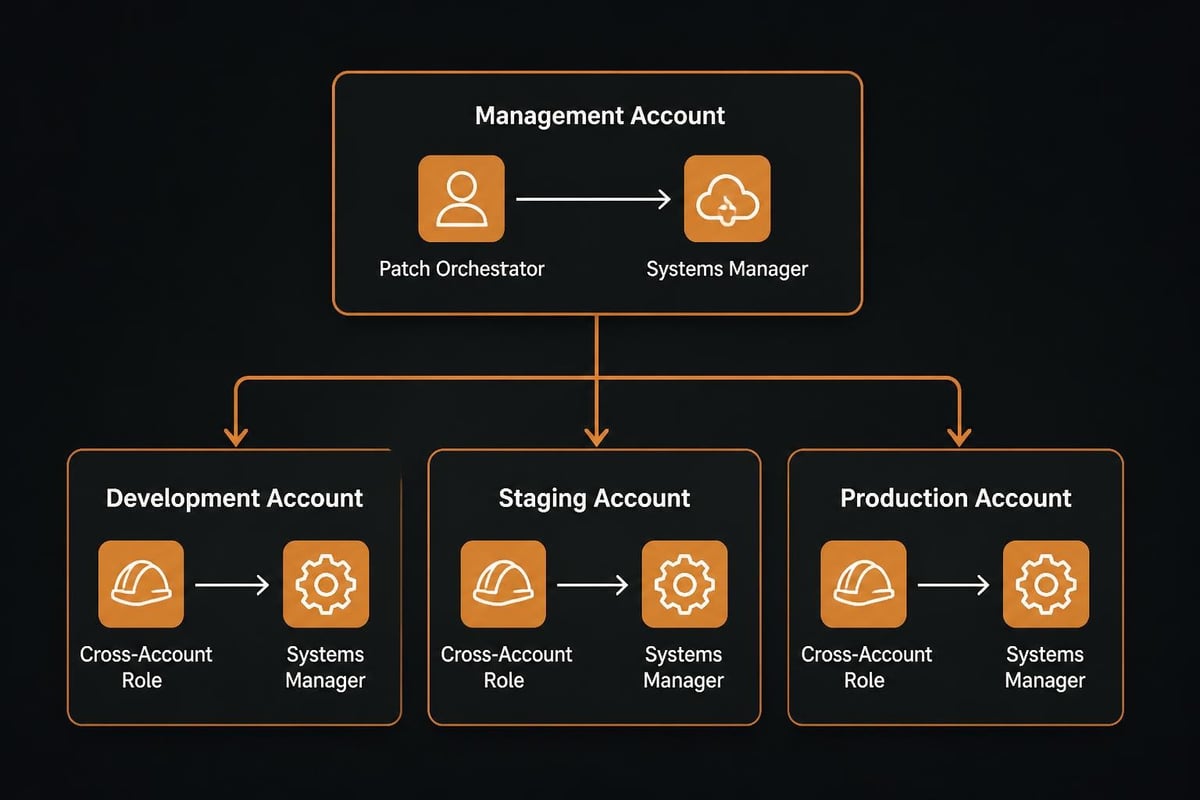
Implementing Cross-Account Patching
Cross-account patch management requires careful configuration of AWS Identity and Access Management (IAM) roles and resource sharing. Additionally, organisations must establish trust relationships that enable the management account to execute patch operations on remote instances whilst maintaining security boundaries.
The implementation process involves:
- Creating resource data sync configurations to aggregate inventory from multiple accounts
- Establishing cross-account IAM roles with appropriate patch management permissions
- Configuring patch baselines that apply consistently across accounts
- Implementing maintenance windows that respect account-specific requirements
- Setting up aggregated compliance reporting for centralised visibility
Furthermore, self-service patching solutions enable application owners to initiate patches whilst adhering to organisational policies. Consequently, this approach balances central governance with operational efficiency, particularly in large enterprises with diverse application portfolios.
Compliance Monitoring and Reporting
Maintaining comprehensive visibility into patch compliance status remains essential for security assurance and regulatory adherence. Therefore, effective aws patch management strategies incorporate robust monitoring and reporting capabilities that provide real-time insights into your security posture.
Centralized Compliance Dashboards
Centralized patch compliance reporting aggregates data from multiple accounts and regions into unified dashboards. Moreover, these dashboards enable security teams to quickly identify non-compliant instances, track remediation progress, and generate audit reports.
Key metrics to monitor include:
- Patch compliance rate across all managed instances
- Critical vulnerability exposure showing instances with unpatched high-severity issues
- Mean time to patch measuring the average duration from patch release to deployment
- Failed patch operations highlighting instances requiring manual intervention
- Compliance trends demonstrating improvement or degradation over time
Regulatory Alignment
Different industries face varying regulatory requirements for patch management. Nevertheless, most frameworks share common expectations regarding timely patch deployment and documented evidence of compliance activities.
| Framework | Patch Requirements | Documentation Needs |
|---|---|---|
| PCI DSS | Critical patches within 30 days | Patch deployment records |
| GDPR | Risk-based patching schedule | Security measures documentation |
| ISO 27001 | Regular vulnerability assessments | Patch management procedures |
| SOC 2 | Defined patch criteria | Compliance monitoring reports |
Furthermore, automated compliance reporting reduces the burden of manual audit preparation. Therefore, organisations can demonstrate adherence to regulatory requirements whilst focusing resources on operational improvements rather than administrative tasks.
Best Practices for AWS Patch Management
Implementing effective aws patch management requires adherence to proven methodologies that balance security, stability, and operational efficiency. Moreover, these practices evolve continuously as new threats emerge and AWS enhances its services.
Testing and Validation Procedures
Never deploy patches directly to production without thorough testing. Instead, establish a multi-tier testing approach:
- Laboratory testing in isolated environments to verify basic functionality
- Development environment validation to assess integration with application code
- Staging environment testing that mirrors production configurations
- Canary deployments to limited production instances before full rollout
- Monitoring and validation to confirm successful patch application
Additionally, maintain documented rollback procedures for every patch deployment. Consequently, teams can quickly restore service if patches introduce unexpected issues or compatibility problems.
Automation and Orchestration
Manual patching processes cannot scale effectively across large cloud environments. Therefore, automation becomes essential for maintaining consistent security postures. Nevertheless, automation must include appropriate safeguards and human oversight at critical decision points.
Effective automation strategies incorporate:
- Automated vulnerability scanning to identify systems requiring patches
- Scheduled maintenance windows that execute without manual intervention
- Pre-patch snapshots for rapid recovery if needed
- Post-patch validation scripts to verify system functionality
- Automated notifications alerting teams to patch activities and exceptions

Change Management Integration
Patch management should integrate seamlessly with broader change management processes. Moreover, this integration ensures proper documentation, approval workflows, and communication channels for all infrastructure modifications. Therefore, organisations maintain visibility into changes whilst reducing the risk of unauthorised or poorly coordinated updates.
The AWS Well-Architected Framework guidance on patch management emphasises the importance of treating patches as standard changes that follow established governance procedures. Furthermore, this approach ensures patches receive appropriate review whilst enabling expedited processes for critical security updates.
Advanced Patching Scenarios
Beyond standard operating system and application patches, aws patch management often encompasses more complex scenarios requiring specialised approaches. Nevertheless, the fundamental principles of testing, automation, and compliance monitoring remain applicable.
Container and Serverless Patching
Containerised workloads and serverless functions introduce unique patching considerations. Additionally, the ephemeral nature of these resources requires different strategies compared to traditional EC2 instances.
For container environments:
- Base image updates should be tested and promoted through container registries
- Automated rebuilds triggered by vulnerability detection in base layers
- Rolling deployments that gradually replace containers with patched versions
- Image scanning integrated into CI/CD pipelines to prevent vulnerable deployments
Serverless functions require:
- Runtime updates managed through function configuration changes
- Dependency management for libraries and frameworks within function code
- Automated redeployment when runtime vulnerabilities are announced
- Version tracking to maintain awareness of function runtime versions
Database and Middleware Patching
Database systems and middleware components demand careful coordination during patch operations. Moreover, these systems often support critical business processes that cannot tolerate extended downtime. Therefore, organisations must implement sophisticated strategies that minimise service disruption.
Approaches include:
- Read replica promotion for database patches with minimal downtime
- Blue-green deployments that switch traffic to patched environments
- Rolling updates across clustered middleware components
- Backup verification before initiating database patches
- Performance testing to ensure patches don't degrade application performance
Security Considerations
Aws patch management fundamentally serves security objectives by reducing vulnerability exposure. Nevertheless, the patching process itself introduces security considerations that require careful attention. Furthermore, organisations must balance rapid patch deployment against the risk of introducing new vulnerabilities or misconfigurations.
Vulnerability Prioritisation
Not all vulnerabilities warrant immediate patching. Therefore, effective prioritisation considers multiple factors:
- Exploitability based on available exploit code and attack complexity
- Asset criticality reflecting the importance of affected systems
- Attack surface exposure considering network accessibility and authentication requirements
- Potential impact on confidentiality, integrity, and availability
- Compensating controls that mitigate risks until patches can be deployed
Additionally, systematic approaches to security patch management provide frameworks for evaluating these factors consistently across your environment. Consequently, security teams can allocate resources effectively to address the most significant threats first.
Patch Source Verification
Ensure patches originate from trusted sources before deployment. Moreover, verify cryptographic signatures and checksums to prevent supply chain attacks that introduce malicious code disguised as legitimate updates. Therefore, organisations should establish approved patch sources and validate all updates against these trusted repositories.
Operational Excellence in Patch Management
Achieving operational excellence requires continuous improvement of aws patch management processes. Moreover, organisations should regularly review their patching performance, identify bottlenecks, and implement enhancements that increase efficiency and effectiveness.
Performance Metrics
Track key performance indicators to measure patching effectiveness:
- Patch deployment velocity measuring time from release to production deployment
- Compliance drift showing the gap between expected and actual patch levels
- Automation rate indicating the percentage of patches deployed without manual intervention
- Failure rates highlighting problematic patches or deployment processes
- Coverage metrics confirming all assets are included in patching scope
Furthermore, these metrics enable data-driven decisions about process improvements and resource allocation. Therefore, organisations can demonstrate continuous enhancement of their security posture to stakeholders and auditors.
Team Training and Documentation
Invest in comprehensive training programmes that ensure operations teams understand aws patch management tools, processes, and best practices. Additionally, maintain detailed documentation covering standard procedures, escalation paths, and troubleshooting guides. Consequently, organisations reduce dependency on individual team members and enable consistent execution across shifts and personnel changes.
If you're evaluating cloud infrastructure solutions that prioritise security and operational excellence, consider exploring vBoxxCloud to see how enterprise-grade cloud platforms implement security best practices. Moreover, understanding different approaches to cloud security can inform your own aws patch management strategy.
Integration with Broader Cloud Operations
Patch management should not operate in isolation from other operational disciplines. Instead, integrate patching with configuration management, security monitoring, and incident response processes to create a cohesive operational framework. Furthermore, this integration enables faster response to emerging threats and more efficient resource utilisation.
Configuration Management Integration
Configuration management tools help maintain consistent system states before and after patch deployment. Moreover, these tools can automatically remediate configuration drift introduced by patches or restore specific settings that updates might modify.
Integration approaches include:
- Pre-patch configuration backups captured automatically before updates
- Post-patch configuration validation ensuring critical settings remain intact
- Automated remediation of known configuration changes introduced by patches
- Compliance scanning to verify patches don't violate security policies
Security Information and Event Management
Connect patch management activities with SIEM platforms to correlate patch status with security events. Additionally, this integration helps identify potential exploitation attempts targeting known vulnerabilities and prioritise patching for actively targeted systems. Therefore, organisations can respond more effectively to emerging threats by combining threat intelligence with patch deployment capabilities.
Effective aws patch management protects your cloud infrastructure whilst maintaining operational stability and regulatory compliance. As organisations continue migrating critical workloads to AWS, systematic approaches to patch management become increasingly essential for security assurance. When you need secure, reliable cloud infrastructure with comprehensive operational support, vBoxx delivers enterprise-grade solutions backed by privacy-focused practices and expert guidance. Our team can help you implement robust security practices across your digital infrastructure whilst maintaining the operational excellence your business demands.