

Businesses operating in the cloud face an expanding landscape of cybersecurity threats, from sophisticated ransomware attacks to data breaches that can compromise sensitive customer information. Moreover, the complexity of managing security across hybrid and multi-cloud environments has grown beyond the capabilities of many internal IT teams. Consequently, organisations are increasingly turning to specialised providers who deliver comprehensive protection through managed platforms. This shift represents a fundamental change in how enterprises approach digital defence, moving from capital-intensive, on-premises security infrastructure to flexible, expertise-driven services that evolve alongside emerging threats.
Understanding the Cloud Security as a Service Model
Cloud security as a service represents a delivery model where third-party providers manage and operate security controls, monitoring, and response capabilities on behalf of client organisations. Furthermore, this approach eliminates the need for businesses to maintain complex security infrastructure internally, instead leveraging the expertise and economies of scale that specialised providers offer.
The model encompasses several distinct service categories, each addressing specific aspects of cloud protection. In addition, these services integrate seamlessly with existing cloud platforms, providing layered defence without requiring fundamental changes to business operations.
Core Components of SECaaS
Security as a service platforms typically deliver protection through multiple integrated modules:
- Identity and access management that enforces zero-trust principles across cloud resources
- Threat detection and response using artificial intelligence and behavioural analytics
- Data loss prevention monitoring sensitive information flows across applications and networks
- Vulnerability assessment conducting continuous scanning of cloud infrastructure
- Compliance monitoring ensuring adherence to regulatory frameworks such as GDPR
- Encryption services protecting data both at rest and in transit
Therefore, organisations benefit from comprehensive coverage without needing to assemble disparate security tools themselves. The NIST Zero Trust Architecture framework provides foundational principles that many cloud security as a service providers implement within their platforms.

Deployment Models and Integration Approaches
Cloud security as a service solutions deploy through several architectural patterns. Nevertheless, the choice of deployment model depends heavily on existing infrastructure and specific business requirements.
| Deployment Model | Integration Method | Best Suited For |
|---|---|---|
| API-based | Direct platform integration | SaaS applications, cloud-native environments |
| Agent-based | Endpoint deployment | Hybrid cloud, workload protection |
| Gateway-based | Network-level filtering | Traffic inspection, DLP enforcement |
| Inline CASB | Proxy architecture | Shadow IT discovery, policy enforcement |
Subsequently, organisations must evaluate which approach aligns with their technical architecture and operational requirements. The Cloud Security Alliance guidance offers detailed frameworks for assessing deployment options and selecting appropriate controls.
Key Benefits Driving Adoption
Businesses implement cloud security as a service for strategic advantages that extend beyond simple cost reduction. Moreover, the model addresses fundamental challenges that internal security teams face when protecting distributed cloud environments.
Expertise and Specialisation
Security service providers maintain dedicated teams of specialists who focus exclusively on threat intelligence, detection engineering, and incident response. In addition, these teams operate at a scale that individual organisations cannot replicate, analysing threat patterns across thousands of clients to identify emerging attack vectors.
This collective intelligence creates a significant advantage over isolated internal teams. Furthermore, providers invest continuously in training, certifications, and tooling that would represent prohibitive expenses for most businesses operating independently.
Continuous Monitoring and Response
Traditional security approaches often struggle with the 24/7 vigilance that cloud environments require. Nevertheless, cloud security as a service platforms deliver round-the-clock monitoring through follow-the-sun operational centres and automated response capabilities.
Key operational advantages include:
- Real-time threat detection across all monitored assets
- Automated containment of suspicious activities before damage occurs
- Expert incident response teams available immediately when breaches are detected
- Continuous security posture assessment identifying configuration drift
- Proactive threat hunting using advanced analytics and threat intelligence
Therefore, organisations benefit from protection that never sleeps, addressing the reality that attackers operate outside traditional business hours.
Scalability and Flexibility
Cloud security as a service platforms scale automatically alongside business growth. Moreover, this elasticity means that security capabilities expand seamlessly as organisations add new cloud services, regions, or workloads.
The subscription-based pricing model converts capital expenditure into operational expense, providing financial flexibility. In addition, businesses avoid the long procurement cycles and depreciation concerns associated with traditional security infrastructure investments.
Critical Capabilities for 2026
The threat landscape continues evolving, and consequently, cloud security as a service providers must deliver advanced capabilities that address sophisticated attack techniques. The MITRE ATT&CK Cloud Matrix documents specific tactics and techniques that adversaries employ against cloud infrastructure, providing a framework for evaluating provider capabilities.
Advanced Threat Detection
Modern platforms employ machine learning algorithms that establish baseline behaviours for users, applications, and infrastructure components. Subsequently, deviations from these baselines trigger automated investigation workflows that can identify zero-day exploits and advanced persistent threats.
Behavioural analytics examine patterns across multiple dimensions:
- User access patterns and privilege escalation attempts
- Data movement between cloud storage repositories
- API call sequences indicating reconnaissance activities
- Network traffic anomalies suggesting command-and-control communications
- Resource provisioning spikes that might indicate cryptomining
Furthermore, integration with global threat intelligence feeds allows platforms to correlate local observations with known attack campaigns, providing context that accelerates response decisions.

Data Protection and Encryption
Cloud security as a service platforms provide multiple layers of data protection that address various threat scenarios. Nevertheless, implementation details matter significantly when evaluating provider capabilities.
Encryption services should cover:
- Data at rest encryption using AES-256 or stronger algorithms
- Transport layer security for all data in motion between services
- Key management with hardware security module backing
- Tokenisation for sensitive structured data elements
- Rights management controlling access even after download
In addition, European businesses must ensure that encryption implementations align with GDPR requirements and that key management operates under jurisdictions that respect data sovereignty principles.
For organisations seeking GDPR-compliant infrastructure, solutions such as vBoxxCloud demonstrate how European providers combine 256-bit AES encryption with ISO 27001-certified data centres in the Netherlands, ensuring protection from both technical threats and jurisdictional overreach.
Compliance Automation
Regulatory requirements create ongoing overhead for security and compliance teams. Therefore, cloud security as a service platforms increasingly incorporate automated compliance monitoring that continuously assesses configurations against regulatory frameworks.
| Compliance Framework | Key Requirements | Automation Capabilities |
|---|---|---|
| GDPR | Data protection, breach notification | Automated data discovery, consent management, incident reporting |
| ISO 27001 | Information security management | Control implementation tracking, audit evidence collection |
| SOC 2 | Security, availability, confidentiality | Continuous control monitoring, attestation support |
| NIS2 | Network and information security | Risk management automation, incident response workflows |
Moreover, these automated assessments generate audit-ready reports that demonstrate compliance posture to regulators, customers, and stakeholders, reducing the manual effort traditionally required for compliance documentation.
Implementation Considerations
Successfully deploying cloud security as a service requires careful planning and alignment with broader IT strategy. Furthermore, organisations must address several critical factors during vendor selection and implementation phases.
Vendor Assessment Criteria
Evaluating potential providers demands rigorous assessment across multiple dimensions. Nevertheless, businesses often struggle to differentiate between marketing claims and substantive capabilities.
Essential evaluation criteria include:
- Infrastructure location and data residency guarantees for regulatory compliance
- Security certifications such as ISO 27001, SOC 2, and industry-specific accreditations
- Integration capabilities with existing cloud platforms and security tools
- Service level agreements specifying uptime, response times, and liability terms
- Incident response procedures detailing escalation paths and communication protocols
- Data portability provisions ensuring exit strategies if provider relationships change
In addition, European businesses should specifically verify that providers operate outside US legal jurisdiction to avoid exposure to extraterritorial data access demands. The CISA cloud adoption guidance provides comprehensive checklists for security assessment, applicable across sectors.
Integration Planning
Cloud security as a service implementations require thoughtful integration with existing systems. Moreover, poorly planned deployments can create visibility gaps or introduce performance bottlenecks that undermine protection effectiveness.
Successful integration follows these phases:
- Discovery and inventory cataloguing all cloud assets requiring protection
- Policy definition establishing security rules aligned with business risk tolerance
- Pilot deployment testing integration with non-critical workloads
- Monitoring calibration tuning detection thresholds to minimise false positives
- Full rollout expanding coverage across production environments
- Continuous optimisation refining policies based on operational experience
Therefore, organisations should allocate sufficient time for each phase, resisting pressure to rush deployment at the expense of proper configuration.
Shared Responsibility Clarity
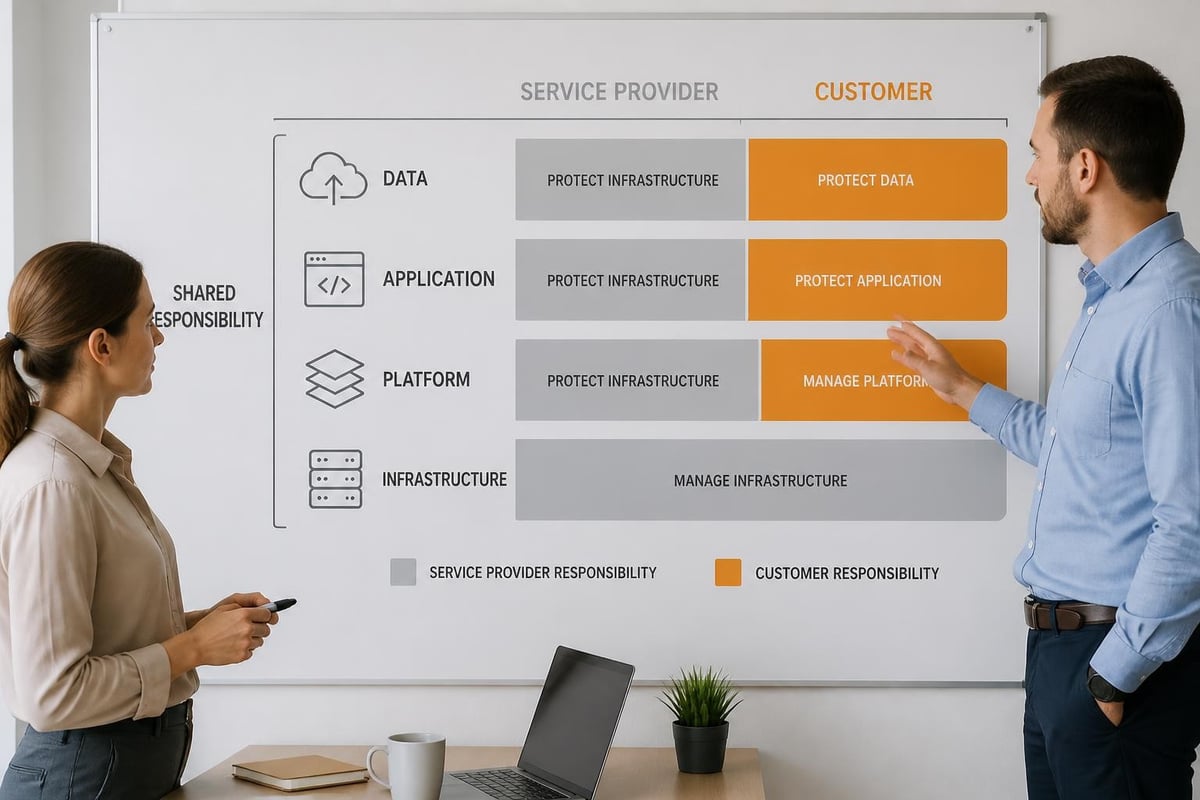
Cloud security as a service does not eliminate all internal security responsibilities. Nevertheless, confusion about accountability boundaries frequently creates protection gaps that sophisticated attackers exploit.
The division of responsibilities typically follows this pattern:
| Security Layer | Provider Responsibility | Customer Responsibility |
|---|---|---|
| Physical infrastructure | Data centre security, hardware protection | None |
| Network | Traffic filtering, DDoS protection | Network segmentation policy |
| Platform | Vulnerability patching, threat monitoring | Access control configuration |
| Application | Code scanning, dependency checks | Secure development practices |
| Data | Encryption, backup | Classification, access governance |
| Identity | Authentication infrastructure | User provisioning, privilege management |
Furthermore, organisations must document these boundaries explicitly within contracts and operational procedures to ensure no security control falls between provider and customer domains.
Emerging Trends Shaping the Market
The cloud security as a service sector continues evolving rapidly in response to technological change and emerging threats. Moreover, understanding these trends helps organisations make forward-looking decisions that protect investments over multi-year planning horizons.
AI-Powered Security Operations
Artificial intelligence transforms security operations by automating tasks that previously required extensive human analyst time. In addition, machine learning models detect subtle attack patterns that rule-based systems miss entirely.
Contemporary platforms employ AI for:
- Analysing millions of log entries to identify attack indicators
- Prioritising security alerts based on actual risk rather than generic severity scores
- Automating initial incident triage and evidence collection
- Generating natural language summaries of complex security events
- Predicting likely attack paths based on current infrastructure configurations
Nevertheless, organisations should recognise that AI augments rather than replaces human expertise, with the most effective implementations combining algorithmic detection with skilled analyst oversight.
Zero Trust Architecture Integration
The zero trust security model assumes that no user, device, or network should be automatically trusted. Therefore, cloud security as a service platforms increasingly implement zero trust principles as foundational architecture rather than optional features.
Practical zero trust implementation requires:
- Continuous authentication and authorisation for every access request
- Micro-segmentation limiting lateral movement within environments
- Least privilege access granting only minimum necessary permissions
- Device health verification before allowing resource access
- Encrypted communications for all data flows
Furthermore, the NIST NCCoE implementation guide provides detailed technical architectures for deploying zero trust across hybrid and multi-cloud environments, serving as valuable reference material during planning phases.
Privacy-Enhancing Technologies
Growing regulatory scrutiny and consumer awareness drive adoption of privacy-enhancing technologies within cloud security as a service platforms. Moreover, these capabilities allow organisations to derive value from data whilst maintaining individual privacy protections.
Key privacy-enhancing approaches include:
- Homomorphic encryption enabling computation on encrypted data without decryption
- Differential privacy adding mathematical noise to prevent individual identification
- Secure multi-party computation allowing collaborative analysis without data sharing
- Confidential computing using hardware-based trusted execution environments
In addition, European providers emphasise data sovereignty and jurisdictional independence as core privacy features, addressing concerns about governmental data access that extend beyond technical controls.
Measuring Security Service Effectiveness
Organisations investing in cloud security as a service require metrics demonstrating that spending delivers measurable protection improvements. Nevertheless, security metrics often prove challenging to define and collect consistently.
Key Performance Indicators
Effective security measurement balances leading indicators that predict future performance with lagging indicators that confirm actual outcomes. Therefore, comprehensive dashboards include both forward-looking and retrospective metrics.
Leading indicators include:
- Mean time to detect security events trending downward
- Percentage of assets with current vulnerability scans
- Security policy coverage across cloud workloads
- Employee security awareness training completion rates
Lagging indicators include:
- Number of successful breaches or data loss incidents
- Financial impact of security events
- Compliance audit findings and remediation status
- Customer trust metrics and security satisfaction scores
Furthermore, these metrics should track trends over time rather than focusing on point-in-time snapshots, revealing whether security posture improves consistently.
Continuous Improvement Processes
Cloud security as a service relationships should incorporate structured improvement cycles that refine protection over time. Moreover, static security configurations quickly become outdated as threats evolve and business requirements change.
Effective improvement processes follow quarterly cycles:
- Performance review assessing metrics against targets
- Threat landscape analysis identifying new attack vectors
- Policy refinement updating rules based on operational experience
- Technology updates deploying new detection capabilities
- Tabletop exercises testing response procedures through simulations
In addition, annual comprehensive assessments should evaluate whether the provider relationship continues meeting business needs or whether alternative approaches merit consideration.
Addressing Common Implementation Challenges
Organisations frequently encounter obstacles when deploying cloud security as a service solutions. Nevertheless, awareness of common challenges enables proactive mitigation strategies that smooth implementation paths.
Alert Fatigue and False Positives
Security platforms generating excessive alerts overwhelm security teams and train analysts to ignore warnings. Therefore, tuning detection thresholds becomes critical for maintaining analyst effectiveness and ensuring genuine threats receive appropriate attention.
Mitigation strategies include:
- Implementing tiered alerting that escalates only high-confidence detections
- Establishing baseline behaviours during pilot phases before production deployment
- Using machine learning to correlate multiple weak signals into stronger indicators
- Creating automated response playbooks for common, low-risk events
- Regularly reviewing dismissed alerts to identify tuning opportunities
Furthermore, providers should demonstrate their approach to minimising false positives during evaluation phases, including sharing typical alert volumes and precision metrics from similar deployments.
Integration Complexity
Cloud environments often span multiple platforms, each with unique APIs and security models. Moreover, legacy applications may lack modern security instrumentation, creating blind spots in monitoring coverage.
Successful integration requires:
- Comprehensive asset inventory documenting all systems requiring protection
- Prioritised rollout focusing first on highest-risk assets
- Custom integration development for legacy or proprietary applications
- Hybrid monitoring combining agent-based and agentless approaches
- Regular validation confirming monitoring coverage remains complete
In addition, organisations should verify that providers offer professional services support for complex integration scenarios rather than expecting entirely self-service deployment.
Skills and Knowledge Gaps
Internal teams often lack expertise with cloud-native security tools and concepts. Therefore, effective cloud security as a service implementations include knowledge transfer ensuring internal staff can interpret findings and collaborate effectively with provider teams.
Training should cover:
- Platform functionality and reporting interfaces
- Alert interpretation and triage procedures
- Incident escalation and communication protocols
- Policy configuration and maintenance responsibilities
- Integration with existing security operations workflows
Moreover, providers should offer ongoing education as platforms evolve, ensuring customer teams maintain current knowledge rather than falling behind as capabilities expand.
Regulatory and Jurisdictional Considerations
European businesses face specific compliance requirements that influence cloud security as a service selection decisions. Furthermore, the regulatory landscape continues evolving, with frameworks such as NIS2 imposing stricter obligations on organisations across multiple sectors.
Data Sovereignty Requirements
GDPR and sector-specific regulations often mandate that personal data remains within specific geographic boundaries. Nevertheless, cloud architectures can obscure actual data locations, particularly when providers operate global infrastructure.
European organisations should verify:
- Physical data centre locations and jurisdictional guarantees
- Subprocessor locations and data transfer mechanisms
- Legal frameworks governing provider operations
- Resistance to extraterritorial data access demands
- Transparency regarding any governmental access requests
In addition, the Forrester cloud standards guide provides frameworks for evaluating provider compliance with international data protection standards.
Compliance Documentation and Auditing
Regulatory frameworks require organisations to demonstrate security controls through documentation and independent audits. Therefore, cloud security as a service providers should generate audit-ready evidence automatically rather than requiring manual compilation during assessments.
Essential documentation includes:
| Document Type | Purpose | Update Frequency |
|---|---|---|
| Security policies | Control specifications and procedures | Annually or upon change |
| Configuration baselines | Current security settings | Continuously monitored |
| Access logs | User activity and privilege usage | Real-time collection |
| Incident reports | Breach detection and response | As events occur |
| Compliance attestations | Third-party validation | Annually |
Moreover, providers should maintain their own compliance certifications, demonstrating commitment to security excellence through independent validation.
Cloud security as a service delivers comprehensive protection that scales with business needs whilst reducing operational complexity and capital requirements. Nevertheless, successful implementation demands careful provider selection, thorough integration planning, and ongoing optimisation to maintain effectiveness against evolving threats. vBoxx combines European data sovereignty with ISO 27001-certified infrastructure in the Netherlands, offering businesses GDPR-compliant cloud solutions, communication platforms, and security services that operate outside US legal jurisdiction. Whether you require secure cloud storage, encrypted communication tools, or managed password protection, vBoxx delivers enterprise-grade security with the privacy guarantees and regulatory compliance that European businesses demand.