

Cloud computing has transformed how businesses operate, offering unprecedented scalability, flexibility, and cost efficiency. Nevertheless, as organisations migrate critical workloads and sensitive data to remote infrastructure, the concerns of cloud computing have grown more complex and urgent. Furthermore, in 2026, regulatory pressures, sophisticated cyber threats, and geopolitical tensions have elevated these concerns from technical considerations to boardroom priorities. Therefore, understanding and addressing these risks is essential for any business seeking to leverage cloud services whilst maintaining security, compliance, and operational control.
Data Sovereignty and Jurisdictional Challenges
One of the most pressing concerns of cloud computing centres on where data physically resides and which legal framework governs it. Moreover, businesses operating within the European Union face particularly stringent requirements under GDPR, which mandates that personal data transferred outside the EU must be protected to equivalent standards. Therefore, selecting a cloud provider becomes a critical decision with lasting legal implications.
The US CLOUD Act presents a significant complication for European organisations. This legislation compels US-based cloud providers to hand over data to American law enforcement agencies, regardless of where that data is physically stored. Consequently, even if your data resides in a European data centre, a US parent company may be legally required to provide access to American authorities. Furthermore, this creates a direct conflict with GDPR principles around data sovereignty and protection.

Regional Compliance Requirements
Different regions impose varying compliance obligations that affect cloud deployment decisions:
- GDPR (European Union): Requires explicit consent, data minimisation, right to erasure, and breach notification within 72 hours
- NIS2 Directive: Expands cybersecurity requirements across critical infrastructure and digital supply chains
- Data Act: Establishes rules for data access, portability, and interoperability across cloud services
- National regulations: Individual EU member states may impose additional requirements for specific sectors
In addition, businesses subject to PCI DSS must implement specific controls when storing or processing payment card data in cloud environments. Therefore, multi-jurisdictional operations require careful mapping of where data flows and which regulations apply at each stage.
Choosing a European provider that operates its own infrastructure within the EU, such as those with ISO 27001-certified facilities in the Netherlands, eliminates many jurisdictional concerns. Nevertheless, organisations must still conduct thorough due diligence on sub-processors, data transfer mechanisms, and contractual safeguards.
Security Vulnerabilities and Cyber Threats
Security remains among the most significant concerns of cloud computing, particularly as threat actors develop increasingly sophisticated attack methods. Furthermore, the shared responsibility model in cloud computing creates potential gaps where organisations assume the provider handles security aspects that actually fall under customer responsibility.
Common Cloud Security Risks
The Cloud Security Alliance identifies several critical threats facing cloud deployments in 2026:
| Threat Category | Description | Impact |
|---|---|---|
| Misconfiguration | Improperly configured storage buckets, access controls, or network settings | Data exposure, unauthorised access |
| Insufficient identity management | Weak authentication, excessive permissions, poor credential hygiene | Privilege escalation, lateral movement |
| Insecure APIs | Vulnerabilities in application programming interfaces | Data breaches, service disruption |
| Account hijacking | Compromised credentials or session tokens | Unauthorised access, data theft |
| Supply chain attacks | Compromised third-party components or dependencies | Widespread impact across multiple customers |
Moreover, ENISA's 2024 Threat Landscape highlights that cloud-specific attacks have increased by 38% year-over-year, with ransomware groups specifically targeting poorly configured cloud environments. Therefore, organisations must implement robust security controls and continuous monitoring.
Shared Responsibility Confusion
A fundamental concern arises from misunderstanding where provider responsibility ends and customer responsibility begins. Cloud providers typically secure the infrastructure itself, whilst customers must protect their data, applications, identities, and configurations. Nevertheless, this division is not always clear, particularly in platform-as-a-service (PaaS) or software-as-a-service (SaaS) models.
In addition, organisations must implement their own security layers:
- Encryption at rest and in transit: Ensure data is protected using strong encryption standards (minimum AES-256)
- Identity and access management: Deploy multi-factor authentication, principle of least privilege, and regular access reviews
- Network segmentation: Isolate workloads and implement zero-trust architecture
- Logging and monitoring: Centralise logs and establish real-time alerting for suspicious activity
- Vulnerability management: Regular patching, scanning, and penetration testing
Furthermore, the OWASP Infrastructure Security Risks framework provides guidance on addressing configuration drift, secrets management, and other cloud-specific weaknesses. Therefore, a comprehensive security strategy must address both technical controls and organisational processes.
Vendor Lock-In and Service Dependency
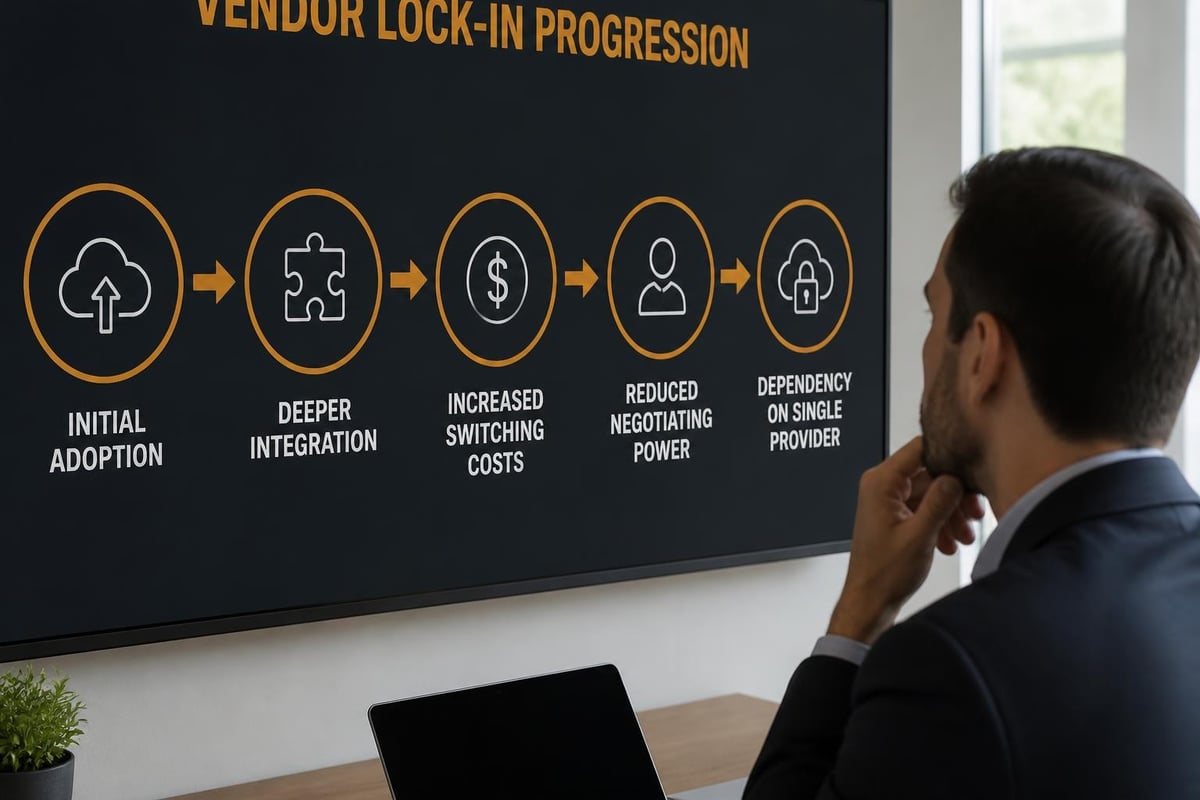
Another significant concern of cloud computing involves becoming overly dependent on a single provider's proprietary technologies, pricing models, and service roadmap. Moreover, this lock-in effect can limit strategic flexibility and create substantial switching costs should business needs change or provider performance decline.
Vendor lock-in manifests in several ways:
- Proprietary APIs and services: Custom features that have no equivalent in other clouds
- Data egress fees: High costs to transfer large datasets out of the platform
- Specialised skills: Staff trained on provider-specific tools and interfaces
- Integration complexity: Deep coupling between applications and platform services
Consequently, organisations find themselves constrained in negotiating pricing, unable to leverage competitive alternatives, and vulnerable to unilateral changes in service terms. Nevertheless, several strategies can mitigate these risks whilst still benefiting from cloud capabilities.
Mitigation Strategies
| Strategy | Implementation | Benefits |
|---|---|---|
| Multi-cloud architecture | Distribute workloads across multiple providers | Reduced dependency, competitive leverage |
| Containerisation | Use Docker, Kubernetes for portable deployments | Platform independence, easier migration |
| Open standards | Prioritise open-source and standardised technologies | Greater flexibility, broader ecosystem |
| Exit planning | Document migration procedures and test regularly | Reduced switching costs, negotiation power |
In addition, businesses should negotiate contract terms that include data portability guarantees, reasonable egress pricing, and advance notice of significant changes. Furthermore, maintaining in-house expertise across multiple platforms prevents over-reliance on a single vendor's ecosystem.
Performance, Availability, and Service Reliability
Concerns of cloud computing extend to operational reliability, particularly as businesses become dependent on provider uptime for their core operations. Moreover, whilst major cloud platforms advertise impressive service level agreements (SLAs), actual performance can vary significantly based on architecture, geography, and shared infrastructure dynamics.
Latency and Network Dependencies
Applications hosted in distant data centres may experience latency that degrades user experience or renders real-time operations impractical. Therefore, businesses with European customer bases benefit substantially from hosting within the region to minimise round-trip times. Furthermore, network congestion, routing inefficiencies, and internet exchange point failures can all impact cloud service accessibility.
In addition, organisations must consider:
- Geographic distribution: Where are your users, and where is your data processed?
- Content delivery: Do you need edge caching or local points of presence?
- Network redundancy: Does your provider offer multiple connectivity paths?
- Bandwidth allocation: Are there throttling limits during peak usage?
Outage Risk and Business Continuity
Even the largest cloud providers experience occasional outages that can cascade across regions or services. Nevertheless, many incidents stem from configuration errors, software bugs, or capacity limitations rather than infrastructure failures. Consequently, businesses must architect for failure and implement their own resilience measures.
Critical business continuity considerations include:
- Multi-region deployment: Distribute workloads across geographically separated facilities
- Automated failover: Implement health checks and traffic routing to backup systems
- Regular backups: Maintain recovery points with tested restoration procedures
- Disaster recovery planning: Document scenarios, responsibilities, and communication protocols
- SLA monitoring: Track actual performance against commitments and trigger escalations
Furthermore, organisations handling critical communications or storing essential business data should consider solutions like vBoxxConnect, which provides GDPR-compliant email, calendar, and collaboration tools hosted in Dutch data centres with robust uptime guarantees and European data residency.
Compliance and Audit Complexity
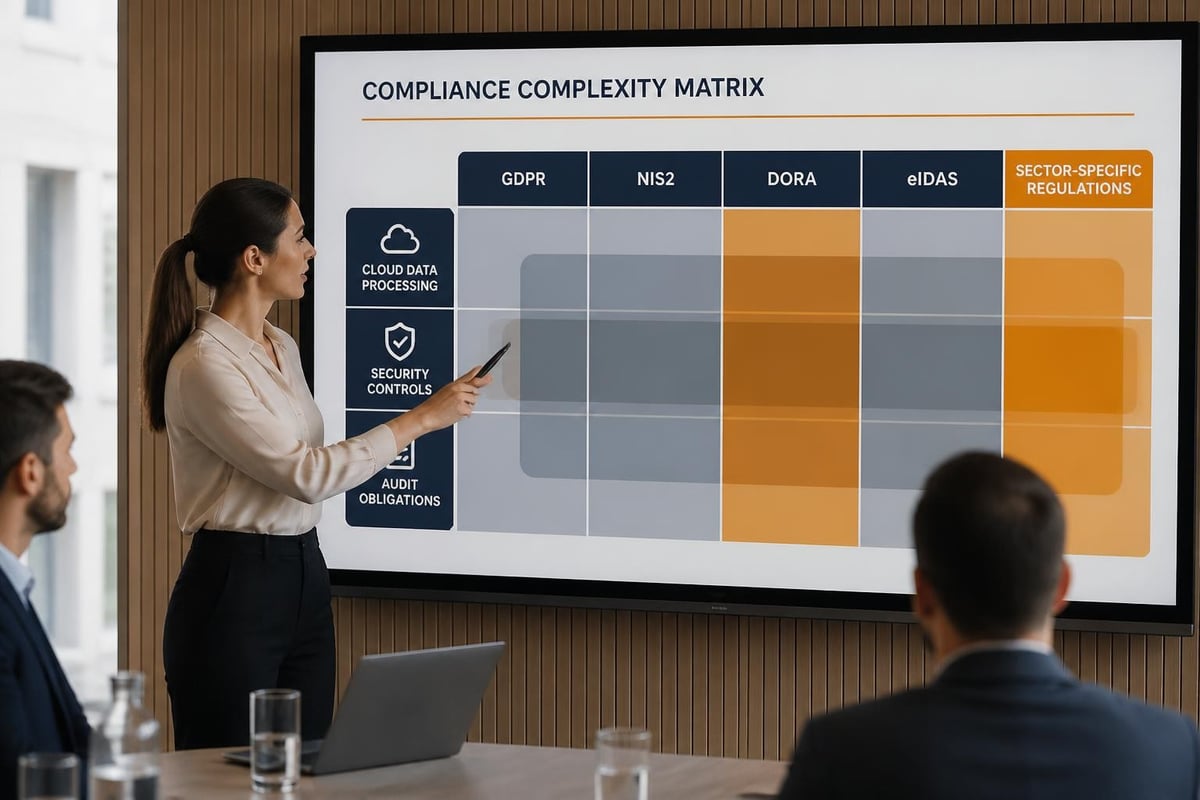
As regulatory frameworks evolve, compliance has become one of the most challenging concerns of cloud computing. Moreover, organisations often operate under multiple overlapping regulations depending on their industry, geography, and customer base. Therefore, demonstrating compliance requires comprehensive documentation, regular audits, and continuous monitoring of cloud configurations.
Regulatory Frameworks Affecting Cloud Use
European businesses in 2026 must navigate an increasingly complex compliance landscape:
- GDPR: Personal data protection, consent management, breach notification
- NIS2: Cybersecurity risk management for essential and important entities
- DORA: Digital operational resilience for financial services
- eIDAS 2.0: Digital identity and trust services including electronic signatures
- AI Act: Requirements for systems using artificial intelligence and machine learning
- Sector-specific rules: Healthcare (MDR), finance (MiFID II), telecommunications (ePrivacy)
In addition, ISACA's State of Cybersecurity 2024 reports that 67% of organisations struggle to maintain consistent governance across hybrid and multi-cloud environments. Consequently, compliance gaps emerge where responsibilities are unclear or monitoring tools lack visibility.
Audit Trail and Evidence Requirements
Regulators increasingly demand detailed audit trails demonstrating who accessed what data, when, and for what purpose. Furthermore, organisations must prove that appropriate technical and organisational measures protect data throughout its lifecycle. Nevertheless, cloud environments can make this challenging when logs are distributed across multiple services or when providers retain limited historical data.
Essential audit capabilities include:
| Requirement | Implementation | Compliance Benefit |
|---|---|---|
| Access logging | Comprehensive IAM and data access records | Demonstrate least privilege, detect anomalies |
| Change tracking | Configuration versioning and approval workflows | Show control over security posture changes |
| Data lineage | Map data flows from collection through processing to deletion | Prove GDPR data minimisation and purpose limitation |
| Encryption evidence | Key management logs and certificate chains | Validate data protection measures |
| Incident documentation | Structured records of security events and responses | Meet breach notification and reporting obligations |
Therefore, selecting cloud providers that offer detailed logging, retain records for sufficient periods, and provide compliance reporting tools significantly reduces audit burden. Moreover, European providers subject to EU supervision may align more naturally with continental regulatory expectations than those operating under different legal frameworks.
Cost Overruns and Hidden Expenses
Financial concerns represent another dimension of cloud computing challenges that often surprise organisations. Moreover, whilst cloud services eliminate upfront capital expenditure, operating costs can escalate unpredictably through usage-based pricing, premium features, and architectural inefficiencies. Therefore, rigorous cost management and forecasting become essential disciplines.
Common Cost Traps
Several factors contribute to unexpected cloud expenses:
- Data egress charges: Fees for transferring data out of the provider's network
- API call pricing: Costs that accumulate with microservices architectures
- Premium storage tiers: Higher prices for performance, redundancy, or features
- Licensing complexity: Per-user, per-core, or per-capacity models that multiply
- Idle resources: Provisioned capacity that runs continuously without utilisation
Furthermore, organisations migrating from fixed-cost on-premises infrastructure may lack the monitoring and governance processes needed to control cloud spending. Consequently, monthly bills can double or triple within months if consumption remains untracked.
In addition, businesses should implement:
- Tagging and allocation: Label resources by project, department, or customer for granular tracking
- Budgets and alerts: Set spending thresholds with automated notifications
- Right-sizing analysis: Regularly review instance sizes and storage tiers against actual usage
- Reserved capacity: Commit to predictable workloads for significant discounts
- Automated shutdown: Power down development and testing environments outside business hours
Nevertheless, transparency in pricing remains a concern, particularly when providers change rate structures or introduce new fee categories. Therefore, contract negotiations should include price stability commitments and advance notice of increases.
Privacy and Data Protection Concerns
Privacy considerations form a critical subset of the broader concerns of cloud computing, particularly as businesses handle increasingly sensitive personal information. Moreover, the distributed nature of cloud infrastructure, combined with sophisticated data analytics capabilities, creates new privacy risks that traditional security controls may not adequately address.
Data Processing and Secondary Use
Cloud providers often operate at massive scale, processing data from millions of customers through shared infrastructure. Consequently, questions arise about how data is handled, whether it might be accessed for provider purposes, and what safeguards prevent unauthorised secondary use. Furthermore, machine learning systems that improve services may inadvertently incorporate customer data into training sets, creating privacy leakage risks.
European data protection principles require:
- Purpose limitation: Data used only for specified, explicit, legitimate purposes
- Data minimisation: Collect and retain only what is necessary
- Storage limitation: Delete or anonymise data when no longer needed
- Integrity and confidentiality: Appropriate security protecting against unauthorised processing
Therefore, data processing agreements (DPAs) must clearly specify permitted uses, sub-processor arrangements, and technical measures protecting data. In addition, organisations should prefer providers offering end-to-end encryption where the provider cannot access plaintext data, ensuring that even lawful access requests cannot compromise privacy.
Cross-Border Data Flows
International data transfers remain among the most complex concerns of cloud computing under GDPR. Moreover, following the invalidation of Privacy Shield and ongoing scrutiny of Standard Contractual Clauses (SCCs), organisations must conduct transfer impact assessments and implement supplementary measures when sending data to countries without adequacy decisions.
Strategies for managing cross-border transfers include:
- EU-only hosting: Select providers operating exclusively within European borders
- Data localisation: Configure services to prevent replication outside specific regions
- Encryption in transit: Protect data moving between locations with strong cryptographic controls
- Contractual safeguards: Ensure SCCs include appropriate technical and organisational measures
- Regular reviews: Monitor legal developments and reassess transfer mechanisms annually
Furthermore, utilising NIST cloud security guidance helps organisations implement privacy-preserving architectures that limit data exposure regardless of jurisdiction. Nevertheless, the simplest approach remains choosing European providers with no foreign jurisdiction complications, eliminating transfer concerns entirely.
Control and Visibility Limitations
A fundamental concern of cloud computing involves the reduced visibility and control organisations experience when entrusting infrastructure to third parties. Moreover, traditional IT management tools and processes often prove inadequate in cloud environments where physical access is impossible and system internals remain opaque. Therefore, businesses must develop new approaches to maintaining oversight and governance.
Monitoring and Observability Gaps
Cloud platforms provide APIs and dashboards for monitoring resources, yet these tools may lack the depth or integration points needed for comprehensive visibility. Consequently, security teams struggle to detect subtle anomalies, operations teams miss performance degradation signals, and compliance teams cannot generate required reports.
Critical visibility requirements include:
- Infrastructure health: Real-time status of compute, storage, network, and platform services
- Application performance: Response times, error rates, and user experience metrics
- Security posture: Configuration compliance, vulnerability status, and threat indicators
- Cost attribution: Granular breakdown of spending by service, team, and project
- Data flows: Tracking where sensitive information moves and who accesses it
In addition, organisations should implement third-party monitoring and security information and event management (SIEM) systems that aggregate logs across cloud and on-premises environments. Furthermore, regular security assessments and penetration testing help validate that visibility tools actually detect the threats they claim to identify.
Configuration Management Challenges
Cloud environments change rapidly as teams deploy, modify, and tear down resources through automated processes. Nevertheless, this velocity creates configuration drift where actual state diverges from intended policy. Moreover, manual change tracking becomes impractical at scale, requiring infrastructure-as-code approaches and continuous compliance scanning.
Effective configuration governance demands:
- Version control: Store infrastructure definitions in Git repositories with review processes
- Automated testing: Validate configurations against security baselines before deployment
- Continuous scanning: Monitor live environments for policy violations and remediate automatically
- Change approval: Require documented justification and appropriate authorisation for modifications
- Baseline enforcement: Define golden images and templates that embed security controls
Therefore, organisations must invest in tools and training that enable infrastructure teams to maintain control even as environments scale and evolve. Furthermore, clear ownership and accountability structures prevent the diffusion of responsibility that allows security gaps to persist.
Understanding the concerns of cloud computing enables organisations to make informed decisions about adoption strategies, provider selection, and risk mitigation measures. Nevertheless, these concerns should not prevent businesses from leveraging cloud benefits when appropriate safeguards are implemented. For European organisations prioritising data sovereignty, regulatory compliance, and robust security, vBoxx delivers cloud storage, communication tools, and infrastructure services from ISO 27001-certified Dutch data centres, entirely outside the reach of the US CLOUD Act and fully aligned with GDPR requirements. Moreover, with comprehensive solutions spanning collaboration, hosting, and security, vBoxx enables businesses to embrace cloud capabilities whilst maintaining the control, privacy, and compliance that European regulations demand.