
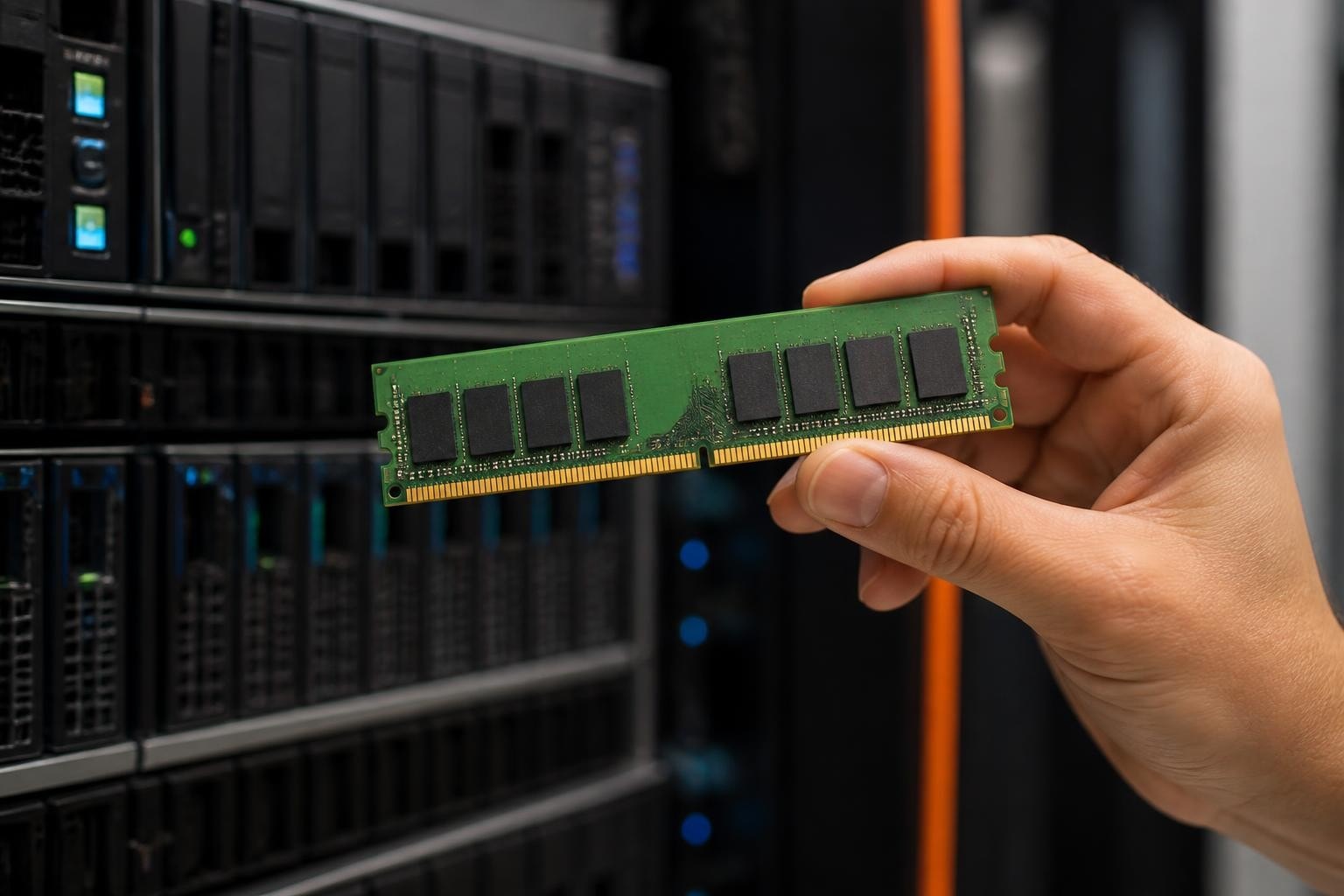
Enterprise infrastructure demands uncompromising reliability. When businesses run critical applications, store sensitive data, or host mission-critical workloads, the memory subsystem becomes a vital component in maintaining operational integrity. The d4ec 2666 16g module represents a class of DDR4 error-correcting code (ECC) memory designed specifically for systems where data accuracy and uptime cannot be compromised. Furthermore, understanding the technical capabilities and deployment scenarios for this specification helps IT teams make informed decisions about server memory configurations that align with business continuity requirements.
What Is the d4ec 2666 16g Specification
The d4ec 2666 16g designation refers to a 16-gigabyte DDR4 SO-DIMM memory module operating at 2666 MT/s with ECC functionality. This specification combines several critical attributes: DDR4 technology for improved bandwidth and power efficiency compared to previous generations, the 2666 speed bin for balanced performance, ECC protection for automatic error detection and correction, and the SO-DIMM form factor for compact server and workstation applications.
Technical Architecture and Standards
DDR4 memory architecture brings substantial improvements over DDR3. The technology operates at lower voltage (1.2V typical versus 1.5V for DDR3), reducing power consumption whilst increasing density. Moreover, DDR4-2666 provides theoretical bandwidth of approximately 21.3 GB/s per module, sufficient for most business applications whilst maintaining excellent power efficiency characteristics.
Key specifications for d4ec 2666 16g modules include:
- Capacity: 16GB per module
- Speed: 2666 MT/s (PC4-21300)
- Form factor: 260-pin SO-DIMM
- Error correction: Single-bit error correction, double-bit error detection
- Voltage: 1.2V nominal
- Operating temperature: Typically 0°C to 85°C
The official Synology specification sheet provides authoritative technical details for this exact module designation, including timing parameters and thermal characteristics essential for system integration planning.

Why ECC Memory Matters for Business Infrastructure
Error-correcting code memory functions fundamentally differently from consumer-grade RAM. Standard non-ECC memory stores data without additional protection, meaning cosmic radiation, electrical interference, or manufacturing defects can cause bit flips that corrupt data silently. In addition, these undetected errors can cascade through systems, producing incorrect calculations, database corruption, or application crashes.
The Cost of Memory Errors
Research indicates that memory errors occur more frequently than many IT professionals assume. Nevertheless, ECC protection identifies and corrects single-bit errors automatically, without system intervention or performance degradation. The technology uses additional bits (typically one extra bit per byte) to store parity information that enables reconstruction of corrupted data.
| Error Type | Non-ECC Behaviour | ECC Behaviour | Business Impact |
|---|---|---|---|
| Single-bit flip | Silent corruption | Automatic correction | Prevented data loss |
| Double-bit error | Silent corruption | Detected, system alerted | Maintenance triggered |
| Multi-bit error | Unpredictable failure | Detected, potential crash | Controlled failure mode |
Therefore, ECC memory transforms unpredictable silent corruption into either automatic recovery or controlled, logged failures that can trigger maintenance procedures. This distinction proves critical for financial systems, healthcare applications, scientific computing, and any workload where data integrity cannot be compromised.
Deployment Scenarios for d4ec 2666 16g Modules
The SO-DIMM form factor combined with 16GB capacity and ECC protection positions the d4ec 2666 16g specification ideally for several business infrastructure scenarios. Furthermore, the compact footprint enables deployment in space-constrained environments whilst maintaining enterprise-grade reliability.
Compact Server Platforms
Modern NAS systems, compact servers, and edge computing devices increasingly utilise SO-DIMM memory to achieve server-class capabilities in reduced footprints. For instance, Synology's enterprise NAS units, Intel NUC server variants, and various 1U rack servers support SO-DIMM ECC configurations. Moreover, these platforms benefit from the d4ec 2666 16g's combination of density and error protection without requiring full-size DIMM slots.
Ideal applications include:
- Network-attached storage systems handling business-critical file shares
- Database servers running customer relationship management platforms
- Virtualisation hosts supporting multiple business applications
- Development and testing environments requiring production-equivalent memory
- Edge computing nodes processing sensitive operational data
The 2666 MT/s speed specification provides sufficient bandwidth for most business workloads whilst maintaining compatibility with broader system ecosystems. Additionally, the power efficiency characteristics prove particularly valuable in environments where thermal management or electricity costs constitute significant operational considerations.
Mac Hosting and Apple Silicon Infrastructure
Businesses deploying Mac-based server infrastructure face unique memory requirements. Although Apple Silicon M-series chips integrate memory differently, Intel-based Mac mini and Mac Pro systems from previous generations utilise SO-DIMM ECC memory configurations. Consequently, organisations maintaining Mac hosting environments for iOS build systems, creative workflows, or macOS application servers benefit from ECC protection during the operational lifespan of these platforms.

Performance Characteristics and System Integration
The d4ec 2666 16g specification balances performance, capacity, and reliability for business deployments. Nevertheless, understanding the performance profile helps IT teams set appropriate expectations and configure systems optimally.
Bandwidth and Latency Considerations
DDR4-2666 operates with CAS latencies typically ranging from CL17 to CL19, depending on the manufacturer and specific SKU. Therefore, actual latency (measured in nanoseconds rather than clock cycles) remains competitive despite the moderate speed bin. The 2666 MT/s transfer rate delivers approximately 21.3 GB/s theoretical bandwidth per module, or 42.6 GB/s in dual-channel configurations common in business servers.
| Configuration | Channels | Total Bandwidth | Typical Use Case |
|---|---|---|---|
| 1 × 16GB | Single | 21.3 GB/s | Basic NAS, light workloads |
| 2 × 16GB | Dual | 42.6 GB/s | Standard business server |
| 4 × 16GB | Dual | 42.6 GB/s | High-capacity database server |
Furthermore, the ECC overhead introduces negligible performance impact (typically less than 2-3% in most workloads), a minimal trade-off for the reliability benefits. Detailed electrical characteristics from module manufacturers provide timing specifications essential for compatibility verification.
Compatibility and Configuration Best Practices
Successful d4ec 2666 16g deployment requires attention to platform compatibility and configuration standards. Moreover, mixing memory speeds, capacities, or manufacturers within a single system can cause stability issues or force the system to operate at the lowest common denominator specification.
Configuration guidelines include:
- Verify motherboard/system support for DDR4-2666 SO-DIMM ECC before procurement
- Use matched pairs (identical manufacturer, speed, capacity) for dual-channel configurations
- Enable ECC functionality in BIOS/UEFI settings, as some platforms disable it by default
- Monitor ECC error logs through system management tools to detect developing hardware issues
- Plan capacity with 20-30% headroom above peak usage to avoid memory pressure
In addition, consulting system vendor compatibility lists ensures the specific d4ec 2666 16g SKU functions correctly with the target platform. Therefore, verifying ECC operation through diagnostic tools after installation confirms the system correctly implements error detection and correction capabilities.
Error Correction Technology in Practice
Understanding how ECC functions helps appreciate the protection level it provides for business infrastructure. The technology employs sophisticated algorithms to detect and correct memory errors in real-time, transparent to applications and operating systems.
Detection and Correction Mechanisms
ECC memory uses additional bits to store checksums that enable error identification. For every 64 bits of data, an additional 8 bits store error correction information (often termed "72-bit memory"). Consequently, the memory controller can detect when stored data differs from the checksum and reconstruct the original value for single-bit errors.
The correction process follows these steps:
- Application writes data to memory
- Memory controller calculates and stores ECC bits alongside data
- When reading, controller recalculates ECC from retrieved data
- Controller compares calculated versus stored ECC values
- Single-bit differences are corrected automatically and transparently
- Multi-bit errors trigger system alerts and logging
Nevertheless, ECC cannot correct all error types. Furthermore, whilst single-bit errors correct automatically, double-bit errors can only be detected, not corrected. Therefore, systems log these events for administrator review, potentially triggering automated alerts or maintenance procedures.

Modern ECC Capabilities and Safety Standards
Contemporary ECC implementations extend beyond simple parity checking. Modern memory controllers from manufacturers like Micron implement advanced error correction algorithms, scrubbing routines that proactively identify and correct errors during idle periods, and detailed logging that supports predictive maintenance strategies.
Moreover, memory modules designed for mission-critical applications often undergo additional testing and validation. The d4ec 2666 16g specification supports systems requiring high reliability, where memory errors could compromise data integrity or operational continuity.
European Infrastructure and Data Sovereignty Considerations
For businesses operating under GDPR and European data protection frameworks, the physical infrastructure supporting applications and data storage carries significant compliance implications. Therefore, organisations deploying servers with d4ec 2666 16g memory modules must consider where these systems physically reside and who maintains administrative access.
Compliance and Hosting Location
European businesses increasingly prioritise infrastructure hosted within EU jurisdictions to maintain clarity around data protection obligations. Furthermore, the choice of hosting provider affects compliance, as providers outside European legal frameworks may face conflicting disclosure requirements under foreign legislation.
Infrastructure hosted in ISO 27001-certified European data centres provides several compliance advantages. In addition, providers operating entirely within European legal frameworks avoid jurisdictional conflicts that could compromise data sovereignty. The combination of reliable hardware like ECC-protected memory systems and compliant hosting infrastructure creates defence-in-depth for sensitive business data.
Key considerations include:
- Physical server location within EU member states
- Provider jurisdiction and applicable legal frameworks
- Administrative access controls and audit trails
- Backup and disaster recovery procedures
- Encryption standards for data at rest and in transit
Therefore, when deploying servers with d4ec 2666 16g modules for business-critical workloads, the hosting environment selection proves equally important to the technical specifications.
Memory Capacity Planning for Business Workloads
The 16GB capacity of d4ec 2666 16g modules positions them appropriately for various business applications. Nevertheless, effective capacity planning requires understanding application memory requirements, operating system overhead, and growth projections.
Application Memory Requirements
Different business workloads exhibit distinct memory consumption patterns. Database servers typically benefit from maximum available memory for caching, whereas application servers require sufficient RAM for concurrent user sessions plus operating system overhead. Moreover, virtualisation platforms demand memory allocation for each virtual machine plus hypervisor requirements.
| Workload Type | Minimum RAM | Recommended | Scaling Factor |
|---|---|---|---|
| File server (NAS) | 8GB | 16-32GB | Storage capacity dependent |
| Database (small business) | 16GB | 32-64GB | Dataset size × 1.5-2.0 |
| Virtualisation host | 32GB | 64GB+ | 4-8GB per VM |
| Application server | 16GB | 32-48GB | Concurrent users × 100-200MB |
Furthermore, effective capacity planning incorporates memory utilisation monitoring over representative time periods. Therefore, deploying two d4ec 2666 16g modules (32GB total) often provides appropriate capacity for small-to-medium business servers whilst leaving expansion capacity for future growth.
Balancing Cost and Capability
Memory represents a significant infrastructure investment. Nevertheless, insufficient memory causes performance degradation, application instability, and operational disruptions that far exceed the cost of appropriate capacity. Moreover, ECC memory provides insurance against data corruption that could otherwise require extensive recovery procedures or result in permanent data loss.
In addition, the d4ec 2666 16g specification occupies a pragmatic position in the price-performance spectrum. The 16GB capacity delivers substantial capability per module whilst the 2666 MT/s speed provides adequate bandwidth without premium pricing associated with higher-speed bins.
Operational Monitoring and Maintenance
Deploying ECC memory provides protection only if organisations implement appropriate monitoring to detect and respond to error events. Therefore, establishing procedures to review ECC logs, track error rates, and trigger maintenance constitutes an essential component of infrastructure management.
Error Logging and Trend Analysis
Most server platforms expose ECC statistics through system management interfaces, operating system logs, or dedicated monitoring agents. Furthermore, tracking correctable error rates over time identifies modules developing reliability issues before they progress to uncorrectable errors or system failures.
Monitoring best practices include:
- Configure automated alerts for uncorrectable ECC errors
- Review correctable error logs weekly or monthly
- Track error rates per module to identify failing hardware
- Correlate errors with environmental factors (temperature, humidity)
- Schedule proactive replacement when error rates exceed thresholds
Moreover, ECC diagnostic tools enable comprehensive memory testing during maintenance windows, verifying error detection and correction functionality operates correctly. Therefore, integrating memory testing into regular maintenance procedures ensures the protection mechanisms remain effective throughout the system lifecycle.
Predictive Maintenance Strategies
ECC error logging enables predictive maintenance approaches that prevent unexpected failures. Nevertheless, this capability requires consistent monitoring and established response procedures. When a memory module exhibits increasing correctable error rates, replacing it proactively during a planned maintenance window prevents potential uncorrectable errors that could cause unplanned downtime.
In addition, documenting memory configurations, error histories, and replacement dates supports long-term infrastructure planning. Therefore, organisations can identify patterns, optimise procurement strategies, and budget appropriately for hardware lifecycle management.
Future-Proofing Business Infrastructure
Technology selection for business infrastructure should balance current requirements with reasonable future capabilities. The d4ec 2666 16g specification, whilst not representing the cutting edge of memory technology, provides a mature, well-supported standard suitable for systems with multi-year operational lifespans.
Technology Lifecycle Considerations
DDR4 memory continues to dominate business server markets in 2026, even as DDR5 adoption increases in newer platforms. Furthermore, the extensive ecosystem surrounding DDR4 ensures availability, competitive pricing, and broad compatibility. Moreover, systems deployed with d4ec 2666 16g modules today can reasonably expect 3-5 year operational lifespans before requiring replacement or upgrade.
Lifecycle factors include:
- Platform support timeframes from hardware vendors
- Operating system and application compatibility
- Availability of replacement modules during operational lifespan
- Performance adequacy for projected workload growth
- Total cost of ownership including power consumption
Therefore, selecting proven specifications like DDR4-2666 ECC provides stability and predictability valuable for business planning, even as newer technologies emerge.
Understanding memory specifications like d4ec 2666 16g helps businesses make informed infrastructure decisions that balance reliability, performance, and cost-effectiveness. When deploying business-critical systems, choosing ECC-protected memory in appropriate capacities ensures data integrity whilst supporting operational continuity. Furthermore, organisations require hosting infrastructure that complements technical specifications with robust security, compliance, and operational practices. vBoxx provides European businesses with ISO 27001-certified hosting environments in the Netherlands, combining reliable infrastructure with GDPR compliance and dedicated support to ensure your digital operations remain secure, available, and fully compliant with European data protection standards.