

Modern businesses generate and process vast quantities of sensitive information daily, from customer records and financial transactions to intellectual property and strategic plans. As organisations increasingly migrate their operations to cloud infrastructure, the question of how to protect this critical data becomes paramount. A secure cloud database serves as the foundation for maintaining data integrity, confidentiality and availability whilst enabling the scalability and flexibility that contemporary enterprises demand. Nevertheless, achieving robust database security in cloud environments requires careful attention to architecture, encryption, access controls and regulatory compliance.
Understanding Secure Cloud Database Fundamentals
A secure cloud database represents far more than simply storing information on remote servers. Furthermore, it encompasses a comprehensive approach to data protection that addresses multiple threat vectors simultaneously. At its core, this security model must protect against unauthorised access, data breaches, insider threats and compliance violations whilst maintaining operational performance.
The Security Triad in Cloud Database Design
The foundation of any secure cloud database rests upon three pillars: confidentiality, integrity and availability. Confidentiality ensures that only authorised individuals can access sensitive information through robust authentication and encryption mechanisms. Integrity guarantees that data remains accurate and unaltered except through legitimate processes, protecting against tampering and corruption. Availability ensures that authorised users can access their data when needed, requiring redundancy and disaster recovery capabilities.
Moreover, these principles must work in concert rather than isolation. A database that prioritises availability but neglects encryption leaves data vulnerable to interception. Similarly, overly restrictive access controls that hamper legitimate business operations create security through obscurity rather than proper design.
| Security Principle | Primary Controls | Business Impact |
|---|---|---|
| Confidentiality | Encryption, access management, network isolation | Prevents data exposure and competitive loss |
| Integrity | Checksums, audit logs, version control | Maintains data accuracy and trust |
| Availability | Redundancy, backups, failover systems | Ensures business continuity |

Encryption Strategies for Data Protection
Encryption forms the cornerstone of any secure cloud database implementation. Nevertheless, simply enabling encryption is insufficient; organisations must understand where and how to apply cryptographic controls effectively.
Encryption at Rest and in Transit
Data exists in two primary states: at rest (stored on disk) and in transit (moving across networks). Therefore, comprehensive protection requires encryption in both scenarios. Encryption at rest protects against physical theft, unauthorised access to storage media and insider threats with access to underlying infrastructure. Industry-standard AES-256 encryption provides robust protection that remains computationally infeasible to break with current technology.
Furthermore, encryption in transit safeguards data as it moves between applications, databases and users. TLS 1.3 protocols ensure that network traffic remains protected from eavesdropping and man-in-the-middle attacks. This becomes particularly critical when accessing cloud databases across public internet connections or through third-party networks.
In addition, organisations should implement encryption key management practices that maintain separation between data and keys. Hardware security modules (HSMs) or dedicated key management services prevent scenarios where compromised database access automatically grants access to decryption keys.
- Use AES-256 for data at rest encryption across all storage volumes
- Implement TLS 1.3 or higher for all database connections
- Rotate encryption keys on a regular schedule (quarterly or annually)
- Store keys separately from encrypted data using HSMs or key vaults
- Maintain audit logs of all key access and usage
Access Control and Identity Management
Controlling who can access your secure cloud database represents one of the most critical security decisions. Moreover, traditional perimeter-based security models prove insufficient in cloud environments where boundaries blur and remote access becomes ubiquitous.
Implementing Zero Trust Architecture
The Zero Trust model operates on the principle of "never trust, always verify," treating every access request as potentially hostile regardless of origin. This approach requires explicit verification for every user, device and application attempting to access database resources. Furthermore, it mandates least-privilege access, granting only the minimum permissions necessary for specific tasks.
Multi-factor authentication (MFA) becomes mandatory rather than optional in Zero Trust frameworks. Therefore, even if credentials are compromised, attackers cannot gain access without the second authentication factor. This dramatically reduces the risk from phishing attacks and credential theft.
Role-based access control (RBAC) structures permissions around job functions rather than individual users. Consequently, access management scales more effectively as organisations grow, and permissions remain consistent across teams performing similar functions.
| Access Control Layer | Implementation | Security Benefit |
|---|---|---|
| Authentication | MFA, SSO, certificate-based | Verifies user identity |
| Authorisation | RBAC, attribute-based policies | Enforces least privilege |
| Session Management | Time limits, IP restrictions | Prevents session hijacking |
| Audit Logging | Comprehensive access records | Enables forensics and compliance |
For businesses managing multiple credentials across cloud services, solutions like vBoxxVault provide centralised password management with zero-knowledge encryption and team sharing capabilities, ensuring that database credentials remain secure whilst remaining accessible to authorised personnel.

Network Security and Isolation
Network architecture plays a crucial role in securing cloud databases. Nevertheless, many organisations underestimate the importance of proper network segmentation and traffic control.
Virtual Private Clouds and Network Segregation
Deploying your secure cloud database within a Virtual Private Cloud (VPC) creates logical isolation from other cloud tenants and the public internet. Furthermore, within the VPC, additional segmentation through subnets and security groups restricts lateral movement should an attacker compromise one component.
Database instances should reside in private subnets without direct internet access. Application servers in separate subnets act as intermediaries, implementing the principle of defence in depth. Therefore, attackers must compromise multiple layers before reaching sensitive data.
Moreover, implementing network access control lists (ACLs) and security groups creates firewall rules that permit only necessary traffic. Deny-by-default policies ensure that only explicitly allowed connections succeed, reducing the attack surface significantly.
- Place databases in private subnets without public IP addresses
- Use bastion hosts or VPN connections for administrative access
- Implement stateful firewall rules allowing only required ports and protocols
- Enable VPC flow logs to monitor network traffic patterns
- Deploy intrusion detection systems (IDS) to identify anomalous activity
In addition, organisations operating within the European Union should consider data sovereignty requirements. Hosting your secure cloud database in European data centres ensures GDPR compliance whilst avoiding potential conflicts with extraterritorial legislation such as the US CLOUD Act.
Monitoring, Logging and Threat Detection
Security remains an ongoing process rather than a one-time configuration. Consequently, comprehensive monitoring and logging capabilities enable organisations to detect, investigate and respond to security incidents effectively.
Building a Security Operations Capability
Database activity monitoring captures queries, access patterns and administrative actions in real time. Furthermore, these logs provide invaluable forensic evidence during security investigations and demonstrate compliance with regulatory requirements. Nevertheless, logging alone proves insufficient without analysis and alerting mechanisms.
Security Information and Event Management (SIEM) systems aggregate logs from databases, applications, networks and security tools. Therefore, correlation engines can identify patterns indicative of attacks that might appear benign when viewed in isolation. For instance, multiple failed login attempts followed by successful authentication from an unusual location suggests credential compromise.
Moreover, behavioural analytics establish baselines of normal activity and alert on deviations. A database account that typically queries customer records during business hours suddenly extracting millions of records at 3 AM represents a clear anomaly requiring investigation.
- Enable comprehensive audit logging for all database operations
- Retain logs for sufficient periods to support investigations (minimum 90 days)
- Implement real-time alerting for critical security events
- Conduct regular log reviews and threat hunting activities
- Maintain incident response procedures specific to database breaches
The ENISA Threat Landscape 2024 highlights emerging threats targeting cloud infrastructure, emphasising the importance of proactive monitoring and rapid response capabilities.
Compliance and Regulatory Considerations
Operating a secure cloud database increasingly requires demonstrating compliance with various regulatory frameworks. Furthermore, these requirements vary by industry, geography and data types processed.
GDPR and European Data Protection
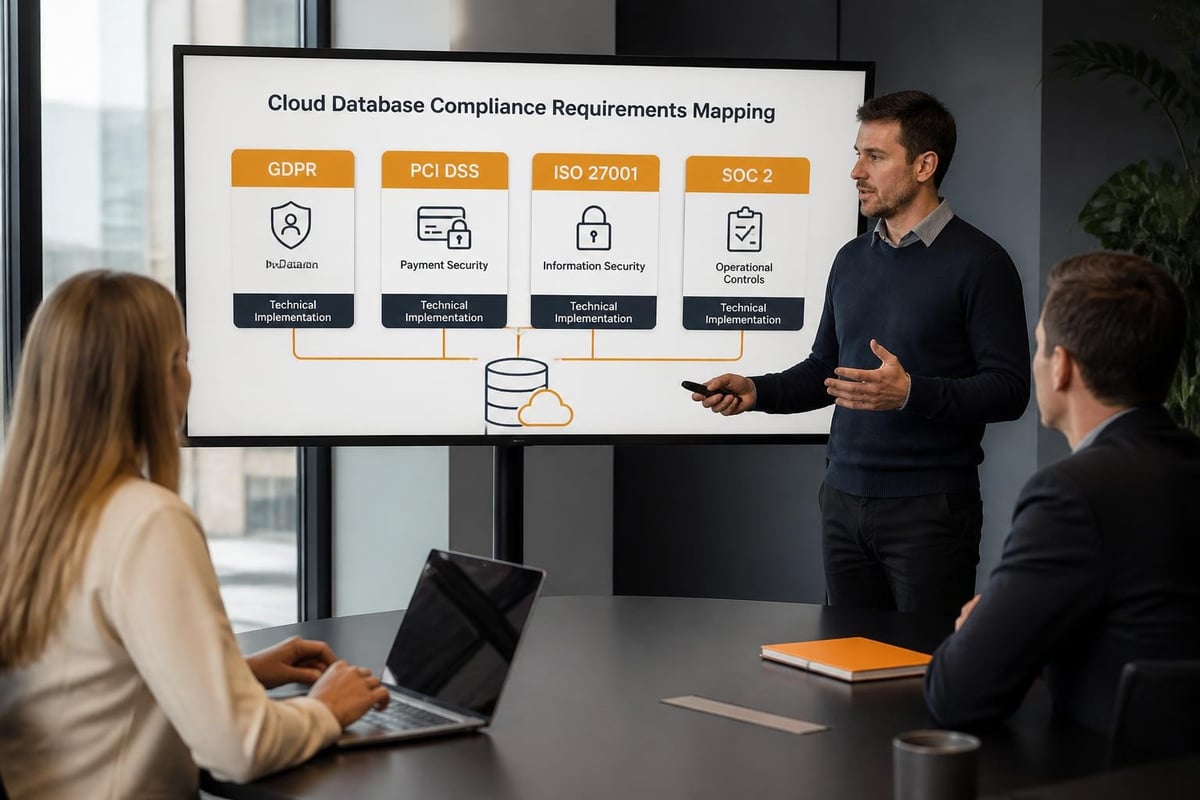
For organisations handling personal data of European residents, the General Data Protection Regulation (GDPR) mandates specific technical and organisational measures. Therefore, your secure cloud database must implement privacy by design, ensuring data minimisation, purpose limitation and individual rights such as access and erasure.
Data localisation provisions may require storing certain information within EU borders. Consequently, selecting cloud providers operating infrastructure within the European Economic Area becomes critical. Moreover, contractual arrangements must include appropriate data processing agreements (DPAs) and standard contractual clauses.
In addition, GDPR's breach notification requirements demand detection capabilities that identify security incidents within 72 hours. Comprehensive logging and monitoring systems enable organisations to meet these tight deadlines whilst conducting thorough impact assessments.
Industry-Specific Requirements
Financial services organisations processing payment card information must comply with PCI DSS requirements, which mandate specific controls around encryption, access management, network segmentation and testing. Healthcare providers handling medical records face HIPAA requirements in the United States or similar frameworks elsewhere.
Nevertheless, compliance represents a minimum baseline rather than comprehensive security. Therefore, organisations should view regulatory requirements as starting points and implement additional controls based on risk assessments and threat models.
| Framework | Primary Focus | Key Database Requirements |
|---|---|---|
| GDPR | Personal data protection | Encryption, access controls, breach notification, data residency |
| PCI DSS | Payment card security | Encryption, access logs, network segmentation, quarterly scans |
| ISO 27001 | Information security management | Risk assessment, controls documentation, regular audits |
| SOC 2 | Service organisation controls | Logging, monitoring, access management, availability |
Database Hardening and Configuration
Secure cloud database deployment requires proper configuration beyond vendor defaults. Moreover, database systems ship with settings optimised for ease of use rather than security, necessitating deliberate hardening efforts.
Following Security Benchmarks
The Centre for Internet Security provides database-specific benchmarks offering consensus-based hardening guidance. These detailed checklists cover authentication, authorisation, auditing, network configuration and data protection across popular database platforms.
Furthermore, organisations should disable unnecessary features and services that expand the attack surface. Development tools, sample databases and demonstration accounts represent common oversights that attackers exploit. Therefore, maintaining separate development, testing and production environments prevents insecure configurations from reaching live systems.
Regular vulnerability scanning identifies outdated software versions, missing patches and misconfigurations. Nevertheless, patching database systems requires careful planning to avoid disrupting business operations. Maintenance windows, rolling updates and blue-green deployments enable organisations to maintain security whilst minimising downtime.
- Remove default accounts and sample databases
- Disable remote root/administrator access
- Implement strong password policies enforcing complexity and rotation
- Apply security patches within 30 days of release (sooner for critical vulnerabilities)
- Conduct quarterly configuration audits against security baselines
The OWASP secure database access guidance provides practical recommendations for preventing injection attacks, managing privileges and securing database connections from application code.
Backup and Disaster Recovery
A truly secure cloud database must protect not only against unauthorised access but also data loss from technical failures, human error or malicious destruction. Consequently, comprehensive backup strategies form an essential component of database security.
The 3-2-1 Backup Strategy
This time-tested approach mandates maintaining three copies of data, on two different media types, with one copy stored off-site. Moreover, in cloud environments, this translates to primary database instances, automated snapshots and geographically distributed backups.
Furthermore, backups themselves require encryption to prevent data exposure through alternative channels. An attacker who cannot penetrate database access controls might target less-protected backup archives instead. Therefore, backup encryption keys should differ from production encryption keys and receive equally rigorous protection.
Regular backup testing verifies that restoration procedures actually work under pressure. Nevertheless, many organisations discover backup failures only during genuine disasters. Quarterly restoration drills to non-production environments validate both backup integrity and recovery procedures whilst training personnel in crisis response.
- Automate daily incremental backups and weekly full backups
- Encrypt all backup data using strong algorithms
- Store backups in geographically separate locations from primary data
- Test restoration procedures quarterly with realistic scenarios
- Document recovery time objectives (RTO) and recovery point objectives (RPO)
In addition, organisations using Software-as-a-Service platforms should recognise that shared responsibility models often place backup obligations on customers. Cloud email and collaboration platforms, for instance, may require separate backup solutions to protect against accidental deletion or retention policy gaps.
Selecting a Secure Cloud Database Provider
Choosing where to host your secure cloud database represents one of the most consequential security decisions. Moreover, the vendor's security practices, infrastructure location and contractual commitments directly impact your organisation's risk profile.
Evaluating Provider Security Credentials
Third-party certifications provide independent validation of security controls. ISO 27001 certification demonstrates implementation of comprehensive information security management systems. SOC 2 Type II reports detail operational controls and their effectiveness over time. Nevertheless, certifications represent minimum standards; organisations should investigate specific security practices relevant to their requirements.
Furthermore, data centre location carries legal and operational implications. European organisations particularly benefit from providers operating infrastructure within EU jurisdictions, ensuring GDPR compliance and avoiding potential conflicts with foreign surveillance legislation. The Cloud Security Alliance guidance emphasises the importance of data sovereignty in cloud security architectures.
Transparency regarding security incidents and response procedures indicates provider maturity. Therefore, vendors who publicly disclose breaches, publish security advisories and maintain clear communication channels demonstrate accountability and customer focus.
- Verify ISO 27001, SOC 2 Type II or equivalent certifications
- Confirm data centre locations align with regulatory requirements
- Review security incident history and response procedures
- Evaluate encryption capabilities for data at rest and in transit
- Assess availability guarantees and disaster recovery capabilities
Moreover, organisations should understand the shared responsibility model clearly. Cloud providers secure the infrastructure, but customers remain responsible for configuring security controls, managing access and protecting data appropriately.
Application Security and Database Interaction
The most secure cloud database proves vulnerable if applications accessing it contain security flaws. Therefore, organisations must address security across the entire stack, from user interfaces through application logic to database queries.
Preventing Injection Attacks
SQL injection remains one of the most prevalent and dangerous database attack vectors. Furthermore, these attacks exploit improper input validation, allowing attackers to execute arbitrary database commands through application interfaces. Parameterised queries and prepared statements eliminate this vulnerability by separating query structure from user-supplied data.
Moreover, principle of least privilege extends to application database accounts. Applications should connect using credentials with only the permissions required for specific functions. A public-facing web application querying customer information needs no ability to modify database schemas or create administrative accounts.
Input validation at application layers provides defence in depth, rejecting malformed or suspicious data before it reaches the database. Nevertheless, validation alone proves insufficient; properly designed database interactions eliminate entire categories of vulnerabilities regardless of input content.
- Use parameterised queries and prepared statements exclusively
- Implement strict input validation on all user-supplied data
- Grant minimal database privileges to application service accounts
- Employ stored procedures to encapsulate complex operations
- Conduct regular security code reviews and penetration testing
The Trend Micro Cloud Security Report highlights that misconfigurations and insecure application code remain leading causes of cloud database breaches, emphasising the importance of secure development practices.
Performance Considerations in Secure Databases
Security controls inevitably introduce computational overhead. Nevertheless, organisations need not choose between performance and protection when architectures balance both requirements thoughtfully.
Optimising Encrypted Database Operations
Modern processors include hardware acceleration for cryptographic operations through instruction sets like AES-NI. Therefore, encryption overhead on recent hardware proves minimal, typically consuming single-digit percentage points of processing capacity. Furthermore, transparent data encryption (TDE) operates at the storage layer, imposing negligible impact on query performance.
Connection encryption through TLS introduces latency during handshake negotiation. Consequently, applications should implement connection pooling, maintaining persistent authenticated connections rather than establishing new encrypted sessions for each operation. Moreover, session resumption features in TLS 1.3 dramatically reduce reconnection overhead.
Audit logging can generate substantial data volumes in high-transaction environments. Therefore, selective logging focusing on security-relevant events (authentication, privilege changes, data access) balances compliance requirements against storage and analysis costs.
- Enable hardware cryptographic acceleration in database configurations
- Implement connection pooling in application layers
- Configure selective audit logging for security-critical operations
- Provision adequate IOPS for encrypted storage volumes
- Monitor performance metrics to identify bottlenecks
In addition, regular performance testing under realistic loads validates that security controls maintain acceptable response times. Organisations should establish performance baselines before implementing new security measures, enabling quantitative assessment of any impacts.
Securing cloud databases requires a comprehensive approach encompassing encryption, access controls, network architecture, monitoring and compliance whilst maintaining the performance and availability that modern businesses demand. As organisations across Europe navigate increasingly complex regulatory landscapes and sophisticated threat actors, partnering with providers who prioritise security, privacy and GDPR compliance becomes essential. vBoxx operates ISO 27001-certified infrastructure exclusively within the Netherlands, offering secure hosting solutions that place European data protection principles at the core whilst delivering the reliability and performance your business requires. Contact our team to discuss how our European cloud platform can support your secure database requirements.