

Public cloud infrastructure has fundamentally transformed how businesses deliver digital services, yet security remains the paramount concern for organisations evaluating or operating in these environments. Furthermore, the shared responsibility model, regulatory compliance requirements, and evolving threat landscape demand that enterprises adopt comprehensive security strategies rather than relying solely on provider-native controls. Building a secure public cloud foundation requires understanding not just technical safeguards but also governance frameworks, architectural principles, and operational disciplines that protect data, applications, and infrastructure across multiple layers.
Understanding the Shared Responsibility Model
The cornerstone of any secure public cloud deployment begins with a clear understanding of the shared responsibility model, which delineates security obligations between cloud providers and customers. Moreover, hyperscale platforms such as Amazon Web Services, Microsoft Azure, and Google Cloud Platform assume responsibility for the physical infrastructure, network fabric, and virtualisation layers, whilst customers remain accountable for everything built atop those foundations.
Provider Responsibilities
Cloud providers typically manage:
- Physical data centre security, including perimeter controls, surveillance, and access management
- Network infrastructure and DDoS protection at the platform level
- Hypervisor isolation and compute resource security
- Storage media encryption and secure disposal
- Compliance certifications for the underlying infrastructure
Nevertheless, these provider-side controls represent only half of the security equation, and organisations must not confuse infrastructure security with application or data security.
Customer Responsibilities
Organisations deploying workloads in a secure public cloud environment retain full responsibility for:
- Identity and access management (IAM) policies and privilege governance
- Operating system hardening and patch management
- Application security, including code vulnerabilities and runtime protection
- Data classification, encryption, and access controls
- Network segmentation and firewall rule configuration
- Logging, monitoring, and incident response procedures
Therefore, a robust security posture demands that businesses implement layered controls across every component they manage, regardless of the underlying platform's certifications.

Implementing Zero Trust Architecture
Zero Trust has evolved from a theoretical framework into a practical necessity for organisations operating in public cloud environments. In addition, the traditional perimeter-based security model fails in cloud contexts where workloads span regions, resources scale dynamically, and users access systems from diverse locations and devices.
The CISA Zero Trust Maturity Model provides a structured roadmap for implementing Zero Trust across five pillars: identity, devices, networks, applications and workloads, and data. Furthermore, each pillar progresses through maturity stages from traditional perimeter-based controls through advanced, fully automated Zero Trust implementations.
| Pillar | Traditional Approach | Zero Trust Approach |
|---|---|---|
| Identity | VPN access, static passwords | MFA, conditional access, continuous verification |
| Devices | Perimeter firewall only | Device health attestation, endpoint detection |
| Networks | Flat internal networks | Micro-segmentation, software-defined perimeters |
| Applications | Binary trust (inside/outside) | Application-layer authorisation, least privilege |
| Data | Perimeter protection | Encryption everywhere, dynamic access policies |
Identity-Centric Security
Identity becomes the primary control plane in a secure public cloud environment. Consequently, organisations should enforce multi-factor authentication universally, implement role-based access control with least-privilege principles, and adopt just-in-time access provisioning for administrative functions. Moreover, identity federation and single sign-on reduce credential sprawl whilst centralising audit trails and policy enforcement.
Continuous Verification
Zero Trust fundamentally rejects the notion of trusted networks or devices. Instead, every access request triggers real-time verification based on user identity, device posture, location context, resource sensitivity, and behavioural analytics. Therefore, organisations must implement continuous monitoring and adaptive access controls that respond dynamically to risk signals rather than relying on static allow/deny rules.
Encryption and Data Protection Strategies
Data protection represents perhaps the most critical dimension of a secure public cloud deployment, particularly for European organisations navigating GDPR obligations and cross-border data transfer restrictions. Furthermore, encryption must extend across multiple states: data at rest, data in transit, and increasingly, data in use through confidential computing technologies.
Encryption at Rest
All cloud storage services offer server-side encryption, yet organisations must carefully evaluate key management approaches. Consequently, customer-managed encryption keys provide greater control than provider-managed keys, enabling key rotation policies, access auditing, and the ability to render data cryptographically unreadable by destroying keys if required. Nevertheless, this additional control introduces operational complexity and key management responsibilities.
Encryption in Transit
Transport Layer Security (TLS) 1.3 should protect all network communications between clients and cloud services, between application tiers, and across regions. Moreover, organisations deploying hybrid architectures must encrypt VPN tunnels, direct connections, and any data synchronisation flows. Therefore, certificate management, cipher suite configuration, and perfect forward secrecy become essential operational practices.
Data Residency and Sovereignty
European businesses face particular challenges regarding data sovereignty and regulatory compliance. In addition to technical encryption controls, organisations must implement data residency policies that constrain where data physically resides and which legal jurisdictions govern access. For businesses seeking alternatives outside the reach of extraterritorial legislation such as the US CLOUD Act, vBoxxCloud provides GDPR-compliant storage with 256-bit AES encryption in ISO 27001-certified data centres located exclusively in the Netherlands, ensuring both technical protection and legal sovereignty over business data.

Network Security and Segmentation
Network architecture fundamentally shapes the attack surface and blast radius of potential security incidents. Furthermore, a well-designed secure public cloud network implements multiple defensive layers that limit lateral movement, enforce least-privilege access, and provide visibility into all traffic flows.
Virtual Private Cloud Design
Virtual Private Clouds (VPCs) or equivalent constructs provide network isolation at the foundation of cloud security. Therefore, organisations should design VPC architectures with clear segmentation between environment tiers (development, staging, production), application components (web, application, database), and security zones (public-facing, internal, restricted). Moreover, each segment should implement dedicated subnet ranges, route tables, and security group configurations.
Security Groups and Network ACLs
Granular traffic filtering requires layered controls:
- Network Access Control Lists (ACLs) operate at the subnet level, providing stateless filtering of ingress and egress traffic
- Security groups function as stateful virtual firewalls at the instance level, controlling allowed protocols, ports, and source/destination addresses
- Web Application Firewalls (WAF) inspect HTTP/S traffic for application-layer attacks, SQL injection, and cross-site scripting attempts
Nevertheless, effective network security demands that organisations adopt a default-deny posture, explicitly permitting only necessary traffic flows rather than attempting to block known threats.
Traffic Inspection and Monitoring
Visibility forms the foundation of network security. Consequently, organisations should enable VPC flow logs, centralise log aggregation, and implement network traffic analysis to detect anomalous patterns, unauthorised access attempts, and potential data exfiltration. Furthermore, integration with MITRE ATT&CK cloud-specific tactics enables security teams to map observed behaviours to known adversary techniques and develop appropriate detection and response playbooks.
Compliance Frameworks and Governance
Regulatory compliance and internal governance policies provide the scaffolding for a secure public cloud programme. Moreover, the Cloud Security Alliance's Security Guidance offers a comprehensive framework spanning governance, compliance, information lifecycle management, and infrastructure security that organisations can adapt to their specific regulatory and risk requirements.
Regulatory Requirements for European Businesses
European organisations must navigate a complex regulatory landscape including:
- GDPR requirements for data protection, privacy by design, and breach notification
- NIS2 Directive obligations for critical infrastructure operators
- eIDAS regulations governing electronic identification and trust services
- ISO 27001 certification requirements for information security management systems
- Sector-specific regulations such as PSD2 for financial services or HIPAA-equivalent health data protection rules
Therefore, a comprehensive compliance programme must map these requirements to specific technical controls, document implementation evidence, and maintain continuous compliance monitoring.
Policy-as-Code and Automated Compliance
Manual compliance validation cannot scale with cloud-native development velocity. Instead, organisations should implement policy-as-code frameworks that codify security and compliance requirements into automated guardrails. Furthermore, infrastructure-as-code templates, admission controllers, and continuous compliance scanning enable shift-left security practices that prevent non-compliant configurations from reaching production environments.
| Compliance Tool Category | Purpose | Implementation Approach |
|---|---|---|
| Cloud Security Posture Management (CSPM) | Continuous configuration assessment | Automated scanning against compliance benchmarks |
| Infrastructure-as-Code scanning | Pre-deployment validation | Template analysis in CI/CD pipelines |
| Policy engines | Runtime enforcement | Admission control, API gateways |
| Audit log analytics | Compliance evidence | Centralised logging, retention policies |
Identity and Access Management
Identity governance represents the control plane for a secure public cloud environment. In addition, modern IAM systems must address not just human users but also service accounts, workload identities, and machine-to-machine authentication across hybrid and multi-cloud deployments.
Least Privilege and Role-Based Access
Every identity should receive the minimum permissions required to fulfil its function. Consequently, organisations should:
- Define granular roles mapped to specific job functions or application requirements
- Implement time-bound credentials for administrative access
- Enforce separation of duties for sensitive operations
- Conduct regular access reviews and permission audits
- Remove unused credentials and revoke access upon role changes
Moreover, privilege escalation pathways demand particular scrutiny, as overly permissive IAM policies often provide indirect routes to sensitive resources through intermediate roles or resource-based policies.
Multi-Factor Authentication and Conditional Access
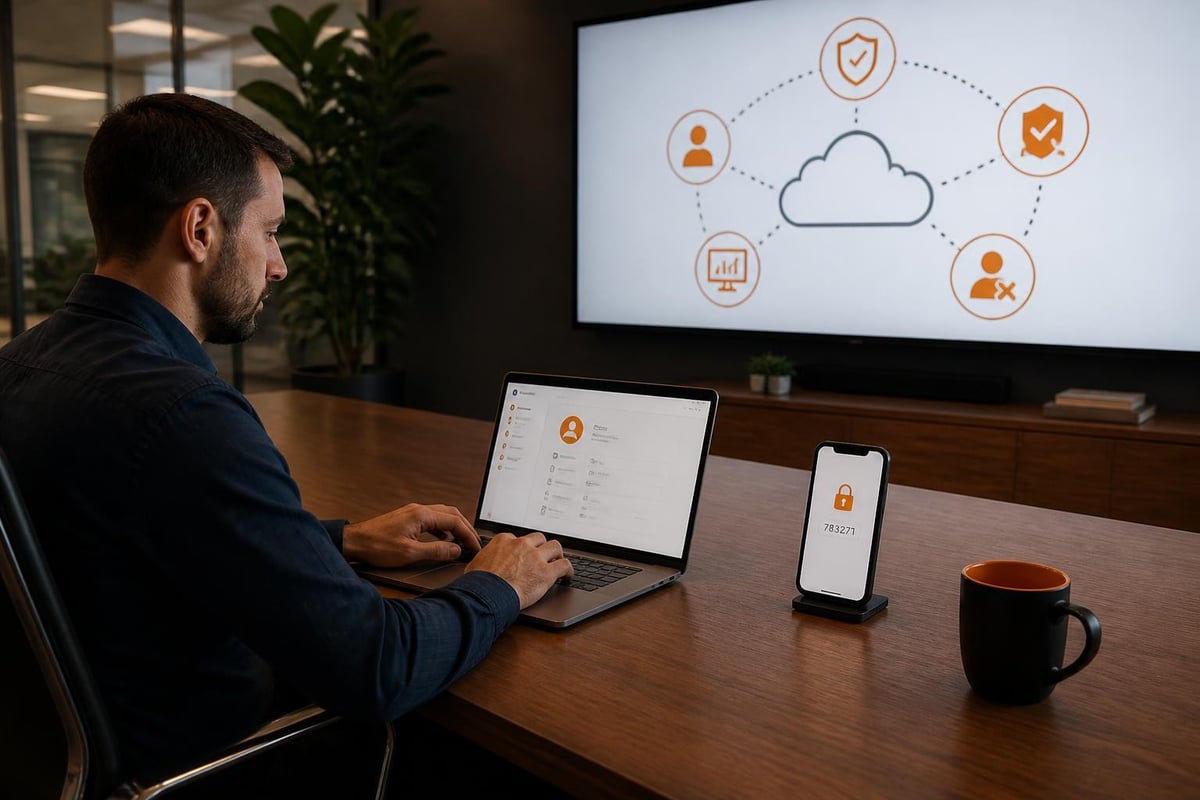
Password-based authentication alone cannot protect high-value cloud assets. Therefore, organisations must enforce multi-factor authentication universally, with phishing-resistant methods such as hardware security keys or biometric authentication for privileged accounts. Furthermore, conditional access policies should evaluate user location, device compliance status, sign-in risk, and application sensitivity before granting access to cloud resources.
Service Account Management
Service accounts and workload identities introduce unique challenges because they typically operate without human oversight. Nevertheless, these identities require equally rigorous governance:
- Use short-lived credentials rotated automatically
- Scope permissions to specific resources rather than broad wildcards
- Implement workload identity federation to eliminate long-lived secrets
- Monitor service account activity for anomalous patterns
- Maintain an inventory of all non-human identities and their permissions
Logging, Monitoring, and Incident Response
Security visibility and rapid incident response distinguish mature secure public cloud programmes from those that merely implement baseline controls. Furthermore, the ephemeral nature of cloud resources, distributed architectures, and shared responsibility model demand purpose-built approaches to logging and monitoring rather than adapting traditional on-premises tooling.
Comprehensive Logging Strategy
Effective security monitoring requires centralised collection of:
- Authentication events and IAM policy changes
- Network flow logs and DNS queries
- API calls and resource configuration changes
- Application logs and database access patterns
- Container and serverless function telemetry
- Security tool alerts and scan results
Moreover, log retention policies must balance compliance requirements, storage costs, and forensic investigation needs, with critical security logs typically retained for extended periods beyond standard operational telemetry.
Security Information and Event Management
Centralised SIEM platforms aggregate logs from cloud services, application workloads, and security tools into a unified analytics environment. Consequently, security teams can correlate events across multiple sources, detect multi-stage attacks, and investigate incidents without navigating disparate consoles. Nevertheless, effective SIEM implementation demands thoughtful log parsing, alert tuning, and integration with threat intelligence feeds to reduce false positives whilst maintaining high detection fidelity.
Incident Response Planning
Preparation determines incident response effectiveness. Therefore, organisations should develop cloud-specific runbooks addressing:
- Compromised credentials and unauthorised access
- Data exfiltration and storage bucket exposure
- Crypto-mining and resource abuse
- Misconfigurations and security group changes
- Distributed denial-of-service attacks
Furthermore, regular tabletop exercises and simulated breach scenarios validate response procedures, identify gaps in tooling or authority, and build muscle memory for security teams before actual incidents occur.
Cloud-Native Security Services
Hyperscale cloud providers offer extensive security services beyond basic infrastructure protection. In addition, Microsoft Azure's security documentation and Google Cloud's Security Foundations guide provide detailed guidance on leveraging platform-native controls effectively.
Security Capabilities Worth Considering
Platform-native security services typically include:
- Managed threat detection analysing logs and network traffic for indicators of compromise
- Vulnerability scanning for compute instances, container images, and serverless functions
- Secret management with automatic rotation and access auditing
- DDoS protection absorbing volumetric attacks at the network edge
- Web application firewalls protecting HTTP/S endpoints from application-layer attacks
- Data loss prevention scanning for sensitive information in storage and transit
Nevertheless, organisations must carefully evaluate vendor lock-in implications, service coverage gaps, and integration capabilities when selecting between provider-native tools and third-party security platforms.
Cloud Security Posture Management
CSPM solutions continuously assess cloud configurations against security best practices and compliance benchmarks. Moreover, these tools identify misconfigurations such as publicly accessible storage buckets, overly permissive security groups, unencrypted databases, or IAM policies violating least privilege principles. Therefore, CSPM platforms provide essential guardrails for organisations moving at cloud-native velocity where manual configuration reviews cannot keep pace with deployment frequency.
Building a Secure Multi-Cloud Strategy
Many organisations adopt multi-cloud architectures for resilience, cost optimisation, or best-of-breed service selection. Furthermore, security complexity increases proportionally with each additional platform, as teams must maintain expertise across divergent control interfaces, IAM models, and networking constructs whilst enforcing consistent policies.
Unified Security Controls
Consistency requires abstraction layers that decouple security policies from platform-specific implementations. Consequently, organisations should:
- Implement centralised identity providers federating to all cloud platforms
- Adopt common tagging taxonomies and resource naming conventions
- Deploy unified SIEM and CSPM solutions with multi-cloud visibility
- Standardise encryption key management across environments
- Establish consistent network segmentation patterns regardless of platform
Moreover, infrastructure-as-code frameworks enable templated deployments that embed security controls consistently across AWS, Azure, Google Cloud, or private infrastructure.
Avoiding Security Gaps
The CISA Cloud Security Technical Reference Architecture provides vendor-agnostic guidance for architecting secure cloud environments, particularly valuable for organisations managing multiple platforms. Nevertheless, careful attention to control overlap, visibility boundaries, and incident response scope ensures that multi-cloud deployments strengthen rather than weaken overall security posture.
Operational Security Practices
Technical controls alone cannot deliver a secure public cloud environment without supporting operational disciplines. In addition, security must integrate into development workflows, change management processes, and business operations rather than functioning as a separate audit activity.
DevSecOps Integration
Security automation within CI/CD pipelines enables:
- Static code analysis identifying vulnerabilities before deployment
- Container image scanning rejecting images with critical CVEs
- Infrastructure-as-code validation enforcing configuration policies
- Dynamic application security testing in staging environments
- Automated compliance checks gating production releases
Therefore, shifting security left reduces remediation costs, accelerates deployment velocity, and prevents vulnerable code from reaching production environments.
Patch Management and Vulnerability Remediation
Cloud providers patch underlying infrastructure automatically, yet customers retain responsibility for operating system updates, application dependencies, and library vulnerabilities. Consequently, organisations must implement automated patching for base images, maintain container image currency, and establish SLA-driven remediation processes based on vulnerability severity and exploit availability. Moreover, virtual patching through WAF rules can provide temporary protection whilst development teams prepare proper fixes.
Backup and Disaster Recovery
High availability and redundancy do not eliminate the need for backups. Furthermore, ransomware attacks, accidental deletion, and compliance requirements demand that organisations maintain point-in-time recovery capabilities. Therefore, backup strategies should implement the 3-2-1 rule (three copies, two media types, one off-site) with immutable storage protecting against malicious deletion. For businesses leveraging Microsoft 365 or Google Workspace alongside cloud infrastructure, exploring cloud-to-cloud backup solutions ensures comprehensive data protection across all business systems.
Building a secure public cloud infrastructure demands a comprehensive approach spanning technical controls, governance frameworks, and operational disciplines across identity, data, network, and application layers. Moreover, organisations must balance security rigour with operational agility, implementing layered defences whilst enabling cloud-native development practices. vBoxx delivers European businesses the security, compliance, and sovereignty they require through ISO 27001-certified infrastructure hosted exclusively in the Netherlands, combining cloud storage, communication platforms, and password management with the privacy guarantees that come from operating outside extraterritorial legal frameworks. Explore how vBoxx can support your secure cloud journey with GDPR-compliant solutions, free migration services, and expert consultancy tailored to European business requirements.