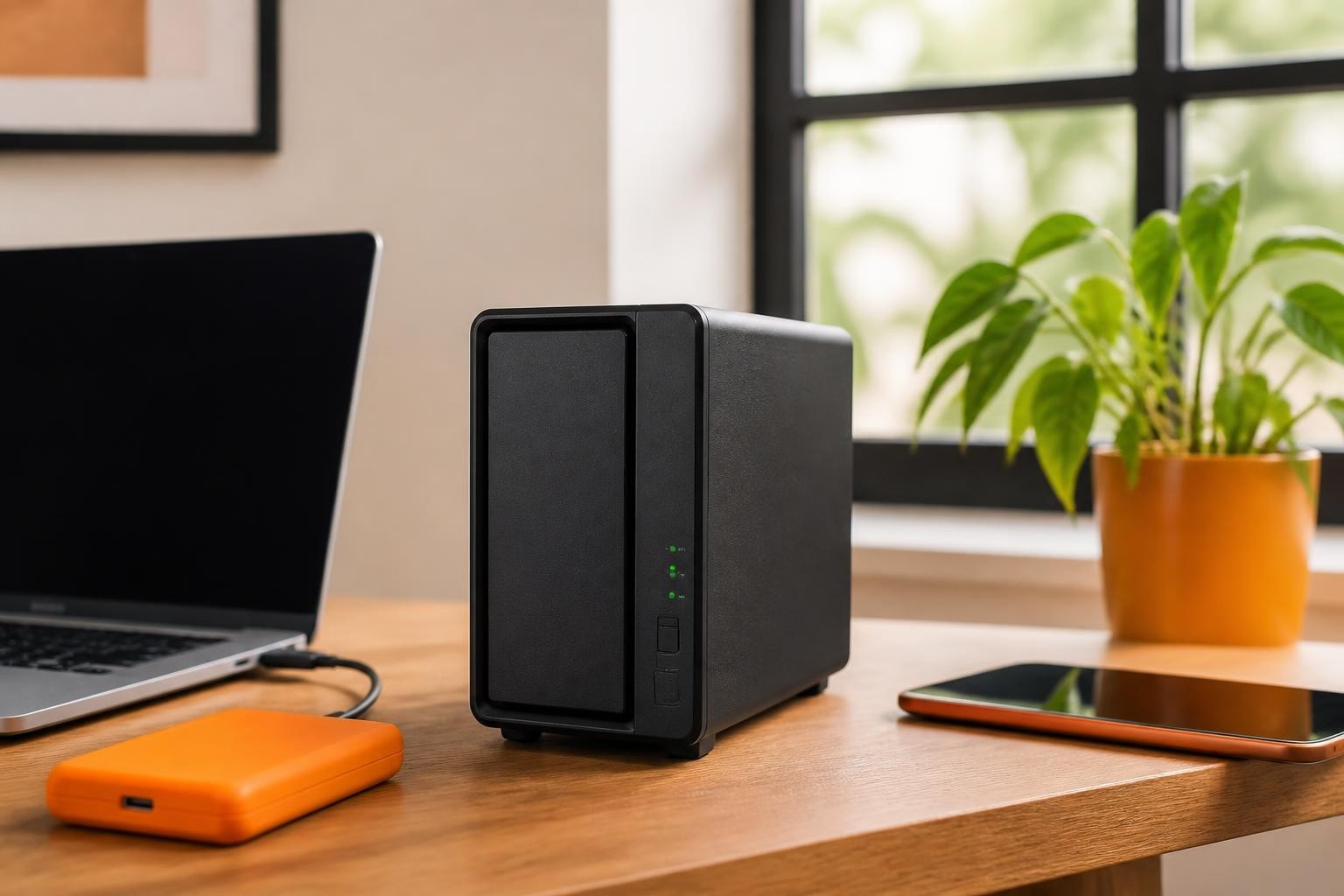

The enterprise storage landscape has evolved dramatically, with organisations demanding solutions that deliver unprecedented capacity, reliability, and performance. In particular, the HD6500 Synology represents a significant step forward in high-density storage systems, specifically engineered for businesses managing massive data volumes whilst maintaining stringent security standards. Furthermore, this comprehensive examination explores how this enterprise-grade storage solution addresses the complex demands of modern cloud hosting environments. Moreover, it highlights its suitability for organisations prioritising data protection and operational efficiency. As a result, businesses can better understand how such systems support scalable and secure data infrastructure strategies.
Understanding the HD6500 Architecture
The Synology HD6500 stands as a purpose-built solution for organisations requiring substantial storage capacity without compromising performance. In particular, this system delivers 60 drive bays in a 4U rackmount chassis, supporting both 3.5-inch and 2.5-inch SATA drives with hot-swappable functionality. Furthermore, it is designed to handle large-scale enterprise workloads with ease. Moreover, the architecture enables efficient expansion and high availability in demanding environments. As a result, organisations benefit from scalable, reliable, and enterprise-grade storage performance.
Key architectural components include:
- Dual redundant power supplies ensuring continuous operation
- Advanced cooling systems maintaining optimal drive temperatures
- SAS connectivity supporting high-throughput data transfer
- Modular design facilitating maintenance without service interruption
Storage Capacity and Scalability
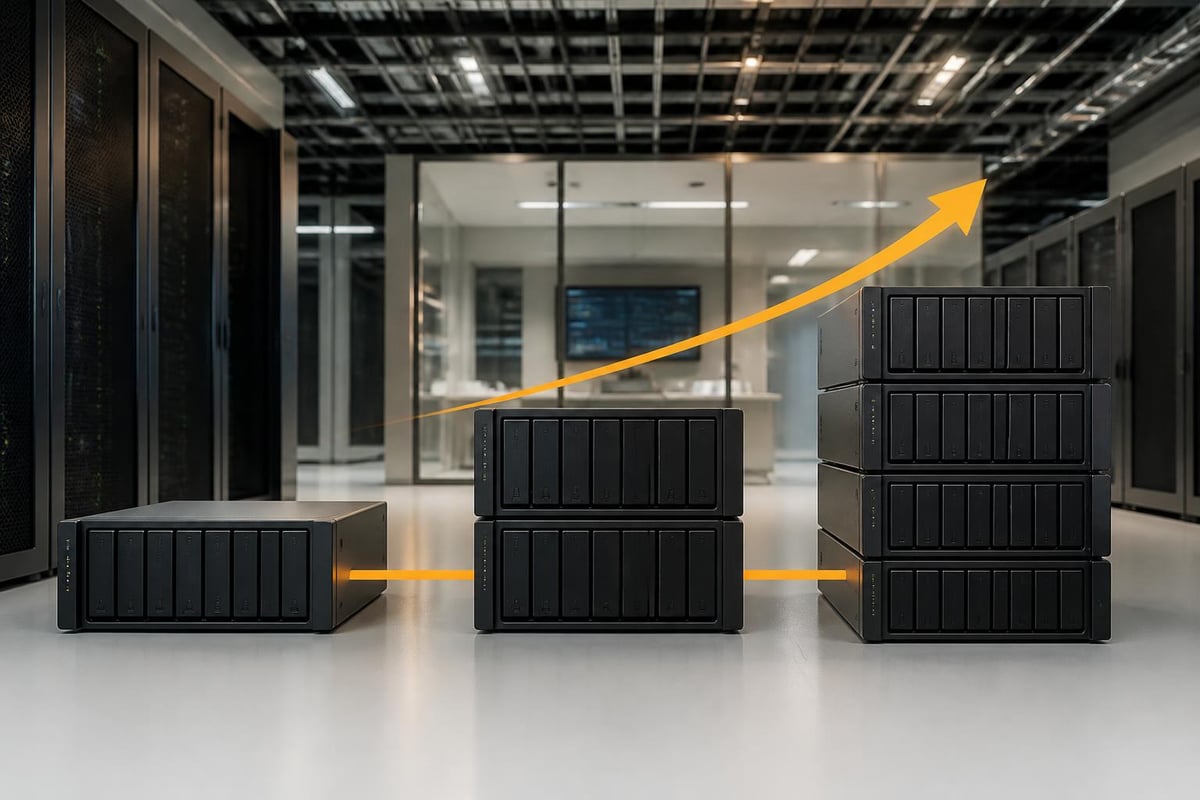
The HD6500 Synology provides extraordinary storage density, accommodating up to 60 drives in a single chassis. In particular, with support for modern high-capacity drives, organisations can achieve petabyte-scale storage within a relatively compact footprint. Furthermore, this enables businesses to consolidate large volumes of data efficiently. As a result, storage infrastructure becomes more scalable and space-efficient.
This scalability extends beyond the base unit. In particular, businesses can expand their infrastructure by daisy-chaining multiple HD6500 units together, creating vast storage pools that grow alongside organisational requirements. Moreover, the system supports BTRFS Peta Volume, enabling single volumes exceeding one petabyte whilst maintaining data integrity through advanced checksumming. Consequently, organisations benefit from both massive scalability and strong data reliability.
| Configuration | Maximum Capacity | Drives Required | Use Case |
|---|---|---|---|
| Standard Deployment | 1.2 PB | 60 x 20TB HDD | Video archives, backup repositories |
| Hybrid Configuration | 768 TB | 48 x 16TB HDD + 12 x SSD | Database hosting with caching |
| Maximum Density | 2.4 PB | Multiple units | Enterprise content delivery |
Performance Specifications and Capabilities
Throughput and IOPS Metrics
The HD6500 Synology delivers robust performance metrics suitable for demanding enterprise workloads. In particular, through dual SAS connections, the system achieves sequential read speeds exceeding 1,800 MB/s and write speeds surpassing 1,600 MB/s under optimal conditions. Furthermore, this enables high-throughput data processing for intensive enterprise applications. As a result, organisations can support large-scale workloads with greater efficiency and speed.
Random I/O operations benefit from intelligent caching mechanisms and workload distribution across multiple drives. In particular, organisations deploying mixed workloads appreciate the system’s ability to maintain consistent performance whilst handling simultaneous read and write operations. Moreover, this improves responsiveness across diverse usage scenarios. Consequently, businesses achieve more stable and predictable performance under heavy system demand.
Performance optimisation features:
- Automated tiering between SSD and HDD storage
- Read and write cache acceleration
- Link aggregation support for network throughput
- Adaptive I/O scheduling based on workload patterns
- Snapshot technology minimising performance impact
Compatibility and Integration
The HD6500 Synology integrates seamlessly with Synology’s DiskStation Manager (DSM) ecosystem, providing organisations with comprehensive management tools. In particular, this integration enables centralised administration across multiple storage systems whilst maintaining granular control over individual units. Furthermore, it simplifies large-scale infrastructure management for IT teams. As a result, organisations can improve operational efficiency and system oversight.
For businesses operating secure cloud hosting platforms, compatibility with industry-standard protocols proves essential. In particular, the system supports SMB, NFS, iSCSI, and AFP, facilitating integration with diverse client environments. Moreover, advanced features such as LUN mapping and target management enable precise control over storage resource allocation. Consequently, businesses can achieve flexible, interoperable, and highly controlled storage environments.
Data Protection and Redundancy Features
RAID Configurations and Fault Tolerance
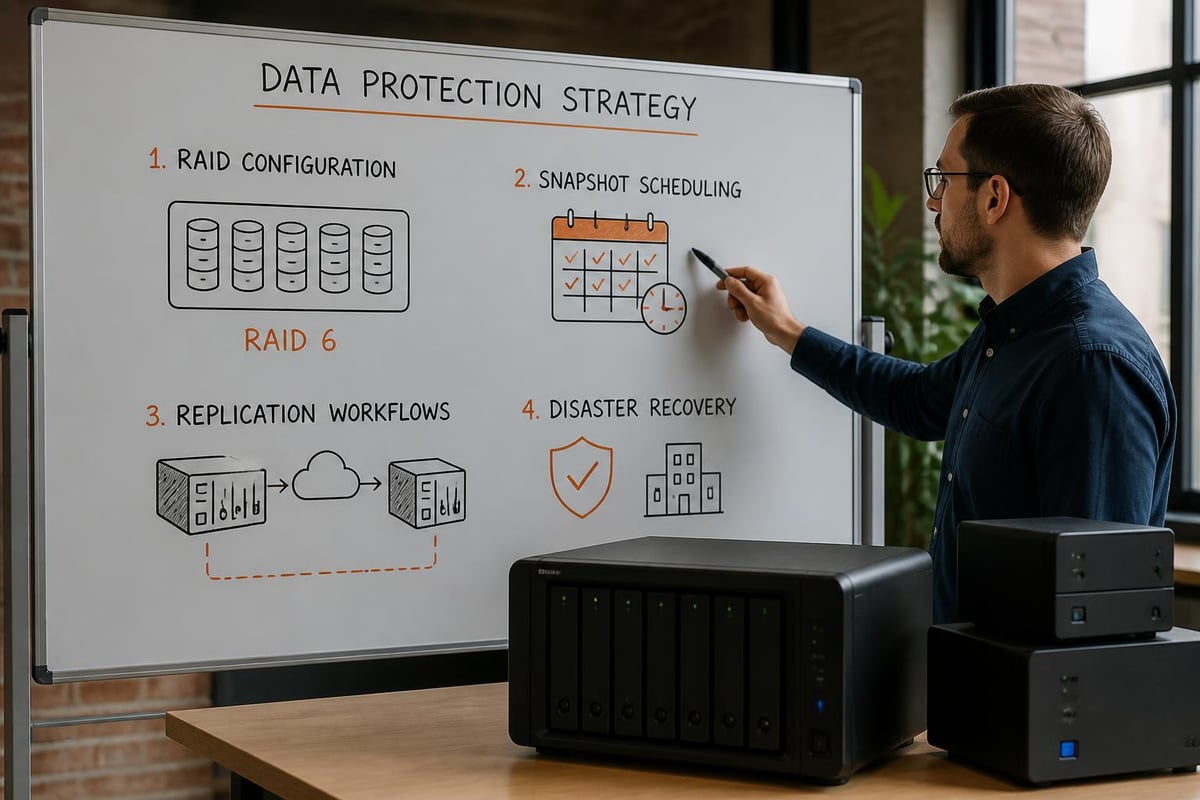
Data integrity remains paramount in enterprise storage deployments. In particular, the HD6500 Synology supports comprehensive RAID configurations, including RAID 0, 1, 5, 6, 10, and Synology’s proprietary Synology Hybrid RAID (SHR). Furthermore, these options allow organisations to tailor redundancy and performance based on workload requirements. As a result, businesses can maintain stronger data protection and operational resilience.
SHR technology particularly benefits organisations deploying mixed drive capacities, automatically optimising storage space whilst maintaining appropriate redundancy levels. In particular, this flexibility reduces waste and simplifies capacity planning when upgrading storage infrastructure. Moreover, it allows for more efficient scaling over time. Consequently, organisations achieve better storage utilisation, lower costs, and simplified expansion management.
| RAID Level | Fault Tolerance | Usable Capacity | Best For |
|---|---|---|---|
| RAID 6 | 2-drive failure | ~87% (60 drives) | Critical business data |
| RAID 10 | 1 drive per mirrored pair | 50% | High-performance databases |
| SHR-2 | 2-drive failure | Variable | Mixed drive environments |
Backup and Disaster Recovery
Beyond RAID protection, the HD6500 synology offers sophisticated backup capabilities essential for business continuity. Snapshot technology enables point-in-time recovery without consuming significant storage space, whilst incremental backup mechanisms reduce bandwidth requirements.
As outlined in comprehensive coverage from PNP Storage, replication features support both local and remote backup strategies. Organisations can configure scheduled replication to secondary storage systems, ensuring data availability even during primary system failures.
For secure cloud hosting providers, these capabilities translate directly into enhanced service level agreements (SLAs) and improved customer confidence. The ability to guarantee rapid recovery times whilst maintaining data consistency addresses critical business requirements.
Security Considerations for Enterprise Deployments
Access Control and Authentication
Security architecture within the HD6500 Synology encompasses multiple layers of protection. In particular, advanced access controls enable administrators to define granular permissions based on user roles, groups, and resource requirements. Furthermore, this ensures that only authorised users can access specific data sets. Moreover, it reduces the risk of internal and external data exposure. As a result, organisations can maintain stronger security governance and tighter control over sensitive information.
Security features include:
- Two-factor authentication (2FA) for administrative access
- Active Directory and LDAP integration
- Encrypted network protocols (HTTPS, SFTP, FTPS)
- IP auto-blocking following failed authentication attempts
- Comprehensive audit logging for compliance requirements
Encryption and Compliance
Data encryption capabilities address regulatory requirements and industry best practices. The system supports AES 256-bit encryption for both data at rest and data in transit, ensuring comprehensive protection across the entire information lifecycle.
For organisations managing sensitive client information, such as those providing secure cloud services, these encryption capabilities prove non-negotiable. Shared folder encryption enables selective protection of particularly sensitive data without imposing performance penalties across the entire storage array.
Businesses evaluating comprehensive security solutions can explore how integrated platforms address multiple security layers. The demonstration provided by secure hosting specialists illustrates how storage security integrates with broader infrastructure protection strategies.
Management and Monitoring Tools
Centralised Administration
DiskStation Manager provides the operational foundation for HD6500 Synology deployments. In particular, this web-based interface simplifies complex administrative tasks whilst providing deep visibility into system health, performance metrics, and storage utilisation. Furthermore, it centralises monitoring and configuration within a single platform. Moreover, this improves efficiency for IT administrators managing large-scale environments. As a result, organisations gain better control, insight, and operational simplicity across their storage infrastructure.
Administrative capabilities include:
- Real-time performance monitoring with historical trend analysis
- Automated alert notifications for system events
- Scheduled maintenance tasks and firmware updates
- Storage provisioning and volume management
- User and permission administration
Proactive Monitoring and Alerts
The hd6500 synology implements intelligent monitoring systems that detect potential issues before they impact operations. S.M.A.R.T. drive monitoring identifies failing drives early, whilst temperature sensors ensure optimal environmental conditions.
Email notifications, SNMP traps, and syslog integration enable seamless incorporation into existing IT management frameworks. For organisations operating 24/7 cloud hosting environments, these proactive monitoring capabilities reduce downtime and support predictable maintenance schedules.
| Monitoring Feature | Capability | Business Benefit |
|---|---|---|
| S.M.A.R.T. Analysis | Predictive drive failure detection | Prevents unexpected data loss |
| Temperature Monitoring | Environmental condition tracking | Extends hardware lifespan |
| Network Traffic Analysis | Bandwidth utilisation reporting | Optimises network infrastructure |
| Storage Utilisation Forecasting | Capacity planning predictions | Prevents storage exhaustion |
Cost Considerations and Total Cost of Ownership
Initial Investment Analysis
The hd6500 synology represents a substantial capital expenditure, with pricing varying based on configuration and regional availability. As discussed in the official Synology video overview, organisations should evaluate total cost of ownership rather than focusing solely on initial hardware costs.
Drive selection significantly impacts overall expenditure. Enterprise-grade drives command premium pricing but deliver superior reliability and warranty coverage. Balancing capacity, performance, and budget constraints requires careful consideration of workload requirements and growth projections.

Operational Efficiency and Energy Consumption
Power efficiency directly impacts operational costs, particularly for organisations managing multiple storage systems. In particular, the HD6500 Synology implements intelligent power management, including drive hibernation during periods of inactivity and adaptive cooling based on thermal loads. Furthermore, these features help reduce unnecessary energy consumption without compromising performance. Moreover, they contribute to improved hardware longevity and system stability. As a result, organisations can lower operational costs while maintaining efficient and reliable storage performance.
Energy efficiency features:
- Variable fan speed reducing power consumption
- Scheduled power on/off for drive groups
- Wake-on-LAN support for remote activation
- Energy-efficient hardware components
For businesses committed to sustainable operations, these efficiency measures align with environmental objectives whilst reducing operational expenses. In particular, power consumption metrics should factor into long-term cost projections alongside hardware depreciation and maintenance expenses. Furthermore, this provides a more accurate view of total cost of ownership over time. Moreover, it helps organisations make more informed infrastructure investment decisions. As a result, businesses can balance sustainability goals with financial efficiency and long-term operational planning.
Deployment Scenarios and Use Cases
Media Production and Archival
Media organisations generating substantial video content benefit significantly from the capacity and throughput the HD6500 Synology provides. In particular, real-time video editing requires sustained high bandwidth, whilst long-term archival demands reliable storage with predictable retrieval times. Furthermore, this ensures both performance and accessibility across demanding workflows. As a result, media teams can manage large-scale content production more efficiently.
The system’s support for multiple simultaneous connections enables collaborative workflows where numerous editors access shared storage pools. In particular, version control through snapshots protects against accidental deletions whilst maintaining efficient storage utilisation. Moreover, this enhances both collaboration and data protection in shared environments. Consequently, organisations benefit from safer, more efficient, and highly collaborative media production workflows.
Backup and Disaster Recovery Infrastructure
Secondary storage for enterprise backup systems represents a primary deployment scenario. The hd6500 synology serves effectively as a backup target for smaller NAS systems, servers, and virtual machine environments.
According to expert analysis from Tweak Reviews, organisations implementing 3-2-1 backup strategies particularly value the system’s capacity and reliability. Integration with major backup software platforms simplifies deployment within existing infrastructure.
Virtualisation and Database Hosting
Virtual machine storage requires consistent performance and high availability. In particular, the HD6500 Synology supports iSCSI connectivity, enabling integration with virtualisation platforms such as VMware vSphere and Microsoft Hyper-V. Furthermore, this ensures seamless compatibility with enterprise virtualisation environments. As a result, organisations can maintain reliable and scalable virtual machine storage performance.
Database workloads benefit from hybrid configurations combining SSD caching with high-capacity HDD storage. In particular, this approach delivers responsive query performance whilst accommodating substantial data volumes within budget constraints. Moreover, it balances speed and storage efficiency in demanding database environments. Consequently, businesses achieve improved performance without significantly increasing infrastructure costs.
Hardware Specifications and Technical Details
Processing and Memory
The detailed specifications provided by Synology Kenya outline the hardware foundation supporting the HD6500 synology. Unlike unified storage systems, the HD6500 functions as an expansion unit connecting to primary Synology servers through SAS cables.
This architecture enables organisations to scale storage capacity independently from computing resources. Primary servers provide processing power, whilst HD6500 units deliver pure storage capacity, optimising resource allocation and cost efficiency.
Physical Characteristics and Rack Requirements
The 4U form factor accommodates 60 drive bays whilst maintaining reasonable depth for standard server racks. Physical dimensions measure approximately 482mm (W) x 708mm (D) x 177mm (H), with weight varying based on drive configuration.
Rack planning considerations:
- Standard 19-inch rack compatibility
- Adequate ventilation spacing (recommended 1U above and below)
- Cable management for SAS connections
- Power distribution unit capacity for dual power supplies
- Physical security for drive access
Network Integration and Connectivity
SAS Connectivity Architecture
The hd6500 synology employs mini-SAS HD (SFF-8644) connectors supporting 12 Gb/s throughput per connection. Dual redundant connections provide both performance benefits and failover protection, ensuring storage accessibility even during connection failures.
Cable quality and length significantly impact performance and reliability. Organisations should specify certified SAS cables within recommended length limits to maintain signal integrity and achieve advertised performance levels.
Network Infrastructure Requirements
Whilst the HD6500 functions as an expansion unit without direct network connectivity, overall storage system performance depends heavily on network infrastructure. Organisations deploying these systems should ensure adequate network bandwidth between storage systems and client environments.
Network optimisation strategies:
- Dedicated storage network isolation from general traffic
- Jumbo frame enablement for improved throughput
- Link aggregation for increased bandwidth
- Quality of Service (QoS) configuration prioritising storage traffic
- Regular network performance monitoring and tuning
Maintenance and Lifecycle Management
Firmware Updates and System Maintenance
Regular firmware updates address security vulnerabilities, introduce new features, and resolve known issues. The HD6500 synology supports non-disruptive firmware updates in most scenarios, minimising service interruption during maintenance windows.
Scheduled maintenance should include drive health assessments, RAID consistency checks, and backup verification. These proactive measures identify potential issues before they escalate into service-affecting problems.
Drive Replacement Procedures
Hot-swappable drive bays enable replacement of failed drives without system shutdown. RAID rebuild processes automatically restore redundancy following drive replacement, though rebuild times increase with drive capacity and RAID configuration complexity.
Organisations should maintain adequate spare drive inventory, particularly for critical deployments where rapid replacement proves essential. Drive compatibility verification ensures replacement drives meet performance and reliability specifications.
| Maintenance Task | Frequency | Impact on Operations |
|---|---|---|
| Firmware Updates | Quarterly | Minimal (scheduled maintenance) |
| RAID Consistency Checks | Monthly | Low (background process) |
| Drive Health Assessments | Weekly | None (monitoring only) |
| Backup Verification | Daily | Low (depends on volume) |
| Physical Inspection | Annually | Requires brief downtime |
Competitive Positioning and Alternatives
Market Comparison
The enterprise storage market offers numerous alternatives to the HD6500 synology, each with distinct advantages and limitations. Traditional SAN solutions provide robust performance but command premium pricing and require specialised expertise.
Direct-attached storage offers simplicity and cost-effectiveness for smaller deployments but lacks the scalability and management features of networked solutions. Evaluating alternatives requires careful consideration of current requirements, growth projections, and total cost of ownership.
Value Proposition Analysis
The hd6500 synology delivers particular value for organisations already invested in Synology ecosystems. Unified management across multiple systems, standardised backup procedures, and simplified training reduce operational complexity.
For businesses prioritising data security and reliable performance, the combination of hardware quality, software capabilities, and vendor support justifies the investment. The system’s modular nature enables gradual capacity expansion aligned with business growth.
The HD6500 Synology addresses critical storage challenges facing modern enterprises, delivering scalable capacity, robust performance, and comprehensive data protection within a manageable framework. Organisations requiring secure, reliable storage infrastructure benefit from evaluating how this system aligns with their specific operational requirements. If you’re seeking comprehensive cloud hosting solutions that prioritise security, performance, and sustainability, vBoxx delivers enterprise-grade infrastructure backed by expert support and green hosting practices. Our secure cloud services provide the foundation for businesses demanding uncompromising data protection and operational excellence.