

Cloud storage has fundamentally transformed how businesses manage their digital assets. Nevertheless, many organisations still struggle to fully understand what cloud storage truly entails and how it can benefit their operations. Furthermore, with the increasing emphasis on data security and compliance, particularly within European markets, selecting the right cloud storage solution has become more critical than ever. This comprehensive guide will help you define cloud storage, explore its mechanisms, and understand its practical applications for your business.
What Does Define Cloud Storage Mean in Technical Terms?
To define cloud storage properly, we must examine its core architecture and functionality. Cloud storage refers to a service model where data is transmitted to and stored on remote systems maintained by third-party providers. Therefore, instead of keeping files exclusively on local hard drives or on-premises servers, businesses can access their information from any location with internet connectivity.
The technical infrastructure involves multiple components working together seamlessly. Moreover, data centres house the physical servers that store your information, whilst sophisticated software manages access, security, and synchronisation across devices. In addition, redundancy mechanisms ensure your data remains available even if individual servers experience failures.
The Fundamental Components
When we define cloud storage from an architectural perspective, several key elements emerge:
- Data centres: Physical locations housing servers and storage equipment
- Virtualisation layers: Software that abstracts physical hardware into flexible resources
- Access protocols: Secure methods for uploading, downloading, and managing files
- Synchronisation engines: Systems ensuring data consistency across multiple devices
- Security frameworks: Encryption, authentication, and authorisation mechanisms
Furthermore, modern cloud storage operates on an object-based model, where each file becomes an object with unique identifiers and metadata. This approach enables superior scalability compared to traditional file systems.

How Cloud Storage Works Behind the Scenes
Understanding the operational mechanics helps businesses make informed decisions. Therefore, let's explore the process from upload to retrieval. When you save a file to cloud storage, your device first encrypts the data locally. Subsequently, the encrypted information travels through secure internet connections to the provider's infrastructure.
Upon arrival, the cloud storage system performs several operations simultaneously. Moreover, it typically creates multiple copies of your data, distributing them across different servers or even separate geographical locations. This redundancy protects against hardware failures and ensures business continuity.
| Process Stage | What Happens | Business Benefit |
|---|---|---|
| Upload | Data encryption and transmission | Security during transfer |
| Storage | Distribution across multiple servers | Protection against data loss |
| Synchronisation | Real-time updates across devices | Team collaboration |
| Retrieval | Decryption and download | Quick access from anywhere |
| Backup | Automated versioning | Recovery from errors |
In addition, cloud storage providers maintain sophisticated monitoring systems. These systems track performance metrics, detect potential security threats, and optimise resource allocation. Nevertheless, the complexity remains invisible to end users, who simply experience reliable access to their files.
Primary Types of Cloud Storage Solutions
To accurately define cloud storage, we must recognise that not all solutions function identically. Furthermore, businesses encounter three primary deployment models, each serving distinct purposes.
Public Cloud Storage
Public cloud platforms offer shared infrastructure managed entirely by the service provider. Therefore, multiple organisations utilise the same physical resources, though data remains isolated through virtualisation. This model provides excellent scalability and cost efficiency. Moreover, providers handle all maintenance, updates, and security patches automatically.
Private Cloud Storage
Private cloud environments dedicate resources exclusively to a single organisation. Consequently, businesses gain enhanced control over security policies and compliance requirements. In addition, this model appeals to organisations handling sensitive information or operating within heavily regulated industries.
Hybrid Cloud Storage
Hybrid approaches combine public and private elements strategically. Nevertheless, implementation requires careful planning to ensure seamless integration. Organisations might store sensitive customer data privately whilst utilising public cloud resources for less critical workloads. Furthermore, this flexibility enables businesses to optimise costs without compromising security.
Key Benefits That Define Cloud Storage Value
When businesses seek to define cloud storage's value proposition, several compelling advantages emerge. Therefore, understanding these benefits helps organisations evaluate whether cloud storage aligns with their strategic objectives.
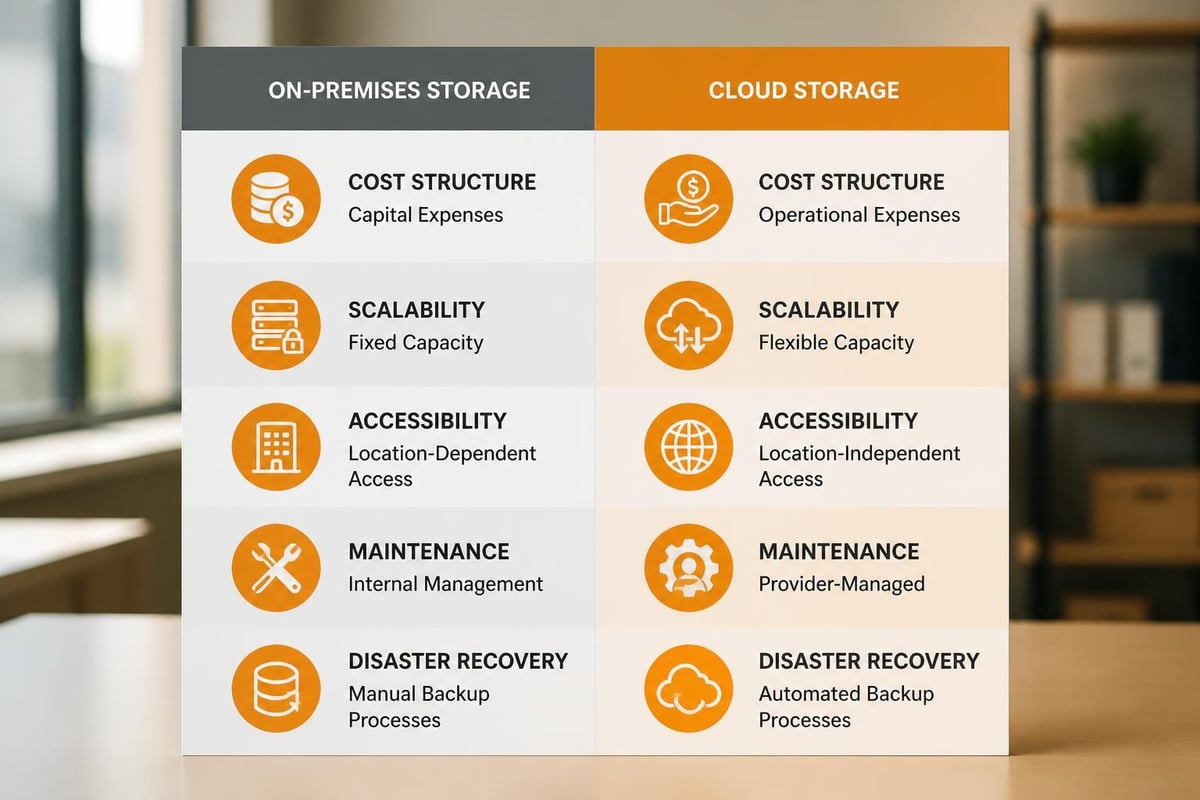
Cost efficiency represents perhaps the most immediate benefit. Moreover, cloud storage eliminates substantial capital expenditure on physical hardware. Instead, businesses pay predictable monthly fees based on actual usage. In addition, organisations avoid costs associated with maintaining on-premises infrastructure, including electricity, cooling, and dedicated IT staff.
Scalability provides another critical advantage. Furthermore, businesses can expand or contract storage capacity rapidly without purchasing new equipment. This elasticity proves particularly valuable for organisations experiencing seasonal fluctuations or rapid growth.
- Accessibility: Access files from any device with internet connectivity
- Collaboration: Multiple team members can work on documents simultaneously
- Disaster recovery: Automated backups protect against data loss
- Automatic updates: Providers handle software maintenance and security patches
- Environmental benefits: Shared resources reduce overall energy consumption
Nevertheless, the collaboration capabilities deserve special attention. Therefore, teams can share files instantly, comment on documents, and maintain version control effortlessly. In addition, this functionality proves essential for remote and hybrid work environments.
Security Considerations When You Define Cloud Storage
Security remains paramount when evaluating cloud storage solutions. Moreover, businesses must understand potential risks alongside protective measures. Therefore, comprehensive security strategies encompass multiple layers of defence.
Encryption Standards
Encryption protects data both during transmission and whilst stored on servers. Furthermore, industry-standard protocols ensure that even if unauthorised parties intercept data, they cannot decipher its contents. In addition, businesses should verify whether providers offer client-side encryption, where data becomes encrypted before leaving your premises.
Access Control Mechanisms
Sophisticated authentication systems prevent unauthorised access. Therefore, multi-factor authentication adds crucial protection beyond simple passwords. Moreover, role-based access controls ensure employees only access information relevant to their responsibilities. Nevertheless, organisations must maintain proper governance over user permissions.
Compliance and Data Sovereignty
For European businesses, data sovereignty carries particular importance. Furthermore, regulations such as GDPR mandate specific handling of personal information. In addition, organisations must ensure their cloud storage provider maintains data centres within appropriate jurisdictions. Therefore, selecting European-based providers often simplifies compliance whilst supporting local infrastructure.
Practical Applications Across Business Functions
To fully define cloud storage's impact, we must examine real-world applications. Therefore, different departments leverage cloud storage in unique ways that enhance operational efficiency.
Finance departments utilise cloud storage for secure document management. Moreover, invoices, contracts, and financial reports require both accessibility and stringent security. In addition, version control ensures audit trails remain intact, supporting compliance requirements.
Marketing teams benefit from collaborative asset libraries. Furthermore, large media files like videos and high-resolution images consume substantial storage space. Therefore, cloud solutions provide the necessary capacity whilst enabling creative teams to work together seamlessly.
Human resources manages sensitive employee information securely. Nevertheless, HR professionals require flexible access to personnel files, contracts, and benefits documentation. In addition, cloud storage facilitates remote onboarding processes and distributed workforce management.
Sales and Customer Service
Sales teams accessing customer information whilst travelling represent another compelling use case. Moreover, cloud storage ensures representatives always have current product specifications, pricing information, and proposal templates. Furthermore, customer service departments maintain comprehensive knowledge bases accessible to support staff globally.
| Department | Primary Use Case | Critical Requirement |
|---|---|---|
| Finance | Document retention | Compliance and security |
| Marketing | Asset management | Large file handling |
| HR | Employee records | Privacy protection |
| Sales | Mobile access | Real-time synchronisation |
| IT | System backups | Reliability and recovery |
Selecting the Right Cloud Storage Provider
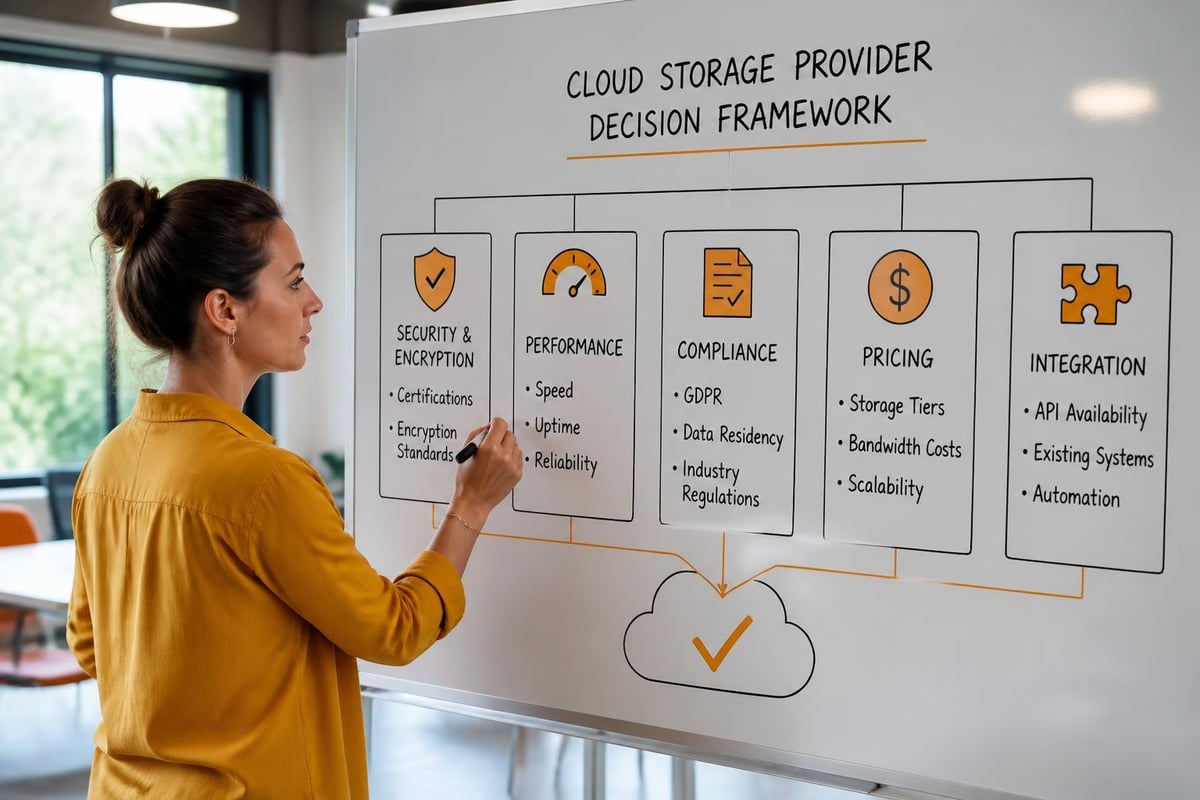
When businesses define cloud storage requirements, provider selection becomes crucial. Therefore, evaluation criteria should extend beyond simple pricing comparisons. Moreover, organisations must assess factors that impact long-term success and security.
Performance metrics deserve careful consideration. Furthermore, upload and download speeds directly affect productivity. In addition, latency becomes particularly important for teams collaborating across geographical distances. Nevertheless, selecting appropriate storage types for specific workloads optimises performance.
Security certifications provide independent validation of provider practices. Therefore, look for ISO 27001 certification, SOC 2 compliance, and GDPR readiness. Moreover, European businesses should prioritise providers demonstrating commitment to local data protection standards.
Integration capabilities determine how smoothly cloud storage fits existing workflows. Furthermore, compatibility with productivity software, accounting systems, and communication platforms eliminates friction. In addition, API availability enables custom integrations tailored to unique business processes.
For organisations exploring cloud storage solutions, experiencing platforms first-hand proves invaluable. Therefore, scheduling a demonstration allows businesses to evaluate features within their specific context, ensuring the solution aligns with operational requirements whilst maintaining robust security standards.
Implementation Best Practices for Business Success
Successfully deploying cloud storage requires strategic planning. Moreover, organisations that approach implementation methodically achieve better outcomes than those rushing adoption. Therefore, following established best practices minimises disruption whilst maximising benefits.
Migration Planning
Begin with comprehensive data auditing. Furthermore, understanding what information you possess, where it resides, and who requires access informs migration strategy. In addition, categorising data by sensitivity level helps determine appropriate security measures.
- Audit existing data across all departments and systems
- Classify information based on sensitivity and compliance requirements
- Develop migration timeline with clearly defined phases
- Test thoroughly before full deployment
- Train employees on new systems and security protocols
- Monitor performance and gather user feedback
- Optimise configurations based on actual usage patterns
Nevertheless, maintaining offline backups alongside cloud storage provides additional protection. Therefore, implementing a comprehensive backup strategy that includes both cloud and local copies ensures maximum data resilience.
Ongoing Management
Cloud storage requires continuous oversight rather than one-time setup. Moreover, regular audits of access permissions prevent security gaps. In addition, monitoring storage consumption helps optimise costs and identify opportunities for efficiency improvements.
Furthermore, establishing clear policies around file organisation prevents chaos as data volumes grow. Therefore, consistent naming conventions, folder structures, and retention policies maintain order. Nevertheless, policies must balance structure with flexibility to accommodate diverse departmental needs.
Cost Optimisation Strategies
Understanding pricing models helps businesses define cloud storage budgets accurately. Moreover, providers typically charge based on storage volume consumed, data transfer quantities, and API requests. Therefore, optimising each component reduces overall expenditure.
Storage tiering enables cost savings by matching data importance with appropriate storage classes. Furthermore, frequently accessed files warrant premium storage offering rapid retrieval. In addition, archival data accessed rarely can reside in lower-cost tiers with acceptable retrieval delays.
Data lifecycle policies automatically transition files between storage tiers based on age or access patterns. Moreover, these policies reduce manual management whilst ensuring optimal cost efficiency. Nevertheless, organisations must configure policies carefully to avoid inadvertently affecting accessibility.
- Monitor usage patterns to identify optimisation opportunities
- Implement compression for suitable file types
- Remove duplicate files through deduplication
- Archive inactive data to lower-cost storage tiers
- Set retention policies to delete obsolete information
- Negotiate volume discounts with providers
Furthermore, understanding egress charges prevents unexpected costs. Therefore, data downloads sometimes incur fees, particularly when transferring large volumes externally. In addition, architectural decisions that minimise unnecessary data movement preserve budget.
Future Trends Shaping Cloud Storage
As technology evolves, how we define cloud storage continues to expand. Moreover, emerging trends promise enhanced capabilities whilst addressing current limitations. Therefore, forward-thinking organisations monitor developments to maintain competitive advantages.
Edge computing integration brings storage closer to data sources. Furthermore, processing information at edge locations reduces latency and bandwidth consumption. In addition, this architecture proves particularly valuable for organisations with distributed operations or IoT deployments.
Artificial intelligence increasingly enhances cloud storage management. Moreover, AI-powered systems automatically categorise files, detect anomalies, and optimise resource allocation. Nevertheless, these capabilities introduce new considerations around data privacy and algorithmic transparency.
Sustainability considerations gain prominence as environmental awareness grows. Furthermore, energy-efficient data centres and renewable power sources reduce cloud storage's carbon footprint. In addition, European providers particularly emphasise green hosting practices, aligning with regional environmental priorities.
| Emerging Trend | Business Impact | Timeline |
|---|---|---|
| Edge computing | Reduced latency | Currently deploying |
| AI management | Automated optimisation | Rapidly expanding |
| Quantum encryption | Enhanced security | 3-5 years |
| Green hosting | Environmental compliance | Already available |
| Decentralised storage | Improved resilience | Early adoption phase |
Moreover, quantum-resistant encryption prepares for future security challenges. Therefore, providers developing post-quantum cryptography ensure long-term data protection. In addition, these investments demonstrate commitment to sustained security excellence.
Understanding how to define cloud storage properly empowers businesses to make informed infrastructure decisions that balance functionality, security, and cost-efficiency. Moreover, selecting the right provider requires careful evaluation of technical capabilities alongside compliance with European data protection standards. vBoxx delivers secure, sustainable cloud storage solutions designed specifically for businesses prioritising privacy and reliability, combining robust infrastructure with comprehensive support services that ensure your digital assets remain protected and accessible.