

Mobile applications have fundamentally transformed how businesses operate, yet their success depends entirely on robust backend infrastructure. The cloud for mobile ecosystem encompasses everything from authentication and data synchronization to push notifications and real-time collaboration, all whilst maintaining security and regulatory compliance. Furthermore, as enterprises increasingly prioritize data sovereignty and privacy, understanding how cloud infrastructure supports mobile workloads has become essential for technical decision-makers. This guide explores the architectural patterns, security considerations, and strategic choices that define effective cloud for mobile deployments in 2026.
Understanding Cloud for Mobile Architecture
Cloud for mobile refers to the backend infrastructure, services, and platforms that power mobile applications beyond the device itself. Therefore, whilst users interact with apps on smartphones and tablets, the heavy lifting occurs in distributed data centers that handle storage, computation, authentication, and business logic.
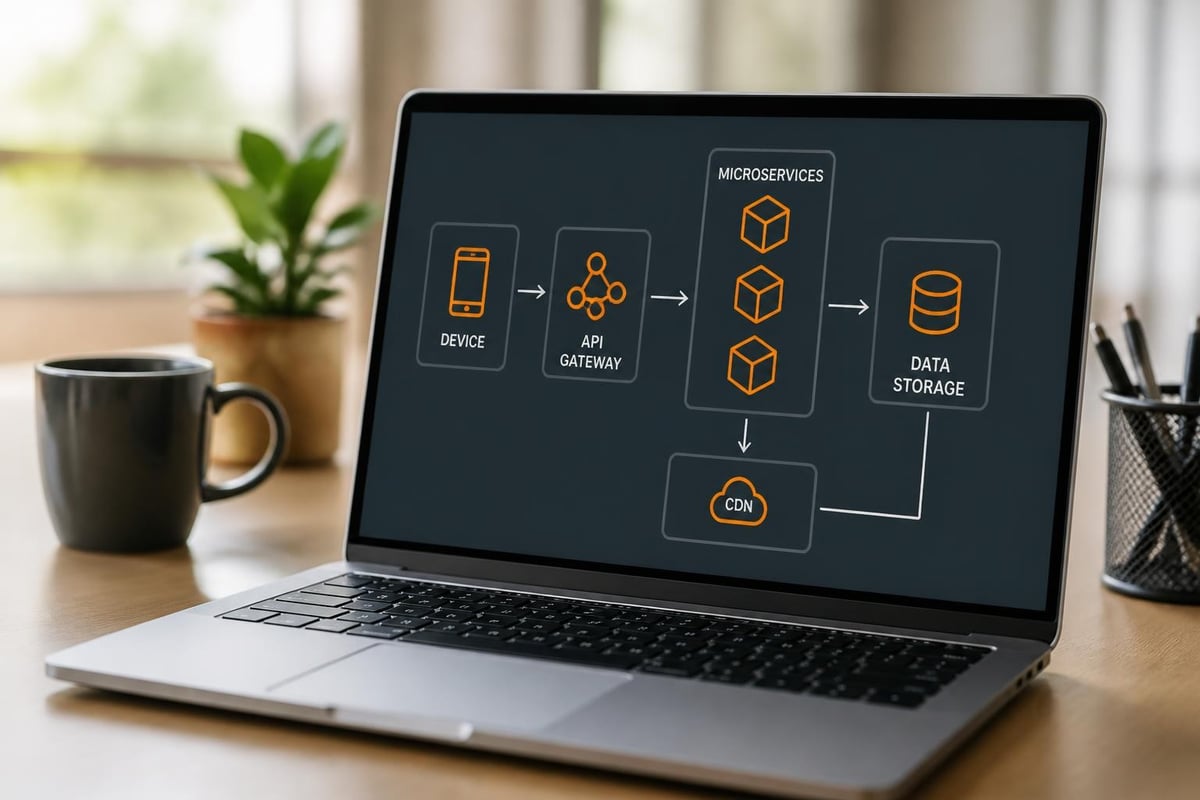
Modern mobile cloud architectures typically comprise several key layers. The presentation layer runs on the device, whilst the application programming interface (API) gateway manages requests between mobile clients and backend services. Moreover, these gateways handle authentication, rate limiting, and protocol translation, ensuring secure and efficient communication.
Core Components of Mobile Cloud Infrastructure
The foundation of any cloud for mobile deployment includes several critical services:
- Authentication and identity management to verify users and manage permissions
- Database services for structured and unstructured data persistence
- Object storage for media files, documents, and large binary objects
- Push notification services to re-engage users and deliver timely updates
- Content delivery networks to serve static assets with low latency globally
- Analytics platforms to track user behavior and application performance
Nevertheless, the specific implementation varies significantly based on whether organizations choose platform-as-a-service offerings, build custom solutions on infrastructure-as-a-service, or adopt backend-as-a-service frameworks designed explicitly for mobile use cases.
Data Synchronization and Offline-First Design
One distinguishing characteristic of cloud for mobile applications is the need to handle intermittent connectivity gracefully. Consequently, successful mobile apps implement offline-first architectures that allow users to work productively regardless of network availability.
Synchronization strategies fall into several categories. Furthermore, optimistic synchronization assumes operations will succeed and resolves conflicts later, whilst pessimistic approaches lock resources before modification. The choice depends on data sensitivity and acceptable conflict scenarios.
Conflict Resolution Patterns
| Pattern | Use Case | Complexity | Data Integrity |
|---|---|---|---|
| Last-write-wins | Simple documents, activity logs | Low | Acceptable for non-critical data |
| Operational transformation | Collaborative editing | High | Maintains intent across clients |
| Conflict-free replicated data types (CRDTs) | Distributed systems, real-time collaboration | Medium | Mathematically guaranteed convergence |
| Manual resolution | Financial records, critical business data | Medium | Highest accuracy, requires user input |
Apple's CloudKit, for example, provides built-in conflict detection and resolution mechanisms. According to Apple’s developer guidance, understanding when CloudKit fits your application's data model prevents architectural mismatches that emerge later in development.
In addition, throttling and rate limits present significant considerations. Apple’s technical documentation on CloudKit throttling explains how operational behavior affects sync reliability, particularly crucial for applications with large user bases or frequent updates.
Security and Compliance in Mobile Cloud Deployments
Security requirements for cloud for mobile applications extend beyond traditional web security models. Mobile devices operate in inherently untrusted environments, therefore requiring defense-in-depth strategies that assume compromise at multiple layers.
Transport security forms the baseline requirement. All communication between mobile clients and cloud backends must use TLS 1.3 or later with strong cipher suites. Moreover, certificate pinning prevents man-in-the-middle attacks by embedding expected certificate information directly in the application.
Authentication and Authorization Framework
Modern mobile applications typically implement OAuth 2.0 or OpenID Connect flows, with refresh tokens stored securely in platform-specific keystores. Nevertheless, token management introduces complexity.
Best practices include:
- Short-lived access tokens (15-60 minutes) to limit exposure
- Secure refresh token storage using hardware-backed keystores
- Biometric authentication as a second factor for sensitive operations
- Certificate-based mutual TLS for high-security enterprise scenarios
- Device attestation to verify application integrity and prevent tampering
Furthermore, regulatory compliance adds another dimension. For European businesses, GDPR mandates strict controls over personal data processing, storage location, and cross-border transfers. Therefore, selecting cloud infrastructure within the European Economic Area ensures compliance without complex data transfer agreements.
vBoxx exemplifies this approach by operating ISO 27001-certified data centers exclusively in the Netherlands, placing infrastructure outside the reach of the US CLOUD Act whilst maintaining full GDPR compliance. Their vBoxxCloud platform provides 256-bit AES encryption and eIDAS-compliant digital signing, addressing both security and regulatory requirements that mobile enterprise applications demand.

Backend Services and Microservices Architecture
Cloud for mobile backends increasingly adopt microservices patterns rather than monolithic architectures. This shift enables independent scaling, technology diversity, and faster deployment cycles. Moreover, microservices align naturally with mobile development practices where feature teams own vertical slices of functionality.
Container orchestration platforms like Kubernetes have become the de facto standard for deploying mobile backends. According to the CNCF annual survey, adoption continues to accelerate across organizations of all sizes, driven by portability, declarative configuration, and ecosystem maturity.
Service Mesh and API Management
As microservices proliferate, managing inter-service communication becomes critical. Service meshes provide:
- Mutual TLS between services without application code changes
- Traffic management including retries, timeouts, and circuit breaking
- Observability through distributed tracing and metrics collection
- Policy enforcement for access control and rate limiting
In addition, API gateways serve as the entry point for mobile clients, aggregating multiple backend calls into single requests to reduce mobile network round trips. This pattern, known as backend for frontend (BFF), optimizes performance for specific client types.
Edge Computing and Mobile Cloud Integration
The boundary between cloud and edge computing continues to blur, particularly for mobile applications requiring low latency or operating in bandwidth-constrained environments. Therefore, hybrid architectures that distribute workload between centralized cloud and edge nodes have emerged as practical solutions.
Edge computing for mobile encompasses several deployment patterns. Multi-access edge computing (MEC) places compute resources at cellular network base stations, reducing latency to single-digit milliseconds. Furthermore, content delivery networks increasingly offer edge compute capabilities, allowing logic execution close to end users.
The CNCF whitepaper on cloud-native and edge-native approaches clarifies architectural differences and overlaps, helping teams design systems that span both environments effectively. Moreover, the NIST report on edge computing provides comprehensive guidance on security considerations for hybrid cloud and edge deployments supporting mobile workloads.
Use Cases for Edge-Enhanced Mobile Applications
| Application Type | Edge Function | Benefit |
|---|---|---|
| Augmented reality | Object recognition, spatial mapping | Sub-20ms latency requirement |
| Industrial IoT | Sensor aggregation, anomaly detection | Bandwidth reduction, reliability |
| Retail and payments | Transaction processing, fraud detection | Low latency, compliance with data locality |
| Gaming | Physics simulation, matchmaking | Consistent performance, reduced jitter |
Nevertheless, edge deployment introduces operational complexity. Teams must manage distributed systems spanning multiple locations, each with different network characteristics and resource constraints.
Platform Selection and Vendor Strategy
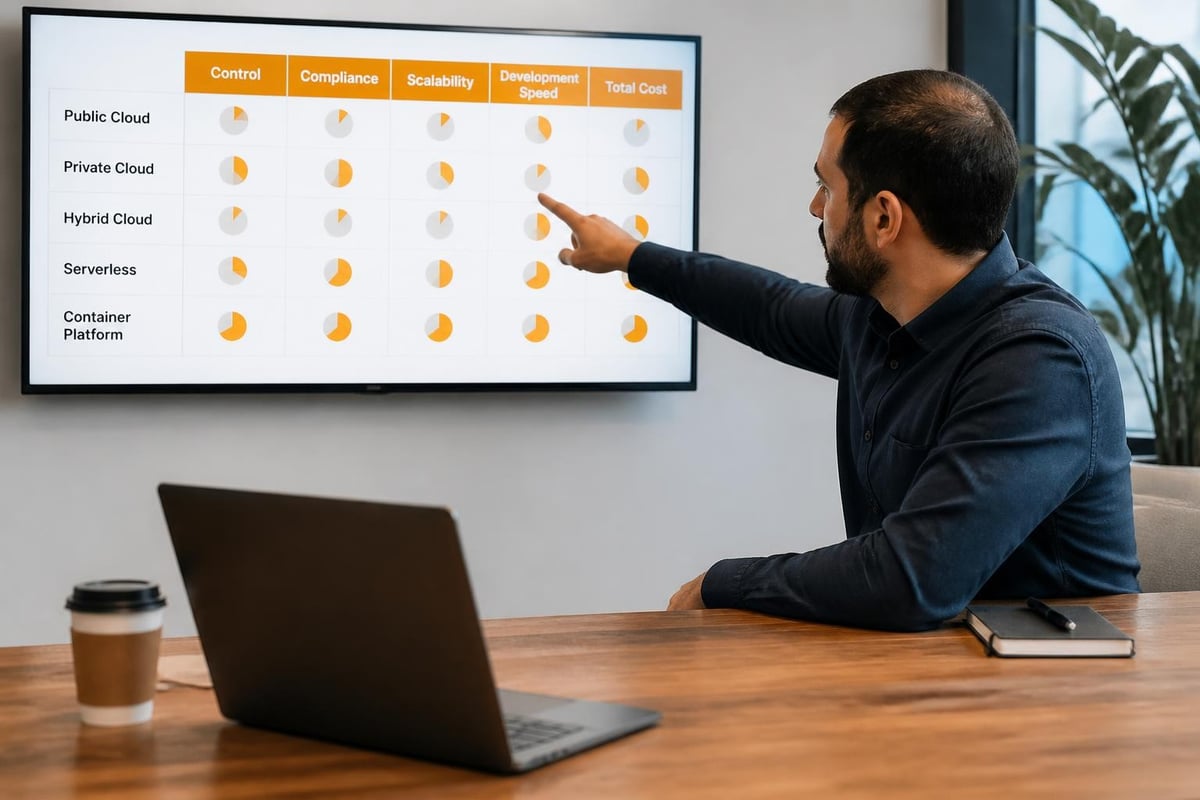
Choosing the appropriate cloud platform for mobile applications requires evaluating numerous technical and business factors. Public cloud providers offer comprehensive mobile backend services, whilst private and hybrid clouds provide greater control and regulatory compliance.
Platform-as-a-service offerings like Firebase, AWS Amplify, and Azure Mobile Apps accelerate development through managed authentication, databases, and analytics. However, these introduce vendor lock-in and may constrain architectural choices. Therefore, organizations must balance time-to-market against long-term flexibility.
Build vs. Buy Decision Framework
When evaluating cloud for mobile platforms, consider:
- Development team expertise: Does your team have experience operating cloud infrastructure, or do managed services better match capabilities?
- Scalability requirements: Will usage patterns demand elastic scaling, or remain relatively stable?
- Data sovereignty: Do regulatory requirements mandate specific geographic locations or ownership models?
- Integration complexity: How many external systems must connect to your mobile backend?
- Total cost of ownership: Beyond infrastructure costs, factor in operational overhead and engineering time.
In addition, multi-cloud strategies provide redundancy and avoid single points of failure. Nevertheless, they introduce significant complexity in areas like identity federation, data replication, and operations.
Performance Optimization and Monitoring
Cloud for mobile applications must deliver consistently excellent performance across diverse network conditions and device capabilities. Furthermore, mobile users exhibit lower tolerance for latency and errors compared to desktop users, making optimization critical to retention and satisfaction.
Database query optimization forms the foundation of backend performance. Proper indexing, query planning, and caching strategies prevent slow API responses that frustrate mobile users. Moreover, implementing read replicas and distributed databases reduces latency for geographically dispersed user bases.
Mobile-Specific Monitoring Metrics
Traditional server monitoring alone proves insufficient for cloud for mobile deployments. Therefore, comprehensive observability must include:
- Client-side performance: App launch time, screen rendering, interaction responsiveness
- Network performance: Request latency by connection type (4G, 5G, WiFi), payload sizes
- API success rates: Error rates, timeout frequency, retry patterns
- Crash analytics: Platform-specific crash reports with stack traces
- User flows: Conversion funnels, drop-off points, feature adoption
Furthermore, mobile applications should implement adaptive behavior based on network conditions. Progressive image loading, request prioritization, and graceful degradation maintain usability even when connectivity suffers.
Future Trends in Mobile Cloud Computing
The evolution of cloud for mobile continues to accelerate driven by advances in connectivity, processing capabilities, and user expectations. 5G networks enable new application categories that were impractical under previous generation cellular technology. Moreover, integration of artificial intelligence at both cloud and edge layers transforms what mobile applications can accomplish.
Recent research on mobile edge computing highlights convergence of 5G/6G networks with edge infrastructure, creating opportunities for ultra-low-latency applications including autonomous vehicles, remote surgery, and immersive experiences. Nevertheless, these advances require rethinking traditional client-server boundaries.
Emerging Architectural Patterns
Several trends are reshaping cloud for mobile infrastructure:
- Split learning and federated machine learning that train models across distributed mobile devices whilst preserving privacy
- Progressive web applications blurring distinctions between native apps and web experiences
- WebAssembly on edge nodes enabling portable, performant code execution outside traditional containers
- Blockchain integration for decentralized identity and trustless data exchange
- Quantum-resistant cryptography preparing for post-quantum security requirements
In addition, sustainability concerns increasingly influence infrastructure decisions. Energy-efficient data centers, renewable power sources, and optimized workload placement reduce environmental impact whilst potentially lowering operational costs.
The IEEE research collection on mobile cloud computing provides deeper exploration of enabling technologies, security considerations, and real-world implementation patterns that inform these architectural evolutions. Furthermore, O’Reilly’s comprehensive resource offers practical tutorials on implementing modern mobile cloud architectures.
Development and Deployment Best Practices
Successful cloud for mobile projects require disciplined engineering practices spanning development, testing, and operations. Infrastructure as code ensures reproducible deployments and eliminates configuration drift between environments. Moreover, automated testing at multiple levels catches issues before they reach production.
Continuous Integration and Delivery Pipeline
Mobile applications demand specialized CI/CD workflows. Build pipelines must handle:
- Multi-platform compilation for iOS, Android, and potentially web
- Automated testing including unit, integration, and end-to-end scenarios
- Code signing and provisioning for distribution through app stores
- Backend deployment coordinated with mobile releases to maintain API compatibility
- Staged rollouts enabling gradual release to subset of users for risk mitigation
Furthermore, feature flags decouple deployment from release, allowing teams to activate functionality independently of app store review cycles. This proves particularly valuable when coordinating mobile client updates with backend changes.
For organizations requiring macOS build infrastructure, dedicated hosting solutions provide consistent environments without local hardware management overhead. Platforms like vBoxx Mac hosting offer managed Mac mini and Mac Pro systems running on Apple M4 hardware in European data centers, ideal for iOS build pipelines whilst maintaining GDPR compliance.
Nevertheless, managing mobile and backend deployments requires careful versioning and compatibility testing. API versioning strategies, graceful degradation for older clients, and clear deprecation timelines prevent breaking changes that frustrate users.
Data Strategy and Storage Architecture
Cloud for mobile applications generate substantial data requiring thoughtful storage architecture. User-generated content, application state, analytics events, and system logs each demand different storage characteristics. Therefore, polyglot persistence using specialized databases for specific workloads often outperforms single-database approaches.
Relational databases suit transactional data with complex relationships and strict consistency requirements. Document stores handle semi-structured data and hierarchical objects common in mobile applications. Furthermore, time-series databases excel at storing and querying metrics and events.
Storage Tier Selection
| Data Type | Storage Solution | Characteristics | Access Pattern |
|---|---|---|---|
| User profiles | Relational or document DB | ACID transactions, complex queries | Frequent reads, infrequent writes |
| Media files | Object storage | Massive scale, CDN integration | Write-once, read-many |
| Session state | In-memory cache | Microsecond latency | Very frequent reads and writes |
| Analytics events | Time-series DB or data lake | Append-only, aggregation queries | Write-heavy, batch analysis |
| Application logs | Log aggregation service | Full-text search, retention policies | Write-heavy, occasional queries |
In addition, data lifecycle management automates transitions between storage tiers based on access patterns. Hot data resides on fast, expensive storage whilst cold data migrates to archival tiers, optimizing costs without sacrificing availability.
Team Structure and Organizational Considerations
Building cloud for mobile solutions requires cross-functional collaboration between mobile developers, backend engineers, security specialists, and operations teams. Moreover, organizational structure significantly influences architectural outcomes through Conway's Law, which observes that system design mirrors communication patterns.
Feature teams owning vertical slices from mobile UI through backend services promote autonomy and reduce coordination overhead. Nevertheless, platform teams providing shared services and infrastructure create consistency and prevent redundant effort.
Skills and Knowledge Distribution
Effective cloud for mobile teams combine expertise across several domains:
- Mobile platform development (iOS, Android, cross-platform frameworks)
- RESTful and GraphQL API design
- Cloud infrastructure and container orchestration
- Security and identity management
- Database design and optimization
- Monitoring, logging, and observability
Furthermore, encouraging knowledge sharing through documentation, internal tech talks, and rotation programs prevents knowledge silos that create bottlenecks and single points of failure.
Cloud for mobile architecture demands careful consideration of performance, security, compliance, and operational complexity to deliver applications that users trust and enjoy. As enterprises navigate these technical and regulatory requirements, partnering with infrastructure providers committed to European data sovereignty and transparent security practices becomes increasingly valuable. vBoxx delivers ISO 27001-certified cloud infrastructure operated entirely within the Netherlands, combining GDPR compliance with the managed services, green hosting practices, and technical expertise that modern mobile backends require.