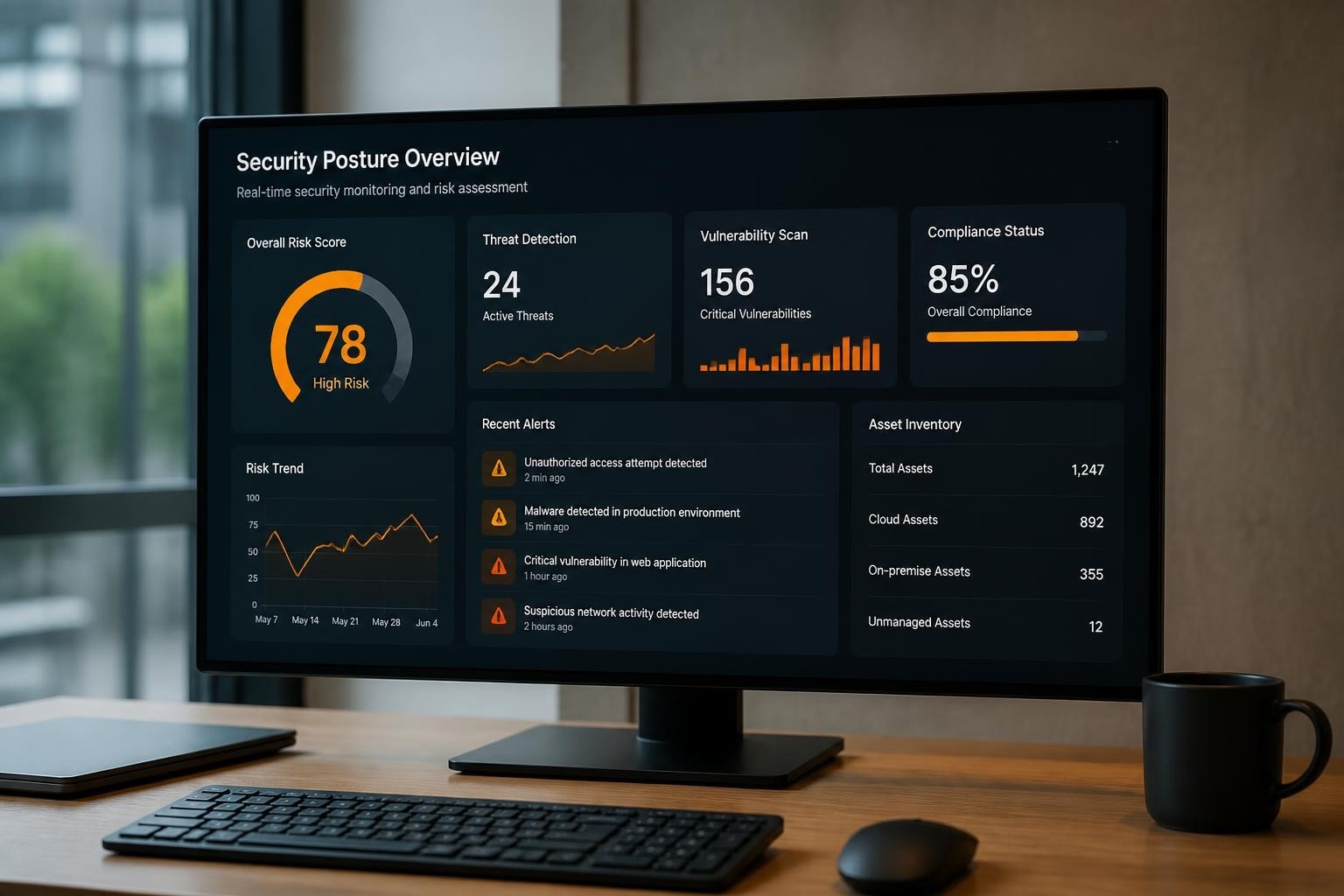

Organisations migrating to cloud infrastructure face an expanding attack surface and increasingly sophisticated threats. Traditional security tools often struggle to provide unified visibility across distributed cloud environments, leaving gaps in threat detection and compliance monitoring. Google Cloud Security Command Center addresses these challenges by offering a centralised platform for security and risk management across Google Cloud Platform workloads. Furthermore, as businesses adopt multi-cloud strategies and face stricter regulatory requirements in 2026, understanding comprehensive security posture management tools becomes essential for protecting sensitive data and maintaining operational resilience.
Understanding Google Cloud Security Command Center Architecture
The google cloud security command center serves as Google Cloud Platform's native security and risk management solution, providing a single pane of glass for asset inventory, vulnerability detection, threat identification, and compliance monitoring. Moreover, the platform integrates deeply with Google Cloud services to deliver continuous security insights without requiring extensive configuration or third-party integrations.
At its core, Security Command Center collects data from multiple sources across your cloud environment. These sources include Security Health Analytics for misconfigurations, Container Threat Detection for runtime threats in GKE clusters, Event Threat Detection for suspicious activity in logs, and Web Security Scanner for application vulnerabilities. Additionally, the system ingests findings from integrated third-party security tools through the Security Command Center API, creating a comprehensive security intelligence layer.

The platform operates on a hierarchical structure aligned with Google Cloud's resource organisation. Security findings propagate from individual projects through folders to the organisation level, enabling security teams to monitor entire cloud estates whilst maintaining granular visibility. Consequently, administrators can define security policies at the organisation level and inherit them across all subordinate resources, ensuring consistent security standards.
Service Tiers and Capabilities
Google Cloud Security Command Center operates across two distinct tiers: Standard and Premium. The Standard tier, available at no additional cost, provides foundational security capabilities including Security Health Analytics, Web Security Scanner findings, and basic asset inventory. Nevertheless, organisations requiring advanced threat detection typically opt for the Premium tier.
| Feature | Standard Tier | Premium Tier |
|---|---|---|
| Security Health Analytics | Basic detectors | All detectors plus custom modules |
| Threat Detection | Not included | Event Threat Detection, Container Threat Detection |
| Compliance Monitoring | Limited | CIS, PCI-DSS, NIST, ISO 27001 benchmarks |
| Asset Discovery | Basic inventory | Continuous discovery with change tracking |
| Integration Options | Limited API access | Full API, SIEM export, BigQuery streaming |
| Vulnerability Scanning | Web Security Scanner only | Web Scanner plus OS and container scanning |
Premium subscribers gain access to Event Threat Detection, which analyses Google Cloud logs to identify threats such as malware, cryptomining, unauthorised access attempts, and data exfiltration. Furthermore, Container Threat Detection provides runtime security for Kubernetes workloads, detecting suspicious binaries, reverse shells, and privilege escalation attempts within containers.
Implementing Security Posture Management
Security posture management represents one of the google cloud security command center's most valuable capabilities for European organisations navigating GDPR, NIS2, and sector-specific compliance requirements. The platform continuously assesses cloud resources against security best practices and regulatory frameworks, identifying misconfigurations before they become exploitable vulnerabilities.
Security Health Analytics automatically scans Google Cloud resources for common security issues. These include publicly accessible storage buckets, overly permissive IAM policies, missing encryption at rest, weak SSL/TLS configurations, and disabled audit logging. Therefore, security teams receive immediate notification when resources drift from established security baselines.
Compliance Framework Mapping
The Premium tier provides built-in compliance monitoring against recognised frameworks. Organisations can enable continuous assessment against CIS Google Cloud Platform Foundation Benchmark, PCI-DSS requirements, NIST 800-53 controls, and ISO 27001 standards. Moreover, the Security Command Center documentation details how to configure custom compliance detectors for organisation-specific requirements.
- CIS Benchmark monitoring tracks configuration against Center for Internet Security recommendations
- PCI-DSS assessment validates controls protecting cardholder data environments
- NIST 800-53 mapping aligns findings with federal security control families
- ISO 27001 coverage identifies gaps in information security management controls
- Custom policy creation enables enforcement of internal security standards
In addition to framework-based assessments, organisations can create custom security modules using Common Expression Language (CEL). This functionality proves particularly valuable for European businesses implementing privacy-by-design principles or enforcing data residency requirements. Consequently, security policies can mandate that all storage resources remain within EU regions or verify encryption key management aligns with GDPR technical measures.
Asset Inventory and Discovery
Understanding what assets exist within your cloud environment forms the foundation of effective security management. Security Command Center maintains a continuously updated inventory of all Google Cloud resources, including compute instances, storage buckets, databases, networking components, and service accounts. Nevertheless, the true value emerges from the platform's ability to track asset relationships and configuration changes over time.
Asset discovery operates automatically, requiring no agent deployment or manual cataloguing. The system records resource metadata, IAM policies, network configurations, and security settings. Furthermore, change history enables security teams to investigate when misconfigurations occurred and identify the root cause of security drift.

Threat Detection and Response Capabilities
Beyond posture management, the google cloud security command center delivers real-time threat detection across multiple attack vectors. Event Threat Detection analyses audit logs, VPC flow logs, and DNS queries to identify indicators of compromise and anomalous behaviour patterns. Subsequently, security teams receive actionable alerts prioritised by severity and potential business impact.
Attack Pattern Recognition
Event Threat Detection employs machine learning models and threat intelligence feeds to recognise attack patterns. The system identifies brute-force authentication attempts, tor exit node activity, cryptocurrency mining operations, credential exfiltration, and lateral movement between projects. Additionally, integration with Google's global threat intelligence provides early warning of emerging attack campaigns targeting cloud infrastructure.
- Initial access detection identifies compromised credentials and unauthorised API calls
- Persistence mechanism alerts flag creation of backdoor service accounts or SSH keys
- Privilege escalation warnings detect unexpected IAM policy changes
- Defence evasion notifications identify disabled logging or audit trail tampering
- Data exfiltration monitoring tracks unusual data transfers to external destinations
The platform's container security capabilities extend threat detection into Kubernetes environments. Container Threat Detection analyses runtime behaviour within GKE clusters, identifying reverse shell execution, unexpected binary execution, and container escape attempts. Moreover, the system correlates container-level findings with infrastructure-level threats to provide comprehensive attack visibility.
Integration with Security Operations
Modern security operations require integrating multiple tools and platforms. Security Command Center supports bidirectional integration with security information and event management systems through continuous export to Pub/Sub topics and BigQuery datasets. Therefore, organisations can incorporate Google Cloud security findings into existing SOC workflows and correlation engines.
For European organisations concerned with data sovereignty, findings can be exported to self-hosted SIEM platforms or European cloud-based security tools. Furthermore, the platform supports webhook notifications for real-time alerting to incident response platforms and ticketing systems. This flexibility ensures security teams maintain operational control whilst benefiting from Google Cloud's native detection capabilities.
Data Analysis and Reporting Workflows
Effective security management requires transforming raw findings into actionable intelligence. The google cloud security command center provides multiple mechanisms for analysing security data and generating compliance reports. Nevertheless, organisations with sophisticated analytics requirements typically leverage BigQuery export capabilities to perform custom analysis and build executive dashboards.
BigQuery Integration for Security Analytics
Continuous export to BigQuery enables security teams to perform historical trend analysis, identify recurring vulnerabilities, and measure remediation effectiveness over time. The BigQuery findings analysis guide provides detailed instructions for configuring export pipelines and querying security data using SQL.
Key analysis use cases include:
- Tracking mean time to remediation across vulnerability categories
- Identifying projects or teams with persistent security issues
- Correlating security findings with deployment or configuration changes
- Generating compliance reports for auditors and regulators
- Building executive dashboards showing security posture trends
Moreover, BigQuery's integration with Looker Studio and other visualisation tools enables creation of custom security dashboards. European organisations can build privacy-focused analytics that demonstrate GDPR compliance, track data processing activities, and verify encryption implementation across cloud resources.
API-Driven Automation
The Security Command Center API enables programmatic access to findings, assets, and security sources. Consequently, organisations can build automated remediation workflows that respond to specific finding types. For instance, a workflow might automatically revoke overly permissive IAM bindings, enable encryption on unprotected storage buckets, or isolate compromised compute instances.
| Automation Pattern | Use Case | Implementation Approach |
|---|---|---|
| Auto-remediation | Fix known misconfigurations | Cloud Functions triggered by Pub/Sub findings |
| Ticket creation | Route findings to responsible teams | ServiceNow/Jira integration via API |
| Compliance reporting | Generate audit documentation | Scheduled BigQuery queries with email delivery |
| Threat escalation | Alert SOC for critical findings | Webhook to incident response platform |
In addition to reactive automation, the API supports proactive security workflows. Security teams can query asset inventory before deploying new resources, validate IAM policies against least-privilege principles, and enforce approval workflows for high-risk configuration changes.
Multi-Cloud and Hybrid Security Considerations
Whilst Security Command Center focuses primarily on Google Cloud Platform resources, organisations increasingly operate across multiple cloud providers and on-premises infrastructure. Therefore, understanding how the platform fits within broader multi-cloud security strategies becomes essential for comprehensive protection.
Complementary Security Tools
The google cloud security command center excels at securing GCP workloads but requires complementary tools for complete multi-cloud visibility. Organisations running workloads across AWS, Azure, and Google Cloud typically implement cloud security posture management platforms that aggregate findings from provider-native tools. Nevertheless, maintaining Security Command Center alongside AWS Security Hub and Azure Security Center provides the deepest visibility into each environment.
For European businesses hosting critical infrastructure in sovereign data centres, integrating cloud security findings with on-premises monitoring creates unified threat intelligence. The Cloud Security Alliance’s best practices guidance emphasises avoiding common pitfalls such as inconsistent security policies across environments and inadequate logging for hybrid architectures.

Zero Trust Architecture Implementation
Modern security frameworks emphasise zero trust principles: verify explicitly, use least-privilege access, and assume breach. Security Command Center supports zero trust implementation by continuously verifying resource configurations, monitoring for privilege escalation, and detecting lateral movement attempts. Furthermore, integration with NIST’s Zero Trust Architecture guidance helps organisations map platform capabilities to zero trust maturity models.
The platform's IAM policy analysis capabilities prove particularly valuable for implementing least-privilege access. Security Health Analytics identifies service accounts with excessive permissions, detects primitive role usage that grants broad access, and flags external entities with access to sensitive resources. Subsequently, security teams can systematically reduce attack surface by removing unnecessary permissions.
Operational Best Practices for European Organisations
European businesses face unique compliance and data sovereignty requirements when implementing cloud security tools. The google cloud security command center's configuration options support GDPR compliance and data residency mandates, provided organisations follow specific implementation guidelines. Moreover, understanding regulatory implications ensures security monitoring doesn't inadvertently create compliance risks.
GDPR Compliance Considerations
Security Command Center processes metadata about cloud resources, configuration settings, and security events. Whilst the platform doesn't directly access user content stored in cloud resources, organisations must still consider data protection implications. Therefore, implementing appropriate data handling procedures ensures compliance with Articles 32 and 35 requirements for security measures and data protection impact assessments.
- Enable audit logging for all Security Command Center access and configuration changes
- Restrict access to security findings using IAM policies aligned with need-to-know principles
- Document data processing activities related to security monitoring in GDPR records
- Configure finding retention periods consistent with organisational data retention policies
- Implement encryption for exported findings sent to external systems or backup locations
In addition, organisations subject to NIS2 requirements should configure Security Command Center to support incident reporting obligations. The platform's finding severity classification and timestamp data facilitate the 24-hour initial notification and detailed incident reports required under the directive.
Data Residency and Sovereignty
Google Cloud Security Command Center processes and stores findings data in Google-managed infrastructure. Whilst organisations can specify regions for their workload data, Security Command Center metadata may be stored in locations determined by Google Cloud. Nevertheless, exported findings can be directed to organisation-controlled storage in specific European regions.
For businesses requiring strict data sovereignty, implementing continuous export to self-hosted BigQuery datasets or European cloud storage ensures complete control over security data location. Furthermore, this approach aligns with recommendations in NIST’s cloud security guidelines for maintaining visibility and control in public cloud environments.
Just as organisations carefully select where their workload data resides, password management and authentication credentials require similar sovereignty considerations. European businesses can complement cloud security monitoring with tools like vBoxxVault, which provides zero-knowledge password management hosted entirely in Dutch data centres, ensuring credentials remain under European jurisdiction and outside the reach of extraterritorial data access laws.
Cost Optimisation and Licensing Strategies
Implementing comprehensive security monitoring requires balancing protection requirements against budget constraints. The google cloud security command center's tiered pricing model enables organisations to start with foundational capabilities and expand as security maturity increases. Nevertheless, understanding cost drivers helps optimise security investments and avoid unnecessary expenses.
Standard Versus Premium Tier Selection
The Standard tier provides substantial value at no additional cost, making it suitable for development environments, proof-of-concept projects, and organisations with basic security requirements. However, production environments handling sensitive data typically require Premium tier capabilities for comprehensive threat detection and compliance monitoring.
Premium tier pricing follows a consumption-based model tied to Google Cloud resource usage. Costs scale with the number of projects, compute resources, and storage volumes under management. Therefore, organisations should carefully scope which projects require Premium protection and which can operate with Standard tier monitoring.
| Scenario | Recommended Tier | Rationale |
|---|---|---|
| Development/test projects | Standard | Basic posture management sufficient for non-production |
| Production with sensitive data | Premium | Threat detection and compliance monitoring essential |
| Multi-project organisations | Mixed | Premium for critical workloads, Standard for supporting resources |
| Regulated industries | Premium | Compliance frameworks and audit requirements necessitate advanced features |
In addition to tier selection, organisations can reduce costs by optimising finding retention periods, limiting BigQuery export volumes, and implementing efficient notification filtering. Furthermore, regular review of enabled security sources ensures organisations pay only for capabilities actively used in security operations.
Return on Investment Calculation
Quantifying security tool value challenges most organisations, yet several metrics demonstrate Security Command Center ROI. Measuring time saved through automated vulnerability scanning, reduced incident response time from integrated threat detection, and avoided compliance penalties from continuous framework monitoring provides tangible value indicators. Moreover, comparing the platform's cost against equivalent third-party tools often reveals significant savings.
European organisations should also consider the reduced operational overhead from consolidating multiple point security products into an integrated platform. Subsequently, security teams spend less time correlating findings from disparate tools and more time addressing actual security risks.
Recent Developments and Future Capabilities
Google Cloud continues expanding Security Command Center capabilities to address evolving threats and customer requirements. Recent announcements at Google Cloud Next 2025 introduced enhanced AI-powered threat detection, expanded compliance framework support, and deeper integration with Google Security Operations platform. Furthermore, the platform's evolution reflects broader industry trends toward unified security platforms and automated response capabilities.
Generative AI Security Features
The integration of generative AI into security operations represents a significant development for 2026. Security Command Center now leverages AI to provide contextual finding explanations, recommend remediation steps, and generate investigation queries. Therefore, security analysts can more quickly understand complex threats and determine appropriate responses.
Moreover, AI-powered security capabilities extend to vulnerability assessment, where machine learning models predict which misconfigurations pose the greatest risk based on organisational context. This prioritisation helps security teams focus efforts on findings most likely to result in actual compromise.
Attack Path Simulation
Future enhancements include attack path modelling that visualises how attackers might chain multiple vulnerabilities to achieve objectives. The platform analyses asset relationships, IAM permissions, and network connectivity to identify potential attack sequences. Consequently, security teams can proactively address vulnerability combinations that individually might seem low-risk but collectively enable compromise.
Additionally, integration with Google's Mandiant threat intelligence provides attribution data linking observed attacks to specific threat actor groups. This context enables organisations to understand whether they face opportunistic scanning or targeted campaigns from advanced persistent threat actors.
Effective cloud security requires comprehensive visibility, continuous monitoring, and rapid response capabilities across increasingly complex infrastructure. The google cloud security command center delivers these capabilities for Google Cloud Platform workloads whilst supporting broader multi-cloud and hybrid security strategies through flexible integration options. European organisations benefit from implementing security posture management and threat detection tools that complement regional compliance requirements and data sovereignty principles. When you're ready to strengthen your organisation's security foundation with European-hosted infrastructure that prioritises privacy, GDPR compliance, and operational resilience, vBoxx provides ISO 27001-certified cloud solutions, secure password management, and managed hosting services designed specifically for businesses requiring data sovereignty and protection from extraterritorial data access.