The digital transformation landscape has fundamentally altered how organisations approach their IT infrastructure. In this context, as businesses navigate the complexities of modern computing demands, hybrid cloud has emerged as a strategic solution that combines the best aspects of private and public cloud environments. In particular, this architectural approach offers enterprises the flexibility to optimise workloads, enhance security, and maintain control over sensitive data, while simultaneously leveraging the scalability of public cloud resources. As a result, understanding the benefits of hybrid cloud is essential for organisations seeking to build resilient, efficient, and future-ready IT ecosystems. Furthermore, it enables businesses to adapt more effectively to evolving technological and regulatory requirements.
Understanding the Hybrid Cloud Advantage
Hybrid cloud infrastructure represents a carefully orchestrated blend of on-premises private cloud resources and third-party public cloud services. In essence, this integration creates a unified environment where data and applications can move seamlessly between different platforms, depending on business requirements, performance needs, and cost considerations. Furthermore, this dynamic structure enhances adaptability across IT operations.
Moreover, the architecture enables organisations to maintain critical workloads and sensitive data within their private infrastructure, while simultaneously utilising public cloud resources for less sensitive operations or to handle variable demand. As a result, this strategic distribution of resources delivers operational advantages that neither purely private nor exclusively public cloud deployments can match. Consequently, organisations gain greater flexibility, efficiency, and control over their IT environments. In addition, this approach supports long-term scalability and improved resource optimisation.
Flexibility in Workload Management
One of the most significant benefits of hybrid cloud lies in its ability to accommodate diverse workload requirements. Businesses can strategically place applications based on their specific needs, whether that involves regulatory compliance, performance requirements, or cost optimisation.
Key workload distribution benefits include:
- Running latency-sensitive applications on private infrastructure for optimal performance
- Leveraging public cloud resources for development and testing environments
- Maintaining legacy systems on-premises whilst gradually migrating to cloud-native solutions
- Scaling resources dynamically based on seasonal or unexpected demand fluctuations
This flexibility extends beyond simple resource allocation. Organisations can experiment with new technologies in the public cloud without disrupting existing operations, creating an environment that encourages innovation whilst maintaining stability.

Cost Optimisation and Financial Efficiency
The financial benefits of hybrid cloud stem from the ability to optimise spending across different infrastructure models. In particular, rather than overprovisioning private infrastructure to handle peak demand or paying for unused public cloud capacity during quiet periods, organisations can balance their resources intelligently. As a result, costs become more closely aligned with actual usage. Furthermore, this approach improves budget predictability and reduces unnecessary expenditure. In addition, it enables organisations to allocate financial resources more strategically across IT operations.
Strategic Resource Allocation
Hybrid cloud environments enable businesses to implement a cost-effective approach to infrastructure investment. Capital expenditure on private infrastructure can be reserved for predictable, steady-state workloads, whilst operational expenditure on public cloud services handles variable demand.
| Cost Factor | Traditional Infrastructure | Hybrid Cloud Approach |
|---|---|---|
| Initial Investment | High upfront capital costs | Balanced capital and operational spending |
| Scalability Costs | Expensive overprovisioning | Pay-as-you-go for additional capacity |
| Maintenance | Ongoing fixed costs | Shared responsibility model |
| Resource Utilisation | Often underutilised | Optimised across environments |
This financial flexibility allows organisations to maintain tighter control over their IT budgets whilst ensuring they have the resources necessary to meet business demands. According to research from TechTarget, businesses can achieve significant cost savings by strategically distributing workloads across hybrid environments.
The ability to right-size infrastructure investments represents a substantial advantage for growing businesses. Rather than making large capital commitments based on projected growth, companies can scale incrementally, reducing financial risk whilst maintaining operational agility.
Enhanced Security and Compliance Capabilities
Security remains a paramount concern for organisations handling sensitive data, and accordingly, the benefits of hybrid cloud extend significantly into this domain. In particular, hybrid architectures enable businesses to implement nuanced security strategies that address different risk profiles across their application portfolio. Moreover, this approach allows organisations to apply stricter controls to sensitive workloads, while simultaneously leveraging the flexibility of public cloud environments for less critical operations. As a result, overall security posture becomes both stronger and more adaptable. In addition, organisations gain improved visibility and control over data governance across environments.
Data Sovereignty and Regulatory Compliance
Organisations operating under strict regulatory frameworks particularly value hybrid cloud’s ability to maintain sensitive data within controlled environments. In particular, financial institutions, healthcare providers, and government agencies can keep regulated data on private infrastructure, while simultaneously leveraging public cloud services for other workloads. As a result, this approach ensures compliance requirements are met without sacrificing operational flexibility. Moreover, it enables organisations to optimise resource allocation across different types of workloads.
Compliance advantages include:
- Maintaining personally identifiable information within jurisdiction-specific infrastructure
- Implementing tailored security controls for different data classification levels
- Conducting regular audits on private infrastructure whilst benefiting from cloud provider certifications
- Creating isolated environments for sensitive processing activities
The security posture extends beyond simple data location. Hybrid cloud enables organisations to implement defence-in-depth strategies, using multiple security layers across different environments. IBM’s analysis of hybrid cloud advantages highlights how this approach strengthens overall security whilst maintaining operational flexibility.
Business Continuity and Disaster Recovery
The distributed nature of hybrid cloud infrastructure inherently supports robust business continuity planning. In particular, organisations can replicate critical data across multiple environments, thereby ensuring availability even during infrastructure failures or disaster scenarios. As a result, resilience is significantly improved across the entire IT environment.
Moreover, modern hybrid cloud implementations facilitate sophisticated disaster recovery strategies that were previously accessible only to large enterprises with substantial resources. For example, businesses can maintain warm standby environments in the public cloud, activating them only when needed. Consequently, this significantly reduces the cost of comprehensive disaster recovery capabilities while still maintaining high levels of protection and readiness.

Performance Optimisation and User Experience
The benefits of hybrid cloud extend to application performance and end-user experience. In particular, by strategically placing workloads closer to where they’re consumed, organisations can reduce latency, improve responsiveness, and deliver superior digital experiences. As a result, users benefit from faster and more reliable application performance. Moreover, this approach enables organisations to optimise infrastructure placement based on real-world usage patterns.
Geographic Distribution and Edge Computing
Hybrid cloud architectures support distributed computing models that place resources near end users. This geographic flexibility enables businesses to serve global audiences efficiently whilst maintaining centralised control over core infrastructure.
Organisations can leverage cloud hosting services to establish presence in multiple regions without building physical data centres. This approach combines the performance benefits of local infrastructure with the scalability and management efficiency of cloud platforms.
The integration of edge computing within hybrid cloud strategies further enhances performance for latency-sensitive applications. Processing data closer to its source reduces round-trip times and enables real-time decision-making, critical for applications like IoT analytics, content delivery, and financial trading platforms.
Operational Agility and Innovation Enablement
Modern businesses require IT infrastructure that accelerates rather than hinders innovation. In particular, the benefits of hybrid cloud include creating an environment where development teams can experiment, iterate, and deploy new solutions rapidly, while still maintaining production stability. As a result, organisations can innovate faster without compromising operational reliability. Moreover, this balance supports continuous improvement and more agile development practices.
Development and Testing Flexibility
Hybrid cloud environments provide developers with the flexibility to provision resources on demand without lengthy approval processes or hardware procurement delays. In particular, teams can spin up development environments in the public cloud, test at scale, and then deploy to private infrastructure as needed. As a result, development cycles become significantly faster and more efficient. Moreover, this approach reduces operational bottlenecks and supports more agile delivery practices.
Innovation enablement features:
- Rapid provisioning of development and testing environments
- Access to cutting-edge cloud services and artificial intelligence capabilities
- Sandboxed experimentation without risking production systems
- Seamless integration between development and production environments
This operational model supports DevOps practices and continuous integration/continuous deployment (CI/CD) pipelines. Development teams can leverage the breadth of services available in public cloud whilst maintaining production workloads in more controlled environments.
Technology Modernisation Pathways
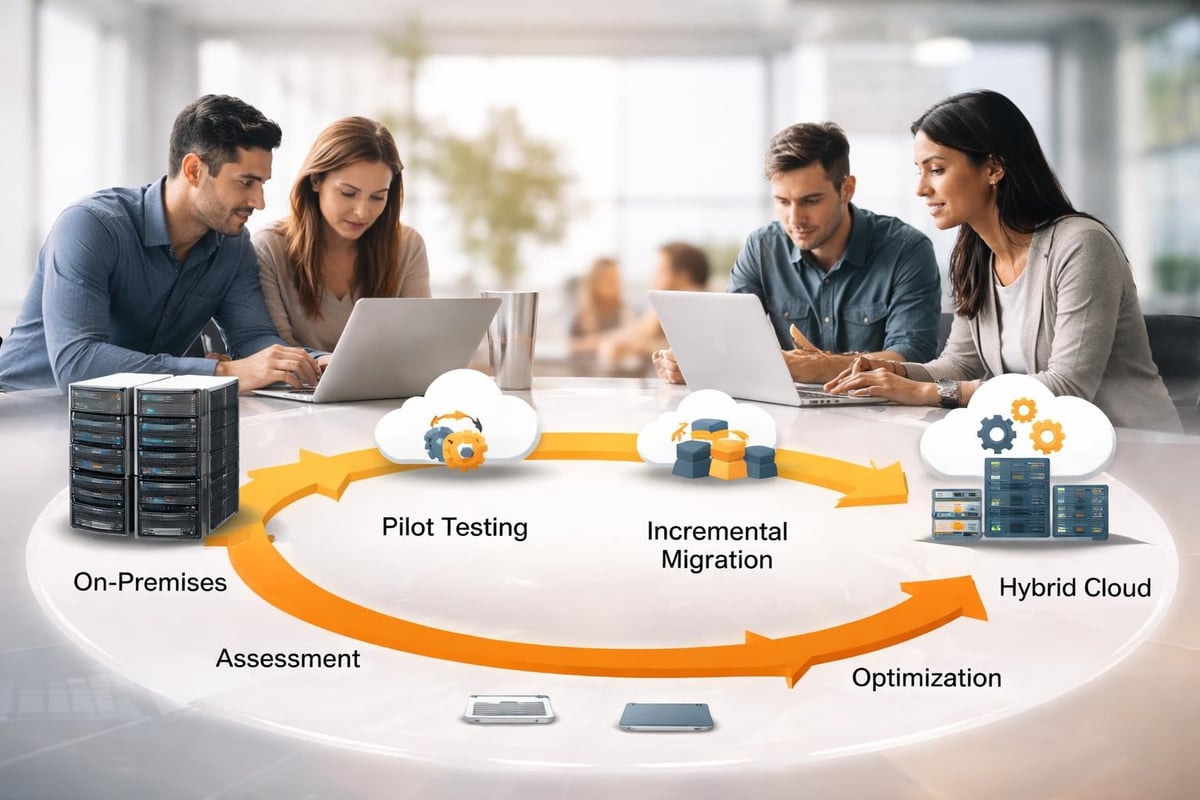
Hybrid cloud provides a pragmatic path for organisations modernising legacy applications. In particular, rather than facing an all-or-nothing migration decision, businesses can gradually transform their application portfolio, while simultaneously moving suitable workloads to the cloud and maintaining others on-premises. As a result, this reduces migration risk and operational disruption. Moreover, it enables organisations to modernise at a controlled and manageable pace.
| Modernisation Phase | Hybrid Cloud Benefit |
|---|---|
| Assessment | Test cloud readiness without commitment |
| Pilot Projects | Validate cloud performance with non-critical workloads |
| Gradual Migration | Move applications incrementally based on business priority |
| Coexistence | Run legacy and modern applications side-by-side |
| Ongoing Optimisation | Continuously adjust placement based on performance data |
This phased approach reduces risk, spreads costs over time, and allows organisations to build cloud expertise gradually. Teams learn cloud-native practices whilst maintaining familiar on-premises systems, creating a smoother transition than forced migration scenarios.
Scalability and Resource Management
The ability to scale infrastructure efficiently represents one of the most compelling benefits of hybrid cloud. In particular, organisations gain access to virtually unlimited public cloud capacity whilst maintaining baseline resources on private infrastructure, thereby creating a highly elastic computing environment. As a result, they can respond quickly to changing demand without overprovisioning resources. Moreover, this flexibility improves both cost efficiency and operational responsiveness.
Dynamic Resource Allocation
Hybrid cloud enables sophisticated resource management strategies that respond to changing business conditions. During peak demand periods, workloads can burst into public cloud, accessing additional compute, storage, or network resources instantly. When demand subsides, operations return to private infrastructure, optimising costs.
This elasticity proves particularly valuable for businesses with predictable seasonal fluctuations. Retailers handling holiday shopping surges, educational institutions managing enrolment periods, or accounting firms processing tax season workloads can all benefit from temporary capacity expansion without permanent infrastructure investment.
According to Databank’s analysis, this scalability advantage enables businesses to respond to market opportunities quickly, launching new products or entering new markets without infrastructure constraints limiting growth.
Automated Resource Optimisation
Modern hybrid cloud platforms incorporate intelligent automation that optimises resource allocation based on defined policies. Workloads can migrate automatically between environments based on performance metrics, cost thresholds, or compliance requirements.
Automation capabilities include:
- Policy-based workload placement across environments
- Automatic scaling based on demand patterns
- Cost optimisation through intelligent resource scheduling
- Performance monitoring and automatic remediation
These automated systems reduce the operational burden on IT teams whilst ensuring infrastructure operates efficiently. Rather than manually managing resource allocation, administrators define policies and let orchestration platforms handle implementation.
Vendor Independence and Strategic Flexibility
The benefits of hybrid cloud extend to reducing vendor lock-in and maintaining strategic flexibility. Organisations can leverage multiple cloud providers whilst maintaining their private infrastructure, avoiding dependence on any single vendor’s ecosystem.
Multi-Cloud Integration
Hybrid cloud architectures naturally support multi-cloud strategies where businesses utilise services from different providers based on specific capabilities. In particular, this approach enables organisations to select best-of-breed services whilst maintaining interoperability across platforms. As a result, businesses can avoid vendor lock-in and optimise performance across workloads. Moreover, they gain greater flexibility in designing their IT ecosystems.
For example, organisations can leverage specialised services from various providers, such as advanced analytics from one platform, superior machine learning capabilities from another, and robust infrastructure-as-a-service from a third, while simultaneously maintaining core systems on private infrastructure. Consequently, this creates a highly adaptable and resilient technology environment.
Strategic Negotiating Position
Maintaining hybrid infrastructure strengthens an organisation’s negotiating position with cloud providers. The ability to move workloads between environments creates competitive pressure that can lead to better pricing, improved service levels, and more favourable contract terms.
This flexibility proves particularly valuable as cloud services evolve. Huawei’s hybrid cloud overview emphasises how hybrid architectures provide organisations with options, enabling them to adapt as technology and business requirements change.
Data Management and Analytics Excellence
Effective data management represents another area where the benefits of hybrid cloud become apparent. Organisations can optimise data placement based on access patterns, compliance requirements, and processing needs, creating efficient analytics ecosystems.
Intelligent Data Tiering
Hybrid cloud enables sophisticated data tiering strategies where frequently accessed data resides on high-performance private infrastructure whilst archival or infrequently accessed information moves to cost-effective cloud storage. This approach optimises both performance and costs.
Modern file hosting services within hybrid environments support automated data lifecycle management, moving information between tiers based on age, access frequency, or business rules. This automation ensures optimal resource utilisation without manual intervention.
Advanced Analytics Integration
The combination of private infrastructure and public cloud services creates powerful analytics capabilities. Organisations can process sensitive data within controlled environments whilst leveraging scalable cloud resources for compute-intensive analytics tasks.
| Analytics Function | Optimal Environment | Rationale |
|---|---|---|
| Data Storage | Hybrid based on sensitivity | Compliance and performance balance |
| Data Processing | Public cloud for bursting | Scalable compute for intensive tasks |
| Machine Learning | Public cloud services | Access to advanced AI/ML platforms |
| Reporting | Private infrastructure | Consistent performance for users |
This distributed analytics model supports sophisticated use cases like predictive modelling, real-time analytics, and artificial intelligence applications. Data scientists can access powerful cloud-based tools whilst data governance teams maintain control over sensitive information.
Cloud4C’s discussion of hybrid cloud benefits highlights how this approach accelerates digital transformation initiatives by combining data control with analytical power.
Environmental Sustainability and Green IT
The environmental benefits of hybrid cloud align with growing corporate sustainability commitments. Optimising resource utilisation across hybrid environments reduces energy consumption and carbon footprint compared to traditional infrastructure models.
Energy Efficiency Optimisation
Hybrid cloud enables organisations to leverage the energy efficiency of modern cloud data centres whilst maintaining necessary on-premises infrastructure. Cloud providers achieve economies of scale that individual organisations cannot match, operating facilities with advanced cooling, renewable energy sources, and high utilisation rates.
Sustainability advantages include:
- Reduced energy consumption through improved resource utilisation
- Access to cloud providers using renewable energy sources
- Decreased physical infrastructure footprint
- Optimised cooling and power management across environments
By carefully balancing workloads between environments, organisations can minimise their environmental impact whilst meeting operational requirements. Workloads can shift to cloud regions powered by renewable energy during off-peak hours, supporting sustainability goals without compromising performance.
Resource Utilisation Excellence
Traditional infrastructure often operates at low utilisation rates, with servers consuming energy whilst sitting idle. Hybrid cloud’s dynamic resource allocation ensures infrastructure operates efficiently, with workloads consolidated during low-demand periods and distributed during peaks.
This efficiency extends beyond compute resources to storage, networking, and facilities management. Google Cloud’s hybrid cloud overview emphasises how optimised resource management contributes to both operational efficiency and environmental responsibility.
Implementation Considerations and Success Factors
Whilst the benefits of hybrid cloud are substantial, successful implementation requires careful planning and execution. Organisations must address technical, operational, and cultural challenges to realise the full potential of hybrid architectures.
Technical Integration Requirements
Effective hybrid cloud deployment demands robust connectivity between environments, sophisticated orchestration platforms, and unified management tools. In particular, organisations need reliable, high-bandwidth connections linking private infrastructure to cloud providers, thereby ensuring seamless workload mobility and data synchronisation. As a result, performance and consistency across environments are significantly improved. Moreover, this foundation enables smoother integration and more efficient hybrid operations.
Critical technical elements:
- Secure, redundant network connectivity between environments
- Unified identity and access management across platforms
- Consistent monitoring and management interfaces
- Automated orchestration for workload placement and scaling
- Data synchronisation and replication mechanisms
These technical foundations enable the seamless operation that defines successful hybrid cloud implementations. Without proper integration, organisations risk creating disconnected silos that negate hybrid cloud’s benefits.
Skills Development and Organisational Change
Hybrid cloud success requires teams with expertise spanning traditional infrastructure management and cloud-native practices. Organisations should invest in training programmes that build capabilities across both domains, creating versatile teams capable of managing complex hybrid environments.
For businesses seeking guidance on implementing secure hybrid cloud solutions, professional demonstrations like the vBoxxCloud all-in-one demonstration can provide valuable insights into how integrated cloud platforms operate in practice.
Cultural adaptation proves equally important. Teams accustomed to traditional infrastructure management must embrace cloud-native approaches like infrastructure-as-code, automated deployment, and consumption-based resource allocation. This cultural shift enables organisations to leverage hybrid cloud’s full capabilities rather than simply replicating traditional approaches in new environments.
The benefits of hybrid cloud extend across operational, financial, security, and strategic dimensions, making this architectural approach increasingly essential for modern businesses. By combining private infrastructure control with public cloud scalability, organisations create flexible, efficient, and resilient IT ecosystems capable of supporting current operations whilst enabling future innovation. vBoxx delivers secure hosting and cloud solutions designed to help businesses implement effective hybrid strategies, combining robust private infrastructure with seamless cloud integration. Whether you’re exploring hybrid cloud possibilities or ready to transform your infrastructure, vBoxx provides the expertise, technology, and support necessary to build sustainable, high-performance digital environments.