Managing passwords across an organisation has evolved from a simple IT task into a critical security imperative. In particular, as businesses expand their digital footprint, the number of credentials employees must manage grows exponentially. Consequently, enterprise password management provides the framework and tools necessary to secure, organise, and control access to sensitive systems, while simultaneously maintaining operational efficiency. Moreover, for organisations handling confidential data and customer information, implementing robust password policies protects against breaches, while also enabling sustained productivity.
Understanding the Fundamentals of Enterprise Password Management
Enterprise password management encompasses the strategies, policies, and technologies organisations deploy to control credential access across their digital infrastructure. In essence, unlike consumer password tools, enterprise solutions must scale to support thousands of users, integrate with existing systems, and provide granular administrative controls.
At its core, the foundation rests on several key principles. Firstly, centralised credential storage eliminates password sprawl, thereby enabling security teams to enforce consistent policies. Secondly, role-based access controls ensure employees only access systems relevant to their responsibilities. Finally, audit trails create accountability by tracking who accessed what credentials and when, thus strengthening overall security governance.
Key components include:
- Encrypted credential vaults protecting passwords at rest and in transit
- Single sign-on integration reducing authentication friction
- Multi-factor authentication adding verification layers
- Automated password rotation for privileged accounts
- Compliance reporting for regulatory requirements
Modern solutions extend beyond simple storage. They actively monitor for compromised credentials, detect risky password behaviours, and integrate with identity management platforms. This holistic approach transforms password management from a reactive security measure into a proactive defence strategy.
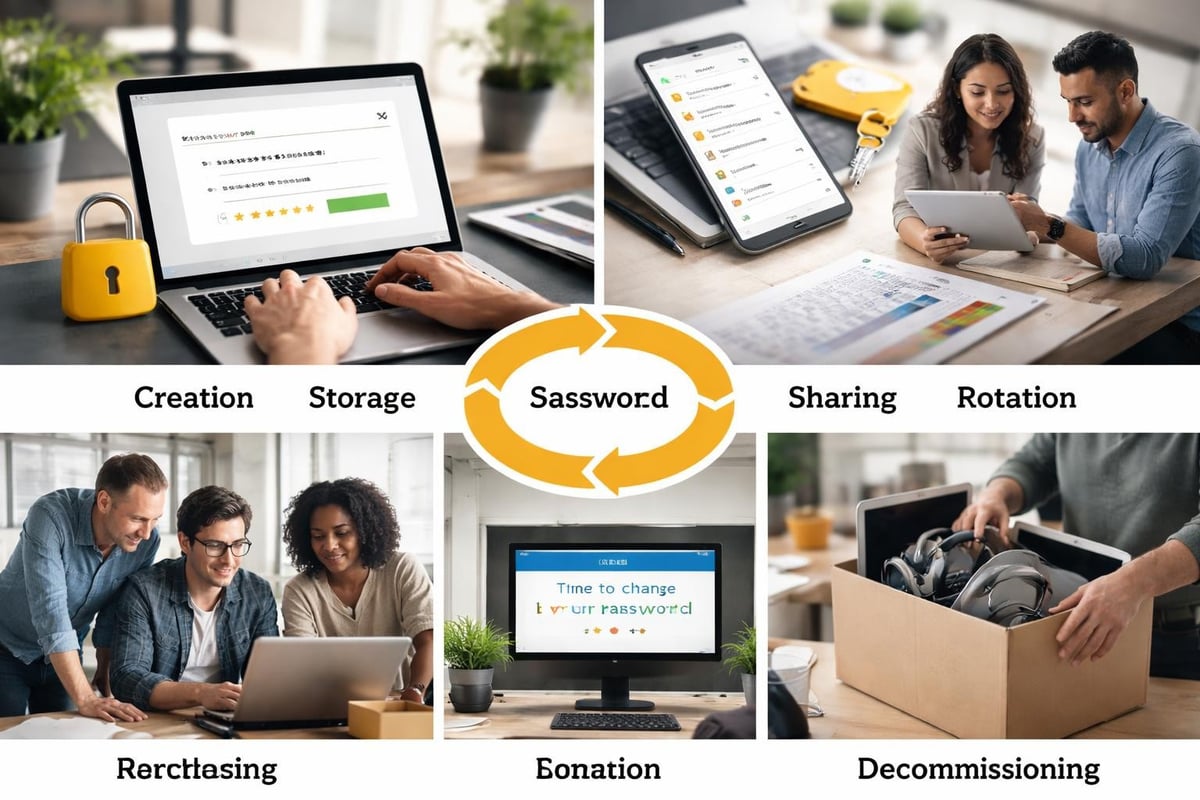
Security Risks Driving Enterprise Password Solutions
Data breaches frequently originate from compromised credentials. In particular, attackers exploit weak passwords, credential reuse, and unsecured sharing practices to infiltrate corporate networks. As a result, understanding these threats clarifies why enterprise password management demands strategic investment.
Moreover, research consistently shows that password hygiene remains problematic across organisations. For example, employees often reuse passwords across multiple systems, thereby creating cascading vulnerabilities. Consequently, when one service experiences a breach, attackers systematically test those credentials against other platforms. This practice, known as credential stuffing, succeeds because users frequently prioritise convenience over security.
Common Vulnerability Patterns
Password sharing via insecure channels presents another critical risk. Teams email credentials, save them in unencrypted documents, or write them on physical notes. Each method exposes sensitive information to interception or unauthorised access. Studies examining password hygiene reveal these practices persist despite awareness campaigns.
Privileged account credentials require particular attention. Administrator passwords grant extensive system access, making them high-value targets. Without proper management, organisations struggle to track who holds these credentials or when they were last changed. This opacity creates security blind spots attackers eagerly exploit.
| Risk Factor | Impact | Mitigation Strategy |
|---|---|---|
| Password reuse | Credential stuffing attacks | Enforced unique passwords per service |
| Weak passwords | Brute force attacks | Complexity requirements and length minimums |
| Unencrypted storage | Direct credential theft | AES-256 encrypted vaults |
| Uncontrolled sharing | Unauthorised access | Secure sharing with permissions |
Shadow IT complicates the landscape further. Employees adopt cloud services without IT approval, creating accounts outside centralised management. These orphaned credentials escape security policies, leaving gaps in the organisation’s defensive perimeter. Addressing hidden gaps in enterprise password management becomes essential for comprehensive protection.
Implementing Enterprise Password Management Systems
Successful implementation requires careful planning and phased execution. Organisations must balance security requirements with user experience to ensure adoption whilst maintaining protection standards. Rushing deployment often results in resistance, workarounds, and incomplete coverage.
The implementation process typically follows these stages:
- Assessment and Planning: Audit existing password practices, identify critical systems, and define security requirements
- Solution Selection: Evaluate vendors based on features, integration capabilities, and compliance support
- Pilot Programme: Deploy to a limited user group, gather feedback, and refine policies
- Phased Rollout: Gradually expand coverage across departments whilst providing training
- Continuous Improvement: Monitor usage, address issues, and update policies as threats evolve
Technical Integration Considerations
Integration with existing infrastructure determines solution effectiveness. The platform must connect with directory services like Active Directory, support SAML or OAuth protocols for single sign-on, and provide APIs for custom applications. Poor integration creates silos where some credentials remain unmanaged.
Best practices for enterprise password management emphasise starting with high-risk systems. Prioritising administrative accounts, financial systems, and customer databases delivers immediate security value. This approach builds momentum whilst demonstrating tangible benefits to stakeholders.
Administrative controls deserve careful configuration. Define clear ownership for credential categories, establish approval workflows for access requests, and implement session recording for privileged access. These governance mechanisms prevent authorised users from becoming security liabilities.
User onboarding significantly impacts adoption rates. Comprehensive training programmes explain not just how to use the tool but why it matters. Highlighting how enterprise password management protects personal data alongside corporate assets resonates more effectively than compliance-focused messaging alone. For organisations seeking comprehensive security solutions, vBoxx offers a demonstration of their all-in-one platform, including vBoxxVault for secure password storage integrated with cloud and email services.

Evaluating Enterprise Password Management Solutions
The market offers numerous platforms, each with distinct capabilities and philosophies. Evaluation criteria must extend beyond feature checklists to encompass architecture, vendor stability, and long-term viability. Questions about whether password managers are safe for enterprise use highlight the importance of thorough vetting.
Architecture fundamentally affects security posture. Cloud-based solutions offer convenience and accessibility but require trusting third-party infrastructure. Self-hosted alternatives provide greater control but demand internal expertise for maintenance and updates. Zero-knowledge architectures ensure even the vendor cannot access stored credentials, though they complicate account recovery.
Essential evaluation criteria include:
- Encryption standards (AES-256 minimum) and key management practices
- Authentication methods supporting hardware tokens and biometrics
- Granular permission controls for different user roles
- Compliance certifications (SOC 2, ISO 27001, GDPR alignment)
- Vendor security track record and incident response history
Recent research has revealed security flaws in several enterprise password managers, underscoring the importance of continuous security assessment. Organisations should regularly review vendor security bulletins and participate in early access programmes for patches.
Comparing Deployment Models
| Deployment Model | Advantages | Considerations |
|---|---|---|
| Cloud-based SaaS | Rapid deployment, automatic updates, lower initial costs | Data residency concerns, ongoing subscription fees |
| On-premises | Complete data control, customisation flexibility | Higher infrastructure costs, update responsibility |
| Hybrid | Balance control and convenience | Complexity in management, potential synchronisation issues |
Vendor evaluation should include proof-of-concept testing with actual workflows. Theoretical capabilities matter less than practical usability within your specific environment. Testing reveals integration challenges, performance bottlenecks, and user experience issues before full commitment.
Support and documentation quality directly correlate with long-term success. Comprehensive knowledge bases, responsive technical support, and active user communities indicate vendor commitment. These resources become crucial during implementation challenges and subsequent optimisation efforts.
Policy Development and Governance Frameworks
Technology alone cannot secure credentials. In fact, robust policies establish expectations, define responsibilities, and create accountability mechanisms. As a result, these governance frameworks transform tools into comprehensive enterprise password management programmes.
Moreover, password policies should specify minimum complexity requirements, while at the same time avoiding unnecessary friction. In particular, current guidance recommends length over complexity, with passphrases preferred over character substitutions. For example, requiring 15-character passwords without mandating special characters often produces stronger, more memorable credentials than complex 8-character alternatives. Consequently, organisations can enhance both security and usability. Additionally, this reduces user frustration and improves long-term compliance.
Establishing Clear Responsibilities
Rotation schedules balance security against operational disruption. Understanding the pros and cons of enterprise password managers helps establish appropriate policies. Privileged accounts warrant frequent rotation (30-60 days), whilst standard user credentials may rotate quarterly. Automated rotation reduces administrative burden whilst ensuring consistency.
Access review procedures prevent permission creep. Quarterly audits verify users retain only necessary credentials. When employees change roles or depart, prompt credential revocation prevents unauthorised access. Automated workflows triggered by HR system changes streamline this process whilst reducing oversight risks.
Exception handling processes acknowledge reality whilst maintaining security. Some legacy systems lack modern authentication support, requiring documented workarounds. Exception requests should require justification, approval from security teams, and compensating controls. This structured approach balances operational needs against risk management.
Incident response procedures specific to credential compromise accelerate remediation. Pre-defined workflows guide teams through credential rotation, access log analysis, and affected system identification. Modern solutions for the breach era emphasise speed and coordination during credential-related incidents.
Training and User Adoption Strategies
The most sophisticated enterprise password management system fails without user buy-in. Therefore, training programmes must address both technical usage and security awareness, thereby building competence alongside motivation. In practice, resistance typically stems from perceived inconvenience rather than philosophical objection.
For this reason, initial training should occur before deployment reaches each user group. Specifically, hands-on workshops demonstrate practical workflows relevant to daily tasks. Moreover, showing employees how the solution simplifies their work, rather than adding steps, transforms perception from burden to benefit. As a result, adoption rates improve and security practices become more consistent. Additionally, ongoing reinforcement through refresher sessions helps sustain long-term behavioural change.
Effective training components include:
- Role-specific scenarios demonstrating relevant use cases
- Common troubleshooting for typical issues
- Security incident examples showing real consequences
- Quick reference guides for frequent tasks
- Champions programme recruiting enthusiastic early adopters
Ongoing reinforcement prevents skills decay and addresses emerging questions. Monthly tips highlighting advanced features encourage deeper engagement. Simulated phishing campaigns testing credential handling provide practical assessment whilst raising awareness.

Feedback mechanisms identify friction points requiring attention. Regular surveys, usage analytics, and helpdesk ticket analysis reveal where users struggle. Addressing these pain points through policy adjustments or additional training demonstrates responsiveness whilst improving adoption.
Measuring Success and Continuous Improvement
Quantifiable metrics demonstrate programme value whilst identifying improvement opportunities. In particular, effective measurement balances security indicators with operational efficiency, thereby avoiding optimisation for single dimensions at the expense of overall effectiveness.
Firstly, security metrics track risk reduction directly attributable to enterprise password management. For example, organisations monitor password strength scores across the organisation, measuring improvements over time. Additionally, they track credential reuse rates, unique password percentages, and multi-factor authentication adoption. As a result, these indicators reflect behavioural changes fundamental to security improvement.
Secondly, operational metrics demonstrate efficiency gains justifying continued investment. Specifically, organisations measure password reset ticket volume, comparing pre-implementation and post-implementation periods. Moreover, they calculate time savings from single sign-on integration and automated password rotation. Consequently, these tangible benefits resonate strongly with business stakeholders focused on productivity and cost efficiency.
Key Performance Indicators
| Metric Category | Example Indicators | Target Benchmark |
|---|---|---|
| Security | Average password strength score | Above 80/100 |
| Compliance | Percentage of privileged accounts under management | 100% |
| Adoption | Active user percentage | Above 95% |
| Efficiency | Password reset tickets monthly | 50% reduction |
Compliance metrics satisfy regulatory and audit requirements. Generate reports demonstrating policy enforcement, access reviews completion, and audit trail integrity. Enterprise password security guidelines inform appropriate benchmarks for different industries and regulatory frameworks.
Vulnerability assessments provide external validation. Regular penetration testing should include credential-based attack scenarios. Engage third parties to attempt common attacks like credential stuffing, password spraying, and social engineering. Their success or failure directly reflects programme effectiveness.
Continuous improvement cycles incorporate measurement insights into iterative refinement. Quarterly reviews analyse metrics, gather stakeholder feedback, and identify enhancement opportunities. This structured approach ensures enterprise password management evolves alongside emerging threats and changing business requirements. Organisations prioritising security alongside operational efficiency often explore comprehensive platforms like those offered by encrypted cloud service providers that integrate credential protection with broader infrastructure security.
Advanced Capabilities and Emerging Trends
Modern enterprise password management extends beyond basic credential storage. In particular, advanced capabilities address sophisticated threats whilst supporting complex organisational requirements. As a result, understanding these features helps organisations select solutions aligned with future needs rather than current minimums.
Firstly, privileged access management integrates tightly with password vaults, adding session monitoring and just-in-time access provisioning. For example, rather than permanently granting administrative credentials, systems provide temporary elevation for specific tasks. Consequently, this approach minimises exposure whilst maintaining detailed audit trails of privileged activities.
Secondly, automated credential discovery scans networks, thereby identifying unmanaged passwords. Specifically, these tools detect hardcoded credentials in scripts, configuration files, and applications. In turn, bringing shadow credentials under management eliminates blind spots whilst demonstrating comprehensive coverage to auditors.
Finally, behavioural analytics detect anomalous credential usage patterns. In particular, machine learning models establish baseline patterns for each user, thus flagging unusual access times, locations, or system combinations. As a result, these intelligent alerts enable rapid response to potential compromises before significant damage occurs.
Emerging capabilities shaping the future:
- Passwordless authentication using biometrics and hardware tokens
- Blockchain-based decentralised identity management
- Quantum-resistant encryption preparing for post-quantum threats
- Continuous authentication monitoring session behaviour throughout access duration
Integration with security information and event management platforms creates unified visibility. Credential events correlate with network traffic, application logs, and endpoint data, enabling comprehensive threat detection. This holistic approach identifies attack patterns invisible when examining isolated data sources.
Addressing Common Implementation Challenges
Organisations encounter predictable obstacles during enterprise password management deployment. Anticipating these challenges and preparing mitigation strategies accelerates implementation whilst reducing frustration. Learning from common pitfalls prevents repetition of avoidable mistakes.
Legacy system compatibility frequently complicates deployment. Older applications may lack modern authentication protocols or API support. Rather than delaying implementation, establish documented exceptions with compensating controls. Prioritise modernising or replacing the most critical legacy systems over time.
User resistance manifests through workarounds undermining security objectives. Employees write down master passwords, share credentials outside the system, or maintain shadow spreadsheets. Avoiding common mistakes in enterprise password management requires addressing root causes rather than symptoms. Simplify workflows, improve training, and demonstrate value to reduce resistance motivations.
Resource constraints limit dedicated implementation teams. Assign clear ownership to prevent initiatives stalling amid competing priorities. Executive sponsorship ensures adequate budget and personnel allocation. Without visible leadership support, programmes struggle gaining necessary traction.
Common challenge patterns and solutions:
- Challenge: Mobile device support gaps. Solution: Prioritise vendors with robust mobile applications and offline access capabilities
- Challenge: Merger and acquisition integration complexity. Solution: Design flexible architectures supporting multiple directory services and gradual consolidation
- Challenge: Contractor and third-party access. Solution: Implement guest access tiers with automatic expiration and limited scope
- Challenge: Regulatory compliance across jurisdictions. Solution: Select vendors with data residency options and relevant certifications
Change management deserves equal attention alongside technical deployment. Communicate benefits consistently, celebrate adoption milestones, and address concerns transparently. Organisational transformation requires patience and persistence beyond initial enthusiasm.
Supporting Business Continuity and Disaster Recovery
Enterprise password management systems become single points of failure without proper continuity planning. Therefore, organisations must ensure credential access survives various disaster scenarios, while still maintaining security throughout recovery processes. In particular, balanced planning prevents security measures from hindering recovery efforts.
Firstly, backup and recovery procedures require special handling given sensitive contents. For example, encrypted backups should exist both on-site and off-site, thereby ensuring redundancy, with tested restoration procedures. Moreover, recovery time objectives for credential systems should match the most critical dependent applications. Consequently, if financial systems require four-hour recovery, password infrastructure must restore faster.
Secondly, high availability architectures prevent service interruptions from disrupting operations. In this context, redundant servers across multiple locations ensure continuous access despite localised failures. Additionally, load balancing distributes requests, while also enabling maintenance without downtime. As a result, these investments prove worthwhile given that credential access blocks productivity across entire organisations.
Enterprise resilience and continuity planning
Furthermore, emergency access procedures enable recovery when primary systems fail. For instance, break-glass accounts with documented credentials stored in physical safes provide last-resort access. Importantly, these procedures balance availability against security, accepting elevated risk for extreme circumstances, while still maintaining audit trails.
Finally, succession planning addresses personnel risks. In particular, organisations should document administrative procedures, cross-train multiple team members, and establish clear escalation paths. As a result, they avoid concentrating critical knowledge in single individuals for systems this essential. In addition, regular rotation of administrative responsibilities builds institutional knowledge, thereby reducing dependency risk.
Implementing enterprise password management delivers measurable security improvements whilst streamlining operations across your organisation. Overall, by establishing robust policies, deploying appropriate technology, and maintaining user engagement, businesses transform credential management from vulnerability into competitive advantage. In addition, vBoxx provides secure hosting and cloud solutions designed with privacy and security at their foundation, offering integrated platforms that protect your digital infrastructure whilst supporting sustainable business growth. Ultimately, this enables organisations to strengthen their security posture through comprehensive, environmentally responsible cloud services tailored to modern business requirements.