
The way companies collaborate and store files has changed fundamentally. For many organisations, cloud collaboration is now a standard part of daily operations. At the same time, rising cybersecurity risks and stricter data protection rules are changing what businesses expect from a cloud solution. This has pushed European companies to reconsider how and where they store data. As a result, many organisations are reassessing whether established cloud services like Dropbox still meet their compliance and data sovereignty needs or if they should be looking into Dropbox alternatives.
Although Dropbox remains one of the most popular cloud storage providers, its origins as a US-based service raise concerns for European businesses. Today, companies prioritise GDPR compliance, transparency, and regional data control, making the search for a Dropbox alternative more important than ever.
In this article, we outline why data sovereignty has become a core business priority, which limitations Dropbox poses for EU organisations, and how European cloud solutions like vBoxxCloud offer a secure, compliant, and future-proof alternative.
Key Overview
| Criteria | Dropbox | vBoxxCloud |
| Jurisdiction | US-based, subject to CLOUD Act | EU-based, Dutch jurisdiction only |
| Data Location | Global infrastructure, EU hosting not guaranteed | 100% EU-hosted in the Netherlands |
| GDPR Compliance | Third-country transfer risks | Fully GDPR-compliant, no external transfers |
| Data privacy | Potential metadata processing | No scanning, no tracking, no data mining |
Why consider a Dropbox substitute in the first place?
The cloud storage sector has changed significantly in recent years. New regulations such as GDPR, NIS2, ISO 27001 and stricter data protection requirements in Europe are reshaping what customers need from a secure cloud solution. As a result, many modern providers have emerged, challenging the long-standing pioneer of the industry.
Dropbox remains a reliable and user-friendly choice, and it still stands out with strong collaboration features and a well-established ecosystem.
However, there are important considerations that lead many organizations to look for alternatives:
- US-based company: Dropbox and most of its data centers are located in the United States. This means Dropbox is subject to US regulations such as the CLOUD Act, which obliges cloud providers to hand over data to US authorities upon request. This raises privacy concerns, especially since personal plans do not offer end-to-end encryption.
- Past security incidents: Dropbox has experienced several security issues over the years. The most notable was a major breach in 2012, where nearly 70 million user passwords were stolen. Even today, due to its popularity, Dropbox remains a frequent target for phishing attacks and other security threats.
- Restricted control for regulated environments: While Dropbox is easy to use, its admin controls, audit options, and compliance features may be insufficient for highly regulated sectors. Organisations with strict security, logging, and access requirements often need more granular control than Big Tech platforms typically provide.
Three trends accelerating the shift away from US-based cloud providers
1. Stricter GDPR enforcement on third-country transfers
European data protection rules are becoming stricter, and enforcement is increasing. For companies, this means they must clearly know where their data is stored and which laws apply.
With US-based providers, data can still fall under US regulations, even if servers are located in Europe. This creates legal uncertainty for European organisations that need full GDPR compliance.
2. Increased cybersecurity risks
Ransomware and phishing attacks continue to rise. Organisations need:
– full visibility over access logs
– granular user permissions
– flexible backup retention
These features are not always fully available or transparent in large, global cloud platforms.
3. Rising expectations for transparency
Companies now expect clear answers to:
– where their data is stored
– who can access it
– how it is protected
With globally distributed cloud infrastructures and complex ownership structures, getting clear answers can be difficult. This is driving many organisations to look for cloud providers that offer local hosting, transparency, and clear accountability.
These trends are driving many organisations to look for a privacy-first Dropbox alternative such as vBoxxCloud, that provides strong compliance and local data control.
vBoxxCloud: A Secure and Fully GDPR-Compliant Dropbox Competitor
vBoxxCloud, hosted in the Netherlands, is designed for European businesses needing a reliable, transparent, and sovereignty-first cloud environment. Unlike US-based competitors, vBoxxCloud operates entirely under EU legislation, with zero exposure to foreign surveillance laws.
What makes vBoxxCloud different?
Easy Collaboration
Create team folders to collaborate with your colleagues or share files externally with free guest users.
True Privacy
No analytics, no scanning, no behavioural tracking. Your files remain yours.
Strong Security made simple
Granular permissions, audit trails, MFA, ransomware protection.
Choosing the Right Dropbox Alternative: Key Questions to Ask
Before selecting a cloud provider, evaluate:
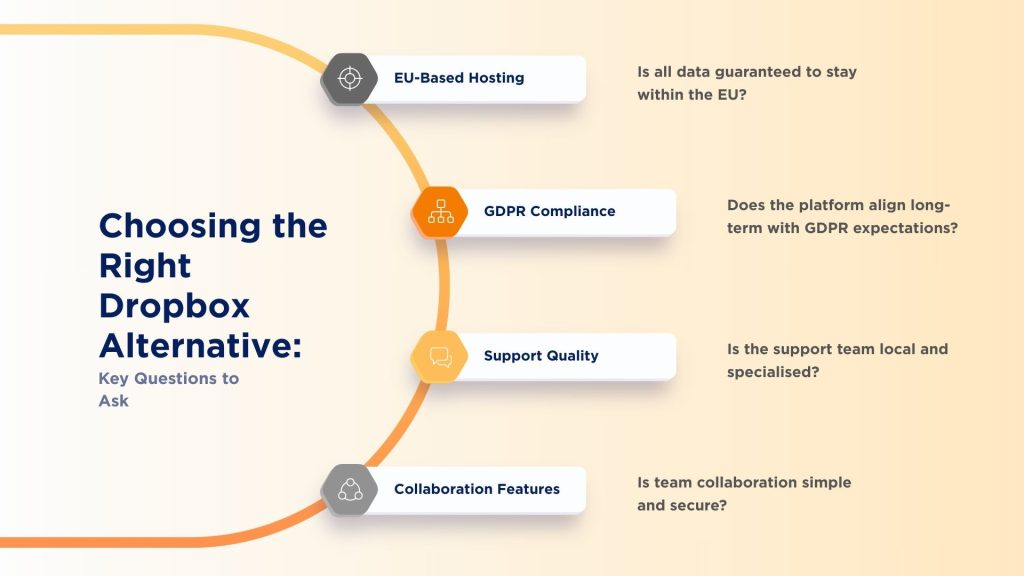
If any answer is uncertain, it may be time to explore a European, privacy-centric solution.
Take Control of Your Data with vBoxxCloud
Choosing a cloud platform is no longer just about storage and file sharing. It’s about sovereignty, compliance, and trust.
For organisations seeking a secure and transparent Dropbox substitute, vBoxxCloud offers a fully GDPR-compliant solution built in Europe.
Ready to explore vBoxxCloud?
Start a free trial or contact our team of experts for a personalised consultation.