

Modern businesses face unprecedented demands for digital agility, scalability, and security. Cloud based infrastructure has emerged as the foundational technology enabling organisations to meet these challenges whilst simultaneously reducing capital expenditure and operational complexity. Furthermore, as we progress through 2026, the adoption of cloud based infrastructure continues to accelerate across European markets, driven by enhanced security standards, environmental considerations, and the need for resilient business continuity planning. Therefore, understanding the components, benefits, and strategic implementation of cloud based infrastructure has become essential for decision-makers seeking competitive advantage.
Understanding Cloud Based Infrastructure Fundamentals
Cloud based infrastructure represents a paradigm shift from traditional on-premises computing environments. According to the National Institute of Standards and Technology (NIST) definition, cloud computing delivers five essential characteristics: on-demand self-service, broad network access, resource pooling, rapid elasticity, and measured service. Moreover, these characteristics distinguish genuine cloud based infrastructure from conventional hosting arrangements.
Core Components and Architecture
The architecture of cloud based infrastructure comprises multiple interconnected layers that work together to deliver computing resources. At the foundation, virtualisation technology abstracts physical hardware resources, enabling multiple virtual machines to operate independently on shared infrastructure. Subsequently, orchestration tools automate the provisioning, configuration, and management of these resources across distributed environments.
Key architectural elements include:
- Compute resources for processing workloads and running applications
- Storage systems providing persistent data repositories with redundancy
- Network infrastructure connecting components and enabling communication
- Management platforms for monitoring, automation, and governance
- Security frameworks protecting data and controlling access
The NIST Cloud Computing Reference Architecture provides a standardised framework for understanding how these components interact. Nevertheless, implementation specifics vary based on deployment models and service configurations.
Service Models Explained
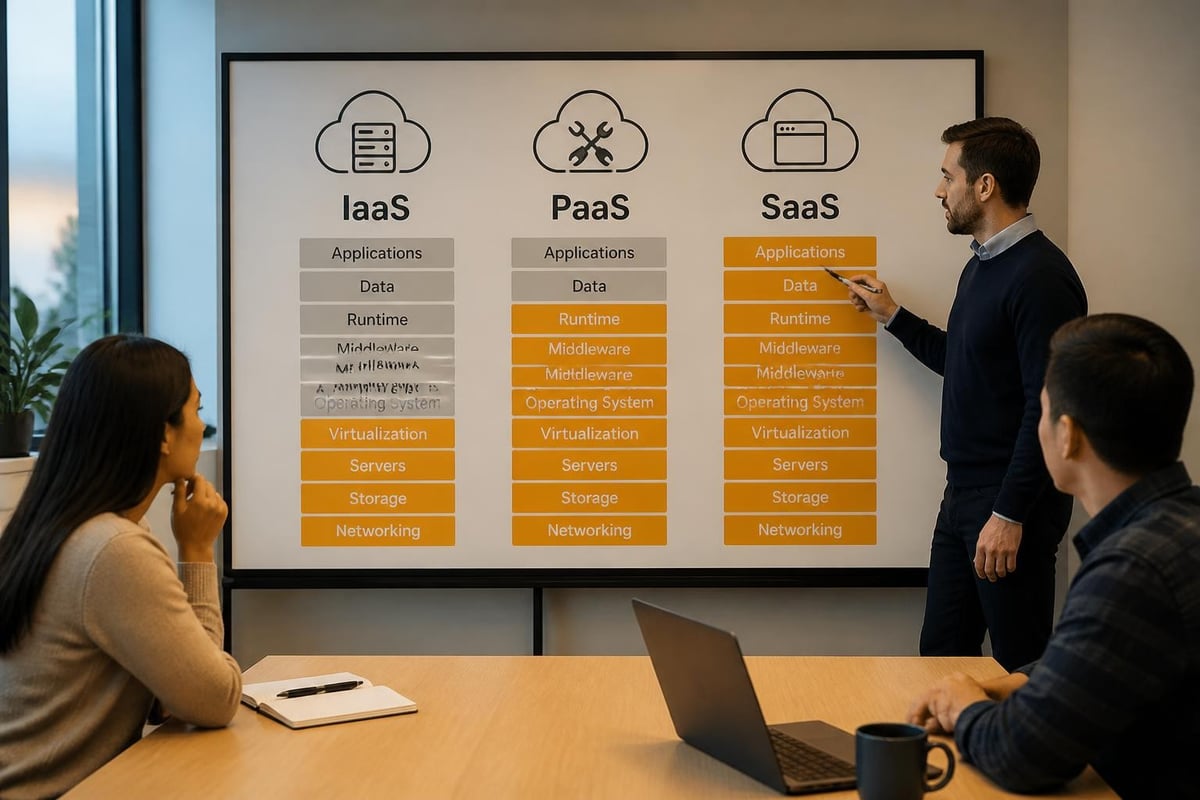
Cloud based infrastructure delivers value through three primary service models, each offering different levels of abstraction and management responsibility. Infrastructure as a Service (IaaS) provides virtualised computing resources, including servers, storage, and networking. Platform as a Service (PaaS) adds development frameworks and middleware, enabling application deployment without infrastructure management. Finally, Software as a Service (SaaS) delivers complete applications accessible through web browsers.
| Service Model | Provider Manages | Customer Manages | Typical Use Cases |
|---|---|---|---|
| IaaS | Physical infrastructure, virtualisation | Operating systems, applications, data | Virtual servers, backup systems, development environments |
| PaaS | Infrastructure, runtime, middleware | Applications, data | Application development, database hosting, API management |
| SaaS | Everything except user data | Configuration, user access | Email, collaboration tools, CRM systems |
Strategic Benefits for Business Operations
Cloud based infrastructure delivers transformative benefits that extend far beyond simple cost reduction. Furthermore, these advantages create compounding value as organisations mature their cloud adoption strategies.
Financial Efficiency and Predictability
Traditional infrastructure requires substantial capital investment in hardware, facilities, and maintenance contracts. In contrast, cloud based infrastructure converts these capital expenses into operational expenditure with predictable monthly billing. Therefore, businesses gain financial flexibility whilst eliminating the risk of over-provisioning or capacity shortages.
Additionally, the pay-per-use model ensures organisations only consume resources they actually need. This granular cost control enables precise budget forecasting and eliminates waste from idle infrastructure. Moreover, businesses avoid the depreciation cycles and refresh costs associated with physical hardware ownership.
Scalability and Performance Optimisation
The ability to scale resources dynamically represents one of the most compelling advantages of cloud based infrastructure. Organisations can respond immediately to changing demands, whether launching new products, handling seasonal traffic spikes, or supporting business growth. Furthermore, this elasticity operates bidirectionally, allowing resource reduction during quieter periods to optimise costs.
Performance optimisation becomes significantly more accessible with cloud based infrastructure. Businesses can deploy resources across multiple geographic regions, reducing latency for distributed user bases. In addition, advanced load balancing and auto-scaling features ensure consistent application performance regardless of demand fluctuations.
Scalability advantages include:
- Immediate resource provisioning without procurement delays
- Horizontal scaling across multiple instances for redundancy
- Vertical scaling to increase individual resource capacity
- Geographic distribution for performance and compliance
- Automated response to traffic patterns and workload changes

Security and Compliance Considerations
Security remains paramount when implementing cloud based infrastructure. Nevertheless, modern cloud environments often provide superior security compared to traditional on-premises deployments, particularly for small and medium enterprises lacking dedicated security teams.
Multi-Layered Security Frameworks
Cloud based infrastructure implements security through multiple defensive layers. Physical security protects data centres with biometric access controls, surveillance systems, and environmental safeguards. Network security employs firewalls, intrusion detection systems, and encrypted communications channels. Furthermore, application-level security includes authentication mechanisms, authorisation controls, and data encryption both at rest and in transit.
European businesses particularly benefit from cloud providers adhering to stringent data protection regulations. The General Data Protection Regulation (GDPR) mandates specific security measures and data handling practices. Therefore, selecting cloud based infrastructure from European providers ensures alignment with regulatory requirements whilst maintaining data sovereignty. For organisations prioritising privacy, solutions like encrypted cloud services offer additional protection layers.
Backup and Disaster Recovery
Cloud based infrastructure fundamentally transforms business continuity planning. Traditional disaster recovery requires duplicate infrastructure maintained at geographically separated locations, representing substantial investment. Conversely, cloud environments enable efficient, automated backup strategies with configurable retention policies and recovery point objectives.
Replication across multiple availability zones ensures data survives localised failures. Moreover, automated failover mechanisms minimise downtime during incidents. Businesses can define recovery time objectives (RTO) and recovery point objectives (RPO) aligned with specific application requirements, balancing protection levels against cost considerations.
Implementation and Migration Strategies
Successfully transitioning to cloud based infrastructure requires careful planning and phased execution. Furthermore, organisations must assess existing workloads, identify dependencies, and prioritise migration candidates based on complexity and business value.
Assessment and Planning Phases
The initial assessment examines current infrastructure inventory, application portfolios, and integration dependencies. This discovery phase identifies which workloads suit immediate migration versus those requiring refactoring or replacement. Additionally, organisations must evaluate data sensitivity, compliance requirements, and performance expectations for each application.
Migration planning considerations:
- Application categorisation into migration-ready, refactor-required, and replace candidates
- Dependency mapping to understand integration points and data flows
- Security requirement documentation for compliance and data protection
- Performance baseline establishment for post-migration validation
- Training programme development for technical teams and end users
The cloud architecture principles emphasise designing for failure, implementing automation, and embracing infrastructure as code. Therefore, organisations should adopt these practices during planning to maximise cloud benefits.
Migration Approaches
Several migration strategies suit different scenarios and organisational capabilities. The "lift and shift" approach moves applications to cloud based infrastructure with minimal modification, providing quick wins and immediate cost benefits. Nevertheless, this strategy may not fully exploit cloud-native capabilities.
Alternatively, the "refactor and optimise" approach redesigns applications to leverage cloud services like managed databases, serverless computing, and container orchestration. Although this requires greater initial investment, it delivers superior long-term performance, scalability, and operational efficiency. Moreover, hybrid approaches combine both strategies, balancing speed with optimisation for different workload categories.

Governance and Management Practices
Effective cloud based infrastructure requires robust governance frameworks balancing flexibility with control. Furthermore, organisations must establish clear policies covering resource provisioning, cost management, security standards, and compliance requirements.
Operational Excellence
The cloud governance and management framework emphasises self-service capabilities combined with guardrails preventing misuse. Organisations should implement tagging strategies for cost allocation, automated policy enforcement for security compliance, and monitoring systems for performance optimisation.
Cost management represents a critical governance function. Without proper oversight, cloud consumption can escalate unexpectedly. Therefore, businesses must implement budget alerts, regular usage reviews, and resource rightsizing programmes. Additionally, reserved capacity commitments and spot instance strategies reduce costs for predictable workloads.
| Governance Area | Key Controls | Implementation Tools |
|---|---|---|
| Cost Management | Budget limits, approval workflows, showback reporting | Cost analysis platforms, automated alerts, resource tagging |
| Security | Access policies, encryption requirements, audit logging | Identity management, security groups, compliance scanners |
| Performance | Resource quotas, monitoring thresholds, scaling policies | Performance dashboards, automated scaling, load balancing |
| Compliance | Data location rules, retention policies, audit trails | Policy engines, compliance reports, certification tracking |
Automation and Infrastructure as Code
Modern cloud based infrastructure management relies heavily on automation. Infrastructure as Code (IaC) treats infrastructure configuration as software, enabling version control, testing, and repeatable deployments. Moreover, this approach eliminates configuration drift and ensures consistency across environments.
Automation extends beyond provisioning to include patch management, security updates, backup scheduling, and incident response. Consequently, organisations reduce manual errors whilst improving operational efficiency. Furthermore, automation enables self-healing systems that detect and remediate common issues without human intervention.
Environmental and Sustainability Benefits
Cloud based infrastructure contributes significantly to corporate sustainability objectives. Large-scale cloud providers achieve energy efficiency unattainable by individual organisations through optimised cooling systems, renewable energy procurement, and high server utilisation rates.
Green Computing Advantages
European cloud providers increasingly prioritise environmental responsibility. Data centres powered by renewable energy sources reduce carbon footprints whilst maintaining operational reliability. Additionally, virtualisation maximises hardware utilisation, reducing the total number of physical servers required globally.
Organisations migrating to cloud based infrastructure typically reduce their energy consumption by 30-50% compared to traditional on-premises deployments. Therefore, cloud adoption supports both financial objectives and corporate social responsibility commitments. Moreover, transparent reporting from cloud providers enables accurate carbon accounting for sustainability disclosures.
Environmental benefits include:
- Reduced energy consumption through shared infrastructure efficiency
- Lower electronic waste from extended hardware lifecycles
- Renewable energy sourcing at scale
- Optimised cooling and power distribution systems
- Carbon footprint transparency and reporting
Selecting the Right Cloud Provider
Choosing appropriate cloud based infrastructure providers requires evaluating multiple factors beyond simple feature comparisons. Nevertheless, organisations should prioritise providers demonstrating commitment to security, privacy, and environmental sustainability.
Evaluation Criteria
Data sovereignty considerations prove particularly important for European businesses. Providers maintaining infrastructure within European jurisdictions ensure compliance with regional data protection regulations. Furthermore, transparent data handling practices and clear contractual terms protect business interests.
For organisations exploring cloud based infrastructure options, comprehensive demonstrations like the all-in-one demonstration provided by leading European providers offer valuable insights into capabilities, security features, and implementation processes. These guided evaluations help decision-makers understand practical implications before committing to specific platforms.
Service level agreements (SLAs) define expected availability, performance, and support responsiveness. Therefore, organisations must carefully review these commitments, understanding compensation mechanisms for service disruptions. Additionally, vendor lock-in risks deserve consideration, with preference for standards-based solutions enabling future flexibility.
Integration with Existing Systems
Cloud based infrastructure rarely operates in isolation. Instead, organisations typically maintain hybrid environments combining cloud resources with on-premises systems. Therefore, integration capabilities determine overall solution effectiveness.
Hybrid and Multi-Cloud Architectures
Hybrid cloud approaches leverage cloud based infrastructure for specific workloads whilst retaining certain systems on-premises. This strategy suits organisations with compliance requirements mandating local data storage or legacy applications unsuited to migration. Moreover, hybrid architectures provide transition pathways, enabling gradual cloud adoption without disruptive forklift upgrades.
Multi-cloud strategies distribute workloads across multiple cloud providers, avoiding vendor dependency whilst optimising for specific capabilities. Nevertheless, this approach increases management complexity and requires sophisticated orchestration tools. Furthermore, network connectivity between environments becomes critical, with secure, high-bandwidth connections essential for seamless operation.
Integration technologies include:
- Virtual private networks (VPNs) for secure connectivity
- Direct connection services for dedicated, high-speed links
- API gateways enabling application communication
- Data synchronisation tools maintaining consistency
- Identity federation for unified access management
Security considerations intensify in hybrid environments. Consistent policies must span cloud and on-premises infrastructure, with unified monitoring detecting threats regardless of location. Additionally, encrypted online storage solutions ensure data protection across distributed environments.
Cloud based infrastructure has evolved from emerging technology to essential business foundation, delivering scalability, security, and sustainability benefits that traditional approaches cannot match. Therefore, organisations prioritising digital transformation must develop comprehensive cloud strategies aligned with business objectives whilst addressing security, compliance, and operational requirements. vBoxx provides European businesses with secure, privacy-focused cloud based infrastructure solutions emphasising data sovereignty and environmental responsibility, enabling organisations to confidently embrace cloud computing whilst maintaining control over sensitive information.