
The landscape of cloud computing suppliers has evolved dramatically over recent years, with organisations now facing a more complex decision-making process than ever before. Furthermore, the market has become increasingly concentrated around a handful of major providers whilst simultaneously offering a broader range of specialised services. Therefore, understanding the nuances between different suppliers, their pricing structures, security approaches, and service models has become essential for businesses seeking to optimise their digital infrastructure. Moreover, the rise of data sovereignty concerns and regulatory requirements has added another layer of complexity to supplier selection, particularly for European organisations prioritising privacy and compliance.
Understanding the Cloud Computing Supplier Landscape
The market for cloud computing suppliers has reached unprecedented scale, with the big three providers capturing two-thirds of the $107 billion market. Nevertheless, this concentration presents both opportunities and challenges for businesses evaluating their options.
Major Global Providers
Amazon Web Services (AWS), Microsoft Azure, and Google Cloud Platform dominate the infrastructure-as-a-service market. These cloud computing suppliers offer comprehensive service catalogues spanning compute, storage, networking, databases, analytics, and artificial intelligence capabilities. Furthermore, their global infrastructure enables businesses to deploy applications across multiple geographic regions with relative ease.
However, this market dominance raises important questions about vendor lock-in and pricing power. Therefore, organisations must carefully evaluate whether these hyperscale providers align with their specific requirements and risk tolerance.
Regional and Specialised Suppliers
Beyond the major players, numerous regional cloud computing suppliers serve specific markets and compliance requirements. In addition, these providers often emphasise data sovereignty, local support, and tailored solutions for particular industries or regulatory frameworks.
European businesses, in particular, increasingly seek suppliers that prioritise GDPR compliance and data residency within EU borders. Moreover, concerns about data access by foreign governments have driven demand for European-based infrastructure and clear jurisdictional controls.

Service Models and Deployment Options
Understanding the different service models offered by cloud computing suppliers is fundamental to making informed decisions. Nevertheless, the boundaries between these categories have become increasingly blurred as providers expand their offerings.
Infrastructure, Platform, and Software Services
Cloud computing suppliers typically offer services across three primary categories:
- Infrastructure as a Service (IaaS) provides virtualised computing resources including servers, storage, and networking
- Platform as a Service (PaaS) delivers development environments and tools for building applications
- Software as a Service (SaaS) offers complete applications accessible via web browsers or APIs
Furthermore, many suppliers now provide integrated solutions that span multiple service layers, enabling organisations to adopt comprehensive cloud strategies from a single vendor.
Hybrid and Multi-Cloud Architectures
Hybrid cloud strategies have gained significant traction as organisations seek to balance control, compliance, and flexibility. Therefore, evaluating cloud computing suppliers based on their hybrid capabilities has become increasingly important.
| Deployment Model | Key Benefits | Primary Considerations |
|---|---|---|
| Public Cloud | Cost efficiency, scalability, minimal maintenance | Data sovereignty, security controls |
| Private Cloud | Enhanced control, customisation, compliance | Higher costs, management overhead |
| Hybrid Cloud | Flexibility, gradual migration, workload optimisation | Integration complexity, expertise requirements |
| Multi-Cloud | Vendor diversity, best-of-breed services, risk mitigation | Management complexity, skill requirements |
In addition, multi-cloud strategies enable organisations to leverage specific strengths from different cloud computing suppliers whilst avoiding complete dependence on any single provider. Nevertheless, this approach introduces management complexity and requires robust governance frameworks.
Security and Compliance Considerations
Security remains paramount when evaluating cloud computing suppliers, particularly as cloud computing faces key challenges in 2026 including evolving threat landscapes and regulatory pressures. Moreover, the shared responsibility model means organisations must understand precisely which security controls fall under their purview versus those managed by suppliers.
Data Protection and Privacy
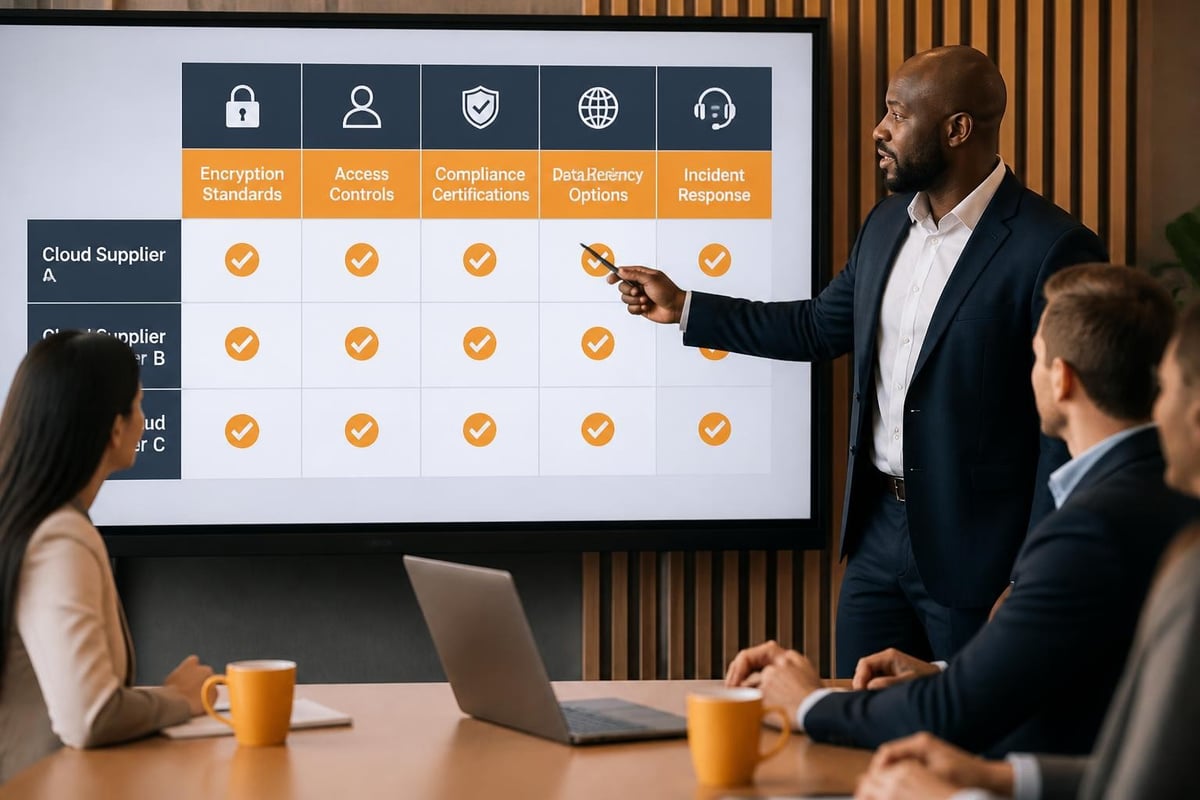
European organisations must prioritise cloud computing suppliers that demonstrate strong commitments to data protection. Furthermore, certifications such as ISO 27001, SOC 2, and compliance with GDPR provide valuable assurance regarding security practices and controls.
Key security considerations include:
- Encryption capabilities for data at rest and in transit
- Access controls including multi-factor authentication and identity management
- Network security features such as firewalls, intrusion detection, and DDoS protection
- Audit logging and monitoring tools for security event tracking
- Incident response procedures and support commitments
In addition, organisations handling sensitive data should investigate suppliers' approaches to data residency, cross-border data transfers, and government access requests. Therefore, understanding the legal jurisdictions governing your data becomes crucial for compliance and risk management.
Certification and Compliance Frameworks
Different cloud computing suppliers maintain varying portfolios of compliance certifications. Nevertheless, businesses in regulated industries must verify that potential suppliers hold relevant certifications for their sector, whether healthcare, finance, government, or critical infrastructure.
Cost Management and Pricing Transparency
One of the most significant challenges organisations face with cloud computing suppliers involves managing costs effectively. Furthermore, cloud bill shock has become increasingly common as complex pricing structures and hidden fees catch businesses off guard.
Understanding Pricing Models
Cloud computing suppliers employ various pricing approaches that can significantly impact total cost of ownership:
- Pay-as-you-go charges based on actual resource consumption
- Reserved instances offer discounts for committed usage periods
- Spot pricing provides discounted access to spare capacity
- Tiered pricing varies rates based on usage volumes
- Bundled services package multiple offerings at combined rates
Moreover, organisations must account for data transfer costs, storage tiers, API calls, and support charges when calculating total expenses. Therefore, obtaining detailed cost breakdowns and conducting proof-of-concept projects helps establish realistic budget expectations.
Cost Optimisation Strategies
Effective cost management with cloud computing suppliers requires ongoing monitoring and optimisation. In addition, organisations should implement several key practices:
- Establish clear tagging and allocation strategies to track spending by department or project
- Implement automated scaling policies to match resources with actual demand
- Regularly review and rightsize instances to eliminate over-provisioning
- Leverage reserved capacity for predictable workloads
- Monitor and optimise data transfer patterns to minimise egress charges
Furthermore, some cloud computing suppliers offer cost management tools and recommendations, though third-party solutions may provide more comprehensive visibility across multi-cloud environments.
Performance and Reliability Requirements
Different workloads demand varying performance characteristics from cloud computing suppliers. Nevertheless, understanding service level agreements (SLAs), network capabilities, and compute options is essential for matching suppliers to specific requirements.
Service Level Agreements
Cloud computing suppliers typically offer tiered SLAs with varying availability guarantees:
| SLA Tier | Uptime Guarantee | Typical Use Cases |
|---|---|---|
| Standard | 99.9% (8.76 hours downtime/year) | Development, testing environments |
| Enhanced | 99.95% (4.38 hours downtime/year) | Business applications, databases |
| Premium | 99.99% (52.56 minutes downtime/year) | Mission-critical systems |
| Maximum | 99.999% (5.26 minutes downtime/year) | Financial services, healthcare |
Moreover, organisations should scrutinise SLA terms carefully, including credit mechanisms, exclusions, and measurement methodologies. Therefore, understanding what constitutes qualifying downtime versus scheduled maintenance becomes crucial for realistic expectations.
Geographic Distribution and Latency
The geographic footprint of cloud computing suppliers directly impacts application performance for distributed user bases. Furthermore, proximity to end users affects latency, whilst multiple regional deployments enable disaster recovery and business continuity capabilities.
In addition, organisations serving European markets should evaluate suppliers offering data centres within the EU to address both performance and regulatory requirements. Therefore, assessing the availability of regional infrastructure in relevant markets forms a critical part of supplier selection.
Vendor Lock-In and Portability
One of the most significant long-term risks when selecting cloud computing suppliers involves vendor lock-in. Nevertheless, proprietary services and APIs can create substantial barriers to migration or multi-cloud strategies.
Minimising Lock-In Risks
Organisations can reduce lock-in exposure through several approaches:
- Prioritise services built on open standards and technologies
- Avoid proprietary databases and middleware where alternatives exist
- Implement abstraction layers that isolate application code from cloud-specific APIs
- Maintain portable data formats and regular exports
- Document dependencies on supplier-specific features
Furthermore, containerisation technologies and orchestration platforms enable greater portability across different cloud computing suppliers. Therefore, adopting cloud-native architectures with portability in mind provides valuable flexibility for future decisions.

Support and Partnership Models
The quality of support and the nature of the partnership relationship varies significantly among cloud computing suppliers. Moreover, organisations should evaluate both technical support capabilities and strategic alignment when making selection decisions.
Support Tiers and Response Times
Different cloud computing suppliers offer varying support models with distinct service levels:
- Community support through forums and documentation
- Email support with business-hours response times
- Phone support with guaranteed response windows
- Dedicated account management for enterprise customers
- Technical account managers providing architectural guidance
In addition, organisations should clarify support coverage for different service components and verify that critical systems receive appropriate attention levels. Therefore, understanding escalation procedures and support boundaries prevents surprises during incidents.
Strategic Alignment and Roadmap
Beyond immediate technical capabilities, evaluating the strategic direction of cloud computing suppliers helps ensure long-term alignment. Furthermore, suppliers investing heavily in areas relevant to your business, such as artificial intelligence, edge computing, or sustainability, may prove more valuable partners over time.
For businesses prioritising environmental responsibility, investigating suppliers' green hosting practices and sustainability commitments provides insight into their values alignment. Moreover, transparent reporting on energy sources and carbon reduction targets indicates genuine commitment versus superficial marketing claims.
Emerging Trends Reshaping Supplier Selection
The cloud computing landscape continues evolving rapidly, with several trends influencing how organisations evaluate suppliers. Nevertheless, staying informed about these developments helps future-proof infrastructure decisions.
Artificial Intelligence and Specialised Hardware
Major cloud computing suppliers are developing custom ASICs to reduce dependence on traditional hardware vendors, reflecting the growing importance of AI workloads. Furthermore, this vertical integration may provide performance and cost advantages for machine learning applications.
In addition, organisations planning significant AI deployments should evaluate suppliers' GPU availability, tensor processing units, and machine learning platforms. Therefore, understanding the roadmap for AI-specific infrastructure helps match suppliers to evolving requirements.
Sovereign Cloud and Data Localisation
Regulatory pressures and geopolitical tensions have accelerated demand for sovereign cloud solutions. Moreover, European organisations increasingly seek cloud computing suppliers offering guaranteed data residency and operational independence from non-EU jurisdictions.
This trend has created opportunities for regional suppliers emphasising local infrastructure, compliance expertise, and alignment with European values around privacy and data protection. Furthermore, understanding regulatory frameworks such as NIS2 becomes essential for organisations in critical sectors.
Edge Computing Integration
As Internet of Things deployments expand and latency requirements tighten, edge computing capabilities are becoming differentiators among cloud computing suppliers. Nevertheless, seamless integration between edge locations and central cloud infrastructure requires careful architectural planning.
Therefore, organisations should evaluate suppliers' edge offerings, including geographic coverage, management tools, and integration capabilities with core cloud services. In addition, understanding pricing models for edge deployments helps avoid unexpected costs as distributed architectures scale.
Evaluation Framework for Supplier Selection
Selecting appropriate cloud computing suppliers requires structured evaluation across multiple dimensions. Furthermore, weighting criteria based on organisational priorities ensures decisions align with strategic objectives rather than vendor marketing.
Key Evaluation Criteria
Organisations should develop scorecards assessing potential suppliers across categories including:
- Technical capabilities matching specific workload requirements
- Security and compliance addressing regulatory obligations
- Cost structure and total ownership projections
- Performance guarantees through SLAs and infrastructure quality
- Support quality and partnership approach
- Vendor stability and long-term viability
- Innovation roadmap and strategic alignment
Moreover, conducting proof-of-concept projects with shortlisted suppliers provides practical insights beyond sales presentations and documentation. Therefore, allocating time and resources for hands-on evaluation pays dividends through reduced implementation risks.
Request for Proposal Best Practices
When engaging cloud computing suppliers through formal procurement processes, detailed requirements specifications and evaluation criteria ensure fair comparisons. In addition, organisations should:
- Clearly articulate technical requirements, compliance needs, and performance expectations
- Request detailed pricing breakdowns including all potential cost components
- Specify required certifications and compliance attestations
- Define support requirements and response time expectations
- Include questions about roadmap, partnerships, and strategic direction
Furthermore, involving technical teams in evaluation ensures proposed solutions align with implementation realities and integration requirements. Nevertheless, balancing technical excellence with commercial considerations remains essential for sustainable partnerships.
Regional Considerations for European Businesses
European organisations face unique considerations when selecting cloud computing suppliers, particularly regarding data sovereignty and regulatory compliance. Moreover, the regulatory environment continues evolving with frameworks like GDPR, NIS2, and sector-specific requirements.
Data Sovereignty and GDPR Compliance
Cloud computing suppliers serving European businesses must demonstrate robust GDPR compliance through data processing agreements, technical measures, and organisational controls. Furthermore, the invalidation of Privacy Shield and ongoing concerns about trans-Atlantic data transfers make supplier location and corporate structure increasingly relevant.
In addition, organisations handling sensitive data should investigate whether suppliers offer dedicated European infrastructure with contractual guarantees preventing data transfer outside EU jurisdictions. Therefore, understanding both technical architecture and legal frameworks becomes essential for compliance assurance.
Local Support and Language Capabilities
Beyond infrastructure location, European businesses benefit from cloud computing suppliers offering local support teams with language capabilities and cultural understanding. Moreover, time zone alignment ensures responsive support during business hours without depending on overnight shifts in distant locations.
For businesses seeking to understand their cloud strategy holistically, resources such as demonstration sessions can provide valuable insights into how integrated cloud solutions address specific European business requirements whilst maintaining privacy and security standards.
Selecting the right cloud computing suppliers requires balancing technical capabilities, security requirements, cost considerations, and strategic alignment with your organisation's specific needs. Furthermore, as the market continues evolving with new technologies, regulatory frameworks, and competitive dynamics, periodic reassessment ensures your infrastructure remains optimised. vBoxx provides secure, European-based cloud solutions designed specifically for businesses prioritising privacy, compliance, and sustainability, offering an alternative to hyperscale providers that aligns with European values and regulatory requirements. Whether you need secure file storage, communication tools, or comprehensive hosting infrastructure, vBoxx delivers reliable cloud services with transparent pricing and dedicated support.