

The shift to cloud hosting for business has fundamentally transformed how organisations manage their digital infrastructure. Moreover, as enterprises increasingly recognise the limitations of traditional on-premises systems, cloud solutions offer unprecedented flexibility, security and cost efficiency. Furthermore, with the global cloud computing market continuing its rapid expansion in 2026, businesses of all sizes must understand how cloud hosting can support their strategic objectives whilst maintaining compliance with evolving data protection regulations.
Understanding Cloud Hosting for Business Operations
Cloud hosting represents a paradigm shift from traditional server infrastructure, delivering computing resources over the internet rather than through physical hardware on company premises. In addition, the National Institute of Standards and Technology (NIST) defines cloud computing through five essential characteristics: on-demand self-service, broad network access, resource pooling, rapid elasticity and measured service.
For businesses, this translates into tangible operational advantages. Nevertheless, understanding the deployment models is crucial for making informed decisions:
- Public cloud: Resources shared across multiple organisations, offering cost efficiency and scalability
- Private cloud: Dedicated infrastructure for a single organisation, providing enhanced control and security
- Hybrid cloud: Combination of public and private environments, enabling flexibility and workload optimisation
- Community cloud: Shared infrastructure amongst organisations with common compliance requirements
Service Models and Business Applications
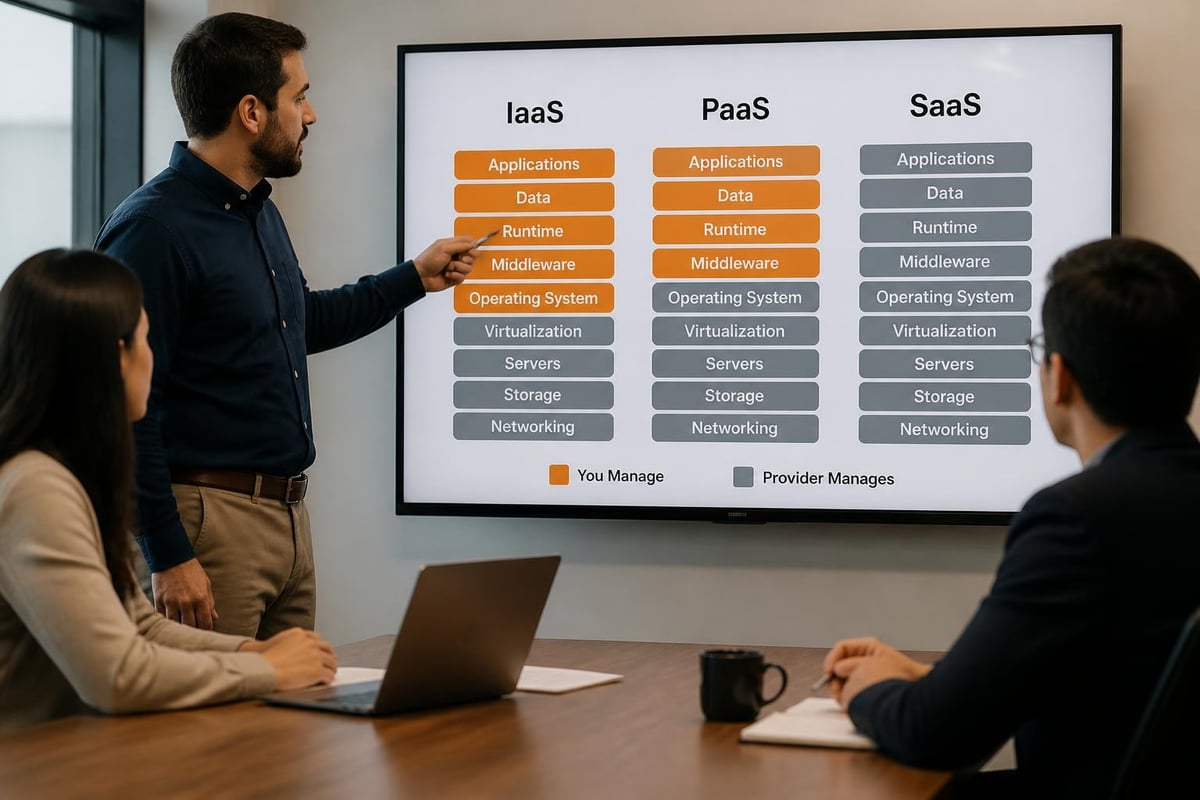
Cloud hosting for business typically manifests in three primary service models, each addressing different operational needs. Infrastructure as a Service (IaaS) provides virtualised computing resources, enabling businesses to run applications without managing physical servers. Therefore, organisations gain the flexibility to scale resources dynamically whilst reducing capital expenditure on hardware.
Platform as a Service (PaaS) delivers a complete development and deployment environment, allowing developers to build applications without managing underlying infrastructure. Furthermore, Software as a Service (SaaS) offers ready-to-use applications accessible via web browsers, eliminating installation and maintenance burdens.
| Service Model | Business Controls | Provider Manages | Ideal For |
|---|---|---|---|
| IaaS | Applications, data, runtime, middleware, OS | Virtualisation, servers, storage, networking | Custom applications, complete control needs |
| PaaS | Applications, data | Runtime, middleware, OS, infrastructure | Development teams, rapid deployment |
| SaaS | Configuration, data | Everything else | Standard business applications, minimal IT overhead |
Security and Compliance Considerations
Security remains the paramount concern when evaluating cloud hosting for business, particularly for European organisations navigating stringent data protection regulations. Moreover, the General Data Protection Regulation (GDPR) imposes specific requirements on data processing, storage location and cross-border transfers. Therefore, selecting a cloud provider with European infrastructure becomes essential for maintaining compliance whilst avoiding jurisdictional complications.
The ENISA cloud security guide for SMEs emphasises several critical security domains that businesses must address. In addition, organisations should evaluate providers against comprehensive security frameworks such as the Cloud Security Alliance's Cloud Controls Matrix, which maps security controls across 17 domains including data security, encryption, identity management and incident response.
Data Sovereignty and Regulatory Frameworks
European businesses face unique challenges regarding data sovereignty. Furthermore, whilst cloud hosting offers global accessibility, regulations require data to remain within specific jurisdictions. The US CLOUD Act, for instance, grants American authorities access to data held by US companies regardless of physical location. Nevertheless, choosing providers operating exclusively under European jurisdiction ensures protection from extraterritorial data requests.
Key compliance considerations include:
- Data location: Verify physical server locations and whether data remains within EU boundaries
- Encryption standards: Ensure AES-256 encryption for data at rest and TLS 1.3 for data in transit
- Certifications: Look for ISO 27001, SOC 2, and industry-specific accreditations
- Access controls: Implement multi-factor authentication and role-based permissions
- Audit capabilities: Maintain comprehensive logs for compliance reporting and forensic analysis
Moreover, the UK NCSC's cloud security principles provide actionable guidance for architecting secure cloud environments, covering 14 principles from data protection to secure development practices.
Cost Management and Financial Optimisation
Cloud hosting for business fundamentally changes the economics of IT infrastructure. In addition, the shift from capital expenditure (CapEx) to operational expenditure (OpEx) provides improved cash flow management and budget predictability. Nevertheless, without proper governance, cloud costs can escalate rapidly through resource sprawl and inefficient utilisation.
The FinOps Framework offers a structured approach to cloud financial management, emphasising collaboration between finance, technology and business teams. Therefore, organisations implementing FinOps practices typically achieve 20-30% cost savings whilst maintaining or improving performance.
Practical Cost Optimisation Strategies
Effective cost management requires continuous monitoring and optimisation. Furthermore, businesses should implement several key practices:
- Right-sizing resources: Match computing capacity to actual workload requirements, avoiding over-provisioning
- Reserved capacity: Commit to longer-term usage for predictable workloads, securing significant discounts
- Automated scaling: Implement auto-scaling policies that adjust resources based on demand patterns
- Storage tiering: Move infrequently accessed data to lower-cost storage classes
- Scheduled shutdowns: Power down non-production environments during off-hours
| Cost Factor | Traditional Hosting | Cloud Hosting | Business Impact |
|---|---|---|---|
| Initial investment | High (hardware, setup) | Minimal (subscription) | Improved cash flow |
| Scaling costs | Step-function increases | Granular, incremental | Better cost control |
| Maintenance | Fixed overhead | Included in service | Reduced IT burden |
| Disaster recovery | Duplicate infrastructure | Built-in redundancy | Lower DR costs |

Performance and Scalability Benefits
Cloud hosting for business delivers performance characteristics unattainable with traditional infrastructure. Moreover, modern cloud platforms distribute workloads across multiple data centres, ensuring high availability and fault tolerance. Therefore, businesses experience improved application performance whilst reducing the risk of downtime that could impact revenue and reputation.
Scalability represents one of cloud hosting's most compelling advantages. In addition, organisations can provision additional resources within minutes rather than weeks required for physical hardware procurement. Furthermore, this elasticity enables businesses to handle seasonal demand spikes, product launches or unexpected traffic surges without maintaining excess capacity year-round.
Measuring Cloud Performance Metrics
Businesses must establish clear performance indicators to evaluate cloud hosting effectiveness. Nevertheless, metrics should align with business objectives rather than focusing solely on technical specifications:
- Availability: Target 99.9% or higher uptime for critical applications
- Response time: Monitor application latency from user perspective
- Throughput: Measure transaction processing capacity during peak loads
- Recovery time: Establish recovery time objectives (RTO) and recovery point objectives (RPO)
- Resource utilisation: Track CPU, memory and storage efficiency
Furthermore, European data protection compliance requirements may influence performance decisions, particularly when data residency mandates preclude using geographically dispersed content delivery networks.
Migration Strategies and Best Practices
Transitioning to cloud hosting for business requires careful planning to minimise disruption whilst maximising benefits. Moreover, organisations should assess their existing applications, data and workflows before selecting migration approaches. Therefore, the "Six Rs" framework provides a structured methodology: rehost (lift-and-shift), replatform (lift-tinker-and-shift), repurchase (move to SaaS), refactor (re-architect), retire (decommission), and retain (keep on-premises).
Phased Migration Approach
Successful migrations typically follow a phased approach rather than attempting wholesale transitions. In addition, businesses should prioritise applications based on complexity, business criticality and interdependencies:
- Phase 1: Migrate non-critical applications to gain experience and build confidence
- Phase 2: Move development and testing environments to reduce infrastructure costs
- Phase 3: Transition production workloads with comprehensive testing and rollback plans
- Phase 4: Migrate mission-critical systems after validating cloud platform stability
Furthermore, comprehensive migration services can significantly reduce risks and accelerate timelines, particularly when transitioning complex email systems, databases or custom applications. Nevertheless, maintaining parallel systems during transition periods provides fallback options should issues arise.

Industry-Specific Cloud Applications
Cloud hosting for business manifests differently across industries, each with unique requirements and compliance obligations. Moreover, healthcare organisations must adhere to medical data protection standards whilst ensuring availability for patient care systems. Therefore, secure hosting solutions with robust encryption and audit trails become essential for maintaining regulatory compliance.
Financial services face stringent requirements around transaction integrity, data retention and regulatory reporting. In addition, the European Commission's cloud and edge computing initiatives promote interoperability standards that facilitate secure cross-border services whilst maintaining sovereignty. Furthermore, creative industries leverage cloud hosting for collaborative workflows, with specialised solutions like Mac mini hosting enabling graphics-intensive applications without local hardware investments.
Manufacturing and Supply Chain Integration
Manufacturing organisations increasingly adopt cloud hosting to integrate disparate systems across global supply chains. Nevertheless, edge computing requirements for real-time factory floor operations often necessitate hybrid architectures combining cloud and local processing. Therefore, businesses must balance latency-sensitive operations with centralised data analytics and planning systems.
Professional services firms benefit from cloud-hosted collaboration platforms that enable remote work and client engagement. Moreover, European cloud storage solutions provide secure file sharing whilst maintaining GDPR compliance, essential for handling sensitive client information across legal, consulting and accounting practices.
Disaster Recovery and Business Continuity
Cloud hosting for business fundamentally transforms disaster recovery capabilities. Moreover, traditional backup strategies requiring tape rotation and off-site storage become obsolete when cloud providers maintain geographically distributed infrastructure. Therefore, organisations achieve recovery point objectives measured in minutes rather than hours or days, significantly reducing potential data loss.
Implementing effective disaster recovery requires understanding several key concepts. In addition, recovery time objective (RTO) defines the maximum acceptable downtime, whilst recovery point objective (RPO) establishes the maximum tolerable data loss. Furthermore, backup solutions for Microsoft 365 and Google Workspace address a common misconception that SaaS platforms provide comprehensive data protection, when in reality, retention policies may not meet business requirements.
Building Resilient Cloud Architectures
Resilience extends beyond simple backups to encompass architectural decisions that prevent failures from impacting operations. Nevertheless, businesses should implement multiple defensive layers:
| Resilience Strategy | Implementation Approach | Business Benefit |
|---|---|---|
| Geographic redundancy | Multi-region deployment | Protects against regional outages |
| Automated failover | Health monitoring with automatic switching | Minimises manual intervention during incidents |
| Immutable backups | Write-once storage preventing ransomware encryption | Ensures clean recovery point availability |
| Regular testing | Scheduled disaster recovery drills | Validates procedures and identifies gaps |
Furthermore, the ISO/IEC 27017 cloud security standard provides specific guidance on cloud-specific controls, supplementing the broader ISO 27001 framework with controls addressing shared responsibility models and virtualisation security.
Environmental Sustainability and Green Hosting
Cloud hosting for business increasingly intersects with corporate sustainability objectives. Moreover, modern data centres achieve power usage effectiveness (PUE) ratios approaching 1.1, significantly better than typical on-premises infrastructure averaging 1.8 or higher. Therefore, migrating to green hosting platforms can substantially reduce an organisation's carbon footprint whilst maintaining or improving performance.
In addition, cloud providers implement sustainability practices at scales impossible for individual businesses:
- Renewable energy: Direct purchase agreements for wind and solar power generation
- Cooling optimisation: Advanced techniques including free cooling and liquid immersion
- Hardware efficiency: Regular upgrades to latest-generation processors offering better performance per watt
- Resource sharing: Multi-tenant infrastructure maximises utilisation, reducing idle capacity
- Circular economy: Responsible hardware recycling and refurbishment programmes
Nevertheless, businesses should verify sustainability claims through transparent reporting and recognised certifications. Furthermore, organisations can align their cloud strategy with Science-Based Targets initiative (SBTi) commitments by selecting providers with documented emissions reduction roadmaps.
Vendor Selection and Due Diligence
Selecting appropriate cloud hosting for business requires rigorous evaluation beyond feature comparisons and pricing. Moreover, the long-term relationship with a cloud provider significantly impacts operational flexibility, data portability and total cost of ownership. Therefore, businesses should assess potential vendors across multiple dimensions including technical capabilities, financial stability, support quality and strategic alignment.
Essential Evaluation Criteria
A structured evaluation framework ensures comprehensive assessment. In addition, businesses should consider both immediate requirements and future growth scenarios:
- Geographic presence: Confirm infrastructure location aligns with data residency requirements
- Compliance certifications: Verify current certifications and audit scope
- Service level agreements: Review uptime guarantees, performance commitments and compensation terms
- Data portability: Understand export capabilities and migration support
- Pricing transparency: Ensure clear, predictable pricing without hidden fees
- Support model: Evaluate response times, expertise levels and communication channels
Furthermore, businesses operating in regulated industries should request security questionnaires and conduct vendor risk assessments. Nevertheless, providers with ISO 27001-certified data centres demonstrate commitment to information security management systems and continuous improvement. Moreover, for European organisations, choosing providers subject to GDPR rather than extraterritorial legislation provides additional legal certainty.
Organisations seeking to understand how cloud solutions can transform their operations should consider a comprehensive evaluation of available platforms. For instance, vBoxxCloud demonstrates how European cloud hosting combines GDPR compliance with advanced features including eIDAS-compliant digital signing, AI-assisted document search and customisable branding, all whilst maintaining data sovereignty through Netherlands-based infrastructure.
Integration with Existing Systems
Cloud hosting for business rarely exists in isolation. Moreover, organisations typically maintain hybrid environments combining cloud services with legacy on-premises systems during transition periods or permanently for specific workloads. Therefore, integration capabilities become critical evaluation criteria when selecting cloud platforms.
Modern cloud hosting environments provide multiple integration mechanisms. In addition, RESTful APIs enable programmatic interaction with cloud services, allowing custom applications to leverage cloud resources. Furthermore, pre-built connectors for common business applications accelerate implementation whilst reducing development costs.
API-First Architecture Benefits
Organisations adopting API-first approaches to cloud integration achieve greater flexibility and maintainability. Nevertheless, several best practices ensure successful implementation:
- Authentication standards: Implement OAuth 2.0 or OpenID Connect for secure API access
- Rate limiting: Protect systems from overload through appropriate throttling mechanisms
- Versioning strategy: Maintain backwards compatibility whilst enabling progressive enhancement
- Monitoring and logging: Track API usage patterns and identify integration issues proactively
- Documentation: Maintain comprehensive API documentation for development teams
Furthermore, integration extends to collaboration tools, communication platforms and specialised business applications. Moreover, businesses can consolidate workflows by selecting providers offering comprehensive suites rather than managing numerous point solutions with complex integration requirements.
Support and Operational Considerations
Cloud hosting for business success depends significantly on operational support quality. Moreover, technical issues requiring resolution outside business hours can severely impact revenue and customer satisfaction. Therefore, evaluating provider support models during vendor selection prevents future frustration and downtime.
Support quality varies dramatically across providers. In addition, businesses should assess several factors:
| Support Aspect | Evaluation Questions | Why It Matters |
|---|---|---|
| Availability | 24/7/365 coverage? Business hours only? | Determines access during emergencies |
| Response time | Guaranteed initial response SLAs? | Impacts incident resolution speed |
| Expertise | Generalist help desk or specialist engineers? | Affects problem diagnosis accuracy |
| Communication | Phone, email, chat, ticket system options? | Ensures convenient access methods |
| Escalation | Clear escalation paths for critical issues? | Prevents unresolved problems languishing |
Furthermore, comprehensive support services that include proactive monitoring, security patching and performance optimisation reduce internal IT burden. Nevertheless, businesses should maintain internal cloud expertise to manage day-to-day operations and strategic planning effectively.
Future-Proofing Your Cloud Strategy
Cloud hosting for business continues evolving rapidly, with emerging technologies reshaping capabilities and use cases. Moreover, artificial intelligence and machine learning workloads increasingly leverage cloud infrastructure's computational power and data storage capacity. Therefore, organisations should select platforms that support emerging requirements whilst maintaining compatibility with current operations.
Edge computing represents another significant trend, distributing processing closer to data sources for latency-sensitive applications. In addition, serverless computing models enable businesses to run code without managing infrastructure, paying only for actual execution time rather than provisioned capacity. Furthermore, containerisation and orchestration platforms like Kubernetes provide portable application deployment across multiple cloud environments, reducing vendor lock-in risks.
Nevertheless, businesses should balance innovation adoption with operational stability. Moreover, proven technologies with robust ecosystems often deliver more reliable results than cutting-edge solutions lacking mature tooling and expertise. Therefore, thoughtful evaluation of emerging capabilities against concrete business requirements ensures technology selections support rather than complicate operations.
In addition, maintaining flexibility through multi-cloud strategies provides options for leveraging specialised capabilities whilst avoiding complete dependence on single vendors. Furthermore, standardised interfaces and portable data formats facilitate future migrations should business needs or provider capabilities change.
Cloud hosting for business delivers transformative benefits across security, scalability, cost efficiency and operational resilience when implemented thoughtfully. Moreover, European organisations must balance these advantages with data sovereignty requirements and regulatory compliance obligations. vBoxx addresses these challenges through European-based infrastructure in ISO 27001-certified Dutch data centres, offering comprehensive cloud solutions from storage and communication to backup and hosting, all whilst maintaining GDPR compliance and freedom from extraterritorial data access laws. Therefore, businesses seeking secure, sustainable and strategically aligned cloud hosting should explore how vBoxx's integrated platform can support their digital transformation journey.