
Email remains the backbone of business communication in 2026, yet many organisations underestimate the vulnerability of their digital correspondence. As a result, every message sent carries sensitive information, from financial data to strategic planning details, making email privacy a critical concern for businesses of all sizes. In this context, understanding how to protect your email communications isn’t just about technology; it’s also about implementing comprehensive strategies that safeguard your organisation’s most valuable asset: information.
Understanding the Current Email Privacy Landscape
The threat landscape surrounding email has evolved dramatically over recent years. Cybercriminals employ increasingly sophisticated methods to intercept, access, and exploit business communications. Phishing attacks have grown more convincing, man-in-the-middle attacks more common, and data breaches more costly.
Modern email privacy challenges extend beyond external threats. Legal protections for email communications vary by jurisdiction, creating compliance complexities for international businesses. Employees accessing work emails on personal devices, cloud-based email services with unclear data policies, and third-party integrations all introduce potential vulnerabilities.
The Business Impact of Compromised Email Privacy
Email remains the backbone of business communication in 2026, yet many organisations underestimate the vulnerability of their digital correspondence. As a result, every message sent carries sensitive information, from financial data to strategic planning details, making email privacy a critical concern for businesses of all sizes. In this context, understanding how to protect your email communications isn’t just about technology; it’s also about implementing comprehensive strategies that safeguard your organisation’s most valuable asset: information.
Direct business impacts include:
- Exposure of confidential client information
- Loss of competitive advantage through leaked strategic plans
- Regulatory fines for data protection violations
- Damage to brand reputation and customer trust
- Legal liability from compromised communications
Consider that a single breached email account can provide attackers with access to years of archived correspondence, contact databases, and authenticated access to connected services. The average cost of a data breach in 2026 exceeds £3.5 million, with email-related incidents representing a significant portion of these incidents.

Essential Technologies for Email Privacy Protection
Protecting email privacy requires multiple layers of defence working in concert. In practice, no single technology provides complete protection. However, combining several approaches creates robust security. As a result, organisations can significantly reduce the risk of unauthorised access and data breaches.
Encryption Methods and Their Applications
Encryption transforms readable messages into coded format, ensuring only intended recipients can access content. In particular, two primary encryption approaches serve different purposes. Furthermore, each method addresses different stages of email transmission and storage. As a result, organisations can apply layered protection to strengthen overall email privacy.
Transport Layer Security (TLS) encrypts emails in transit between servers. This prevents interception during transmission but doesn’t protect messages once they reach the recipient’s server. Most modern email providers implement TLS by default, yet gaps remain when communicating with organisations using outdated systems.
End-to-end encryption (E2E) provides stronger protection by encrypting message content on the sender’s device and only decrypting it on the recipient’s device. This ensures even the email service provider cannot read message contents. Implementation challenges with secure email technologies have historically limited adoption, but user-friendly solutions are increasingly available.
| Encryption Type | Protection Level | Ease of Use | Best For |
|---|---|---|---|
| TLS | Moderate | High | General business email |
| S/MIME | High | Moderate | Regulated industries |
| PGP/GPG | Very High | Low | Technical teams |
| Proprietary E2E | High | High | Organisation-wide deployment |
Implementing Secure Email Practices
Technology alone cannot guarantee email privacy. In reality, organisational policies and user behaviour play equally critical roles in maintaining secure communications. Furthermore, even advanced security systems can fail without proper employee awareness and compliance. As a result, businesses must combine technical safeguards with clear policies and ongoing training.
Authentication and Access Controls
Strong authentication prevents unauthorised access to email accounts. For this reason, multi-factor authentication (MFA) should be mandatory across all business email accounts, requiring users to verify their identity through multiple methods before accessing messages. Furthermore, this additional verification layer significantly reduces the risk of compromised credentials. As a result, organisations can strengthen account security and better protect sensitive communications.
Key authentication measures:
- Implement mandatory MFA using authenticator apps or hardware keys
- Enforce strong password policies with regular rotation requirements
- Monitor login attempts for suspicious patterns or locations
- Review access permissions regularly, removing outdated accounts
- Implement single sign-on (SSO) for centralised access management
Access controls extend beyond initial login. Role-based permissions ensure employees only access emails necessary for their responsibilities. Automated tools can flag when users access unusual volumes of messages or export large amounts of data, potentially indicating compromised accounts or insider threats.
Email Retention and Archiving Policies
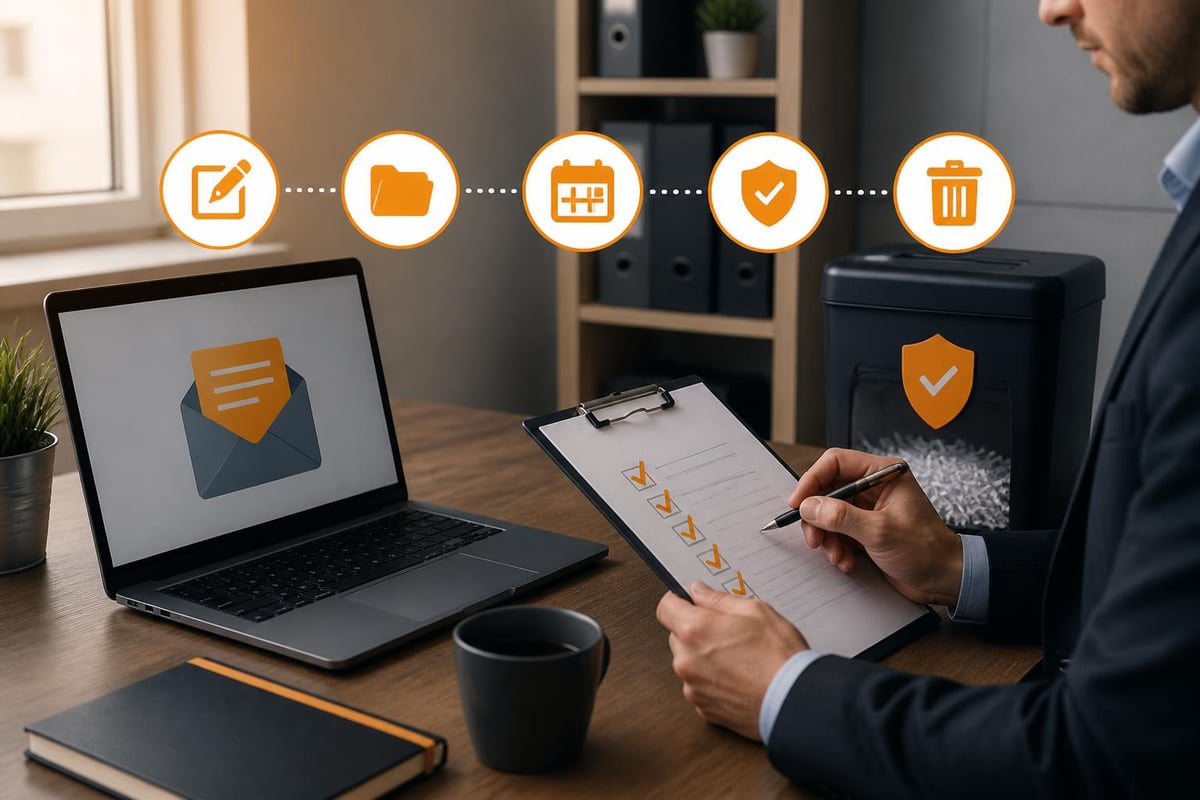
Balancing email privacy with business requirements means developing clear retention policies. Keeping emails indefinitely increases exposure risk, whilst deleting them too quickly may violate regulatory requirements.
Modern archiving solutions encrypt stored messages whilst maintaining searchability for compliance purposes. Understanding email privacy laws helps organisations develop policies that meet legal obligations whilst minimising unnecessary data retention.
Advanced Privacy Strategies for Business Email
Beyond basic security measures, sophisticated organisations implement advanced strategies to enhance email privacy whilst maintaining operational efficiency. In particular, these approaches focus on balancing strong protection with usability and productivity. Furthermore, advanced privacy measures help organisations address evolving cybersecurity threats more effectively. As a result, businesses can strengthen communication security without disrupting daily operations.
Metadata Protection and Email Analytics
Email metadata reveals surprisingly detailed information about business operations. Message headers contain sender and recipient addresses, timestamps, IP addresses, and routing information. Even when message content remains encrypted, metadata analysis can expose communication patterns, business relationships, and strategic timing.
Research into email privacy auditing demonstrates how metadata leaks occur through marketing practices and third-party integrations. Organisations should audit which services access their email data and limit metadata exposure through privacy-focused email configurations.
Anonymising certain communications requires additional measures. Creating anonymous email accounts for specific purposes, such as whistleblowing channels or sensitive negotiations, helps protect both senders and organisations.
Choosing Privacy-Focused Email Providers
The email provider you select fundamentally determines your baseline privacy protection. Not all providers treat data equally, and comparing email providers’ security features reveals significant differences in privacy commitments.
When evaluating providers, examine their data jurisdiction, encryption standards, privacy policies, and track record. Providers operating under stringent European data protection regulations often offer stronger privacy guarantees than those in jurisdictions with weaker protections.
Critical provider selection criteria:
| Criterion | Why It Matters | Questions to Ask |
|---|---|---|
| Data Location | Determines applicable privacy laws | Where are servers physically located? |
| Encryption Standards | Defines protection strength | What encryption protocols are supported? |
| Access Policies | Limits provider data access | Can staff read my emails? |
| Compliance Certifications | Validates security practices | Which standards are certified? |
| Breach History | Indicates security competence | What incidents have occurred? |
For businesses requiring comprehensive secure communication solutions, exploring options like vBoxxConnect through a guided demonstration can clarify how integrated security features protect business communications whilst maintaining usability.
Training and Cultural Approaches to Email Privacy
Technical solutions fail without informed users who understand email privacy principles and their role in maintaining security. For this reason, building a privacy-conscious culture requires ongoing education and clear communication about risks. Furthermore, employees who recognise potential threats are better equipped to avoid security mistakes. As a result, organisations can strengthen their overall email privacy posture through improved awareness and accountability.
Developing Effective Security Awareness Programmes
Regular training helps employees recognise threats and respond appropriately. Simulated phishing exercises test awareness whilst providing learning opportunities. Training should cover identifying suspicious emails, verifying sender authenticity, avoiding public Wi-Fi for sensitive communications, and reporting potential security incidents promptly.
Make email safety practices part of regular business discussions rather than annual compliance exercises. Short, frequent reminders prove more effective than lengthy annual training sessions. Real-world examples from recent breaches help employees understand practical implications.
Effective training components:
- Monthly security newsletters with current threats
- Quarterly simulated phishing tests with feedback
- Brief video modules on specific topics
- Quick reference guides for common scenarios
- Clear reporting procedures for suspicious activity
Policy Development and Enforcement
Written policies establish expectations and provide reference points when questions arise. In particular, effective email privacy policies address acceptable use, personal device access, external communication guidelines, data classification requirements, and incident response procedures.
However, policies must balance security with practicality. Otherwise, overly restrictive policies encourage workarounds that undermine security. For this reason, involving employees in policy development helps identify potential friction points and develop workable solutions. Additionally, regular policy reviews ensure guidelines remain relevant as technology and threats evolve.

Emerging Technologies and Future Considerations
Email privacy continues evolving as new technologies emerge and threat actors develop novel attack methods. Therefore, staying informed about developments helps organisations prepare for future challenges. In addition, continuous monitoring of the threat landscape enables quicker adaptation to emerging risks.
Artificial Intelligence in Email Security
AI-powered tools increasingly assist with email privacy protection. Machine learning algorithms detect anomalous behaviour patterns, identify sophisticated phishing attempts, and automate threat responses. Privacy-preserving anomaly detection methods enable security monitoring without exposing sensitive message content.
However, AI also empowers attackers. Deepfake technology creates convincing impersonation attempts, whilst AI-generated phishing messages bypass traditional detection methods. Organisations must balance AI-enabled security with awareness of AI-enabled threats.
Quantum Computing Implications
Quantum computing poses future challenges to current encryption standards. Although practical quantum attacks remain years away, organisations planning long-term email privacy should monitor developments in quantum-resistant cryptography. In particular, messages encrypted today may be vulnerable to decryption once quantum computers become sufficiently powerful.
Forward-thinking organisations are beginning to implement hybrid encryption approaches that combine current standards with quantum-resistant algorithms. As a result, this ensures communications remain protected even as technology advances. Furthermore, such proactive strategies help organisations future-proof their security posture against emerging threats.
Regulatory Compliance and Email Privacy
Navigating the complex regulatory environment surrounding email privacy requires first understanding multiple frameworks and how they interact. In this context, non-compliance carries significant penalties, making this a board-level concern rather than merely an IT issue. As a result, organisations must treat email privacy governance as a strategic priority rather than a technical afterthought.
Key Regulatory Frameworks
The General Data Protection Regulation (GDPR) establishes strict requirements for handling personal data within email communications. These include obtaining consent for marketing emails, providing data access rights, implementing appropriate security measures, and reporting breaches within 72 hours.
Major regulatory requirements:
- Data minimisation in email collection and retention
- Purpose limitation for how email data is used
- Individual rights to access, correct, and delete data
- Cross-border transfer restrictions for international communications
- Privacy by design in email system architecture
Beyond GDPR, sector-specific regulations impose additional requirements. Healthcare organisations must comply with patient confidentiality rules, financial services face strict communication retention requirements, and legal professionals navigate attorney-client privilege protections.
Building Compliance into Email Systems
Compliance should be embedded in email systems rather than retrofitted. In particular, this includes automated retention schedules based on message classification, built-in encryption for sensitive communications, audit trails documenting access and modifications, and consent management for marketing communications. Furthermore, these mechanisms help ensure that privacy controls operate consistently across all communications.
Regular compliance audits identify gaps before they become violations. In addition, external assessments provide objective evaluation of privacy practices and validate that technical controls function as intended. As a result, documentation proving compliance efforts can mitigate penalties if incidents occur despite good-faith security measures.
Practical Implementation Roadmap
Improving email privacy requires systematic implementation rather than attempting everything simultaneously. In this way, a phased approach allows organisations to build robust protection whilst minimising disruption. Furthermore, it enables teams to prioritise high-risk areas first for maximum impact. As a result, organisations can strengthen email security in a controlled and manageable manner.
Priority implementation sequence:
- Foundation phase: Implement MFA and basic encryption across all accounts
- Policy phase: Develop and communicate clear email privacy policies
- Training phase: Launch security awareness programmes for all staff
- Technology phase: Deploy advanced security tools and monitoring systems
- Optimisation phase: Refine approaches based on metrics and feedback
Start by identifying your most critical email privacy risks through assessment. To begin with, which communications contain the most sensitive information? Next, where do current practices create vulnerabilities? Finally, what regulatory requirements apply to your operations? These answers guide prioritisation decisions.
Monitor key metrics to evaluate programme effectiveness. For instance, track phishing simulation results, measure time to detect and respond to incidents, assess policy compliance rates, and review user feedback about security tools. In addition, continuous improvement based on data ensures email privacy protection evolves with changing threats.
Protecting email privacy requires combining robust technology, clear policies, and informed users within a framework that balances security with operational efficiency. Ultimately, as threats continue evolving and regulations become more stringent, organisations must treat email privacy as an ongoing commitment rather than a one-time project. In this regard, vBoxx delivers secure email solutions designed for businesses that take privacy seriously, offering high-performance infrastructure with comprehensive security features whilst maintaining sustainable, green hosting practices that protect both your data and the environment.