

European businesses face unique challenges when selecting cloud storage solutions. Furthermore, the regulatory landscape, data sovereignty concerns, and compliance requirements make eu cloud storage a critical decision that extends beyond simple file management. As organisations increasingly recognise the strategic importance of where and how their data is stored, the European cloud market has evolved to address specific regional needs whilst competing with global providers.
Understanding the European Cloud Storage Landscape
The European cloud storage market represents a dynamic sector characterised by significant growth and evolving regulatory frameworks. Moreover, market analysis indicates strong expansion driven by digital transformation initiatives across industries. Nevertheless, European providers face considerable challenges in competing with established American hyperscalers.
Market Dynamics and Competitive Pressures
The competitive environment for eu cloud storage reveals a complex picture. Therefore, whilst demand continues to surge, European providers struggle to capture market share against dominant U.S. giants. Recent data shows that European cloud companies face significant hurdles in matching the scale and investment capacity of their American counterparts.
Key market characteristics include:
- Fragmented provider landscape with numerous regional specialists
- Regulatory advantages favouring European data residency
- Investment disparities limiting infrastructure development
- Growing sovereignty awareness amongst enterprise buyers
- Specialised compliance capabilities addressing EU-specific requirements
In addition, the financial pressures on organisations have intensified. Rising cloud storage fees are pushing IT budgets to breaking point, prompting businesses to reassess their provider relationships and seek cost-effective alternatives.
| Market Factor | European Providers | U.S. Hyperscalers |
|---|---|---|
| Data Sovereignty | Native compliance | Additional configuration required |
| Regulatory Alignment | Built-in GDPR support | Varies by region |
| Infrastructure Investment | Limited capital | Significant resources |
| Market Share | Growing but modest | Dominant position |
| Pricing Flexibility | Competitive options | Volume-based advantages |

Data Sovereignty and Regulatory Compliance
Data sovereignty has become a defining characteristic of eu cloud storage solutions. Furthermore, European businesses increasingly prioritise knowing precisely where their data resides and who has access to it. This concern stems from both regulatory obligations and strategic risk management.
GDPR and Data Protection Requirements
The General Data Protection Regulation fundamentally transformed cloud storage requirements across Europe. Therefore, businesses must ensure their cloud providers deliver comprehensive data protection capabilities. Compliance extends beyond simple checkbox exercises to encompass entire data lifecycle management.
Critical compliance considerations include:
- Data residency guarantees ensuring information remains within EU borders
- Processor agreements clearly defining responsibilities and liabilities
- Transfer mechanisms for legitimate cross-border data flows
- Subject access rights enabling efficient response to individual requests
- Breach notification protocols meeting strict 72-hour reporting windows
Moreover, the regulatory environment continues to evolve. EU cloud regulations increasingly emphasise data localisation and sovereign cloud concepts, creating both opportunities and obligations for providers and customers alike.
The Sovereign Cloud Movement
European digital sovereignty has emerged as a significant political and commercial priority. In addition, advocacy efforts by European cloud providers, lawmakers, and NGOs promote the principle of "build European, buy European, protect European" to reduce dependence on non-European technology giants.
Nevertheless, achieving true sovereignty requires more than geographical data centres. The concept encompasses:
- Legal jurisdiction ensuring European courts govern disputes
- Operational independence from foreign government access requests
- Technical resilience with European-controlled infrastructure
- Economic sustainability supporting local innovation ecosystems
- Transparent governance with clear ownership structures
The Sovereign and Resilient Cloud Services Framework provides enterprises with verification mechanisms to assess provider claims. Furthermore, this framework addresses concerns about "sovereignty washing" where providers make misleading assertions about their compliance credentials.
Practical Benefits for European Businesses
Selecting eu cloud storage delivers tangible advantages beyond regulatory compliance. Therefore, organisations report improved performance, enhanced security, and better alignment with operational requirements when choosing European providers.
Performance and Latency Advantages
Data proximity directly impacts application performance. Moreover, storing files on European infrastructure reduces latency for users across the continent, improving collaboration efficiency and user satisfaction.
Performance benefits include:
- Reduced network hops between users and data centres
- Optimised routing within European networks
- Lower bandwidth costs for intra-European transfers
- Faster synchronisation for distributed teams
- Improved availability during regional network issues
In addition, European providers often offer better integration with regional telecommunications infrastructure. This specialisation delivers consistent performance across diverse connectivity scenarios, from metropolitan fibre to rural broadband.

Cost Structure and Transparency
European eu cloud storage providers frequently offer more transparent and predictable pricing models. Furthermore, businesses appreciate straightforward billing without hidden egress fees or complex tier structures that characterise some hyperscaler offerings.
| Cost Element | Typical European Approach | Common Hyperscaler Model |
|---|---|---|
| Storage Pricing | Flat per-gigabyte rates | Multiple tiers with varying costs |
| Data Transfer | Included or minimal fees | Significant egress charges |
| API Requests | Often bundled | Per-request pricing |
| Support | Inclusive tiers | Premium add-ons |
| Commitment Terms | Flexible monthly options | Annual reservations for discounts |
Security and Privacy Posture
European providers emphasise privacy-by-design principles aligned with regional expectations. Therefore, features such as end-to-end encryption, zero-knowledge architectures, and granular access controls are standard rather than premium additions.
Security advantages include:
- Local data protection officers familiar with European privacy culture
- Transparent security practices without conflicting national security obligations
- Incident response teams operating in European time zones
- Audit capabilities aligned with European standards
- Privacy-enhancing technologies integrated from initial design
Moreover, businesses seeking to demonstrate commitment to customer privacy find that European eu cloud storage strengthens their market position, particularly when serving privacy-conscious segments.
Navigating Provider Selection
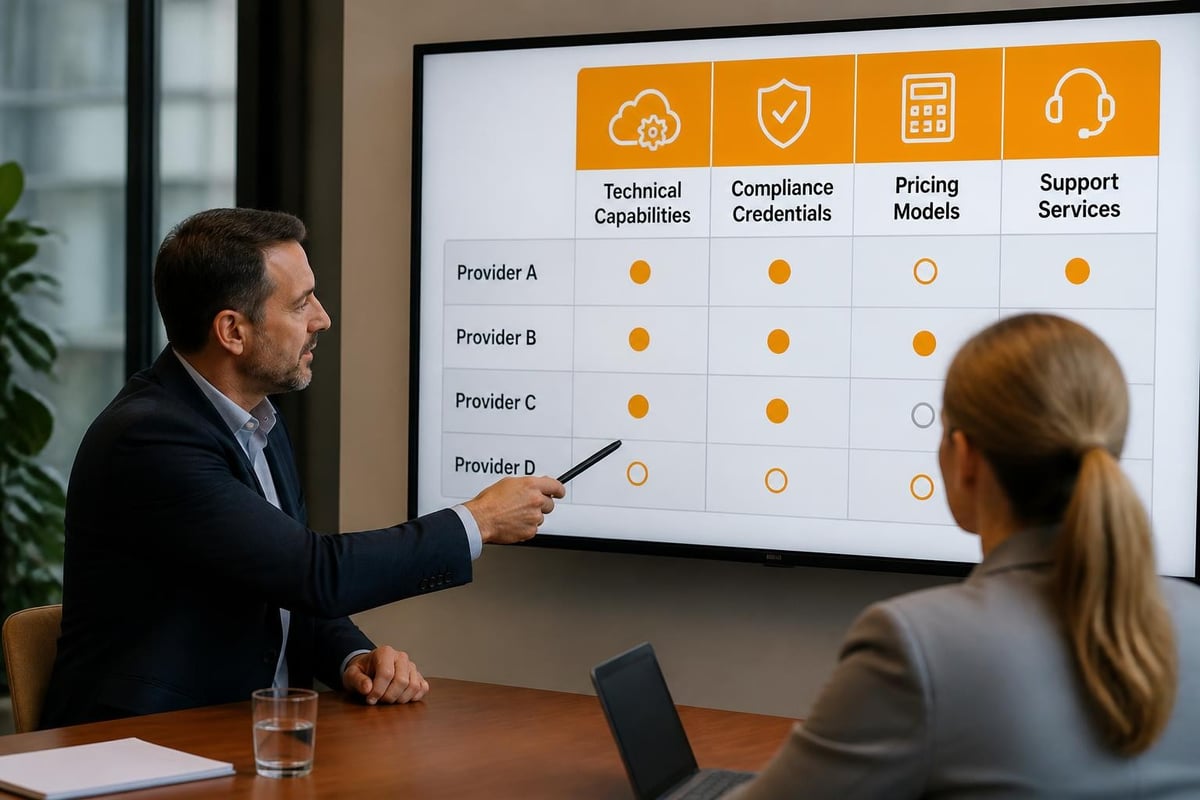
Choosing the appropriate eu cloud storage solution requires systematic evaluation. Nevertheless, the abundance of options can overwhelm decision-makers without clear assessment frameworks.
Essential Evaluation Criteria
Organisations should prioritise several key dimensions when comparing providers. Furthermore, these criteria should be weighted according to specific business requirements and risk tolerance.
Technical capabilities to assess:
- Storage capacity and scalability options
- Redundancy and availability guarantees
- Integration capabilities with existing systems
- Migration support for transitioning from current solutions
- API functionality for custom application development
Operational considerations:
- Geographic coverage of data centre locations
- Support quality including language capabilities and response times
- Service level agreements with clear uptime commitments
- Backup and recovery capabilities for disaster scenarios
- Compliance certifications relevant to your industry
For businesses exploring comprehensive European solutions, a demonstration of integrated platforms can provide valuable insights into how cloud storage, communication, and security tools work together within a cohesive ecosystem.
Regulatory Considerations
Beyond current compliance, forward-looking organisations evaluate provider readiness for emerging regulations. In addition, the Cloud and AI Development Act aims to strengthen European sovereignty and competitiveness, potentially introducing new requirements for cloud service providers.
Furthermore, potential gatekeeper designations under the Digital Markets Act could reshape competitive dynamics. Therefore, businesses should consider how regulatory changes might affect their chosen provider's market position and service delivery.
The EU Data Act 2025 introduces specific provisions for cloud switching rights, addressing vendor lock-in concerns. Moreover, this legislation empowers businesses to migrate between providers more easily, reducing strategic risk associated with provider selection.
Implementation and Migration Strategies
Successfully transitioning to eu cloud storage requires careful planning. Therefore, organisations should approach migration as a structured project with clear phases and success criteria.
Planning Your Migration
Effective migrations begin with comprehensive assessment. Furthermore, understanding current data volumes, access patterns, and integration dependencies prevents surprises during execution.
Migration planning steps:
- Inventory assessment cataloguing all data and applications
- Dependency mapping identifying interconnections and workflows
- Timeline development establishing realistic milestones
- Risk identification anticipating potential challenges
- Rollback planning preparing contingency procedures
- Stakeholder communication managing expectations throughout
In addition, pilot migrations with non-critical data provide valuable learning opportunities. These initial phases reveal integration challenges, performance characteristics, and user experience issues before full-scale deployment.
Managing the Transition
Minimising disruption during migration requires coordination across technical and business stakeholders. Moreover, phased approaches typically deliver better outcomes than "big bang" transitions.
Best practices include:
- Parallel operation periods maintaining old and new systems simultaneously
- User training programmes preparing teams for interface changes
- Performance monitoring tracking metrics throughout migration
- Incremental validation confirming data integrity at each stage
- Support escalation paths addressing issues promptly
Nevertheless, even well-planned migrations encounter unexpected challenges. Therefore, maintaining flexible timelines and adequate contingency resources proves essential for successful outcomes.
Maximising Value from European Cloud Storage
Deploying eu cloud storage represents just the beginning. Furthermore, organisations that actively optimise their implementations achieve significantly better returns on investment.
Optimisation Strategies
Regular review of storage utilisation identifies opportunities for cost reduction and performance improvement. Moreover, most providers offer analytics tools that reveal usage patterns and highlight inefficiencies.
Optimisation activities include:
- Data lifecycle policies automatically archiving or deleting obsolete information
- Compression strategies reducing storage requirements for compatible file types
- Access pattern analysis identifying frequently accessed data for caching
- Permission audits ensuring appropriate access controls remain current
- Integration reviews streamlining workflows and eliminating redundant transfers
| Optimisation Area | Typical Improvement | Implementation Complexity |
|---|---|---|
| Automated archiving | 20-40% cost reduction | Medium |
| Compression | 30-60% space savings | Low |
| Deduplication | 40-70% efficiency gain | Medium |
| Access controls | Enhanced security posture | High |
| Workflow integration | 15-30% productivity increase | High |
Long-Term Strategic Considerations
European cloud storage strategies should evolve with business requirements. In addition, Europe’s ongoing efforts to address digital dependency suggest continued regulatory and market changes that may create new opportunities or obligations.
Forward-looking organisations should:
- Monitor regulatory developments anticipating new compliance requirements
- Evaluate emerging technologies such as edge computing and hybrid architectures
- Assess provider roadmaps ensuring alignment with future capabilities
- Review contract terms periodically to capture improved pricing or features
- Maintain architectural flexibility enabling adaptation to changing circumstances
Furthermore, participating in industry forums and user communities provides valuable insights into evolving best practices. Therefore, businesses that engage actively with the European cloud ecosystem position themselves advantageously for future developments.
European cloud storage offers compelling advantages for businesses prioritising data sovereignty, regulatory compliance, and performance optimisation. Moreover, selecting the right provider and implementing strategic optimisation practices delivers sustained value throughout the cloud journey. If you're seeking a European cloud platform that emphasises privacy, security, and sustainable infrastructure, vBoxx provides comprehensive solutions designed specifically for business requirements across the continent.