

The digital transformation of modern enterprises depends fundamentally on robust IT cloud solutions that deliver scalability, security, and operational efficiency. As organisations migrate critical workloads from traditional on-premises infrastructure to cloud environments, the strategic selection of appropriate cloud services becomes paramount. Furthermore, businesses must navigate an increasingly complex landscape of deployment models, compliance requirements, and vendor ecosystems whilst maintaining business continuity and protecting sensitive data. This comprehensive guide examines the essential components of IT cloud solutions, helping decision-makers understand the technologies, frameworks, and best practices that underpin successful cloud adoption.
Understanding IT Cloud Solutions Architecture
IT cloud solutions encompass a broad spectrum of services and deployment models designed to meet diverse organisational needs. Therefore, understanding the fundamental architecture is essential before embarking on any cloud migration journey.
Service Models and Their Applications
The three primary service models each address different operational requirements:
- Infrastructure as a Service (IaaS) provides virtualised computing resources including servers, storage, and networking, giving organisations maximum control over their environment
- Platform as a Service (PaaS) delivers development frameworks and middleware, enabling developers to build applications without managing underlying infrastructure
- Software as a Service (SaaS) offers complete applications accessed via web browsers, eliminating installation and maintenance overhead
Moreover, many enterprises adopt a combination of these models to address specific workloads. In addition, emerging models such as Function as a Service (FaaS) and Container as a Service (CaaS) provide further specialisation for particular use cases.
| Service Model | Control Level | Management Responsibility | Ideal Use Case |
|---|---|---|---|
| IaaS | High | Customer manages OS, middleware, applications | Custom infrastructure requirements |
| PaaS | Medium | Provider manages infrastructure, customer manages applications | Rapid application development |
| SaaS | Low | Provider manages entire stack | Standardised business applications |
Deployment Models for Different Organisational Needs
Organisations can choose from several deployment models based on their security, compliance, and operational requirements. Nevertheless, each model presents distinct advantages and trade-offs.
Public cloud environments offer maximum scalability and cost efficiency, sharing infrastructure across multiple tenants. In contrast, private cloud deployments provide dedicated resources with enhanced control and customisation options. Furthermore, hybrid cloud architectures combine both approaches, allowing organisations to maintain sensitive workloads on-premises whilst leveraging public cloud resources for less critical applications.
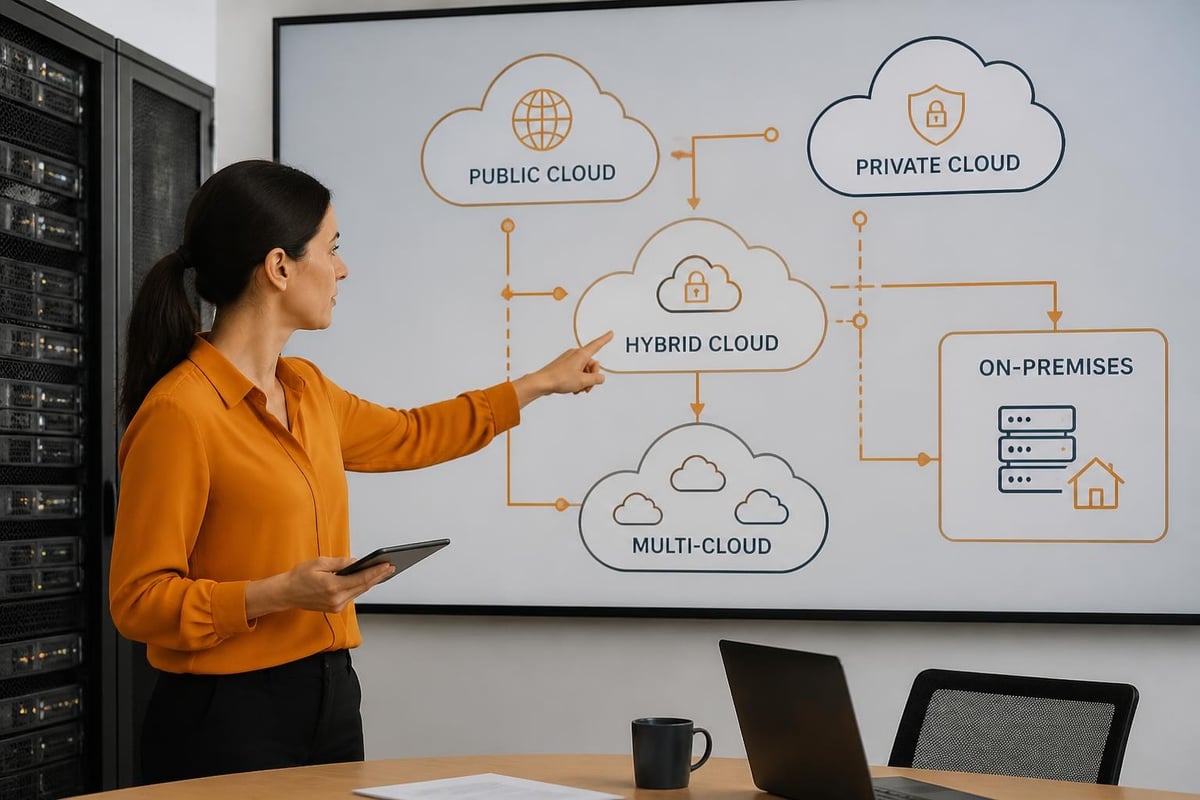
Additionally, multi-cloud strategies distribute workloads across multiple providers to avoid vendor lock-in and optimise performance. Therefore, understanding cloud storage fundamentals becomes crucial when architecting these complex environments.
Security and Compliance in IT Cloud Solutions
Security remains the paramount concern for organisations evaluating it cloud solutions, particularly for European businesses navigating GDPR and sector-specific regulations. Consequently, comprehensive security frameworks must address multiple layers of protection.
Data Protection and Encryption Standards
Modern it cloud solutions employ multiple encryption mechanisms to protect data throughout its lifecycle:
- Data at rest encryption using AES-256 or equivalent standards ensures stored information remains protected even if physical media is compromised
- Data in transit protection via TLS 1.3 safeguards information as it moves between users and cloud infrastructure
- End-to-end encryption provides additional security for sensitive communications, ensuring only authorised parties can decrypt content
- Key management systems control access to encryption keys, often implementing hardware security modules (HSMs) for enhanced protection
Furthermore, zero-knowledge encryption architectures ensure that even cloud providers cannot access customer data. In addition, GDPR-compliant European cloud storage options provide additional assurance for organisations handling EU citizen data.
Regulatory Compliance and Data Sovereignty
European organisations must carefully evaluate where their data resides and which legal frameworks apply. Therefore, data protection compliance becomes a critical selection criterion.
The US CLOUD Act grants American authorities access to data held by US companies regardless of storage location. Consequently, many European businesses prefer providers operating entirely within EU jurisdiction. Moreover, ENISA guidance on implementing security measures provides authoritative frameworks for cloud security compliance.
Nevertheless, compliance extends beyond data location. Organisations must also implement:
- Regular security audits and certifications (ISO 27001, SOC 2, TÜV)
- Access controls based on least-privilege principles
- Comprehensive logging and monitoring capabilities
- Incident response procedures and breach notification protocols
- Data retention and deletion policies aligned with regulatory requirements
Performance Optimisation and Scalability
Effective it cloud solutions deliver consistent performance whilst scaling dynamically to meet changing demands. Furthermore, organisations must balance performance requirements against cost considerations.
Resource Allocation and Auto-Scaling
Modern cloud platforms provide sophisticated mechanisms for matching resources to workload requirements:
Vertical scaling increases the capacity of individual instances by adding CPU, memory, or storage. In contrast, horizontal scaling adds more instances to distribute load across multiple servers. Moreover, auto-scaling policies automatically adjust resources based on predefined metrics such as CPU utilisation or request rates.
| Scaling Approach | Response Time | Cost Efficiency | Complexity | Best For |
|---|---|---|---|---|
| Vertical (scale-up) | Immediate | Moderate | Low | Monolithic applications |
| Horizontal (scale-out) | Delayed | High | Medium | Distributed architectures |
| Auto-scaling | Automatic | Very high | High | Variable workloads |
Additionally, containerisation technologies enable more efficient resource utilisation by packaging applications with their dependencies. Therefore, organisations can achieve better density and faster deployment cycles.
Edge Computing Integration
Edge-cloud collaborative architectures distribute processing between centralised cloud resources and edge locations closer to end users. Consequently, this approach reduces latency for time-sensitive applications whilst maintaining centralised management and analytics capabilities.
Research on edge-cloud collaborative computing demonstrates how organisations can optimise workload distribution for applications ranging from IoT sensor processing to AI model inference. Furthermore, this architecture proves particularly valuable for organisations with geographically distributed operations.

Cloud Migration Strategies and Best Practices
Migrating to it cloud solutions requires careful planning and execution to minimise disruption whilst maximising benefits. Nevertheless, organisations that follow structured methodologies achieve significantly better outcomes.
Assessment and Planning Phases
- Inventory existing infrastructure including applications, dependencies, data volumes, and integration points
- Categorise workloads using frameworks such as the 6 Rs (Rehost, Replatform, Repurchase, Refactor, Retire, Retain)
- Identify compliance requirements specific to each application and dataset
- Estimate costs including migration expenses and ongoing operational costs
- Develop migration roadmap prioritising applications based on complexity, business value, and risk
Moreover, professional migration services can significantly reduce risk and accelerate time-to-value. In addition, pilot migrations allow organisations to validate assumptions before committing to full-scale deployment.
Execution and Optimisation
Once planning concludes, execution demands rigorous project management:
- Establish clear success criteria and key performance indicators
- Implement comprehensive testing environments mirroring production configurations
- Execute migrations during low-usage periods to minimise business impact
- Monitor performance continuously and adjust configurations as needed
- Document processes and configurations for future reference
Furthermore, post-migration optimisation often yields substantial cost savings. Therefore, organisations should regularly review resource utilisation and right-size instances accordingly.
Cost Management and Financial Optimisation
IT cloud solutions offer potential cost advantages over traditional infrastructure, nevertheless, uncontrolled spending can quickly erode these benefits. Consequently, disciplined cost management becomes essential.
Pricing Models and Cost Drivers
Understanding the various pricing mechanisms enables better financial planning:
- Pay-per-use charges based on actual consumption of resources
- Reserved instances provide discounted rates in exchange for commitment periods
- Spot instances offer significant savings for interruptible workloads
- Tiered pricing reduces per-unit costs as consumption increases
Additionally, hidden costs often surprise organisations new to cloud computing. Therefore, budget for data transfer fees, API calls, storage classes, and support plans. Moreover, comparing cloud storage pricing helps establish realistic expectations.
Cost Optimisation Techniques
Several strategies help control cloud expenditure:
- Implement tagging policies to track spending by department, project, or environment
- Schedule non-production resources to shut down outside business hours
- Use lifecycle policies to automatically archive or delete old data
- Monitor and eliminate orphaned resources such as unattached storage volumes
- Leverage committed use discounts for predictable workloads
Furthermore, cloud cost management platforms provide visibility and automated optimisation recommendations. In addition, regular financial reviews ensure spending aligns with business objectives.
Security Operations and Threat Protection
Robust it cloud solutions incorporate multiple layers of security controls addressing diverse threat vectors. Moreover, comprehensive cloud security guidance from the Cloud Security Alliance provides industry-proven frameworks.
Identity and Access Management
Effective IAM forms the foundation of cloud security:
- Implement multi-factor authentication for all user accounts
- Apply role-based access control limiting permissions to necessary functions
- Enforce password policies including complexity requirements and rotation schedules
- Monitor privileged access and maintain comprehensive audit trails
- Regularly review and revoke unnecessary permissions
Additionally, single sign-on integration streamlines user experience whilst maintaining security. Therefore, organisations can enhance both security and productivity simultaneously.
Threat Detection and Response
Modern it cloud solutions must address increasingly sophisticated attack vectors. Consequently, current threat intelligence reveals emerging risks organisations should prepare for.
Proactive monitoring capabilities include:
- Real-time analysis of system logs and network traffic
- Behavioural analytics identifying anomalous activity patterns
- Vulnerability scanning detecting configuration weaknesses
- Intrusion detection systems alerting on suspicious behaviour
- Security information and event management (SIEM) correlating data across multiple sources
Furthermore, incident response procedures should define clear escalation paths and remediation steps. In addition, regular security drills ensure teams can respond effectively when incidents occur.
Backup and Business Continuity
Resilient it cloud solutions incorporate comprehensive backup strategies protecting against data loss from multiple causes. Moreover, organisations must balance recovery objectives against storage and bandwidth costs.
Backup Architecture Design
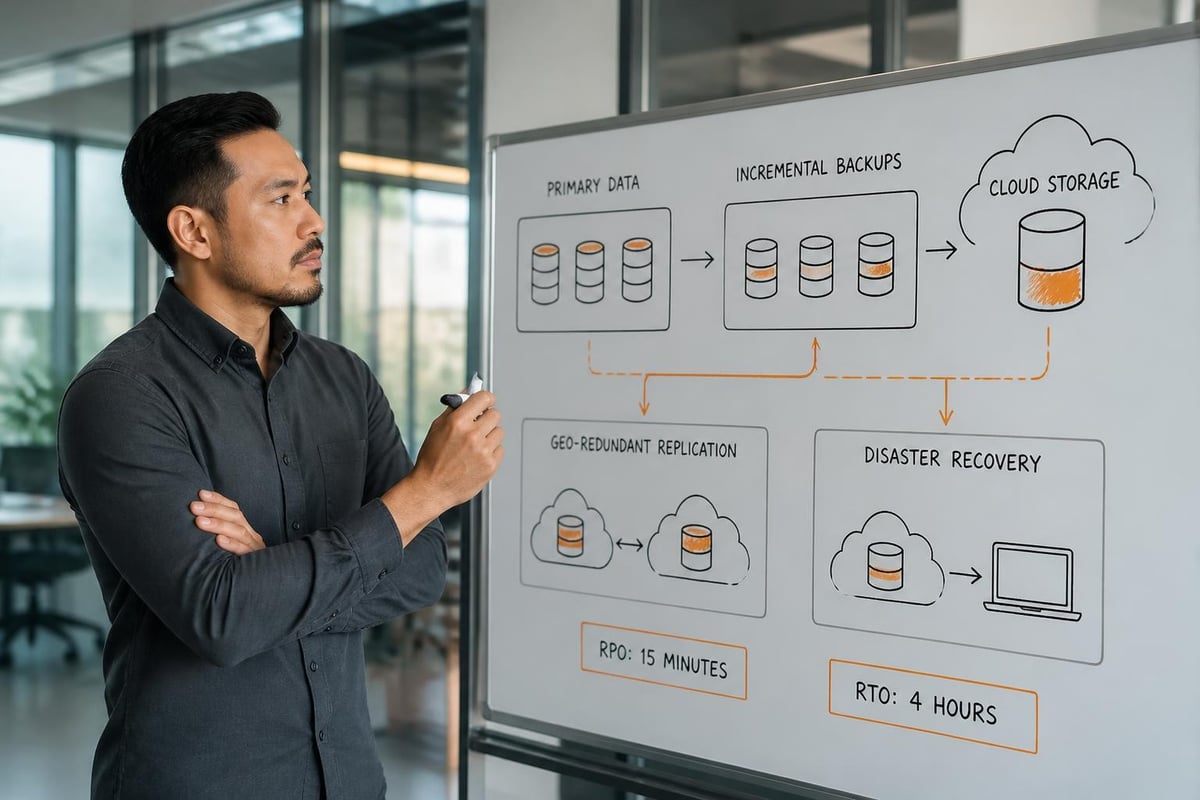
The 3-2-1 rule remains fundamental: maintain three copies of data on two different media types with one copy off-site. Nevertheless, cloud environments enable more sophisticated approaches:
- Continuous data protection captures changes in near-real-time, minimising potential data loss
- Application-consistent backups ensure databases and complex applications remain in usable states
- Incremental and differential backups reduce storage requirements and backup windows
- Immutable backups prevent ransomware from encrypting backup copies
In particular, organisations using SaaS platforms often overlook backup requirements. Therefore, backup solutions for Microsoft 365 and Google Workspace protect against accidental deletion, retention policy gaps, and security incidents.
Disaster Recovery Planning
Recovery Time Objective (RTO) and Recovery Point Objective (RPO) drive disaster recovery architecture decisions. Furthermore, testing recovery procedures regularly ensures they function when needed.
| Recovery Tier | RTO Target | RPO Target | Architecture Approach | Use Case |
|---|---|---|---|---|
| Mission-critical | Minutes | Seconds | Active-active multi-region | Payment systems, medical records |
| Business-critical | Hours | Minutes | Warm standby with sync replication | ERP, CRM applications |
| Important | 24 hours | Hours | Cold standby with daily backups | Internal tools, archives |
| Non-critical | 72+ hours | Days | Backup restoration only | Historical data, reports |
Specialised Cloud Workloads
Beyond general-purpose computing, it cloud solutions increasingly support specialised workloads with unique requirements. Consequently, organisations must evaluate provider capabilities against specific technical demands.
Machine Learning and AI Infrastructure
AI workloads require substantial computational resources and specialised hardware. Therefore, cloud platforms offering GPU and TPU instances enable organisations to train models without capital investment in expensive hardware.
For organisations developing iOS applications or running macOS-specific AI tools, Mac mini hosting on Apple M5 Pro and M6 hardware provides the necessary environment in ISO 27001-certified European data centres. Furthermore, this approach maintains GDPR compliance whilst leveraging Apple Silicon performance for machine learning workloads.
Development and Testing Environments
IT cloud solutions excel at providing isolated environments for software development:
- Rapid provisioning of new environments matching production configurations
- Infrastructure-as-code enabling consistent, repeatable deployments
- Integration with CI/CD pipelines automating build and deployment processes
- Cost-effective testing at scale with resources allocated only when needed
Moreover, containerisation and orchestration platforms simplify deployment across development, staging, and production environments. In addition, version control integration ensures infrastructure changes receive the same scrutiny as application code.
Multi-Cloud and Vendor Management
Sophisticated organisations increasingly adopt multi-cloud strategies distributing workloads across multiple providers. Nevertheless, this approach introduces management complexity requiring robust governance frameworks.
Strategic Rationale for Multi-Cloud
Several factors drive multi-cloud adoption:
- Avoiding vendor lock-in maintains negotiating leverage and strategic flexibility
- Optimising costs by selecting best-value providers for specific workloads
- Meeting compliance requirements mandating data residency in particular regions
- Accessing specialised services unavailable from single providers
- Enhancing resilience through geographic and infrastructure diversity
Furthermore, Forrester's guidance on cloud standards addresses interoperability and portability considerations essential for multi-cloud success.
Management Challenges and Solutions
Multi-cloud environments require careful orchestration:
- Standardised naming conventions and tagging policies across all providers
- Centralised identity management federating authentication across platforms
- Unified monitoring and logging aggregating data from multiple sources
- Consistent security policies enforced regardless of underlying infrastructure
- Cost management dashboards providing consolidated visibility
Additionally, abstraction layers and cloud management platforms reduce provider-specific configuration. Therefore, organisations can maintain operational consistency whilst leveraging diverse capabilities.
Selecting the Right IT Cloud Solutions Provider
Choosing appropriate it cloud solutions requires evaluating multiple criteria beyond basic features and pricing. Moreover, the relationship with your cloud provider extends beyond technology to encompass support, reliability, and strategic alignment.
Critical Evaluation Criteria
When assessing potential providers, consider:
- Data centre locations and their implications for latency, compliance, and data sovereignty
- Security certifications demonstrating commitment to industry standards and best practices
- Service level agreements defining uptime guarantees and compensation for outages
- Support responsiveness and availability of technical expertise when issues arise
- Migration assistance helping transition existing workloads with minimal disruption
Furthermore, European businesses should prioritise providers operating outside US legal jurisdiction to avoid CLOUD Act complications. In addition, understanding provider infrastructure helps assess reliability and performance capabilities.
Long-Term Partnership Considerations
Beyond immediate technical requirements, evaluate providers on strategic dimensions:
- Product roadmap alignment with your future technology needs
- Financial stability ensuring continued operation and investment
- Transparent pricing without hidden fees or unexpected charges
- Ecosystem integration supporting your existing tools and workflows
- Environmental commitment through sustainable hosting practices
Moreover, providers offering comprehensive consultancy services can guide strategic decisions and optimise implementations. Therefore, consider the full relationship rather than isolated technical specifications.
Successful deployment of it cloud solutions requires balancing technical capabilities, security requirements, compliance obligations, and cost management across increasingly complex multi-cloud environments. Furthermore, European organisations must navigate additional considerations around data sovereignty and regulatory compliance. vBoxx delivers secure, GDPR-compliant cloud infrastructure from ISO 27001-certified data centres in the Netherlands, combining enterprise-grade security with European data protection standards and sustainable hosting practices to support your digital transformation journey.