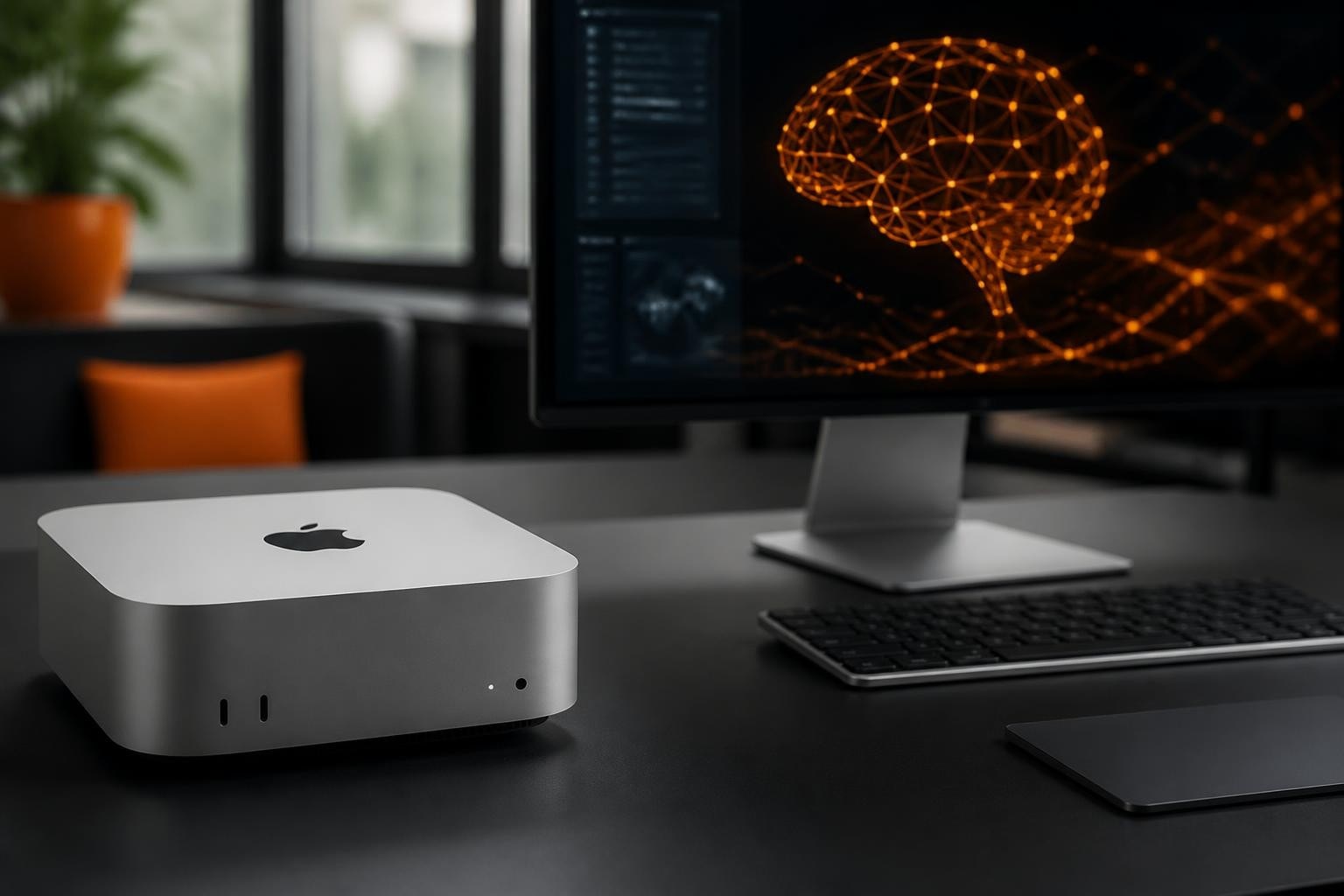

The intersection of compact computing and artificial intelligence has reached a remarkable milestone with the Mac Mini AI capabilities now available to businesses. In particular, as organisations increasingly seek powerful yet space-efficient solutions for their AI workloads, Apple’s latest M4-powered Mac Mini has emerged as a compelling option. Furthermore, this small-form-factor device delivers performance that rivals traditional server infrastructure whilst consuming a fraction of the energy, making it particularly attractive for businesses prioritising both capability and sustainability.
Moreover, the integration of advanced neural processing capabilities positions the Mac Mini AI as a versatile tool for deploying AI agents, running machine learning models, and processing data-intensive tasks without the overhead of larger computing infrastructure. As a result, organisations can access powerful AI capabilities in a compact and cost-effective platform. Consequently, the Mac Mini is becoming an increasingly attractive choice for businesses looking to modernise their AI strategy while maintaining operational efficiency.
Understanding Mac Mini AI Capabilities
The M4 Mac Mini represents a significant leap forward in bringing artificial intelligence processing to compact computing platforms. Therefore, businesses can now deploy sophisticated AI workloads on devices that occupy minimal physical space whilst delivering exceptional computational power. The M4 chip architecture includes dedicated neural processing units capable of handling up to 38 trillion operations per second, which consequently enables real-time AI inference and training tasks.
Neural Engine Architecture
The neural engine embedded within the M4 chip transforms how the mac mini ai processes machine learning workloads. In addition to the standard CPU and GPU cores, this dedicated AI accelerator handles tasks such as:
- Natural language processing for customer service automation
- Image recognition and classification systems
- Predictive analytics for business intelligence
- Real-time data pattern analysis
- Voice recognition and processing
Nevertheless, the true advantage lies in how efficiently these operations execute compared to traditional CPU-based processing, reducing both time and energy consumption significantly.
Performance Benchmarks
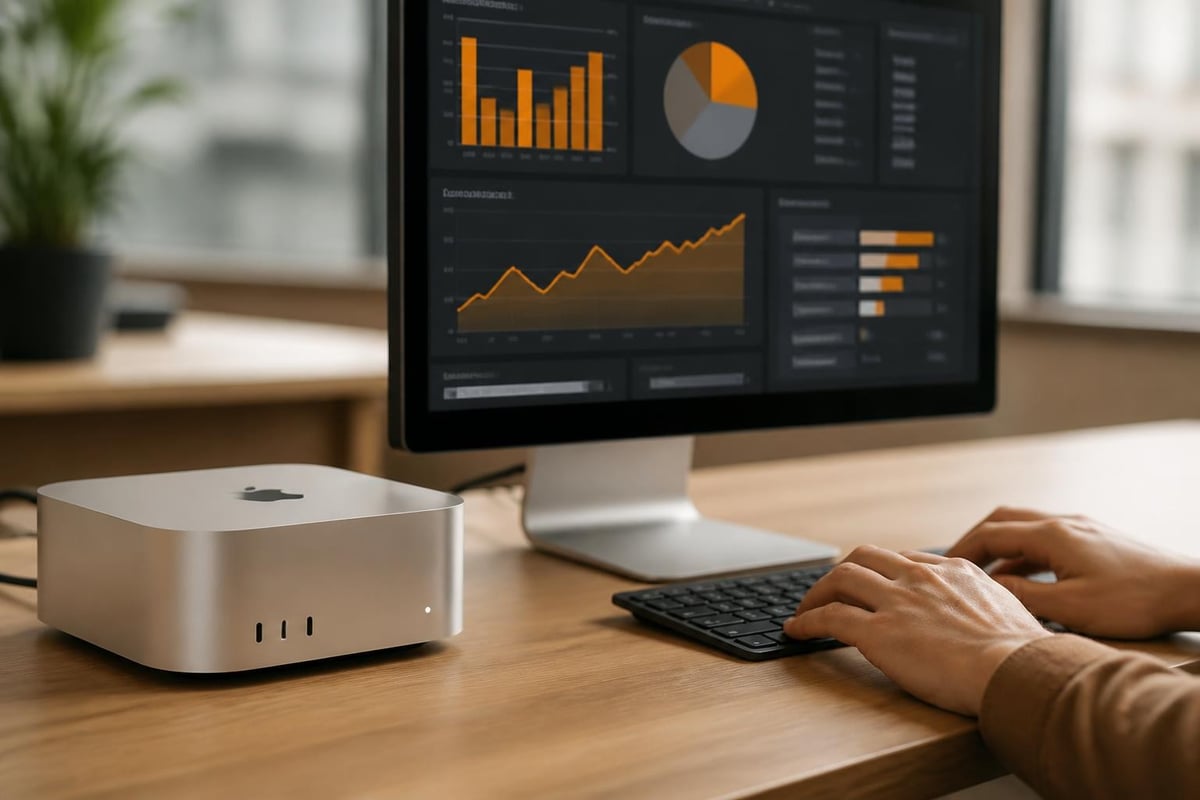
When evaluating the mac mini ai for business deployment, understanding performance metrics becomes essential. The following table illustrates key specifications:
| Component | M4 Specification | AI Performance Impact |
|---|---|---|
| Neural Engine | 16-core, 38 TOPS | Accelerates ML inference by 60% |
| Unified Memory | Up to 64GB | Enables larger model deployment |
| Memory Bandwidth | 273GB/s | Reduces data bottlenecks |
| Power Consumption | 40W typical | 75% less than comparable systems |
Furthermore, these specifications demonstrate why businesses are increasingly considering the mac mini ai as a viable alternative to traditional server-based AI infrastructure.
Practical Business Applications
The versatility of the Mac Mini AI extends across numerous business use cases, making it suitable for organisations of varying sizes and requirements. Furthermore, its broad range of capabilities enables businesses to support everything from AI development and automation to data analysis and edge computing workloads. As a result, organisations can adopt AI technologies without investing in large-scale infrastructure.
Moreover, the compact nature of the device allows for flexible deployment scenarios that were not previously feasible with larger computing infrastructure. For example, it can be deployed in offices, remote locations, development environments, or edge computing setups where space and power efficiency are important considerations. Consequently, businesses gain greater flexibility in how and where they implement AI-powered solutions.
Local AI Agent Deployment
Running AI agents locally on a Mac Mini AI agent server offers businesses significant advantages in terms of data privacy and response times. Consequently, organisations handling sensitive information can process AI workloads without transmitting data to external cloud services, maintaining complete control over their intellectual property and customer data.
Local deployment scenarios include:
- Customer service automation through natural language processing agents
- Document analysis and classification for compliance and records management
- Predictive maintenance systems analysing equipment sensor data
- Financial modelling and risk assessment tools
- Content moderation and filtering applications
In addition, the low power consumption of the mac mini ai makes it economically viable to run these agents continuously, unlike power-hungry GPU servers that significantly impact operational costs.
Development and Testing Environments
Development teams benefit substantially from using the mac mini ai as a local testing platform. Therefore, developers can iterate rapidly on machine learning models without waiting for cloud-based resources or incurring usage charges. The unified memory architecture allows seamless data sharing between CPU, GPU, and neural engine components, which consequently accelerates the development cycle.
Moreover, the ability to connect up to three displays enhances productivity for data scientists and AI engineers monitoring multiple aspects of model training and performance simultaneously.
Integration with Secure Cloud Infrastructure
Whilst the mac mini ai excels at local processing, its true potential emerges when integrated with secure cloud infrastructure. Nevertheless, this hybrid approach combines the privacy and performance benefits of local processing with the scalability and backup capabilities of cloud services.
Hybrid AI Architecture
Businesses can architect solutions where the mac mini ai handles real-time inference and sensitive data processing locally, whilst leveraging cloud resources for:
- Long-term data storage and archiving ensuring regulatory compliance
- Model training on larger datasets that exceed local capacity
- Backup and disaster recovery maintaining business continuity
- Distributed processing across multiple locations
- Collaborative development environments for remote teams
Furthermore, organisations prioritising data security can implement this architecture to ensure sensitive information never leaves their premises whilst still benefiting from cloud scalability. Companies like vBoxx, specialising in secure cloud solutions, can provide the infrastructure necessary to support this hybrid approach with privacy-focused hosting and reliable backup services.

Data Synchronisation Strategies
Implementing effective data synchronisation between local mac mini ai systems and cloud infrastructure requires careful planning. Therefore, businesses must consider:
| Consideration | Local Processing | Cloud Processing | Hybrid Approach |
|---|---|---|---|
| Data Privacy | Excellent | Variable | Good |
| Scalability | Limited | Excellent | Good |
| Latency | Minimal | Variable | Optimised |
| Cost Predictability | High | Variable | Moderate |
| Maintenance Burden | Low | Minimal | Moderate |
In addition, selecting appropriate synchronisation intervals and determining which data requires cloud backup versus local-only storage becomes crucial for optimising both security and performance.
Energy Efficiency and Sustainability
The environmental impact of computing infrastructure has become a critical consideration for businesses. Consequently, the mac mini ai’s energy efficiency positions it as an attractive option for organisations committed to sustainability.
Power Consumption Analysis
Traditional AI server infrastructure typically consumes between 200-400 watts continuously, whereas the mac mini ai operates at approximately 40 watts during typical AI workloads. Therefore, deploying ten Mac Mini units for distributed AI processing still consumes less power than two traditional servers, whilst potentially delivering comparable or superior performance for inference tasks.
Moreover, this efficiency translates directly into operational cost savings:
- Reduced electricity costs of approximately 80% compared to traditional servers
- Lower cooling requirements decreasing HVAC expenses
- Minimal heat generation enabling deployment in standard office environments
- Smaller UPS requirements reducing infrastructure investment
- Extended hardware lifespan through lower thermal stress
Nevertheless, businesses must balance these benefits against their specific workload requirements, as some intensive training tasks may still necessitate larger infrastructure.
Green Computing Initiatives
Organisations implementing green computing strategies find the mac mini ai aligns well with sustainability goals. Furthermore, the compact design reduces material usage in manufacturing, and Apple’s commitment to recycled materials in construction supports circular economy principles. In addition, the device’s longevity and upgrade path reduce electronic waste compared to frequently replaced traditional server hardware.
Security Considerations for AI Workloads
Deploying AI systems introduces unique security challenges that businesses must address. Therefore, understanding how the mac mini ai handles security becomes essential for organisations processing sensitive data or proprietary models.
On-Device Processing Benefits
The ability to process AI workloads entirely on-device provides significant security advantages:
- Data residency control ensuring information never leaves approved locations
- Reduced attack surface by eliminating network transmission vulnerabilities
- Air-gap capability for highly sensitive environments
- Compliance simplification with data protection regulations
- Intellectual property protection for proprietary models and algorithms
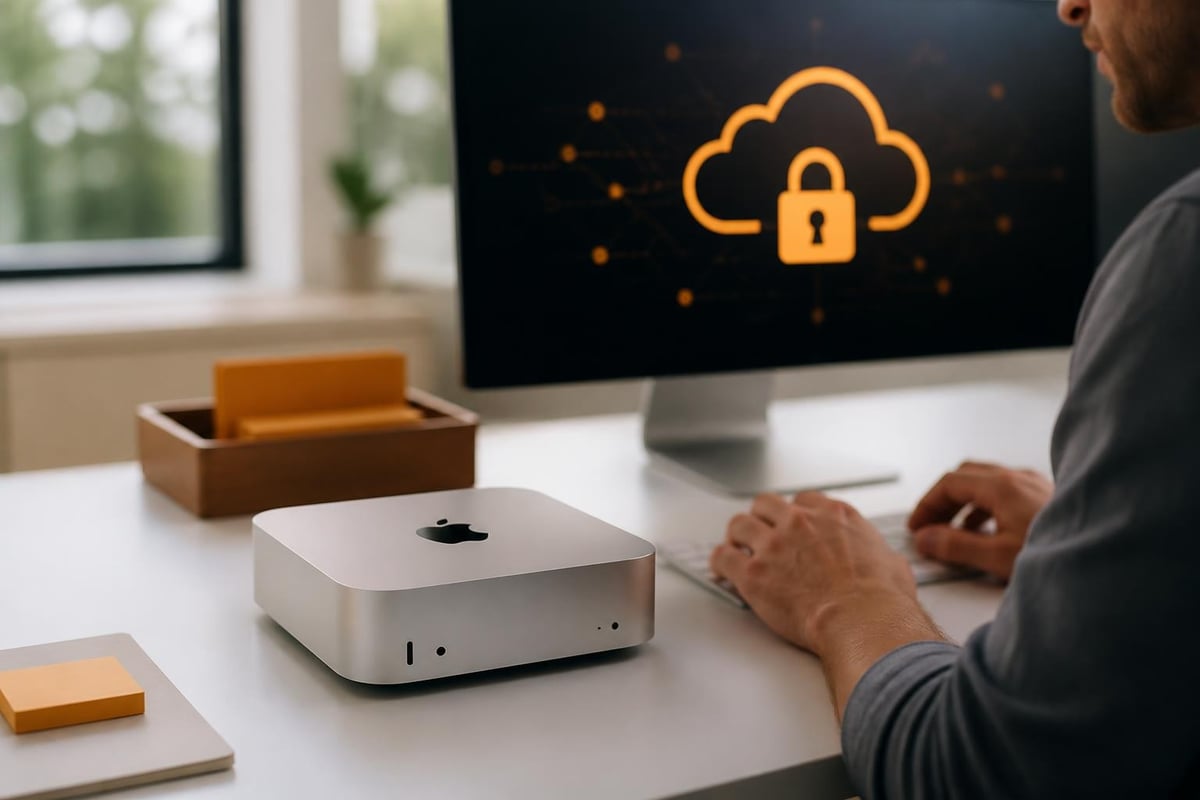
Moreover, the mac mini ai’s integrated security features, including the Secure Enclave and encrypted storage, provide hardware-level protection for AI models and training data. Consequently, businesses can deploy AI capabilities without compromising their security posture.
Network Security Integration
When the mac mini ai connects to broader infrastructure, implementing appropriate network security becomes crucial. Nevertheless, several strategies enhance protection:
- Network segmentation isolating AI systems from general corporate networks
- VPN tunnelling for remote access and cloud synchronisation
- Certificate-based authentication preventing unauthorised access
- Encrypted data transmission protecting information in transit
- Regular security audits identifying potential vulnerabilities
Furthermore, organisations can leverage enterprise mobile device management systems to enforce security policies across their mac mini ai deployments, ensuring consistent protection regardless of physical location.
Model Deployment and Management
Successfully deploying AI models on the mac mini ai requires understanding the platform’s capabilities and limitations. Therefore, businesses must carefully select appropriate models and optimisation strategies to maximise performance.
Supported Frameworks and Tools
The mac mini ai supports a comprehensive ecosystem of AI development frameworks:
- Core ML for optimised on-device inference
- TensorFlow with Metal acceleration
- PyTorch leveraging unified memory architecture
- ONNX Runtime for cross-platform model compatibility
- Create ML for simplified model development
In addition, Apple’s optimisation tools automatically convert models to leverage the neural engine efficiently, consequently reducing the technical expertise required for deployment. Moreover, these frameworks support quantisation and pruning techniques that enable larger models to run effectively within the device’s memory constraints.
Performance Optimisation Strategies
Maximising the mac mini ai’s performance requires implementing several optimisation techniques:
| Technique | Performance Gain | Implementation Complexity |
|---|---|---|
| Model Quantisation | 2-4x faster | Moderate |
| Neural Engine Targeting | 3-5x faster | Low |
| Batch Processing | 1.5-2x faster | Low |
| Memory Optimisation | Variable | High |
| Mixed Precision | 1.5-2x faster | Moderate |
Nevertheless, businesses should benchmark their specific workloads to determine which optimisations provide the greatest benefit for their use cases. Furthermore, the unified memory architecture allows for creative optimisation strategies that wouldn’t be possible on traditional separated memory systems.
Cost-Benefit Analysis for Businesses
Evaluating whether the mac mini ai represents a sound investment requires examining both immediate and long-term financial implications. Therefore, organisations should consider total cost of ownership rather than merely initial purchase price.
Initial Investment Requirements
The base configuration mac mini ai starts at a competitive price point compared to traditional AI infrastructure. Moreover, when factoring in:
- Eliminated server room requirements reducing facility costs
- Minimal cooling infrastructure needed
- Standard desk deployment capability avoiding specialised equipment
- Lower power distribution requirements simplifying electrical infrastructure
- Reduced maintenance contracts due to reliability
Consequently, the total initial investment often proves significantly lower than equivalent performance traditional systems. In addition, businesses can deploy incrementally, adding units as requirements grow rather than over-provisioning expensive server infrastructure.
Return on Investment Timeline
Most organisations deploying the mac mini ai for business applications report positive ROI within twelve to eighteen months. Furthermore, this timeline accounts for:
- Energy savings accumulating monthly
- Productivity improvements from faster AI inference
- Reduced cloud computing charges for local processing
- Lower IT maintenance burden freeing staff for strategic projects
- Improved decision-making through accessible AI capabilities
Nevertheless, specific timelines vary based on utilisation patterns and the value generated by AI-powered insights for individual organisations. Moreover, businesses should establish clear metrics before deployment to accurately track return on investment.
Future-Proofing AI Infrastructure
As artificial intelligence capabilities evolve rapidly, ensuring infrastructure remains relevant becomes essential. Therefore, understanding the mac mini ai’s upgrade path and compatibility roadmap helps businesses make informed long-term decisions.
Ecosystem Evolution
Apple’s commitment to advancing its silicon architecture suggests continued performance improvements in future iterations. Furthermore, the standardised software frameworks ensure models developed today will continue functioning on future hardware with minimal modification. In addition, the official Mac Mini specifications demonstrate Apple’s focus on maintaining compatibility whilst advancing capabilities.
Moreover, businesses benefit from:
- Consistent software updates extending device lifespan
- Framework compatibility across generations
- Unified development environment reducing retraining costs
- Trade-in programmes enabling cost-effective upgrades
- Ecosystem integration with other Apple business products
Consequently, organisations investing in mac mini ai infrastructure can expect several years of productive use before replacement becomes necessary, unlike rapidly obsolescent traditional AI hardware.
The mac mini ai represents a transformative approach to deploying artificial intelligence capabilities within business environments, combining powerful processing with energy efficiency and compact design. Furthermore, its integration potential with secure cloud infrastructure enables organisations to balance local processing benefits with scalable cloud resources effectively. When businesses require reliable, privacy-focused cloud solutions to complement their AI infrastructure, partnering with providers like vBoxx ensures their data remains secure whilst leveraging the full potential of hybrid computing architectures for sustainable digital transformation.