Private cloud hosting services have emerged as a critical infrastructure choice for organisations prioritising data sovereignty, security, and operational control. Furthermore, as businesses navigate increasingly complex regulatory landscapes and cybersecurity challenges in 2026, the demand for dedicated cloud environments continues to accelerate. Unlike public cloud offerings that share resources across multiple tenants, private cloud solutions deliver exclusive infrastructure tailored to individual organisational requirements. Therefore, understanding the nuances of these services becomes essential for making informed infrastructure decisions.
Understanding Private Cloud Infrastructure Architecture
Private cloud hosting services represent a computing model where infrastructure resources serve a single organisation exclusively. Moreover, this dedicated approach fundamentally differentiates private clouds from their public counterparts, offering enhanced control over every layer of the technology stack.
Core Components and Design Principles
The foundation of any private cloud environment consists of several interconnected elements that work cohesively to deliver computing resources. Nevertheless, the implementation approach varies significantly depending on business requirements and technical capabilities.
Essential infrastructure components include:
- Virtualisation layer enabling resource abstraction and allocation
- Orchestration tools managing automated provisioning and scaling
- Storage systems providing persistent data management
- Networking infrastructure ensuring secure connectivity
- Management platforms enabling monitoring and governance
Furthermore, private cloud computing emphasises self-service capabilities, allowing authorised users to provision resources without manual intervention from IT teams. In addition, this automation significantly reduces deployment times whilst maintaining stringent security controls.
| Architecture Type | Location | Management | Best For |
|---|---|---|---|
| On-Premises | Internal data centre | In-house team | Maximum control requirements |
| Hosted | Provider facility | Shared responsibility | Capital expenditure reduction |
| Managed | Provider facility | External team | Limited IT resources |
| Virtual | Existing infrastructure | Hybrid approach | Gradual cloud adoption |

Deployment Models and Configuration Options
Organisations implementing private cloud hosting services must choose between various deployment strategies based on their specific circumstances. Therefore, evaluating factors such as budget constraints, compliance requirements, and internal expertise becomes paramount.
The on-premises model places all infrastructure within the organisation’s physical boundaries, delivering absolute control over hardware and data location. Nevertheless, this approach demands substantial capital investment and ongoing maintenance commitments. Conversely, hosted private clouds leverage provider facilities whilst maintaining dedicated resources for individual clients.
Moreover, different types of private cloud infrastructures serve distinct business needs. Virtual private clouds, for instance, create isolated segments within existing infrastructure using software-defined networking and security policies. In addition, this approach offers flexibility for organisations testing cloud strategies before committing to dedicated hardware.
Security and Compliance Advantages
Private cloud hosting services excel in environments where data protection and regulatory compliance represent non-negotiable requirements. Furthermore, the exclusive nature of these platforms enables organisations to implement security controls precisely matching their risk profiles.
Enhanced Data Protection Mechanisms
Dedicated infrastructure eliminates the multi-tenancy vulnerabilities inherent in shared environments. Therefore, organisations gain complete visibility into their security posture, controlling access at every network layer and application tier.
Key security benefits include:
- Isolated network segments preventing lateral movement
- Customisable encryption standards for data at rest and in transit
- Granular access controls aligned with organisational policies
- Physical security measures tailored to specific requirements
- Audit trail capabilities supporting forensic analysis
In addition, how private clouds function allows businesses to maintain air-gapped environments for particularly sensitive workloads. Nevertheless, achieving optimal security requires ongoing vigilance and regular assessment of emerging threats.
Regulatory Compliance and Data Sovereignty
Organisations operating in heavily regulated sectors face stringent requirements regarding data handling, storage, and processing. Moreover, private cloud hosting services provide the architectural foundation necessary for demonstrating compliance with frameworks such as GDPR, HIPAA, and industry-specific mandates.
Data residency becomes particularly crucial for European businesses subject to strict privacy regulations. Furthermore, private clouds enable organisations to guarantee that information never crosses jurisdictional boundaries, addressing sovereignty concerns that public cloud models cannot always satisfy.
| Compliance Framework | Key Requirements | Private Cloud Advantage |
|---|---|---|
| GDPR | Data residency, privacy controls | Geographic placement certainty |
| HIPAA | Patient data protection | Dedicated security controls |
| PCI DSS | Payment card security | Isolated cardholder environments |
| ISO 27001 | Information security management | Customisable security policies |
Therefore, businesses can design their infrastructure around compliance requirements rather than adapting to predetermined provider configurations. In addition, this flexibility proves invaluable when audit requirements demand specific technical implementations or documentation approaches.

Performance Optimisation and Resource Management
Private cloud hosting services deliver predictable performance characteristics that shared infrastructure cannot guarantee. Nevertheless, realising these benefits requires thoughtful architecture and ongoing optimisation efforts.
Workload Placement and Resource Allocation
Dedicated resources eliminate the “noisy neighbour” phenomenon where one tenant’s activities impact others sharing the same physical infrastructure. Furthermore, organisations gain the ability to fine-tune resource allocation based on application requirements and business priorities.
Performance optimisation strategies include:
- Quality of Service (QoS) policies ensuring critical applications receive priority
- Resource reservation guaranteeing availability during peak demand
- Storage tiering placing frequently accessed data on high-performance media
- Network segmentation reducing latency for time-sensitive communications
- Capacity planning aligning infrastructure growth with business expansion
Moreover, private clouds enable organisations to provision resources exceeding typical public cloud instance sizes when applications demand exceptional compute power or memory. In addition, this flexibility proves essential for specialised workloads such as data analytics, machine learning training, or high-performance computing.
Scalability Considerations and Growth Planning
Whilst public clouds offer theoretically unlimited scaling, private cloud hosting services require more deliberate capacity planning. Therefore, organisations must balance the agility of on-demand provisioning with the physical constraints of dedicated infrastructure.
Nevertheless, modern private cloud platforms provide substantial elasticity within their defined boundaries. Furthermore, automation tools enable rapid provisioning of virtual machines, storage volumes, and network resources without manual hardware configuration.
For businesses experiencing predictable growth patterns, private clouds often deliver superior economics compared to variable public cloud pricing. In addition, the ability to depreciate capital investments over multiple years provides financial predictability that operational expenditure models cannot match.
Cost Analysis and Financial Planning
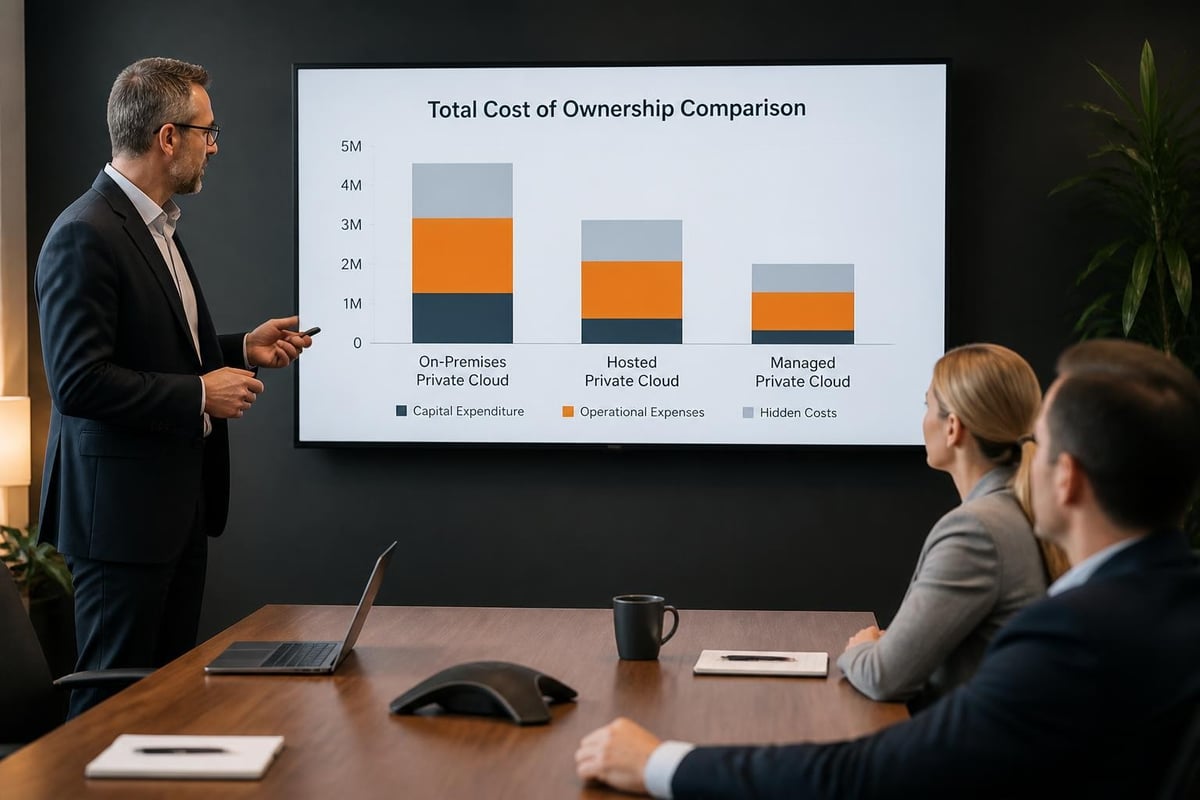
Understanding the total cost of ownership for private cloud hosting services requires examining both visible expenses and hidden operational factors. Moreover, the financial equation varies significantly depending on deployment models and organisational capabilities.
Capital Versus Operational Expenditure Models
On-premises private clouds demand substantial upfront investment in hardware, software licences, and facility preparation. Nevertheless, these capital expenditures distribute across the infrastructure’s useful life, potentially offering lower long-term costs for stable workloads.
Conversely, hosted and managed private cloud services convert infrastructure spending to operational expenses with predictable monthly charges. Furthermore, this model eliminates hardware refresh cycles and reduces the expertise required for physical infrastructure management.
| Cost Factor | On-Premises | Hosted Private Cloud |
|---|---|---|
| Initial investment | High | Low to moderate |
| Monthly fees | Minimal | Moderate to high |
| Hardware refresh | 3-5 year cycles | Provider responsibility |
| Facility costs | Significant | Included in fees |
| IT staffing | Dedicated team required | Reduced requirements |
Therefore, organisations must evaluate their financial preferences alongside technical requirements when selecting deployment approaches. In addition, hybrid strategies combining owned and hosted resources offer middle-ground solutions balancing control and flexibility.
Hidden Costs and Long-Term Considerations
Beyond obvious infrastructure expenses, private cloud hosting services incur operational costs that deserve careful consideration. Moreover, these factors often determine whether private cloud investments deliver anticipated value.
Often overlooked expenses include:
- Specialised training for IT teams managing private cloud platforms
- Licensing fees for virtualisation and management software
- Power and cooling infrastructure supporting on-premises equipment
- Redundancy systems ensuring high availability
- Security tools and services protecting dedicated environments
Furthermore, organisations must account for opportunity costs when dedicating internal resources to infrastructure management rather than strategic initiatives. Nevertheless, the control and customisation benefits often justify these investments for businesses with specific security or compliance requirements.
Provider Selection and Evaluation Criteria
Choosing the right partner for private cloud hosting services demands thorough assessment of technical capabilities, service levels, and organisational alignment. Therefore, establishing clear evaluation criteria prevents costly mismatches between expectations and delivered services.
Technical Capability Assessment
Provider infrastructure forms the foundation of service quality and reliability. Moreover, organisations must verify that potential partners possess the technical expertise and resources necessary for supporting demanding workloads.
Critical evaluation factors include:
- Data centre certifications demonstrating security and reliability standards
- Network connectivity options supporting required bandwidth and latency
- Hardware specifications matching application performance requirements
- Backup and disaster recovery capabilities ensuring business continuity
- Compliance attestations relevant to your regulatory obligations
In addition, evaluating private cloud infrastructure providers requires examining their track record with similar organisations and workloads. Furthermore, requesting reference customers operating in comparable industries provides valuable insights into real-world service delivery.
For European businesses prioritising data sovereignty and privacy, selecting providers with regional infrastructure becomes particularly important. Moreover, platforms like vBoxx demonstrate how cloud solutions can combine security, sustainability, and comprehensive service offerings. In addition, exploring options through resources like a demonstration of all-in-one cloud platforms helps organisations understand how integrated solutions address multiple business requirements simultaneously.
Service Level Agreements and Support Structures
Private cloud hosting services depend on robust support frameworks ensuring rapid issue resolution and ongoing optimisation. Nevertheless, service level agreements vary dramatically between providers, making careful comparison essential.
| SLA Component | Questions to Ask | Importance |
|---|---|---|
| Uptime guarantee | What percentage? What credits for failures? | Critical |
| Support availability | 24/7 or business hours? Response times? | High |
| Performance metrics | What guarantees? How measured? | High |
| Security incident response | What procedures? How quickly? | Critical |
| Change management | How implemented? What notice? | Moderate |
Therefore, organisations should scrutinise SLA terms before committing to long-term contracts. Furthermore, understanding escalation procedures and penalty structures ensures accountability when service delivery falls short of expectations.
Migration Strategies and Implementation Approaches
Transitioning to private cloud hosting services requires methodical planning and execution to minimise disruption whilst maximising benefits. Moreover, the complexity of migration efforts scales with existing infrastructure sophistication and application interdependencies.
Assessment and Planning Phases
Successful migrations begin with comprehensive discovery of current infrastructure, applications, and dependencies. Furthermore, this assessment phase identifies which workloads suit private cloud deployment and which might require alternative approaches.
Migration planning considerations include:
- Application inventory cataloguing all systems and their requirements
- Dependency mapping revealing interconnections between components
- Performance baseline establishing current metrics for comparison
- Compliance review ensuring migration maintains regulatory adherence
- Risk analysis identifying potential challenges and mitigation strategies
In addition, organisations must decide between “lift and shift” approaches that move existing configurations intact versus re-architecting applications to leverage cloud-native capabilities. Nevertheless, each strategy presents distinct trade-offs between speed, cost, and long-term optimisation.
Execution and Validation Procedures
Phased migration approaches reduce risk by validating each step before proceeding. Therefore, starting with non-critical workloads allows teams to refine processes before migrating business-essential systems.
Moreover, thorough testing at each stage ensures applications function correctly in their new environment. Furthermore, maintaining parallel systems during transition periods provides fallback options if unexpected issues emerge.
Post-migration validation confirms that performance, security, and availability meet established requirements. In addition, this phase identifies optimisation opportunities that only become apparent once workloads run in the private cloud environment.
Integration with Existing Infrastructure
Private cloud hosting services rarely operate in isolation, instead connecting with on-premises systems, public cloud resources, and third-party services. Therefore, designing robust integration patterns becomes essential for maximising infrastructure value.
Hybrid Cloud Architectures
Many organisations adopt hybrid approaches combining private cloud hosting services with public cloud platforms and traditional infrastructure. Moreover, this strategy leverages each environment’s strengths whilst mitigating individual weaknesses.
Hybrid integration patterns include:
- Workload placement based on security, performance, and cost requirements
- Data synchronisation maintaining consistency across environments
- Identity federation enabling unified access control
- Network connectivity establishing secure communication channels
- Orchestration platforms coordinating resources across boundaries
Furthermore, understanding what constitutes a private cloud helps organisations design architectures that appropriately segment workloads based on their characteristics. Nevertheless, hybrid complexity demands sophisticated management tools and skilled personnel.
API Integration and Automation Frameworks
Modern private cloud platforms expose programmatic interfaces enabling automation and integration with external systems. Therefore, organisations can build custom workflows spanning multiple infrastructure components and business applications.
In addition, Infrastructure as Code practices allow teams to define and deploy environments through version-controlled templates. Moreover, this approach ensures consistency, accelerates provisioning, and documents infrastructure configurations for compliance purposes.
Future Trends and Emerging Technologies
The private cloud hosting services landscape continues evolving as new technologies and methodologies emerge. Furthermore, understanding these trends helps organisations make forward-looking infrastructure decisions that remain relevant beyond immediate requirements.
Edge Computing and Distributed Architectures
As applications demand lower latency and local data processing, private clouds increasingly extend to edge locations. Moreover, this distribution brings computing resources closer to data sources and end users, improving responsiveness whilst maintaining security controls.
Furthermore, containerisation technologies enable consistent application deployment across diverse infrastructure locations. In addition, orchestration platforms manage workloads spanning centralised private clouds and distributed edge nodes, creating cohesive hybrid architectures.
Artificial Intelligence and Machine Learning Integration
Private cloud hosting services provide the computational foundation for AI and ML workloads requiring substantial resources and data privacy. Nevertheless, implementing these technologies demands specialised infrastructure including GPU acceleration and high-performance storage systems.
Moreover, organisations developing proprietary AI models benefit from private cloud environments that protect intellectual property whilst providing necessary scale. Therefore, providers enhancing their platforms with AI-optimised infrastructure gain competitive advantages in serving sophisticated workloads.
Emerging capabilities include:
- Specialised hardware for AI training and inference operations
- Data pipeline tools managing ML workflow complexity
- Model governance frameworks ensuring responsible AI deployment
- Resource scheduling optimising expensive GPU utilisation
- Privacy-preserving techniques enabling collaborative learning
In addition, as AI becomes central to business operations, the control and security offered by private cloud hosting services grow increasingly valuable. Furthermore, organisations can implement AI governance policies that would prove difficult or impossible in multi-tenant public environments.
Private cloud hosting services deliver unmatched control, security, and performance for organisations with specific infrastructure requirements that public clouds cannot adequately address. Moreover, selecting the right deployment model and provider partner determines whether these investments deliver anticipated value. vBoxx combines secure cloud infrastructure with comprehensive business solutions, emphasising privacy, sustainability, and reliability for European organisations navigating complex digital transformation challenges.