In today's digital landscape, businesses require robust storage solutions that combine performance, reliability, and security. Furthermore, the demand for scalable infrastructure has never been greater, particularly for organisations managing sensitive data across cloud environments. The rs822 represents a sophisticated approach to enterprise storage, offering rack-mounted capabilities designed specifically for businesses that cannot compromise on data integrity or accessibility. Moreover, understanding the technical specifications and practical applications of such systems becomes essential for organisations seeking to modernise their IT infrastructure whilst maintaining stringent security standards.
Understanding the RS822 RackStation Architecture
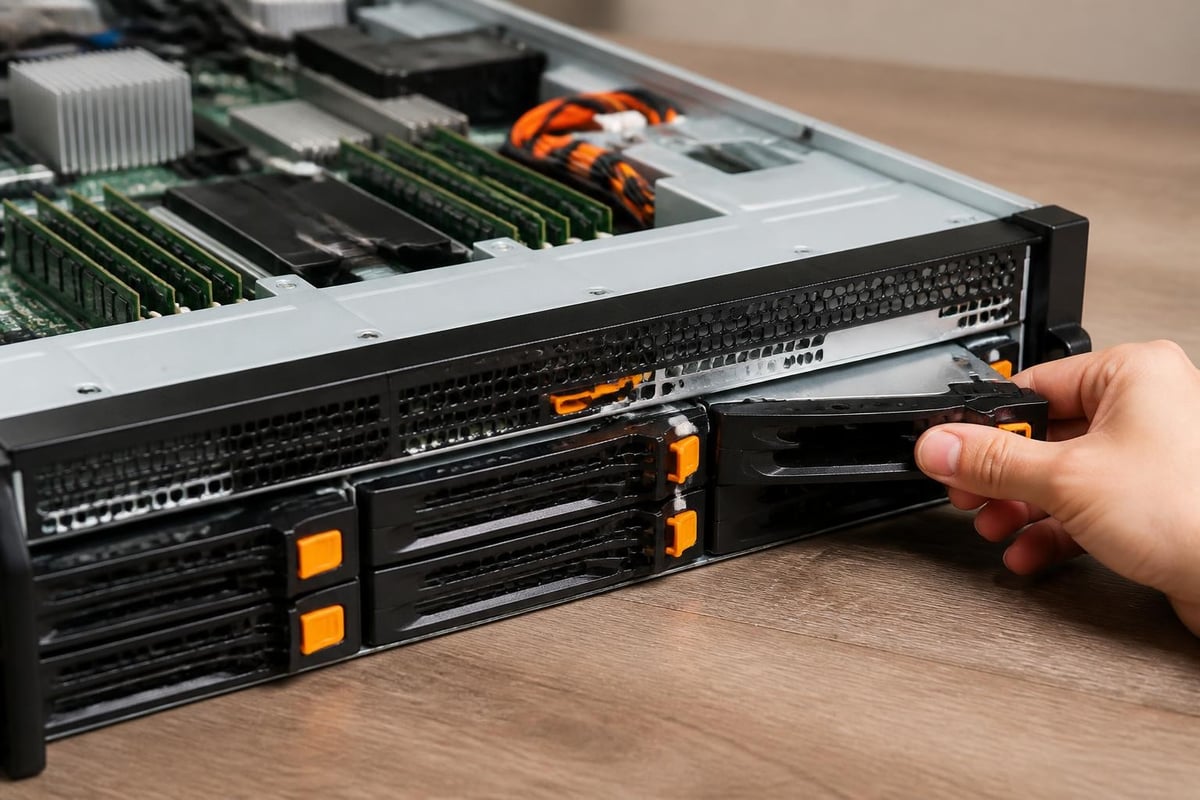
The Synology RS822+ delivers a compact yet powerful solution for businesses requiring professional-grade network-attached storage. This 1U rackmount system supports four drive bays, therefore providing an ideal balance between physical footprint and storage capacity. In addition, the architecture accommodates both traditional hard drives and solid-state drives, allowing organisations to optimise performance based on specific workload requirements.
Core Technical Specifications
The rs822 operates on a quad-core AMD Ryzen processor, consequently delivering processing power that handles multiple concurrent operations efficiently. Nevertheless, what distinguishes this system is its memory configuration, featuring 2GB DDR4 ECC RAM that's expandable to 32GB. This scalability ensures the system grows alongside business requirements.
Key hardware features include:
- Four hot-swappable drive bays with tool-free installation
- Dual M.2 NVMe SSD slots for cache acceleration
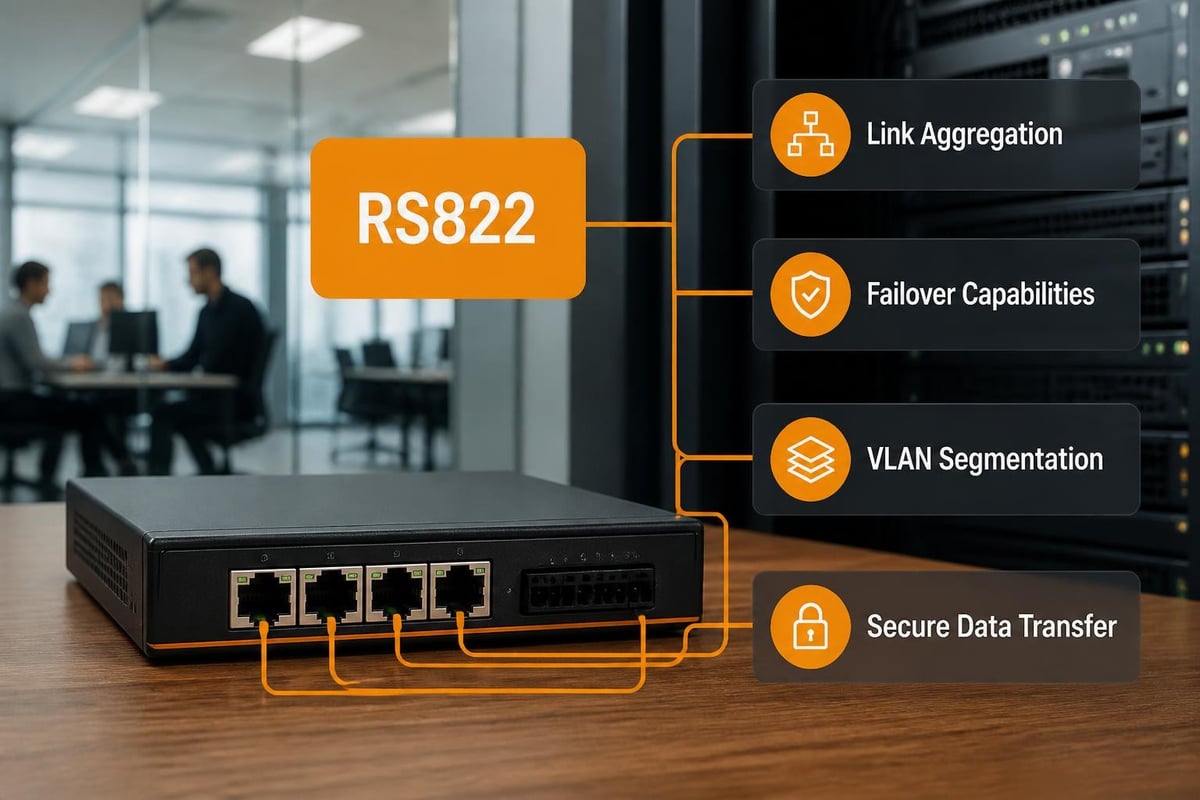
- Four Gigabit Ethernet ports with failover and link aggregation support
- Redundant power supply capability for enhanced reliability
- Compact 1U form factor suitable for standard 19-inch racks
Furthermore, the system's thermal design incorporates intelligent fan control, maintaining optimal operating temperatures whilst minimising noise levels. This consideration proves particularly valuable in office environments where equipment must coexist with personnel.
Storage Capacity and Scalability Options
When evaluating the rs822 for enterprise deployment, storage capacity planning becomes paramount. Therefore, organisations must consider both immediate requirements and future growth trajectories. The four-bay configuration supports drives up to 20TB each, consequently enabling a maximum raw capacity of 80TB in a single unit.
| Configuration | Drive Type | Capacity Per Drive | Total Raw Capacity | Use Case |
|---|---|---|---|---|
| Performance | SSD | 4TB | 16TB | High IOPS applications |
| Balanced | HDD (7200 RPM) | 12TB | 48TB | General business storage |
| Capacity | HDD (Enterprise) | 20TB | 80TB | Archive and backup |
Moreover, the dual M.2 slots provide cache acceleration without consuming primary drive bays. This design choice allows businesses to maintain full storage capacity whilst enhancing performance for frequently accessed data. In addition, the cache implementation reduces latency for virtual machine hosting and database operations.
RAID Configuration Strategies
The rs822 supports multiple RAID levels, allowing administrators to balance redundancy against usable capacity. Nevertheless, selecting the appropriate RAID configuration requires careful analysis of business continuity requirements and acceptable risk levels.
Recommended RAID configurations:
- RAID 5: Single drive fault tolerance with efficient capacity utilisation (75% usable)
- RAID 6: Dual drive failure protection for critical data (50% usable)
- RAID 10: Maximum performance with mirroring (50% usable)
- SHR-2: Synology Hybrid RAID for flexible expansion and dual-drive protection
Furthermore, the system supports hot spare configuration, automatically rebuilding arrays when drive failures occur. This automated recovery mechanism minimises administrative overhead whilst maintaining data availability.
Network Performance and Connectivity
The rs822 incorporates four Gigabit Ethernet ports, therefore enabling sophisticated network configurations. Moreover, these ports support link aggregation, potentially delivering up to 4Gbps throughput when connected to compatible network infrastructure. In addition, failover capabilities ensure continuous operation even when individual network connections experience disruptions.
Optimising Network Configuration
Organisations deploying the rs822 benefit from implementing strategic network segmentation. Consequently, separating management traffic from data transfer operations enhances both security and performance. Nevertheless, proper VLAN configuration requires coordination with existing network architecture.
Network optimisation strategies include:
- Dedicating specific ports to backup operations
- Implementing QoS policies for prioritising critical applications
- Utilising jumbo frames for large file transfers
- Configuring port trunking for increased bandwidth
Furthermore, the system's network stack supports advanced protocols including SMB3 multipath, which distributes traffic across multiple connections simultaneously. This capability proves particularly valuable when serving multiple virtualisation hosts or handling concurrent user sessions.
Security Features and Data Protection
Security considerations remain paramount when deploying storage infrastructure, particularly for organisations handling sensitive business information. Therefore, the rs822 implements multiple security layers addressing authentication, encryption, and access control. Moreover, these features align with compliance requirements common in regulated industries.
Encryption and Access Control
The system supports AES-256 encryption for both data at rest and in-transit operations. Consequently, organisations can ensure confidentiality even if physical drives are compromised. In addition, the rs822 integrates with directory services including Active Directory and LDAP, enabling centralised user management and single sign-on capabilities.
| Security Feature | Implementation | Business Benefit |
|---|---|---|
| Volume Encryption | AES-256 | Protects data at rest |
| SSL/TLS Certificates | Let's Encrypt integration | Secures web-based access |
| Two-Factor Authentication | TOTP, hardware keys | Strengthens authentication |
| IP Auto-Block | Failed login prevention | Mitigates brute force attacks |
| Firewall | Built-in packet filtering | Controls network access |
Furthermore, audit logging capabilities track all system access and modifications, providing the visibility required for security monitoring and compliance reporting. Nevertheless, administrators must establish appropriate log retention policies to balance storage consumption against investigation capabilities.
Virtualisation and Application Deployment
The rs822 serves as an effective platform for lightweight virtualisation workloads, therefore enabling businesses to consolidate infrastructure. Moreover, the system's Virtual Machine Manager supports multiple operating systems, including Windows Server, various Linux distributions, and Virtual DSM instances. In addition, containerised applications through Docker integration provide flexible deployment options for modern microservices architectures.
Performance Considerations for Virtual Workloads
When hosting virtual machines on the rs822, resource allocation requires careful planning. Consequently, organisations must consider CPU, memory, and storage IOPS requirements for each workload. Nevertheless, the system's expandable memory configuration provides headroom for growing virtualisation demands.
Recommended virtual machine configurations:
- File servers and domain controllers (2GB RAM, moderate IOPS)
- Development and testing environments (4GB RAM, variable IOPS)
- Monitoring and logging systems (1GB RAM, low IOPS)
Furthermore, implementing SSD caching dramatically improves virtual machine responsiveness, particularly during boot operations and application launches. This performance enhancement becomes especially noticeable when running multiple concurrent virtual machines.
Backup and Disaster Recovery Capabilities
Implementing comprehensive backup strategies with the rs822 ensures business continuity in the face of data loss scenarios. Therefore, organisations should leverage the system's integrated backup solutions alongside external replication capabilities. Moreover, the platform supports multiple backup methodologies, enabling layered protection approaches.
Hybrid Backup Strategies
The rs822's backup capabilities extend beyond simple file copying, incorporating versioning, deduplication, and compression technologies. Consequently, storage efficiency improves whilst maintaining multiple recovery points. In addition, snapshot technology provides near-instantaneous point-in-time recovery options for critical volumes.
Essential backup components include:
- Scheduled snapshots with configurable retention policies
- Replication to remote systems for off-site protection
- Cloud synchronisation to major providers
- USB/eSATA external drive support for local backups
- Application-aware backups for databases and mail systems
Furthermore, businesses can implement the 3-2-1 backup rule effectively using the rs822 as the primary repository whilst replicating to both local and cloud destinations. Nevertheless, testing recovery procedures regularly remains crucial for validating backup integrity.

Integration with Business Applications
The rs822 functions as more than simple storage, therefore serving as an application platform for essential business services. Moreover, the system's package centre provides pre-configured applications covering collaboration, surveillance, and productivity requirements. In addition, businesses seeking to experience comprehensive cloud solutions can explore guided demonstrations that showcase secure file sharing, email hosting, and password management capabilities within integrated platforms.
Productivity and Collaboration Tools
File synchronisation and sharing capabilities enable businesses to maintain control over sensitive documents whilst providing convenient access for distributed teams. Consequently, organisations reduce dependence on external cloud providers that may not align with privacy requirements. Nevertheless, proper user training ensures adoption and maximises return on investment.
Popular business applications include:
- Synology Drive for file synchronisation and versioning
- Synology Office for collaborative document editing
- Calendar and Contacts Server for PIM synchronisation
- Chat for secure internal communications
- MailPlus for self-hosted email infrastructure
Furthermore, the system's API access enables integration with custom business applications and automation workflows. This extensibility allows organisations to build tailored solutions addressing specific operational requirements.
Hardware Expansion and Upgrade Paths
Understanding upgrade possibilities ensures the rs822 continues meeting business requirements as demands evolve. Therefore, organisations should evaluate expansion options during initial deployment planning. Moreover, the system supports both internal component upgrades and external storage expansion through compatible units.
Memory and Storage Expansion
The rs822's memory expandability represents a significant advantage for growing businesses. Consequently, initial deployments with base memory configurations can scale to 32GB as virtualisation or application demands increase. In addition, external expansion units connect via eSATA, adding additional drive bays without requiring complete system replacement.
| Upgrade Component | Base Specification | Maximum Specification | Impact |
|---|---|---|---|
| System Memory | 2GB DDR4 ECC | 32GB DDR4 ECC | Enhanced multitasking |
| Storage Bays | 4 internal | 4 internal + expansion units | Increased capacity |
| Network Speed | 4x 1GbE | PCIe network card options | Higher throughput |
| Cache | None | 2x M.2 NVMe SSDs | Improved performance |
Furthermore, the download centre provides access to firmware updates and utilities that enhance functionality over time. Nevertheless, organisations should implement change management procedures for production systems, testing updates in non-critical environments before broader deployment.
Monitoring and Management Tools
Effective system administration requires comprehensive monitoring capabilities, therefore the rs822 incorporates extensive management interfaces. Moreover, administrators can access the system through web-based interfaces, mobile applications, and command-line tools depending on task requirements. In addition, SNMP support enables integration with enterprise monitoring platforms.
Proactive System Health Monitoring
The system continuously monitors critical parameters including temperature, drive health, and resource utilisation. Consequently, administrators receive notifications before minor issues escalate into service disruptions. Nevertheless, configuring appropriate alert thresholds prevents notification fatigue whilst ensuring awareness of genuine concerns.
Key monitoring features include:
- Real-time resource graphs for CPU, memory, and network
- SMART attribute tracking for predictive drive failure detection
- Storage pool health and degraded array alerts
- Log analysis tools for troubleshooting and security auditing
- Email and SMS notifications for critical events
Furthermore, the Resource Monitor application provides detailed visibility into processes, connections, and storage operations. This granular insight proves invaluable when diagnosing performance issues or capacity planning.
Energy Efficiency and Environmental Considerations
Modern data centres face increasing pressure to reduce power consumption and environmental impact. Therefore, the rs822 incorporates multiple energy-saving features that align with sustainable IT practices. Moreover, efficient operation reduces cooling requirements and extends component longevity. In addition, businesses committed to environmental responsibility benefit from demonstrable efficiency improvements.
Power Management Features
The system implements intelligent hard drive hibernation, spinning down drives during periods of inactivity. Consequently, organisations reduce power consumption without sacrificing availability for critical workloads. Nevertheless, careful configuration ensures hibernation policies align with service level expectations.
Energy-saving capabilities include:
- Scheduled power on/off for non-24/7 operations
- Configurable drive hibernation timers
- Efficient power supply designs with 80 PLUS certification
- Low-power processor modes during idle periods
Furthermore, the 1U form factor maximises rack density, allowing businesses to consolidate more capability within existing infrastructure. This space efficiency translates directly to reduced facility costs and improved resource utilisation.
Component Specifications and Hardware Insights
Understanding the underlying hardware components enhances appreciation for the rs822's capabilities and reliability. Therefore, examining specifications for critical subsystems provides context for performance expectations. Moreover, familiarity with component datasheets aids troubleshooting and upgrade planning. For organisations requiring deeper technical insights, resources like component datasheets offer detailed electrical and operational characteristics.
Processor and Chipset Architecture
The AMD Ryzen processor delivers balanced performance across diverse workloads, consequently supporting both sequential throughput and random I/O operations effectively. In addition, the processor's integrated graphics capabilities enable hardware-accelerated transcoding for media applications. Nevertheless, the system primarily focuses on storage operations rather than compute-intensive tasks.
Furthermore, high-speed interfaces including PCIe 4.0 connectivity in modern systems enable faster communication between components, reducing bottlenecks and improving overall responsiveness. This advancement particularly benefits NVMe cache operations and network interface cards.
The rs822 represents a comprehensive storage solution addressing the complex requirements of modern businesses, combining robust hardware, extensive software capabilities, and flexible expansion options. When organisations require secure, scalable infrastructure backed by expert support and sustainable practices, vBoxx delivers enterprise-grade cloud services designed around privacy, performance, and reliability. Contact vBoxx today to explore how professional hosting solutions can transform your digital infrastructure whilst maintaining the security standards your business demands.