The landscape of enterprise storage has evolved dramatically in recent years, with businesses demanding faster access to their critical data whilst maintaining robust security and reliability. The snv3410 400g represents Synology's answer to these escalating performance requirements, delivering enterprise-grade NVMe technology specifically engineered for NAS caching applications. This M.2 2280 form factor SSD combines advanced controller technology with optimized firmware to accelerate read-intensive workloads, making it an essential component for businesses seeking to enhance their storage infrastructure without compromising on data integrity or longevity.
Understanding the SNV3410 400G Architecture
The snv3410 400g utilizes PCIe 3.0 x4 interface technology, providing substantial bandwidth for data-intensive operations. Furthermore, this specification ensures compatibility with a wide range of Synology NAS models, allowing businesses to upgrade existing infrastructure without wholesale system replacements.
Technical Specifications and Performance Metrics
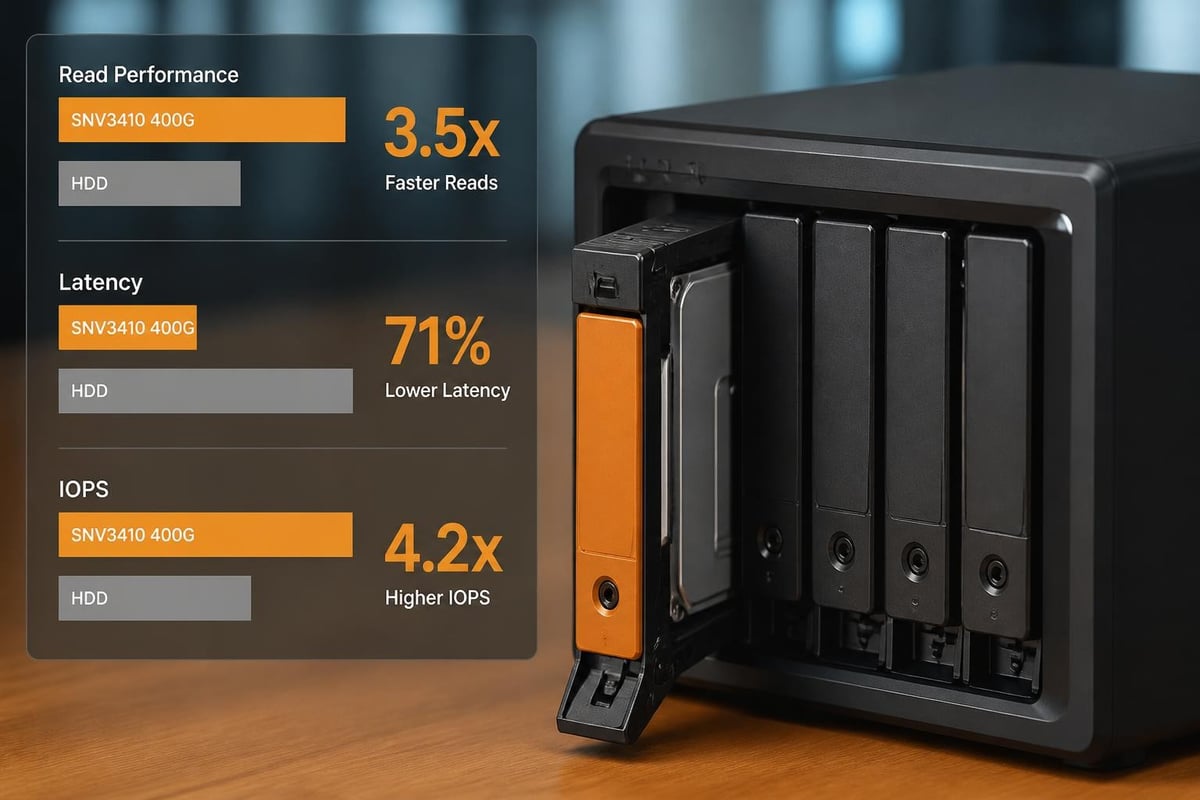
At its core, the snv3410 400g delivers sequential read speeds up to 3,000 MB/s and write speeds reaching 600 MB/s. These figures translate directly into real-world benefits:
- Reduced latency for database queries and application loading times
- Enhanced multi-user access to shared resources and collaborative files
- Accelerated virtual machine performance when deployed as cache storage
- Improved backup and restoration operations for critical business data
Moreover, the drive features a mean time between failures (MTBF) of 1.5 million hours, demonstrating exceptional reliability for continuous business operations. The endurance rating of 215 TBW (terabytes written) ensures the snv3410 400g can handle sustained workloads over extended periods.
| Specification | Value | Business Impact |
|---|---|---|
| Capacity | 400 GB | Optimal cache size for 50-100 TB storage arrays |
| Interface | PCIe 3.0 x4 NVMe | Maximum bandwidth utilization |
| Sequential Read | 3,000 MB/s | Faster file access and retrieval |
| Sequential Write | 600 MB/s | Efficient cache updates |
| MTBF | 1.5M hours | Extended operational lifespan |
| Endurance | 215 TBW | Suitable for moderate write workloads |
Power Efficiency and Thermal Management
The snv3410 400g demonstrates remarkable power efficiency, consuming merely 2.9W during active operations. Therefore, businesses benefit from reduced operational costs whilst maintaining high performance levels. The drive's thermal design allows it to operate reliably in the confined spaces of NAS enclosures without requiring additional cooling infrastructure.
Implementing SSD Cache in Business Environments
SSD caching technology fundamentally transforms how NAS systems handle frequently accessed data. Nevertheless, understanding the optimal implementation strategy ensures maximum return on investment for the snv3410 400g deployment.
Read-Write Cache vs. Read-Only Cache
Businesses must decide between two primary caching configurations when implementing the snv3410 400g. Read-only cache accelerates data retrieval operations without requiring redundancy, making it cost-effective for environments where data loss risk is minimal. In addition, this configuration maximizes the effective cache capacity available.
Conversely, read-write cache provides comprehensive performance enhancement but requires two identical SSDs operating in a RAID 1 configuration. This approach offers superior protection against cache failures whilst accelerating both read and write operations. For mission-critical applications where downtime carries significant costs, read-write caching represents the preferred solution.
Optimal Use Cases for the SNV3410 400G
The snv3410 400g excels in specific business scenarios where performance bottlenecks traditionally impede productivity:
- Database servers handling frequent queries benefit from dramatically reduced response times
- Virtual desktop infrastructure (VDI) deployments experience smoother user experiences
- Media production environments gain faster access to high-resolution assets
- Email servers managing large mailboxes see improved synchronization performance
- Collaborative workspaces with multiple concurrent users benefit from reduced latency
Furthermore, businesses operating cloud storage platforms or file sharing services find the snv3410 400g particularly valuable. When integrated with vBoxxCloud, organizations can provide users with rapid access to shared documents whilst maintaining robust security protocols and European data residency compliance.

Installation and Configuration Procedures
Deploying the snv3410 400g requires careful planning and execution to ensure optimal performance and system stability. Moreover, following manufacturer guidelines prevents common pitfalls that could compromise cache effectiveness.
Physical Installation Requirements
Before installation, verify your NAS model supports M.2 2280 form factor SSDs and includes available NVMe slots. The official product page provides comprehensive compatibility information specific to your hardware configuration.
The installation process involves:
- Powering down the NAS system completely and disconnecting all cables
- Accessing the M.2 slots according to your specific model's service manual
- Inserting the snv3410 400g at the appropriate angle and securing with retention screws
- Reassembling the chassis ensuring all connections remain secure
- Powering on and verifying drive detection through Storage Manager
Software Configuration and Optimization
Once physically installed, the snv3410 400g requires configuration through the Synology DiskStation Manager (DSM) interface. Therefore, administrators should follow the SSD cache setup tutorial to ensure proper implementation.
| Configuration Step | Recommended Setting | Rationale |
|---|---|---|
| Cache Mode | Read-only or Read-write | Based on redundancy requirements |
| Skip Sequential I/O | Enabled | Prevents cache pollution from large file transfers |
| Target Volume | Primary storage pool | Focuses acceleration on active data |
| Cache Size | Full drive capacity | Maximizes performance benefit |
Additionally, enabling the "Skip Sequential I/O" option prevents large file transfers from evicting frequently accessed data from cache. This optimization ensures the snv3410 400g focuses on genuinely random access patterns where performance gains prove most significant.
Performance Monitoring and Maintenance
Effective management of the snv3410 400g extends beyond initial installation. Nevertheless, ongoing monitoring ensures sustained performance and identifies potential issues before they impact business operations.
Key Performance Indicators
Track these critical metrics to assess cache effectiveness:
- Cache hit ratio indicating the percentage of read requests served from cache
- SMART attributes including wear levelling count and available spare capacity
- Temperature readings ensuring thermal parameters remain within specifications
- I/O latency measurements confirming performance improvements meet expectations
Furthermore, maintaining a cache hit ratio above 80% typically indicates optimal configuration and workload suitability. Lower ratios may suggest inappropriate cache sizing or workload patterns that don't benefit from caching.
Lifespan Optimization Strategies
The snv3410 400g's 215 TBW endurance rating supports approximately five years of operation under typical business workloads. Therefore, implementing these practices extends operational lifespan:
- Configure read-only cache when write operations don't require acceleration
- Enable sequential I/O skipping to reduce unnecessary write operations
- Monitor SMART data monthly to track wear indicators and plan replacements
- Maintain adequate cooling within the NAS enclosure to minimize thermal stress
- Schedule regular firmware updates to benefit from performance and reliability improvements

Integration with Enterprise Infrastructure
The snv3410 400g represents one component within a comprehensive storage strategy. Moreover, businesses must consider how SSD caching integrates with broader infrastructure requirements including backup, disaster recovery, and capacity planning.
Complementary Technologies and Solutions
Whilst the snv3410 400g accelerates primary storage access, businesses require additional solutions for complete data management. In addition, combining SSD caching with robust backup strategies ensures data protection matches performance capabilities.
Enterprises deploying the snv3410 400g should consider:
- Regular backup schedules protecting against data loss scenarios
- Offsite replication ensuring business continuity following catastrophic events
- Capacity monitoring tracking storage growth to anticipate expansion requirements
- Network infrastructure ensuring adequate bandwidth to utilize SSD performance
Furthermore, organizations seeking comprehensive cloud infrastructure might benefit from exploring integrated platforms. For instance, scheduling a demonstration of all-in-one solutions can reveal how cloud storage, communication, and security services complement on-premises NAS investments.
Capacity Planning Considerations
The 400GB capacity of the snv3410 400g suits specific deployment scenarios. Therefore, understanding the relationship between cache size and primary storage capacity ensures optimal resource allocation.
| Primary Storage | Recommended Cache | SNV3410 400G Suitability |
|---|---|---|
| 10-20 TB | 200-400 GB | Excellent match |
| 20-50 TB | 400-800 GB | Good for read-only |
| 50-100 TB | 800-1600 GB | Suitable for targeted acceleration |
| 100+ TB | 1600+ GB | Consider multiple drives or higher capacity |
Additionally, businesses with rapidly growing storage requirements should plan for cache expansion or migration to higher capacity models as their infrastructure scales. The modular nature of SSD caching allows incremental upgrades without disrupting existing operations.
Cost-Benefit Analysis for Business Deployment
Evaluating the snv3410 400g investment requires balancing acquisition costs against tangible performance improvements and productivity gains. Nevertheless, quantifying these benefits helps justify the expenditure within budget planning processes.
Quantifiable Performance Improvements
Organizations typically observe these measurable improvements following snv3410 400g deployment:
- 30-50% reduction in average file access times for frequently requested data
- 2-3x improvement in concurrent user capacity without performance degradation
- 40-60% faster backup operations when snapshot technology leverages cache
- Reduced storage bottlenecks eliminating delays that previously hindered workflows
Moreover, these improvements translate into productivity gains across the organization. Furthermore, reduced waiting times for file access mean employees spend more time on value-generating activities rather than managing technical limitations.
Total Cost of Ownership Considerations
Beyond the initial purchase price, businesses should evaluate ongoing operational costs. Therefore, comprehensive TCO analysis includes:
- Power consumption savings compared to HDD-only configurations
- Reduced wear on mechanical drives through cache offloading
- Extended lifespan of primary storage arrays
- Maintenance efficiency from improved system responsiveness
- Replacement planning based on endurance ratings and usage patterns
Additionally, the snv3410 400g's power efficiency contributes to reduced operational expenses over its lifespan. The 2.9W active power consumption compares favourably to multiple mechanical drives that might otherwise handle cached data requests.
Security and Data Integrity Considerations
Performance enhancements mean little if they compromise data security or integrity. Nevertheless, the snv3410 400g incorporates several features designed to maintain enterprise-grade reliability whilst delivering exceptional speed.
End-to-End Data Protection
The snv3410 400g implements advanced error correction algorithms ensuring data integrity throughout the storage stack. Furthermore, these mechanisms detect and correct bit errors that might occur during read, write, or data retention operations.
Key protective features include:
- Error correction code (ECC) protecting against random bit flips
- Wear levelling algorithms distributing write operations evenly across NAND cells
- Bad block management automatically retiring failed storage cells
- Thermal throttling protecting the drive from heat-induced failures
Moreover, when configured in read-write mode with RAID 1 mirroring, the snv3410 400g provides additional redundancy protecting against complete drive failure. This configuration ensures cached data remains accessible even if one SSD fails, preventing performance degradation or data loss.
Compliance and Regulatory Considerations
Businesses operating under strict regulatory frameworks must ensure their storage infrastructure meets compliance requirements. Therefore, the snv3410 400g's implementation should align with organizational data governance policies.
| Compliance Aspect | Implementation Strategy | SNV3410 400G Role |
|---|---|---|
| Data residency | Deploy in compliant datacentres | Cache acceleration for local storage |
| Encryption requirements | Enable volume-level encryption | Transparent cache operation |
| Audit trails | Implement comprehensive logging | Monitor cache access patterns |
| Disaster recovery | Maintain regular backups | Cache supplements primary protection |
Additionally, organizations should document their caching configuration as part of overall information security management systems. This documentation supports audit processes and ensures continuity during staff transitions.
The snv3410 400g delivers enterprise-grade performance acceleration for businesses seeking to optimize their NAS infrastructure without compromising reliability or data integrity. By implementing strategic SSD caching, organizations unlock substantial productivity improvements whilst maintaining robust data protection. When combined with comprehensive cloud and hosting solutions, businesses can build truly resilient digital infrastructure that scales with their needs. vBoxx provides the secure hosting, cloud storage, and backup solutions that complement on-premises NAS investments, ensuring your complete storage ecosystem delivers optimal performance, security, and sustainability for long-term business success.