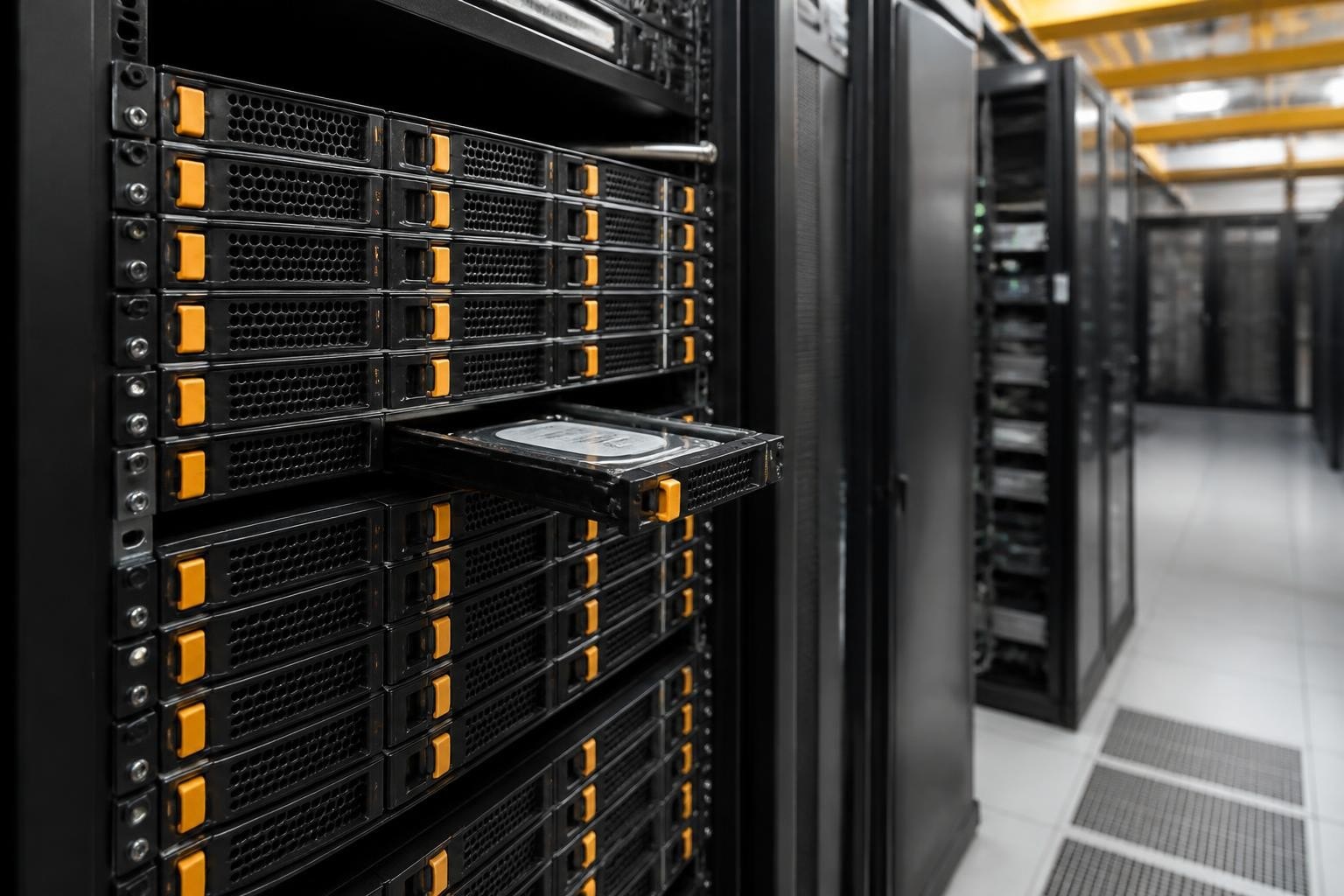

Enterprise storage decisions require careful consideration of performance, reliability, and total cost of ownership. The Synology HAT5300 12T represents Synology's strategic move into the enterprise hard drive market, offering a 12-terabyte solution designed specifically for their NAS ecosystems. This drive arrives at a time when businesses face mounting pressure to balance storage capacity requirements with data sovereignty concerns, particularly within European markets where GDPR compliance and infrastructure control remain paramount. Understanding the technical specifications, compatibility implications, and real-world deployment considerations of the synology hat5300 12t helps organizations make informed decisions about their storage infrastructure investments.
Technical Specifications and Performance Characteristics
The synology hat5300 12t delivers enterprise-grade specifications tailored for continuous operation in multi-bay NAS environments. Furthermore, this drive features a 7200 RPM spindle speed, 256 MB cache buffer, and SATA 6Gb/s interface, positioning it as a workhorse for high-density storage deployments.
Core Performance Metrics
| Specification | Value | Impact on Performance |
|---|---|---|
| Capacity | 12 TB | High-density storage for large datasets |
| Spindle Speed | 7200 RPM | Faster random access versus 5400 RPM alternatives |
| Cache | 256 MB | Improved read/write operations for frequently accessed data |
| Interface | SATA 6Gb/s | Standard enterprise connectivity |
| MTBF | 2.5 million hours | Enterprise reliability rating |
| Workload Rate | 550 TB/year | Suitable for continuous multi-user environments |
The official Synology product page positions these drives as optimized for their DiskStation and RackStation platforms. Nevertheless, the underlying hardware architecture reveals interesting insights about Synology's manufacturing strategy.
Real-World Performance Considerations
Sequential read and write speeds reach approximately 250-270 MB/s under optimal conditions, competitive with other enterprise SATA drives in this capacity class. Moreover, random I/O performance shows solid results for typical NAS workloads including file serving, backup repositories, and surveillance storage.
- Sequential reads: 250-270 MB/s typical
- Sequential writes: 240-260 MB/s typical
- 4K random reads: 85-95 IOPS average
- Power consumption: 7.8W active, 5.2W idle
- Acoustic levels: 28-30 dB during seeks
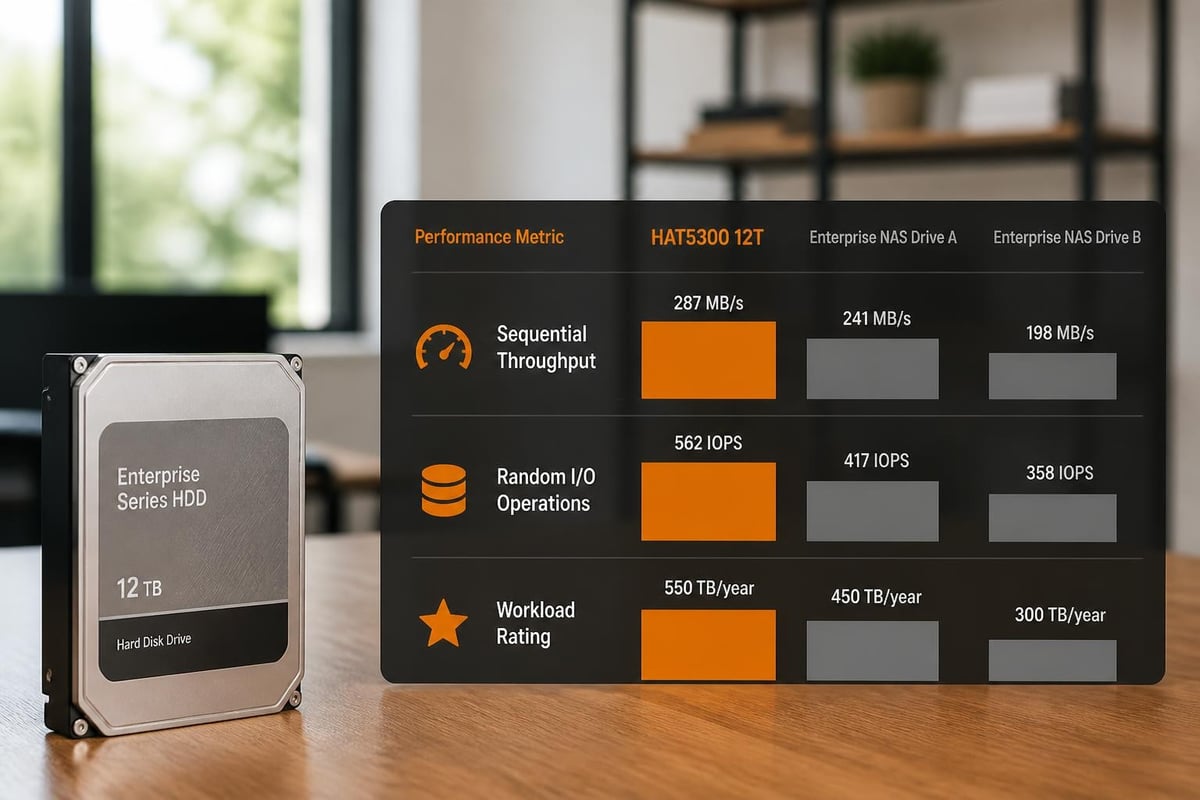
Independent testing from ComputerBase’s detailed review confirms these manufacturer claims whilst highlighting that thermal management remains crucial in densely populated chassis configurations. Therefore, adequate airflow planning becomes essential when deploying multiple synology hat5300 12t units in rack-mount configurations.
Manufacturing Origin and OEM Relationships
Synology's entry into the drive market follows a well-established pattern in the storage industry: OEM partnerships with established manufacturers. In addition, understanding the sourcing strategy behind these drives provides valuable context for evaluating long-term reliability and support.
The synology hat5300 12t utilizes Toshiba MG-series enterprise drive platforms as its foundation. ServeTheHome’s analysis of Synology's enterprise hard drive launch confirms this OEM relationship, whereby Synology applies custom firmware and qualification testing to drives manufactured by Toshiba's storage division.
Implications of OEM Sourcing
This approach carries both advantages and considerations for enterprise buyers:
Advantages:
- Proven enterprise-grade mechanical components from established manufacturer
- Synology-specific firmware optimizations for DSM integration
- Coordinated testing and qualification for specific NAS platforms
- Single-vendor support through Synology channels
Considerations:
- Premium pricing compared to equivalent Toshiba MG-series drives
- Compatibility limitations enforced through firmware and DSM policies
- Dependence on Synology's update and support lifecycle
- Potential supply chain constraints during component shortages
Furthermore, Backblaze’s quarterly drive statistics provide valuable reliability data on Toshiba's MG-series platforms, offering real-world failure rate insights that indirectly inform expectations for the synology hat5300 12t.
Compatibility and Ecosystem Lock-in
Synology's drive compatibility policies have evolved significantly, particularly with DSM 7.3 and subsequent releases. Moreover, these changes directly impact purchasing decisions for organizations building or expanding storage infrastructure.
Drive Compatibility Framework
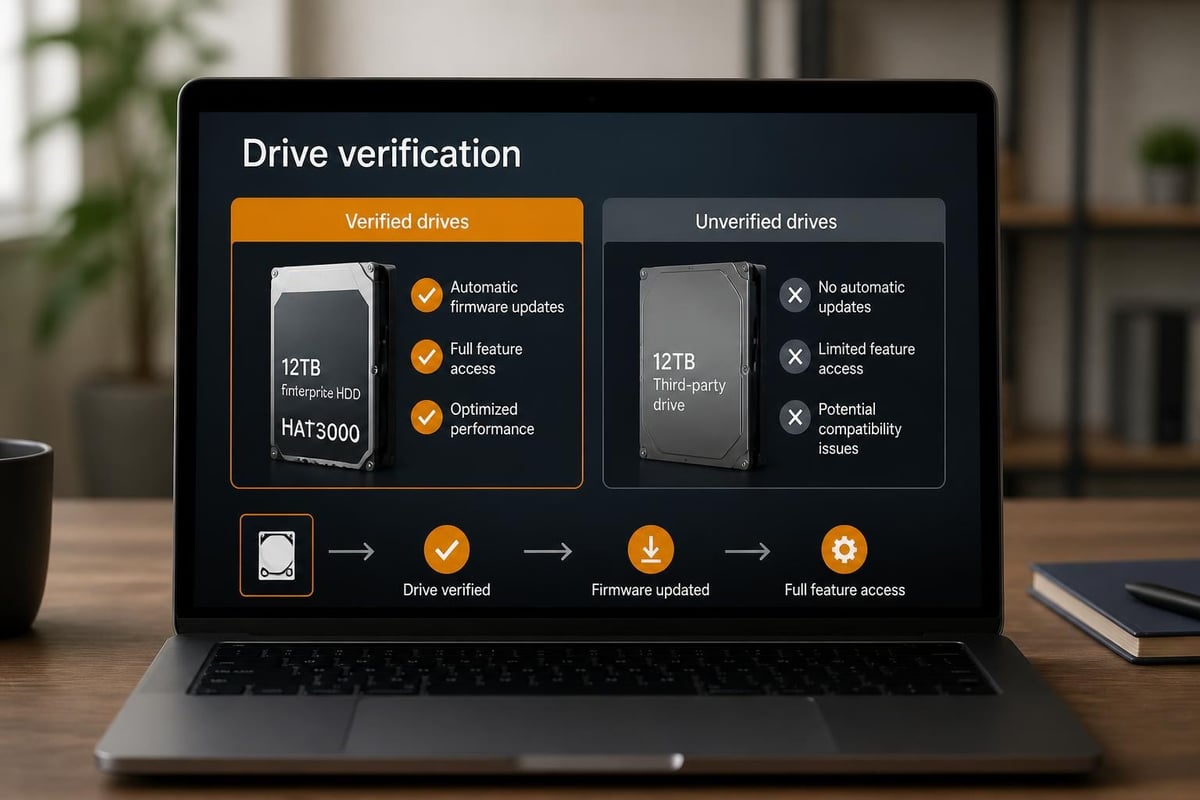
Synology’s knowledge base outlines their compatibility approach, which categorizes drives into verified and unverified classifications. The synology hat5300 12t naturally falls into the verified category, receiving full support and seamless integration.
Nevertheless, unverified drives face increasing limitations:
| Drive Status | Firmware Updates | Feature Access | Notifications | Long-term Support |
|---|---|---|---|---|
| Verified (HAT5300) | Automatic | Full | None | Guaranteed |
| Unverified (Third-party) | Manual only | May be restricted | Warnings displayed | No guarantee |
StorageReview’s unverified drive analysis highlights real-world experiences with third-party drives in Synology systems, documenting the increasing friction introduced through firmware notifications and feature gates.
Total Cost of Ownership Analysis
When evaluating the synology hat5300 12t against alternatives, organizations must calculate beyond the initial purchase price:
- Per-terabyte premium: Approximately 15-25% higher than equivalent Toshiba MG drives
- Operational simplicity: Reduced administrative overhead through guaranteed compatibility
- Warranty alignment: Synology-provided warranty versus drive manufacturer warranty
- Support efficiency: Single point of contact for both hardware and software issues
For businesses prioritizing operational stability and vendor-backed support, this premium often proves justifiable. In addition, the elimination of compatibility troubleshooting reduces IT workload, particularly in resource-constrained teams.
Deployment Scenarios and Use Cases
The synology hat5300 12t serves multiple enterprise deployment patterns, each with specific requirements and considerations. Therefore, understanding optimal use cases helps organizations determine fit within their infrastructure strategy.
Primary Application Workloads
File Server and Collaboration Storage
Organizations running file sharing platforms benefit from the drive's 24/7 operation rating and 550 TB annual workload capacity. Furthermore, the 256 MB cache proves particularly effective for multi-user environments with mixed file sizes and access patterns.
Businesses utilizing GDPR-compliant collaboration platforms like vBoxxCloud for team file sharing and document management can leverage the synology hat5300 12t in underlying storage infrastructure whilst maintaining data sovereignty requirements. Moreover, the drive's reliability specifications align well with business-critical document repositories requiring consistent availability.
Backup and Archive Repositories
The 12 TB capacity makes the synology hat5300 12t particularly suitable for backup target storage, especially in incremental and differential backup scenarios where capacity utilization grows predictably over time.
- Sequential write performance supports backup window requirements
- High capacity reduces per-terabyte infrastructure costs
- Enterprise MTBF rating ensures backup data accessibility
- RAID integration provides additional data protection layers
Surveillance and Continuous Recording
Video surveillance deployments benefit from the drive's consistent write performance and workload ratings. Nevertheless, organizations should verify channel count and retention requirements against capacity planning calculations.
RAID Configuration Recommendations
| RAID Level | Usable Capacity (6× 12TB) | Fault Tolerance | Performance Profile | Recommended Use Case |
|---|---|---|---|---|
| RAID 6 | 48 TB | 2-drive failure | Balanced | General business storage |
| RAID 10 | 36 TB | 1 per mirror pair | High read/write | Database and virtualization |
| SHR-2 (Synology) | ~48 TB variable | 2-drive failure | Balanced + flexibility | Mixed workloads |
Synology's proprietary SHR (Synology Hybrid RAID) offers flexibility advantages when mixing drive capacities during expansion cycles. Furthermore, SHR-2 provides dual-drive fault tolerance whilst maximizing usable capacity.
Pricing Analysis and Market Positioning
StorageReview’s coverage of Synology's RackStation launches contextualizes the synology hat5300 12t within broader enterprise storage economics. Moreover, understanding competitive positioning helps organizations evaluate budget implications.
Comparative Pricing Landscape
Current street pricing positions the synology hat5300 12t at approximately £340-£380 per unit, depending on regional availability and volume purchasing arrangements. In addition, equivalent capacity Toshiba MG08 or Western Digital Ultrastar drives typically retail at £280-£320, creating a 15-20% price differential.
Price-to-Capacity Calculations:
- Synology HAT5300 12T: ~£30 per terabyte
- Toshiba MG08 12TB: ~£25 per terabyte
- WD Ultrastar 12TB: ~£26 per terabyte
- Seagate Exos X16 12TB: ~£24 per terabyte
Nevertheless, the pricing equation shifts when factoring operational considerations:
- Support consolidation: Single vendor contact reduces troubleshooting complexity
- Firmware integration: Automatic updates through DSM eliminate manual intervention
- Compatibility guarantee: Zero risk of feature restrictions or warning notifications
- Procurement simplicity: Direct ordering through Synology channels
Volume Deployment Economics
Organizations deploying larger arrays see per-unit costs become more significant. Therefore, a 24-bay RackStation populated with synology hat5300 12t drives represents approximately £8,200-£9,100 in drive costs alone versus £6,700-£7,700 for equivalent third-party drives.
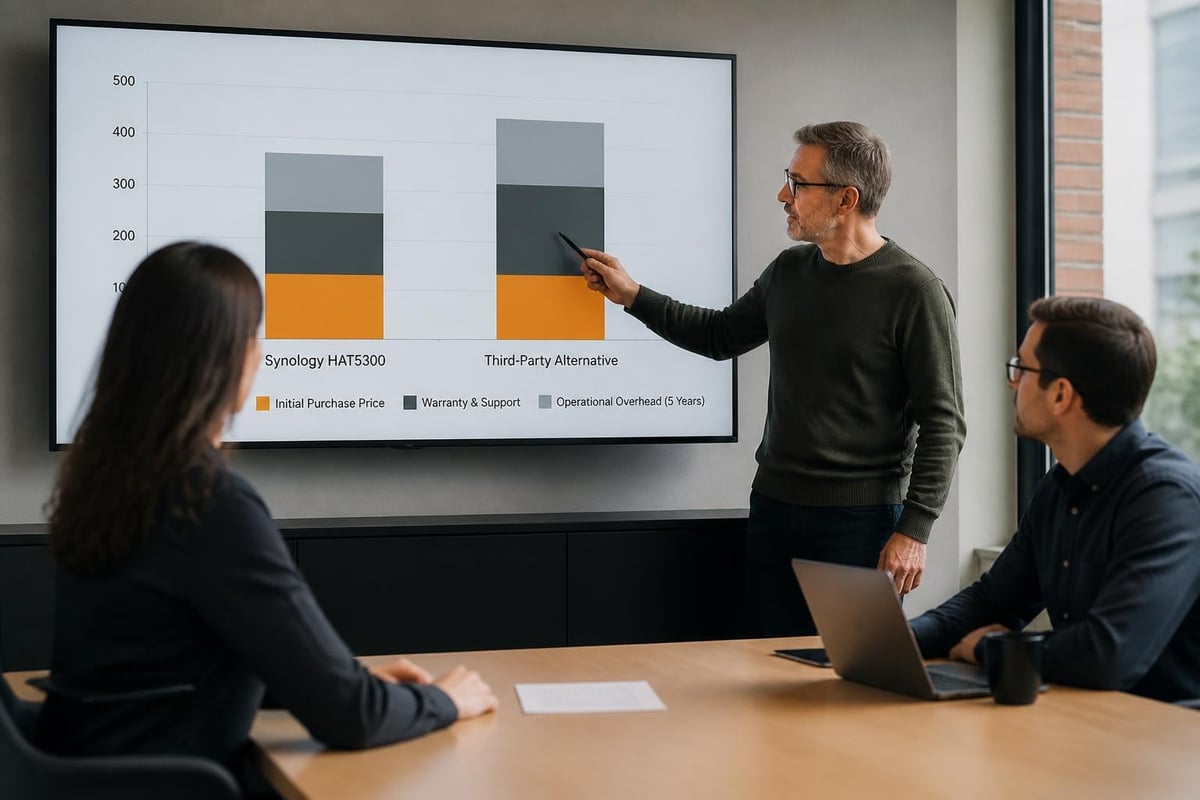
For businesses requiring guaranteed long-term support and preferring vendor-backed configurations, this premium proves manageable within capital budgeting frameworks. Moreover, organizations with limited IT resources often find the operational simplicity justifies higher initial expenditure.
European Data Sovereignty Considerations
European businesses face unique requirements around data location, access controls, and regulatory compliance. Furthermore, storage infrastructure decisions increasingly reflect these sovereignty concerns.
Infrastructure Control and Compliance
When deploying the synology hat5300 12t within European data centres, organizations maintain physical control over storage media containing sensitive business data. In addition, this hardware-level sovereignty complements software-layer protections implemented through GDPR-compliant platforms.
Businesses operating their own on-premises infrastructure benefit from complete data locality, ensuring information never transits through jurisdictions subject to extraterritorial access laws. Nevertheless, this approach requires internal expertise for maintenance, security patching, and capacity planning.
Hybrid Infrastructure Strategies
Many organizations adopt hybrid models, combining on-premises storage built on synology hat5300 12t drives with European cloud services for specific workloads. Therefore, understanding optimal workload placement becomes crucial for balancing performance, compliance, and cost objectives.
- On-premises NAS: Sensitive operational data, primary file servers, development repositories
- European cloud: Collaboration platforms, backup replication, disaster recovery targets
- Hybrid integration: Synchronized folders, automated backup chains, tiered storage
This architectural approach allows businesses to leverage high-capacity local storage whilst maintaining cloud-based redundancy within compliant jurisdictions.
Performance Optimization and Best Practices
Maximizing the operational value of synology hat5300 12t deployments requires attention to configuration details and environmental factors. Moreover, following manufacturer recommendations ensures optimal longevity and performance consistency.
System Configuration Guidelines
Storage Pool Design:
- Align RAID stripe size with predominant file sizes in workload profile
- Enable write cache with UPS protection for improved performance
- Schedule RAID scrubbing during low-utilization windows
- Monitor SMART attributes for early warning of degradation
Thermal Management:
- Maintain chassis ambient temperature below 30°C for optimal drive lifespan
- Verify adequate airflow across all drive bays using thermal monitoring
- Consider additional cooling fans in high-density configurations
- Allow proper acclimatization when installing cold drives into warm systems
Furthermore, Synology's DSM provides comprehensive monitoring dashboards displaying drive temperatures, throughput metrics, and health indicators. Therefore, establishing baseline performance metrics during initial deployment enables effective anomaly detection.
Firmware and Update Strategy
The synology hat5300 12t receives firmware updates through DSM's centralized management interface. Nevertheless, organizations should establish change control procedures for production systems:
- Review release notes for firmware updates before deployment
- Test updates in non-production environments when possible
- Schedule maintenance windows for critical storage infrastructure
- Verify RAID integrity and backup currency before applying updates
- Monitor system logs for 48 hours post-update for anomalies
In addition, maintaining current firmware versions ensures compatibility with DSM feature releases and security patches addressing potential vulnerabilities.
Long-Term Reliability and Warranty Considerations
Enterprise storage deployments require multi-year reliability expectations. Therefore, understanding warranty coverage and failure prediction becomes essential for capacity planning and budget forecasting.
Warranty Structure
Synology provides a five-year limited warranty on the synology hat5300 12t when purchased through authorized channels. Moreover, this coverage includes advance replacement options for qualified business customers, minimizing downtime during drive failures.
Warranty Comparison:
| Manufacturer | Standard Warranty | Advanced Replacement | On-site Support Option |
|---|---|---|---|
| Synology HAT5300 | 5 years | Available | Through partners |
| Toshiba MG Series | 5 years | Available | Through partners |
| WD Ultrastar | 5 years | Available | Through partners |
| Seagate Exos | 5 years | Available | Through partners |
Nevertheless, warranty coverage applies to individual drive failures rather than data loss. Therefore, robust backup strategies remain essential regardless of drive reliability ratings.
Failure Rate Expectations
Enterprise drives typically exhibit bathtub-curve failure patterns: elevated early failures during burn-in period, low stable failure rates during operational lifespan, and increasing failures approaching end-of-life. Furthermore, environmental factors significantly influence actual failure rates versus manufacturer specifications.
Based on MTBF ratings and industry averages, organizations should anticipate approximately 1-2% annual failure rates in properly maintained environments. In addition, deploying appropriate RAID levels provides tolerance for expected failures without service interruption.
The synology hat5300 12t represents a capable enterprise storage solution for organizations prioritizing vendor integration and operational simplicity, though the premium pricing versus OEM alternatives requires careful TCO evaluation. European businesses seeking complete infrastructure control alongside proven cloud services can combine on-premises NAS deployments with GDPR-compliant platforms. vBoxx delivers precisely this combination through ISO 27001-certified data centres in the Netherlands, offering secure cloud storage, communication platforms, and backup services built on European infrastructure outside US CLOUD Act jurisdiction, complemented by expert consultancy and migration support for businesses transitioning to sovereignty-focused digital infrastructure.