

Modern businesses generate vast quantities of data daily, including financial records, client information, project documentation, and marketing materials. As a result, managing this digital ecosystem requires robust infrastructure that balances accessibility, security, and sustainability. In particular, file storage online has emerged as the definitive solution for organisations seeking to streamline operations while still maintaining control over their critical information assets. Consequently, understanding the nuances of cloud-based storage systems enables businesses to make informed decisions that protect their data and support growth objectives.
Understanding Modern File Storage Solutions
The evolution of digital storage has fundamentally transformed how organisations manage their information infrastructure. While traditional on-premises systems offer direct control, they also present significant challenges in terms of scalability, disaster recovery, and maintenance costs. In contrast, cloud-based alternatives provide dynamic solutions that adapt to changing business requirements without the burden of managing physical hardware.
Moreover, contemporary file storage online platforms operate through distributed data centres that replicate information across multiple geographic locations. As a result, this architecture ensures redundancy while also enabling rapid access from anywhere with an internet connection. Furthermore, businesses benefit from reduced capital expenditure as they transition from ownership models to subscription-based services, thereby aligning costs with actual usage.

Key Components of Enterprise Storage Systems
Professional storage solutions encompass several critical elements that distinguish them from consumer-grade offerings:
- Encryption protocols that protect data both in transit and at rest
- Access control mechanisms enabling granular permission management
- Version control systems tracking document changes and enabling recovery
- Audit logging for compliance and security monitoring
- API integration allowing seamless connection with existing business applications
The file-hosting service ecosystem has matured significantly, offering businesses a spectrum of options tailored to specific industry requirements. Financial institutions, healthcare providers, and legal firms each face unique regulatory frameworks that dictate how they must handle sensitive information.
Security Considerations for Business Storage
Data protection remains paramount when evaluating file storage online solutions. Breaches can result in substantial financial penalties, reputational damage, and operational disruption. Selecting providers with comprehensive security frameworks mitigates these risks whilst ensuring compliance with evolving regulations.
Encryption Standards and Implementation
Modern storage platforms employ multiple encryption layers to safeguard information. Transport Layer Security (TLS) protects data during transmission, whilst Advanced Encryption Standard (AES) with 256-bit keys secures stored files. Zero-knowledge encryption models, where only the client holds decryption keys, offer maximum privacy but require careful key management to prevent data loss.
Businesses must assess their risk tolerance and regulatory obligations when choosing encryption approaches. Some industries require specific certifications such as ISO 27001 or SOC 2 compliance, which validate a provider’s security posture through independent audits. Encrypted cloud service implementations provide additional assurance for organisations handling particularly sensitive information.
| Security Feature | Standard Implementation | Enhanced Implementation |
|---|---|---|
| Data Encryption | AES-256 at rest | Client-side + AES-256 |
| Access Control | Password protection | Multi-factor authentication |
| Audit Logging | Basic activity logs | Comprehensive forensic trails |
| Backup Frequency | Daily snapshots | Continuous replication |
| Geographic Redundancy | Single region | Multi-region distribution |
Access Management and Authentication
Controlling who accesses files and under what circumstances forms the foundation of data security. Role-based access control (RBAC) systems enable administrators to define permissions based on job functions rather than individual users, simplifying management as organisations scale. Single sign-on (SSO) integration streamlines authentication whilst maintaining security through centralised identity management.
Multi-factor authentication (MFA) adds critical protection against credential theft. Even if passwords are compromised, additional verification steps prevent unauthorised access. Modern file storage online platforms support various MFA methods including authenticator applications, hardware tokens, and biometric verification.
Evaluating Storage Providers and Solutions
Selecting appropriate storage infrastructure requires systematic assessment of technical capabilities, commercial terms, and strategic alignment. Businesses should prioritise providers demonstrating commitment to security, transparency, and customer service excellence.
Performance and Reliability Metrics
Service Level Agreements (SLAs) define expected performance standards and remedies when providers fail to meet commitments. Key metrics include:
- Uptime guarantees: Industry-leading platforms commit to 99.9% or higher availability
- Data durability: Specifications indicating the probability of data loss over time
- Recovery time objectives: Maximum acceptable duration for service restoration
- Recovery point objectives: Maximum acceptable data loss measured in time
- Support response times: Guaranteed timeframes for addressing technical issues
Understanding how providers measure and report these metrics helps businesses set realistic expectations. Some vendors offer financial credits when SLAs are breached, providing tangible accountability for service quality. Secure cloud data storage solutions that prioritise reliability ensure business continuity even during unexpected events.

Cost Structures and Budgeting
File storage online pricing models vary considerably across providers. Common approaches include:
- Per-gigabyte storage fees: Charges based on total data volume stored
- Data transfer costs: Fees for uploading and downloading information
- API request pricing: Charges for programmatic access operations
- Feature tiers: Different capability levels at varying price points
- User-based licensing: Costs determined by number of active accounts
Businesses should model total cost of ownership across realistic usage scenarios, accounting for growth projections. Hidden costs such as egress fees (charges for retrieving data) can significantly impact budgets, particularly for organisations frequently accessing stored information. Requesting detailed quotations based on specific requirements prevents unexpected expenses.
Sustainability and Ethical Considerations
Environmental impact increasingly influences technology purchasing decisions. Data centres consume substantial energy, contributing to carbon emissions unless powered by renewable sources. Progressive storage providers invest in green infrastructure and offset programmes to minimise ecological footprints.
Green Hosting Practices
Sustainable file storage online platforms implement multiple strategies to reduce environmental impact:
Energy efficiency: Modern facilities employ advanced cooling systems and optimised server configurations that reduce power consumption per gigabyte stored. Liquid cooling and free-air cooling techniques harness natural temperature regulation rather than energy-intensive air conditioning.
Renewable energy: Providers committed to sustainability power operations through solar, wind, or hydroelectric sources. Some organisations purchase renewable energy certificates to offset conventional power usage, whilst others develop on-site generation capabilities.
Carbon offsetting: Programmes that invest in reforestation or clean energy projects counterbalance unavoidable emissions. Transparent reporting of environmental metrics enables businesses to assess providers’ genuine commitment versus superficial marketing claims.
Selecting environmentally responsible storage solutions aligns with corporate social responsibility objectives whilst appealing to increasingly conscious consumers. The business case for sustainability extends beyond ethics, as energy-efficient operations typically correlate with cost savings passed to customers.
Integration and Workflow Optimisation
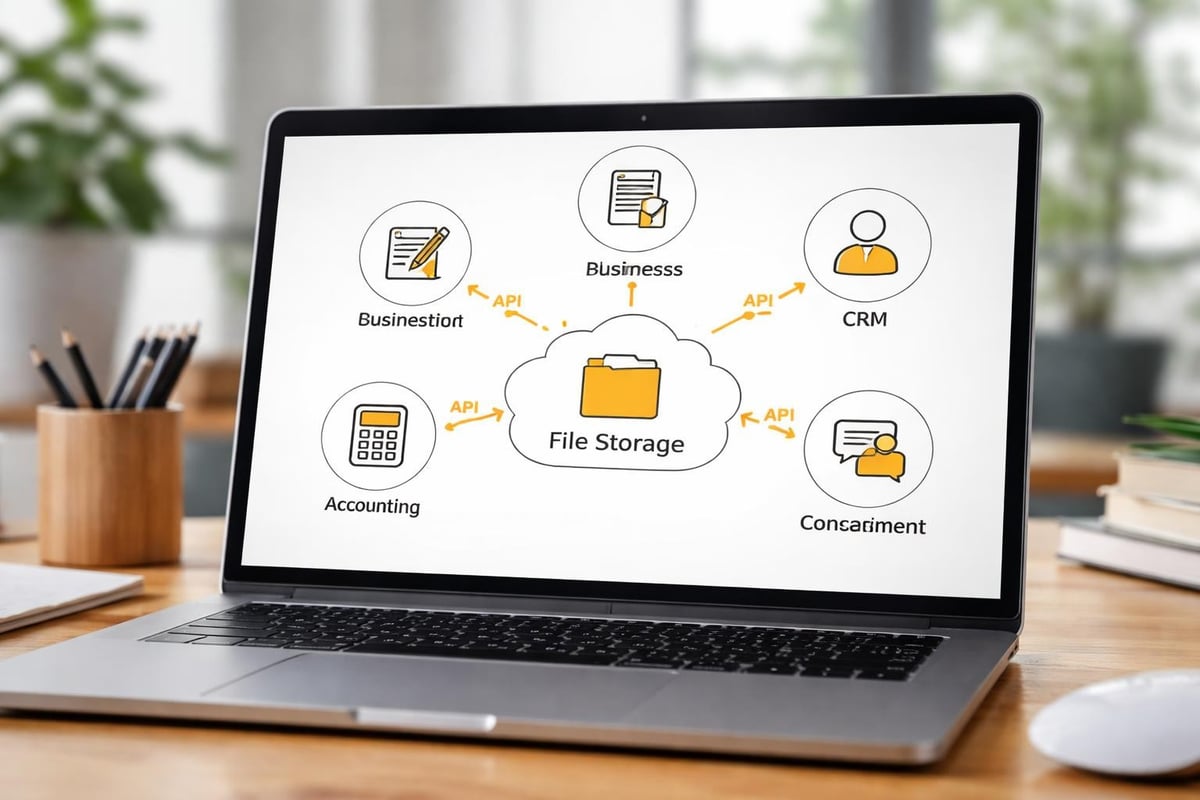
Maximum value from file storage online emerges when systems seamlessly connect with existing business applications. APIs and pre-built integrations enable automation that eliminates manual data transfers and reduces error rates.
Common Integration Scenarios
Professional storage platforms connect with numerous business tools:
- Productivity suites: Automatic synchronisation with document editing applications
- Project management software: File attachment and sharing within task workflows
- Customer relationship management: Document storage linked to client records
- Accounting systems: Invoice and financial record archival with audit trails
- Collaboration platforms: Real-time file sharing and co-editing capabilities
Organisations should evaluate integration ecosystems when selecting storage providers, ensuring compatibility with critical business systems. Open API standards facilitate custom development when proprietary integrations prove insufficient for specific requirements.
Collaboration and Productivity Features
Modern storage solutions transcend simple file repositories, offering sophisticated collaboration capabilities. Real-time co-editing allows multiple team members to work simultaneously on documents, eliminating version conflicts and email attachments. Comment threads and annotation tools facilitate feedback without creating separate communication channels.
File versioning maintains comprehensive histories of document changes, enabling teams to review edits, restore previous iterations, or understand decision evolution. Some platforms offer intelligent conflict resolution when simultaneous edits occur, merging changes or flagging contradictions for manual review.
Data Governance and Compliance
Regulatory frameworks governing data handling continue expanding in complexity and geographic scope. File storage online solutions must accommodate diverse requirements spanning multiple jurisdictions, particularly for organisations operating internationally.
Regulatory Landscape
Key regulations affecting storage decisions include:
| Regulation | Geographic Scope | Primary Requirements |
|---|---|---|
| GDPR | European Union | Data subject rights, breach notification, consent management |
| HIPAA | United States (Healthcare) | Patient data protection, encryption standards, audit controls |
| SOX | United States (Public Companies) | Financial record retention, access controls, audit trails |
| NIS2 | European Union | Critical infrastructure protection, incident reporting, supply chain security |
| ISO 27001 | International | Information security management system certification |
Understanding applicable regulations guides provider selection and configuration choices. Data residency requirements may mandate storage within specific geographic boundaries, whilst retention policies dictate minimum storage durations before deletion is permissible. Authoritative sources help businesses verify compliance requirements and evaluate provider claims.
Archival and Retention Strategies
Effective data lifecycle management balances accessibility, cost, and compliance. Active files requiring frequent access warrant premium storage tiers optimised for performance, whilst archival data accessed infrequently can reside on more economical platforms. The Active Archive Alliance promotes best practices for managing information across its lifecycle.
Automated retention policies ensure compliance whilst minimising storage costs. Rules-based systems can transition files between storage tiers based on age or access patterns, then delete information when retention periods expire. Legal holds override standard deletion schedules when litigation or investigations require preservation.
Migration Planning and Execution
Transitioning existing data to file storage online platforms requires careful planning to minimise disruption and prevent information loss. Successful migrations follow structured methodologies addressing technical, organisational, and change management dimensions.
Migration Methodology
Effective data transfer projects typically progress through distinct phases:
- Assessment: Inventory existing data, identify dependencies, and define success criteria
- Planning: Develop detailed migration schedules, resource allocation, and rollback procedures
- Preparation: Clean data, resolve inconsistencies, and configure destination systems
- Pilot testing: Migrate subset of data to validate approach and identify issues
- Execution: Systematic transfer of information according to predetermined schedules
- Validation: Verify data integrity, completeness, and system functionality
- Optimisation: Refine configurations based on real-world usage patterns
Parallel running periods where old and new systems operate simultaneously provide safety nets during transitions. Teams can validate that new platforms meet requirements before decommissioning legacy infrastructure. Comprehensive testing across all critical workflows prevents disruption to business operations.
Common Migration Challenges
Organisations frequently encounter obstacles during storage transitions:
Bandwidth limitations restrict transfer speeds, particularly for large data volumes. Providers may offer physical data transfer services where hard drives are shipped to data centres for direct loading, bypassing network constraints. Scheduling intensive transfers during off-peak hours minimises impact on operational systems.
Application dependencies require careful mapping to ensure all systems can access files post-migration. Legacy applications lacking cloud integration may necessitate gateway solutions or architecture modifications. Early identification of incompatibilities allows time for remediation before critical deadlines.
User adoption challenges emerge when workflows change significantly. Training programmes and clear communication about benefits help teams embrace new systems rather than resist change. Identifying champions within user communities accelerates acceptance and provides peer support.
Advanced Features and Future Developments
The file storage online landscape continues evolving rapidly as providers incorporate emerging technologies. Forward-thinking organisations consider future capabilities when making infrastructure decisions to ensure long-term viability.
Artificial Intelligence and Automation
Machine learning algorithms increasingly enhance storage platforms through:
- Intelligent search: Natural language queries that understand context and relationships
- Automated classification: Content analysis that applies metadata and organises files
- Predictive access: Pre-loading frequently accessed files to reduce latency
- Anomaly detection: Identification of unusual access patterns indicating security threats
- Capacity forecasting: Predictive analytics guiding infrastructure scaling decisions
These capabilities transform static repositories into intelligent systems that actively support business processes. Automatic extraction of key information from documents enables downstream automation, whilst sentiment analysis can flag communications requiring immediate attention.
Blockchain and Decentralised Storage
Experimental approaches leverage distributed ledger technology for enhanced security and resilience. Decentralised file storage systems fragment data across numerous independent nodes, eliminating single points of failure whilst preserving privacy through cryptographic techniques. Whilst currently serving niche applications, these architectures may influence mainstream platforms as technology matures.
Smart contracts enable automated enforcement of access policies and usage terms without centralised authority. Immutable audit trails provide cryptographic proof of data provenance and integrity, valuable for regulatory compliance and legal proceedings. However, performance limitations and complexity currently restrict widespread adoption for general business use.
Selecting the Right Solution for Your Organisation
Matching storage capabilities to specific business requirements demands systematic evaluation across multiple dimensions. Generic comparisons prove insufficient given the diversity of organisational needs and operational contexts.
Assessment Framework
Organisations should evaluate potential solutions against criteria including:
Security posture: Encryption standards, compliance certifications, access controls, and incident response capabilities. Businesses handling sensitive information require providers demonstrating robust security through independent audits and transparent practices.
Performance characteristics: Transfer speeds, latency, concurrent user capacity, and search responsiveness. Applications with demanding performance requirements need platforms optimised for rapid access rather than economical archival.
Scalability potential: Ability to accommodate growth in data volume, user count, and transaction rates without degradation. Platforms should scale seamlessly as businesses expand rather than requiring disruptive migrations.
Total cost of ownership: Comprehensive accounting of storage fees, transfer costs, administration overhead, and integration expenses. Cheapest solutions often prove most expensive when hidden costs emerge.
Support quality: Responsiveness, technical expertise, and availability of assistance during critical incidents. Premium support tiers may justify additional cost for mission-critical applications.
The optimal file storage online platform balances these factors according to organisational priorities. Healthcare providers might prioritise compliance and security above cost, whilst media companies emphasise performance and capacity. Document storage solutions illustrate how providers tailor offerings to specific use cases.
Vendor Due Diligence
Thorough investigation of potential providers reduces risk of selecting unsuitable partners. Key investigation areas include:
Financial stability: Reviewing annual reports, funding status, and market position ensures providers possess resources for long-term operation. Storage migrations prove disruptive and expensive, making vendor longevity crucial for infrastructure decisions.
Customer references: Speaking with existing clients, particularly those in similar industries or with comparable requirements, provides insights beyond marketing materials. Specific questions about support quality, outage frequency, and pricing transparency reveal operational realities.
Security practices: Examining incident histories, penetration testing results, and security certifications validates claims about protective measures. Providers should willingly discuss security architectures and respond transparently to detailed technical questions.
Data portability: Understanding export capabilities and formats ensures businesses retain control over information. Vendor lock-in through proprietary formats or restrictive terms creates dependencies that limit future flexibility.
Professional storage management platforms demonstrate commitment to customer success through transparent operations and comprehensive documentation. Businesses benefit from partners viewing relationships as long-term collaborations rather than transactional sales.
Modern businesses require storage solutions that deliver security, accessibility, and sustainability whilst supporting operational efficiency and regulatory compliance. Selecting appropriate file storage online platforms demands careful evaluation of technical capabilities, commercial models, and strategic alignment with organisational objectives. vBoxx provides secure, sustainable cloud storage solutions designed specifically for businesses prioritising data protection and environmental responsibility, combining enterprise-grade security with green hosting practices to support your digital infrastructure needs.