

As businesses accelerate their digital transformation, cloud computing has become the backbone of modern operations. However, this shift introduces critical challenges around safeguarding sensitive information. In particular, data protection cloud computing combines technological solutions, governance frameworks, and strategic planning to ensure that information stored and processed in cloud environments remains secure, available, and compliant with regulatory requirements. Moreover, understanding the complexities of protecting data in cloud infrastructures is no longer optional but essential for organisations seeking to maintain customer trust and operational resilience.
Understanding the Cloud Security Landscape
The cloud computing environment presents unique security considerations that differ fundamentally from traditional on-premises infrastructure. In particular, unlike physical servers housed within company premises, cloud resources are distributed across multiple locations, accessed via the internet, and often shared with other tenants in multi-tenant architectures. As a result, organisations must adopt different security approaches tailored to these distributed and shared environments. Moreover, this complexity increases the importance of robust access controls and continuous monitoring.
The Shared Responsibility Model
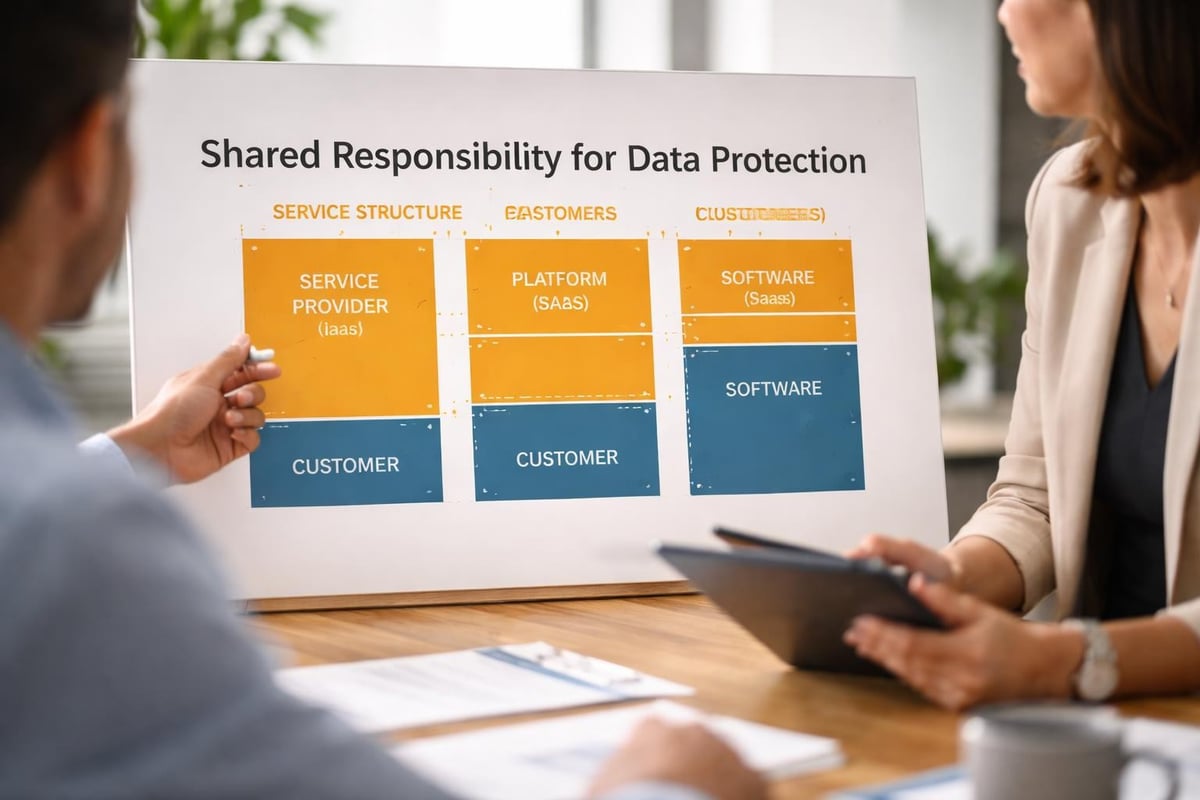
Cloud service providers and customers share responsibility for security, though the exact division depends on the service model. In particular, in Infrastructure as a Service (IaaS) arrangements, providers secure the underlying infrastructure whilst customers protect their data, applications, and access controls. Meanwhile, Platform as a Service (PaaS) shifts more responsibility to the provider, and Software as a Service (SaaS) further reduces customer obligations. As a result, organisations must clearly understand their role within each model to ensure comprehensive security coverage.
Key stakeholder responsibilities include:
- Providers: Physical security, network infrastructure, hypervisor protection
- Customers: Data classification, encryption key management, identity access management
- Both parties: Incident response, compliance monitoring, security assessments
This division creates potential gaps where organisations mistakenly assume their provider handles aspects that remain their responsibility. Understanding data privacy and cloud computing requires clarity on these boundaries to avoid security vulnerabilities.
Encryption Strategies for Cloud Data
Encryption serves as the cornerstone of data protection cloud computing, rendering information unreadable to unauthorised parties even if they gain access to storage systems. In particular, effective encryption strategies address data at rest, in transit, and increasingly, during processing. Moreover, this comprehensive approach ensures protection across all stages of the data lifecycle. As a result, organisations significantly reduce the risk of data exposure and unauthorised access.
Implementing Layered Encryption
Modern cloud security architectures employ multiple encryption layers to create defence in depth. In particular, Transport Layer Security (TLS) protects data moving between users and cloud services, whilst Advanced Encryption Standard (AES) with 256-bit keys secures stored information. In addition, for highly sensitive workloads, homomorphic encryption enables computations on encrypted data without decryption. As a result, organisations achieve stronger, multi-layered protection across different data states and use cases.
| Encryption Type | Primary Use Case | Key Management |
|---|---|---|
| TLS/SSL | Data in transit | Certificate authorities |
| AES-256 | Data at rest | Customer or provider managed |
| Field-level | Specific data elements | Application-controlled |
| End-to-end | User-to-user communications | User-managed keys |
Organisations should maintain control over encryption keys whenever possible, using Hardware Security Modules (HSMs) or dedicated key management services. In particular, this approach ensures that even cloud providers cannot access sensitive data without explicit authorisation, a principle known as zero-knowledge architecture. Moreover, it strengthens overall data sovereignty and reduces third-party risk. As a result, organisations gain greater assurance that sensitive information remains fully under their control.
Balancing Security and Performance
Encryption introduces computational overhead that can impact application performance. Cloud data security protection strategies must balance security requirements against operational efficiency. Selective encryption, where only sensitive fields receive protection, offers a middle ground for performance-critical applications.
Modern processors include built-in encryption acceleration through technologies like AES-NI, significantly reducing performance penalties. Cloud providers increasingly offer transparent encryption that operates without application modifications, making it easier to implement comprehensive protection.
Access Control and Identity Management
Controlling who can access what data represents a fundamental pillar of data protection cloud computing. In particular, traditional perimeter-based security proves insufficient in cloud environments where resources exist outside organisational boundaries and users connect from diverse locations. As a result, organisations must adopt more granular, identity-centric security models. Moreover, this shift enables stronger enforcement of access policies regardless of user location or device.
Zero Trust Architecture
Zero trust frameworks assume no user or system is inherently trustworthy, requiring continuous verification regardless of location. In particular, every access request undergoes authentication and authorisation checks based on multiple factors including user identity, device health, location, and requested resource sensitivity. As a result, this reduces the risk of unauthorised access even in compromised environments. Moreover, it strengthens overall security posture by enforcing consistent verification across all interactions.
Core zero trust principles include:
- Verify explicitly using all available data points
- Apply least privilege access limiting users to minimum necessary permissions
- Assume breach by segmenting access and monitoring continuously
Multi-factor authentication (MFA) adds essential protection by requiring multiple verification methods. Combining something users know (passwords), possess (security tokens), and are (biometric data) dramatically reduces unauthorised access risks even when credentials are compromised.
Role-Based Access Controls
Role-based access control (RBAC) assigns permissions based on organisational roles rather than individual users, simplifying management at scale. A finance team member receives access to financial systems, whilst marketing staff access customer relationship management tools, with neither group seeing the other’s data.
Cloud data protection approaches increasingly incorporate attribute-based access control (ABAC), which evaluates multiple attributes including time of day, resource classification, and current risk scores to make dynamic access decisions.

Compliance and Regulatory Considerations
Navigating the complex web of data protection regulations represents a significant challenge for organisations operating in cloud environments. Different jurisdictions impose varying requirements regarding data handling, storage location, and processing activities.
Understanding Key Regulations
The General Data Protection Regulation (GDPR) governs personal data of European Union residents, imposing strict requirements on consent, data minimisation, and breach notification. As a result, organisations face substantial penalties for non-compliance, making adherence essential for any business serving European customers.
In addition, other significant frameworks include the California Consumer Privacy Act (CCPA), Health Insurance Portability and Accountability Act (HIPAA) for healthcare data, and Payment Card Industry Data Security Standard (PCI DSS) for payment information. Moreover, each regulation establishes specific technical and organisational measures required for compliance.
Data Residency and Sovereignty
Many regulations require that certain data types remain within specific geographic boundaries. Key factors to achieve data security in cloud computing include understanding where providers store data and whether it crosses international borders during processing or backup operations.
Cloud providers typically offer region-specific deployments, allowing customers to specify approved locations. However, organisations must verify that all data copies, including backups and disaster recovery systems, respect residency requirements. Contractual agreements should explicitly address data location and provider obligations regarding government access requests.
| Regulation | Geographic Scope | Key Requirements |
|---|---|---|
| GDPR | EU residents | Consent, right to erasure, breach notification |
| CCPA | California residents | Disclosure, opt-out rights, deletion requests |
| HIPAA | US healthcare | Access controls, audit trails, business associate agreements |
Backup and Disaster Recovery
Data protection cloud computing extends beyond preventing unauthorised access to ensuring information availability even during system failures, natural disasters, or malicious attacks. Comprehensive backup and recovery strategies form the safety net when primary protection measures fail.
The 3-2-1 Backup Rule
This time-tested principle recommends maintaining three copies of data on two different media types with one copy stored off-site. In cloud contexts, this might involve primary data in production storage, secondary copies in cloud backup services, and tertiary copies in a different cloud region or on-premises systems.
Modern backup strategies incorporate:
- Continuous data protection capturing changes in near-real-time
- Immutable backups preventing modification or deletion for specified periods
- Air-gapped copies isolated from network access to resist ransomware
- Regular recovery testing validating that backups actually restore successfully
Recovery Time Objectives (RTO) and Recovery Point Objectives (RPO) define acceptable downtime and data loss parameters. Mission-critical systems might require seconds of RTO and RPO, whilst less critical data might tolerate hours or days. Backup frequency and recovery infrastructure should align with these objectives.
Testing Recovery Procedures
Many organisations discover backup failures only when attempting recovery during actual emergencies. Regular testing through simulated disaster scenarios validates that backup systems function correctly and staff understand recovery procedures. Documentation should detail step-by-step recovery processes for various failure scenarios.
Businesses seeking to understand comprehensive cloud security might benefit from a demonstration covering secure file storage, encrypted email, and password management to see how integrated solutions address multiple protection requirements simultaneously.

Monitoring and Threat Detection
Passive security measures alone prove insufficient in today’s threat landscape. Active monitoring and real-time threat detection enable organisations to identify and respond to security incidents before they escalate into major breaches.
Security Information and Event Management
SIEM platforms aggregate logs and security events from across cloud infrastructure, applying correlation rules and machine learning to detect anomalous patterns. Unusual login locations, unexpected data access patterns, or privilege escalation attempts trigger alerts for security team investigation.
Cloud data security best practices emphasise the importance of comprehensive logging covering authentication attempts, configuration changes, data access, and administrative actions. Retention periods should meet compliance requirements whilst balancing storage costs.
Automated Response Capabilities
Security orchestration, automation, and response (SOAR) platforms execute predefined workflows in response to detected threats. An account showing signs of compromise might be automatically suspended, preventing further damage whilst security teams investigate. High-risk activities could trigger additional authentication requirements or temporary access restrictions.
Artificial intelligence and behavioural analytics establish baselines for normal activity, then flag deviations that might indicate security incidents. These tools reduce false positives that overwhelm security teams, allowing focus on genuine threats requiring human judgment.
Data Classification and Loss Prevention
Not all data requires identical protection levels. Data classification schemes categorise information based on sensitivity, enabling proportionate security controls that protect critical assets without unnecessarily restricting less sensitive resources.
Establishing Classification Frameworks
Typical classification schemes include public, internal, confidential, and restricted categories. Public information faces no disclosure restrictions, internal data serves operational needs, confidential information could harm the organisation if disclosed, and restricted data includes trade secrets, personal information, or regulated content.
- Identify data types and sources across the organisation
- Assess potential impact of unauthorised disclosure
- Assign classification levels based on sensitivity
- Apply protection requirements appropriate to each level
- Train staff on handling requirements for each category
Data loss prevention (DLP) tools enforce classification policies by monitoring data in use, in motion, and at rest. Attempts to email restricted documents to personal accounts, upload confidential files to unauthorised cloud services, or copy sensitive data to removable media trigger blocks or alerts based on policy configuration.
Lifecycle Management
Data protection cloud computing must address information throughout its lifecycle from creation through deletion. Retention policies specify how long different data categories should be preserved, balancing legal requirements, operational needs, and privacy principles favouring minimal retention.
Secure deletion proves particularly challenging in cloud environments where data may be replicated across multiple systems. What is cloud data security includes understanding provider deletion practices and verifying that data removal requests actually eliminate all copies including backups and archives.
Vendor Management and Due Diligence
Selecting appropriate cloud providers represents a critical data protection cloud computing decision. Not all providers offer equivalent security capabilities, and organisations must conduct thorough due diligence before entrusting sensitive data to third parties.
Evaluating Security Certifications
Industry certifications provide independent validation of security practices. ISO 27001 demonstrates comprehensive information security management systems, SOC 2 Type II reports detail security controls and their effectiveness over time, and specific certifications address particular requirements like PCI DSS for payment data.
Key evaluation criteria include:
- Third-party audit reports and certifications
- Security incident history and transparency
- Data encryption capabilities and key management options
- Geographic location of data centres and legal jurisdiction
- Breach notification procedures and customer support responsiveness
- Financial stability and business continuity planning
Contractual agreements should clearly define responsibilities, specify security requirements, establish incident notification timelines, and address data ownership and portability. Service level agreements (SLAs) codify availability guarantees and compensation for failures to meet commitments.
Ongoing Vendor Oversight
Due diligence continues beyond initial selection. Regular reviews assess whether providers maintain security standards and adapt to evolving threats. Organisations should monitor provider security announcements, review updated audit reports, and participate in provider security programmes when available.
The principle of defence in depth suggests avoiding single points of failure. Multi-cloud strategies distribute workloads across providers, reducing dependency on any single vendor. However, this approach introduces complexity requiring additional integration and security coordination.
Employee Training and Security Culture
Technology alone cannot ensure data protection cloud computing effectiveness. Human factors, including employee awareness, decision-making, and behaviour, profoundly impact security outcomes. Phishing attacks, weak passwords, and inadvertent data sharing represent persistent vulnerabilities that training must address.
Building Security Awareness
Effective security training moves beyond annual compliance exercises to create ongoing awareness embedded in daily operations. Simulated phishing campaigns test employee vigilance whilst providing immediate feedback and additional training for those who fall for simulated attacks without real consequences.
Training should address role-specific risks, recognising that finance staff face different threats than customer service representatives. Practical scenarios relevant to actual job functions prove more effective than generic security lectures. Microlearning approaches deliver brief, focused content at regular intervals, improving retention compared to lengthy annual sessions.
Incident Reporting Culture
Employees must feel comfortable reporting suspected security incidents without fear of blame or punishment. Early reporting enables faster response, potentially containing breaches before they cause significant damage. Data protection and cloud computing risks often materialise through employee actions, making their cooperation essential for effective security.
Clear reporting procedures, accessible through multiple channels, remove barriers to incident notification. Regular communication about security incidents, lessons learned, and improvements implemented demonstrates that reports drive positive change rather than punishment.
Emerging Technologies and Future Considerations
The data protection cloud computing landscape continues to evolve as new technologies emerge and threats become more sophisticated. Forward-looking organisations anticipate future challenges whilst addressing current requirements.
Quantum Computing Implications
Quantum computers threaten current encryption standards, potentially rendering today’s protected data vulnerable to future decryption. Post-quantum cryptography develops algorithms resistant to quantum attacks, with organisations beginning to implement these standards ahead of quantum computing maturity.
Crypto-agility, the ability to quickly update encryption algorithms, provides flexibility to respond to breakthrough threats. Systems designed with abstraction layers separating encryption implementation from application logic can swap algorithms with minimal disruption.
Artificial Intelligence in Security
AI enhances both attack and defence capabilities. Adversaries use machine learning to craft more convincing phishing messages and identify vulnerabilities, whilst defenders employ AI for threat detection, automated response, and security analytics. The arms race between attackers and defenders increasingly involves competing AI systems.
Confidential computing technologies create trusted execution environments where data remains encrypted even during processing. This capability addresses the remaining gap in traditional encryption strategies, which require decryption before computation. As these technologies mature, they will enable new use cases combining cloud efficiency with on-premises level control.
Protecting data in cloud environments requires a comprehensive approach combining encryption, access controls, compliance management, backup strategies, and ongoing monitoring. As threats evolve and regulations expand, organisations must remain vigilant whilst balancing security with operational efficiency. At vBoxx, we understand these challenges and provide secure cloud hosting solutions emphasising privacy, security, and sustainable practices. Our expertise in cloud storage, virtual servers, and backup solutions, combined with consultancy and migration services, helps businesses achieve robust data protection cloud computing without compromising performance or accessibility.