
In an era where data has become the most valuable asset for businesses and governments alike, the question of who controls that data and where it resides has never been more critical. In particular, as geopolitical tensions rise and data protection regulations proliferate across jurisdictions, organisations are increasingly asking what is sovereign cloud and how it differs from traditional cloud computing models. Moreover, this emerging paradigm represents a fundamental shift in how enterprises approach cloud infrastructure. Specifically, it places data sovereignty, regulatory compliance, and national control at the forefront of cloud strategy. As a result, organisations are rethinking how they design and govern their cloud environments in response to these evolving pressures.
Understanding the Fundamentals of What is Sovereign Cloud
What is sovereign cloud in its simplest form? At its core, a sovereign cloud is a cloud computing environment designed to give organisations and governments complete control over their data, ensuring it remains subject to the laws and regulations of a specific jurisdiction. Unlike traditional public cloud services where data may traverse international borders and fall under multiple legal frameworks, sovereign cloud infrastructure maintains strict geographical boundaries and operational independence.
Key Defining Characteristics
Several fundamental attributes distinguish sovereign clouds from conventional cloud services:
- Data residency guarantees that ensure information never leaves specified geographical boundaries
- Legal jurisdiction clarity placing data firmly under local laws and regulations
- Operational independence from foreign entities and governments
- Access controls preventing unauthorised third-party access, including by cloud providers
- Compliance alignment with regional data protection frameworks
The architecture underpinning sovereign cloud solutions goes beyond simple geographic restrictions. These environments typically feature locally owned and operated infrastructure, with staff members who are citizens of the jurisdiction in question. This comprehensive approach addresses concerns about data sovereignty and legal jurisdiction that have become paramount in recent years.

The Regulatory Landscape Driving Sovereign Cloud Adoption
European organisations face an increasingly complex web of regulations that make understanding sovereign cloud essential for compliance. In particular, the General Data Protection Regulation (GDPR) established stringent requirements for data handling, whilst sector-specific regulations add additional layers of complexity. Moreover, these overlapping frameworks create significant compliance challenges for organisations operating across multiple jurisdictions. As a result, businesses must carefully structure their cloud strategies to ensure regulatory alignment. Furthermore, failure to comply can lead to substantial financial penalties and reputational damage.
Regulatory Drivers Across Industries
Different sectors encounter unique compliance challenges that sovereign cloud solutions address:
| Industry | Key Regulations | Primary Concerns |
|---|---|---|
| Financial Services | MiFID II, PSD2, Banking Secrecy Acts | Transaction data protection, customer privacy |
| Healthcare | GDPR, Medical Device Regulation | Patient confidentiality, health record security |
| Government | National security frameworks, FOI laws | Classified information, citizen data |
| Telecommunications | ePrivacy Directive, NIS2 Directive | Communications metadata, network security |
The European Commission has recognised these concerns, awarding digital sovereignty contracts that emphasise the importance of maintaining control over critical data infrastructure. This regulatory momentum has accelerated sovereign cloud adoption across member states.
Technical Architecture and Implementation Models
Implementing a sovereign cloud requires careful consideration of technical architecture that balances security, performance, and compliance requirements. In particular, organisations must evaluate several deployment models when determining how to operationalise their sovereign cloud strategy.
Deployment Approaches
Private cloud environments offer maximum control, with dedicated infrastructure operated exclusively for a single organisation. In particular, these environments provide the highest levels of security and customisation but require significant capital investment and operational expertise.
Moreover, community cloud models serve multiple organisations within a specific sector or jurisdiction, sharing infrastructure costs whilst maintaining strict data control and compliance requirements. As a result, this model has gained traction amongst government agencies and regulated industries seeking cost efficiency without compromising oversight.
In addition, hybrid cloud architectures combine on-premises infrastructure with cloud services, enabling organisations to maintain sensitive workloads in controlled environments whilst leveraging additional capacity for less critical applications. Consequently, this approach offers flexibility but introduces complexity in data governance.
When evaluating cloud server hosting options, organisations should assess providers based on their ability to demonstrate genuine sovereignty credentials rather than mere marketing claims.
Benefits and Strategic Advantages
Understanding sovereign cloud means recognising the substantial benefits these environments offer beyond simple compliance checkbox ticking. Organisations implementing sovereign cloud strategies gain multiple strategic advantages.
Operational and Business Benefits
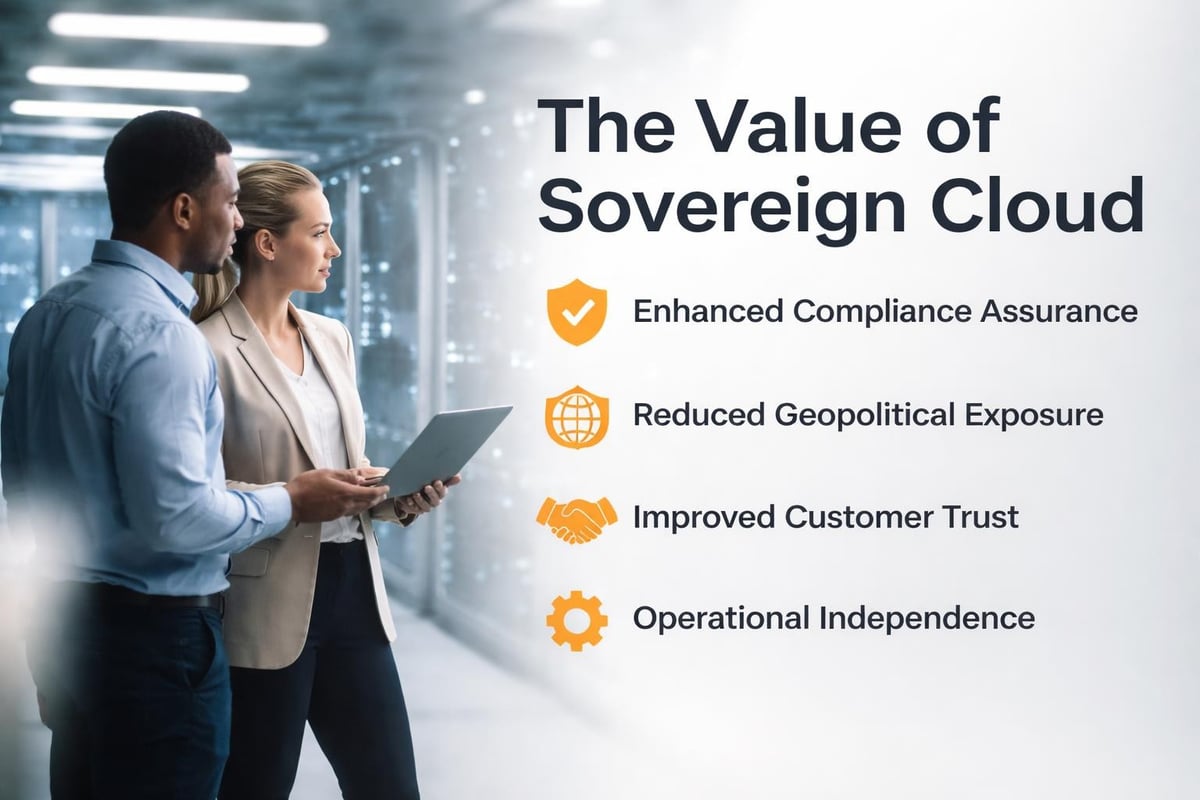
Enhanced data protection comes naturally from sovereign cloud architecture, as data remains under consistent legal frameworks without jurisdictional ambiguity. This clarity simplifies compliance management and reduces legal risk exposure.
Trust and transparency improve when customers and partners know exactly where data resides and which laws govern its handling. This transparency becomes particularly valuable when dealing with government contracts or highly regulated sectors.
Reduced geopolitical risk protects organisations from international conflicts that might otherwise compromise data access. Recent events have demonstrated how geopolitical tensions can disrupt cross-border data flows, making sovereign cloud arrangements increasingly attractive.
Performance considerations also favour sovereign architectures in many scenarios:
- Reduced latency from localised data centres serving regional users
- Improved reliability through independence from international network dependencies
- Better disaster recovery with recovery sites within the same jurisdiction
- Optimised bandwidth usage by keeping data transfers within national boundaries
Challenges and Considerations in Sovereign Cloud Adoption
Whilst the advantages are compelling, organisations must navigate significant challenges when implementing sovereign cloud solutions. The pros and cons of sovereign clouds require careful evaluation before committing to this approach.
Technical and Operational Challenges
Limited provider choice represents a significant constraint, as regulatory and data residency requirements naturally restrict options to local providers. In particular, this limitation may result in fewer features, less competitive pricing, or reduced innovation compared to global hyperscale providers.
Moreover, higher costs frequently accompany these implementations due to smaller economies of scale and duplicated infrastructure across jurisdictions. As a result, organisations must carefully weigh these premium costs against the value of compliance and data control.
In addition, skill shortages pose another obstacle, as these environments often require specialised expertise in local regulatory frameworks alongside technical capabilities. Consequently, finding professionals with this combination proves challenging in many markets.
Strategic Considerations
Organisations evaluating sovereign cloud options should assess several strategic factors:
- Data classification to determine which workloads genuinely require sovereign hosting
- Vendor lock-in risks from dependence on regional providers with limited portability
- Future scalability needs and whether sovereign constraints will accommodate growth
- Integration complexity when connecting sovereign and non-sovereign environments
The phenomenon of geopatriation reshaping global cloud strategy demonstrates how organisations are actively relocating workloads in response to sovereignty concerns, despite these challenges.
Debunking Common Sovereign Cloud Misconceptions
Several persistent myths about sovereign cloud continue to circulate, thereby potentially preventing organisations from making informed decisions about their cloud strategy.
Myth Versus Reality
Myth: Sovereign cloud is only for government agencies
Reality reveals that whilst government adoption drove initial sovereign cloud development, private sector organisations across healthcare, finance, and critical infrastructure increasingly require these capabilities. Any organisation handling sensitive personal data or operating in highly regulated environments benefits from sovereign cloud attributes.
Myth: Sovereign clouds sacrifice performance for compliance
Modern sovereign cloud infrastructure delivers performance comparable to traditional public clouds through localised data centres and optimised network architectures. In fact, proximity to end users often improves latency compared to distant international data centres.
Myth: Implementing sovereign cloud means abandoning all public cloud services
A hybrid approach allows organisations to use sovereign cloud for sensitive regulated workloads whilst leveraging public cloud for appropriate use cases. Common misconceptions about sovereign cloud often stem from viewing sovereignty as an all-or-nothing proposition rather than a strategic choice.
Implementation Strategies and Best Practices
Successfully deploying sovereign cloud infrastructure requires methodical planning and execution. In particular, organisations should follow structured approaches to ensure their implementation meets sovereignty objectives whilst delivering business value.
Assessment and Planning Phase
Begin by conducting a comprehensive data inventory to understand what information your organisation holds, where it currently resides, and which regulatory requirements apply. This assessment forms the foundation for determining sovereign cloud requirements.
Classification frameworks help prioritise workloads based on sensitivity and regulatory importance:
loud Priority
| Data Sensitivity | Regulatory Impact | Sovereign C | Example Workloads |
|---|---|---|---|
| Critical | High | Essential | Healthcare records, financial transactions |
| Sensitive | Medium | Recommended | Customer databases, HR systems |
| Internal | Low | Optional | Development environments, internal tools |
| Public | None | Unnecessary | Marketing websites, public documentation |
Migration and Transition Strategies
Phased migration approaches reduce risk by moving workloads incrementally, starting with less critical systems before tackling core applications. This strategy allows teams to develop expertise and refine processes before handling mission-critical workloads.
Parallel operation maintains existing infrastructure alongside new cloud environments during transition periods, ensuring business continuity whilst validating new systems. This approach requires additional resources but significantly reduces migration risk.
For organisations seeking guidance on implementing sovereign cloud solutions, exploring options through a demonstration of all-in-one solutions can provide valuable insights into how different components work together within a sovereign framework.

The Future of Sovereign Cloud Computing
As we progress through 2026, sovereign cloud continues evolving in response to technological advances and changing geopolitical realities. Several trends will shape sovereign cloud in coming years.
Emerging Technologies and Integration
Artificial intelligence and machine learning workloads present unique sovereignty challenges, as training data and model development often involve cross-border collaboration. In particular, sovereign cloud providers are developing specialised AI infrastructure that maintains data residency whilst enabling advanced analytics.
Moreover, edge computing naturally complements cloud principles by processing data closer to its source, reducing the need for international data transfers. As a result, this convergence will accelerate as Internet of Things deployments proliferate.
In addition, quantum-safe cryptography will become essential as quantum computing threatens current encryption methods. Consequently, sovereign cloud providers are investing in quantum-resistant security measures to future-proof data protection.
Market Evolution and Consolidation
The sovereign cloud market continues maturing, with major providers announcing new capabilities that address sovereignty requirements whilst maintaining enterprise-grade functionality. This competition drives innovation and gradually reduces the cost premium associated with sovereign solutions.
Regional cloud alliances are forming across Europe and other jurisdictions, enabling organisations to maintain sovereignty whilst accessing broader service catalogues and geographic coverage. These partnerships represent pragmatic approaches to balancing sovereignty with operational requirements.
Selecting the Right Sovereign Cloud Provider
Choosing a sovereign cloud provider demands rigorous evaluation beyond traditional cloud selection criteria. In particular, organisations must verify genuine sovereignty capabilities rather than accepting marketing assertions at face value.
Critical Evaluation Criteria
Ownership and control structures deserve thorough investigation. Examine whether the provider is genuinely independent or ultimately controlled by foreign entities through corporate structures, investment relationships, or contractual obligations.
Operational transparency indicators include:
- Clear documentation of data centre locations and ownership
- Published details about staff citizenship and security clearances
- Transparent audit processes and third-party certifications
- Explicit contractual commitments regarding data access and jurisdiction
Technical capabilities must meet both sovereignty and operational requirements. Assess redundancy, disaster recovery, performance benchmarks, and service level agreements specific to your workload needs.
Compliance certifications provide external validation of sovereignty claims. Look for recognised standards such as ISO 27001, SOC 2, and jurisdiction-specific certifications that verify adherence to local regulations.
Questions to Ask Prospective Providers
Before committing to a sovereign cloud provider, organisations should obtain clear answers to several critical questions:
- Where exactly are data centres located, and who owns the physical infrastructure?
- Which legal jurisdiction governs data at rest and in transit?
- Under what circumstances could third parties, including the provider itself, access data?
- What happens to data if the provider is acquired or changes ownership?
- How does the provider handle requests from foreign governments or law enforcement?
IBM’s perspective on sovereign cloud emphasises these considerations, highlighting how organisations can use sovereignty to maintain compliance whilst protecting sensitive information.
Industry-Specific Sovereign Cloud Applications
Different sectors apply sovereign cloud principles in distinct ways, reflecting unique regulatory environments and operational requirements. In particular, understanding these applications clarifies cloud in practical contexts.
Healthcare and Life Sciences
Healthcare organisations face stringent patient privacy requirements that make sovereign cloud particularly valuable. In particular, electronic health records, genomic data, and clinical trial information require protection under frameworks like GDPR whilst enabling legitimate research and treatment activities.
Moreover, sovereign cloud architectures allow hospitals and research institutions to share data within defined jurisdictions whilst preventing unauthorised international access. As a result, this capability supports collaborative research without compromising patient confidentiality or violating data protection regulations.
Financial Services and Banking
Financial institutions manage extraordinarily sensitive information including transaction records, customer identities, and proprietary trading algorithms. In particular, sovereign cloud environments help banks maintain compliance with banking secrecy laws, anti-money laundering regulations, and financial reporting requirements that vary significantly across jurisdictions.
Moreover, cross-border banking operations particularly benefit from sovereign cloud approaches that maintain clear jurisdictional boundaries for different customer populations and transaction types.
Government and Public Sector
Government agencies represent the archetypal sovereign cloud use case, handling classified information, citizen data, and critical infrastructure controls that absolutely must remain under national control. In particular, public sector sovereign clouds often operate under enhanced security frameworks with additional personnel vetting and operational restrictions.
Moreover, these environments enable digital transformation initiatives whilst maintaining the sovereignty essential for national security and citizen trust.
Balancing Sovereignty with Multi-Cloud Strategies
Many organisations pursue multi-cloud strategies for resilience and vendor independence, which may initially seem incompatible with sovereign cloud principles. However, thoughtful architectures can accommodate both objectives.
Hybrid Sovereignty Models
Workload segregation enables organisations to use sovereign cloud for regulated data whilst leveraging international public clouds for appropriate workloads. This approach requires robust data governance to ensure sensitive information never migrates to non-sovereign environments.
Federated architectures connect multiple sovereign cloud environments across jurisdictions, enabling multinational organisations to maintain local sovereignty for each market whilst achieving operational consistency. This model demands sophisticated orchestration and policy management.
The article from TechRadar on turning sovereign cloud theory into action provides practical guidance for EU organisations navigating these complexities in an increasingly fragmented regulatory landscape.
Managing Complexity and Governance
Multi-cloud sovereign architectures introduce governance challenges that organisations must address through clear policies and robust tooling:
- Data flow mapping to track information movement between environments
- Automated compliance checking preventing policy violations
- Unified identity management across sovereign boundaries
- Centralised security monitoring with jurisdiction-aware controls
Understanding what is sovereign cloud has become essential for organisations navigating the complex intersection of digital transformation, regulatory compliance, and geopolitical uncertainty in 2026. As data sovereignty concerns continue intensifying, businesses must carefully evaluate whether sovereign cloud approaches align with their operational requirements and compliance obligations. vBoxx delivers secure hosting and cloud solutions designed with privacy and security at their core, helping organisations maintain control over their digital infrastructure whilst meeting stringent data protection requirements. Contact our team to explore how our sovereign-ready cloud services can support your compliance objectives without compromising performance or operational flexibility.