

Data breaches increasingly target information whilst it's being processed, representing a critical vulnerability that traditional security measures struggle to address. Furthermore, as organisations migrate sensitive workloads to cloud environments, the need to protect data during computation has become paramount. Confidential computing represents a transformative approach to securing data in use, employing hardware-based isolation to create trusted execution environments that shield information even from cloud providers and system administrators. Moreover, aws confidential computing offers European businesses robust mechanisms to maintain sovereignty and compliance whilst leveraging cloud infrastructure.
Understanding Confidential Computing Fundamentals
Traditional cloud security focuses predominantly on protecting data at rest through encryption and data in transit via secure protocols like TLS. Nevertheless, a significant gap exists when data must be decrypted for processing. During computation, information becomes vulnerable to unauthorised access from malicious insiders, compromised hypervisors, or sophisticated attackers who exploit system-level privileges.
Confidential computing addresses this challenge through hardware-based trusted execution environments (TEEs). These isolated processing areas create secure enclaves where data remains encrypted during active computation. Therefore, even privileged users with administrative access cannot view or extract the information being processed.
Core Security Principles
The foundation of aws confidential computing rests on several critical principles that distinguish it from conventional security approaches:
- Memory encryption protects data whilst residing in RAM during processing
- CPU-level isolation prevents unauthorised processes from accessing secure enclaves
- Attestation mechanisms verify the integrity of the execution environment before processing begins
- Cryptographic verification ensures code hasn't been tampered with before execution
In addition, these technologies create a mathematically verifiable chain of trust. Organisations can demonstrate to auditors and stakeholders that sensitive data remains protected throughout its entire lifecycle, including the most vulnerable processing phase.

AWS Nitro System Architecture
The AWS Nitro System represents Amazon's purpose-built infrastructure for delivering confidential computing capabilities. This architecture fundamentally reimagines how hypervisors, security, and hardware interact to create isolated execution environments.
Traditional virtualisation relies on software-based hypervisors with extensive access to virtual machine memory and resources. Furthermore, this design creates inherent trust assumptions that become problematic when processing highly sensitive data. The Nitro System addresses these concerns by offloading virtualisation functions to dedicated hardware and security chips.
Nitro Enclaves Implementation
AWS Nitro Enclaves provide isolated compute environments within EC2 instances. These enclaves function as separate virtual machines with no persistent storage, interactive access, or external networking. Moreover, they possess their own kernel and memory, completely isolated from the parent instance.
| Feature | Traditional VM | Nitro Enclave |
|---|---|---|
| Memory Access | Shared with hypervisor | Fully isolated |
| Administrative Access | Root access available | No interactive access |
| Networking | Full network stack | Restricted local channel only |
| Attestation | Limited verification | Cryptographic attestation |
Nevertheless, communication between the parent instance and enclave occurs through a secure local channel using the vsock protocol. This design ensures that applications can process sensitive data within the enclave whilst maintaining necessary integration with broader systems.
The attestation process generates cryptographically signed documents that prove the enclave's identity and that specific code is running unchanged. Therefore, organisations can verify computational integrity before transmitting sensitive information for processing.
Practical Applications for European Businesses
European organisations face stringent regulatory requirements under frameworks like GDPR, NIS2 directive, and sector-specific regulations. Furthermore, data sovereignty concerns make it essential to demonstrate robust protection mechanisms. AWS confidential computing provides technical controls that align with these compliance obligations.
Financial Services and Payment Processing
Banks and financial institutions process extraordinarily sensitive data including transaction records, customer financial profiles, and authentication credentials. Moreover, these organisations must comply with PCI DSS, PSD2, and various banking regulations.
Confidential computing enables secure processing of payment data and fraud detection algorithms without exposing raw transaction details. In addition, machine learning models can analyse patterns across encrypted datasets whilst maintaining customer privacy. This capability proves particularly valuable for:
- Real-time fraud detection systems
- Credit scoring algorithms
- Anti-money laundering analysis
- Customer behaviour analytics
The hardware-based isolation ensures that even cloud administrators cannot access decrypted payment information during processing cycles.
Healthcare and Medical Research
Medical institutions handle protected health information (PHI) subject to strict confidentiality requirements. Nevertheless, collaborative research and advanced analytics demand the ability to process and analyse health data across organisational boundaries.
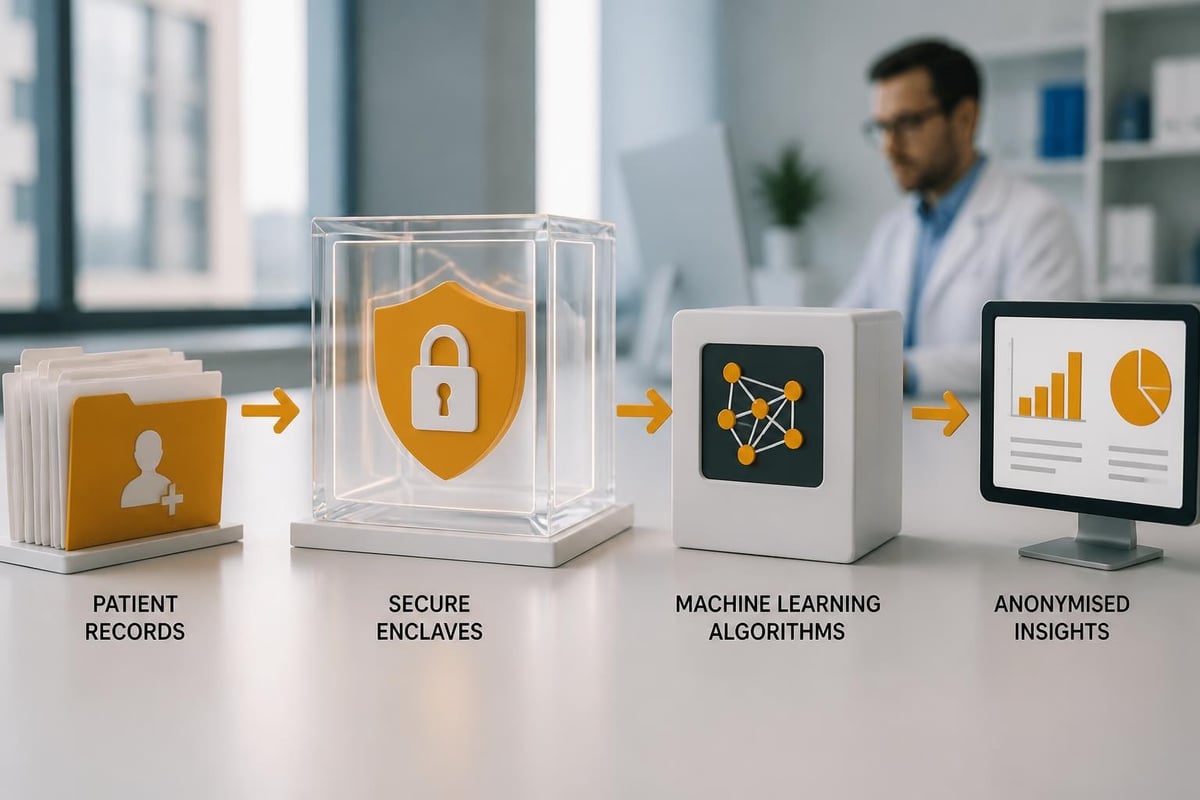
European healthcare providers can leverage aws confidential computing to enable secure multi-party computation. Research institutions can analyse patient data from multiple sources whilst maintaining privacy guarantees. Furthermore, genomic research particularly benefits from these protections, as genetic information requires exceptionally stringent security controls.
Technical Implementation Considerations
Deploying aws confidential computing requires careful architectural planning to maximise security benefits whilst maintaining operational efficiency. Moreover, organisations must evaluate which workloads genuinely require enclave-level protection versus those adequately secured through standard encryption.
Workload Selection Criteria
Not every application warrants the additional complexity and performance overhead of confidential computing. Therefore, prioritise workloads based on these factors:
- Data sensitivity classification determines whether information requires protection during processing
- Regulatory compliance requirements may mandate specific technical controls
- Third-party processing scenarios where external entities handle sensitive data
- Intellectual property protection for proprietary algorithms and models
- Multi-tenant security when processing data from multiple customers simultaneously
Subsequently, conduct a thorough risk assessment to identify which processes handle data at its most vulnerable state. Focus confidential computing investments on these high-risk processing points.
Performance and Resource Planning
Confidential computing introduces computational overhead due to memory encryption and isolation mechanisms. Nevertheless, modern CPU architectures have significantly reduced this performance impact. Intel SGX and AMD SEV technologies now deliver enclave protection with minimal latency increases.
When planning capacity requirements, consider these factors:
- Memory allocation must account for both parent instance and enclave requirements
- CPU overhead typically ranges from 5-15% depending on workload characteristics
- Attestation latency adds initial setup time before processing begins
- Communication channels between parent and enclave introduce slight data transfer delays
In addition, benchmark representative workloads in test environments before production deployment. This evaluation helps establish realistic performance expectations and appropriate instance sizing.
Integration with Existing Security Frameworks
AWS confidential computing complements rather than replaces existing security controls. Furthermore, organisations should integrate enclave-based protection into comprehensive defence-in-depth strategies that address multiple threat vectors.
Layered Security Architecture
| Security Layer | Traditional Controls | Confidential Computing Enhancement |
|---|---|---|
| Network | Firewalls, VPC isolation | Enclave network restrictions |
| Identity | IAM policies, MFA | Attestation-based access |
| Data at Rest | Volume encryption | N/A (ephemeral only) |
| Data in Transit | TLS/SSL | Encrypted memory channels |
| Data in Use | Limited options | Hardware-enforced isolation |
Moreover, combine confidential computing with robust key management practices. AWS Key Management Service (KMS) integration allows enclaves to access encryption keys only after successful attestation. This pairing creates a powerful mechanism for protecting both data and the keys that secure it.
Compliance Documentation and Auditing
European businesses must demonstrate compliance through comprehensive documentation and audit trails. Nevertheless, confidential computing's attestation mechanisms provide cryptographic proof of security controls that traditional systems cannot match.
Attestation documents serve as tamper-proof evidence that specific code executed in verified isolation. Therefore, compliance teams can present these cryptographic signatures to auditors as objective verification of data protection measures. This capability proves particularly valuable for organisations subject to NIS2 directive requirements and similar regulatory frameworks.

Advanced Use Cases and Emerging Applications
Beyond foundational data protection, aws confidential computing enables entirely new categories of secure collaboration and computation. Furthermore, these advanced applications demonstrate the technology's potential to reshape how organisations handle sensitive information.
Secure Multi-Party Computation
Multiple organisations often need to collaborate on analytics or research whilst maintaining confidentiality of their individual datasets. Traditional approaches require centralising data, creating unacceptable privacy and competitive risks. Moreover, regulations may prohibit sharing raw data across organisational boundaries.
Confidential computing enables secure multi-party computation where each participant contributes encrypted data to a shared enclave. The enclave processes combined datasets and returns aggregate results without any party viewing others' raw information. In addition, attestation mechanisms prove that only authorised algorithms executed within the secure environment.
This capability unlocks valuable collaborations previously deemed too risky:
- Industry benchmarking where competitors share performance metrics anonymously
- Supply chain optimisation across multiple partners without revealing proprietary data
- Medical research consortiums combining patient data from multiple institutions
- Financial crime detection sharing threat intelligence whilst protecting customer privacy
Machine Learning Model Protection
Organisations invest significantly in developing proprietary machine learning models representing substantial intellectual property. Nevertheless, deploying these models for inference in cloud environments traditionally exposes algorithms to potential theft or reverse engineering.
AWS confidential computing protects both training data and model architectures during inference operations. The model executes within an isolated enclave where neither the cloud provider nor instance administrators can extract the algorithm. Furthermore, attestation proves to model owners that their intellectual property remains secured during third-party inference requests.
This protection proves especially valuable for scenarios such as:
- Medical diagnosis algorithms deployed across multiple healthcare facilities
- Fraud detection models processing transactions for partner organisations
- Recommendation engines handling competitive commercial data
- Predictive maintenance models analysing proprietary operational data
Migration Strategies and Best Practices
Transitioning existing workloads to leverage aws confidential computing requires methodical planning and phased implementation. Moreover, organisations must balance security improvements against development effort and operational complexity.
Phased Adoption Approach
Rather than attempting wholesale migration, successful implementations typically follow progressive adoption patterns:
- Pilot programmes targeting a single high-value, high-risk workload
- Architecture refinement based on lessons learned from initial deployment
- Expanded deployment to additional sensitive processing workflows
- Continuous optimisation of performance and security configurations
- Integration enhancement with broader security and compliance systems
Subsequently, document lessons learned and develop internal expertise before scaling confidential computing across the organisation. This measured approach minimises disruption whilst building organisational capability.
Application Refactoring Considerations
Existing applications rarely run unmodified within confidential computing environments. Therefore, development teams must adapt code to function within enclave constraints. Common refactoring requirements include:
- Eliminating external dependencies that require network access
- Minimising memory footprint to fit within enclave size limitations
- Implementing attestation integration for cryptographic verification
- Adapting communication patterns to use vsock channels
- Removing interactive debugging reliance on logging instead
In addition, design applications with clear separation between trusted and untrusted components. Place only the most sensitive processing logic within enclaves whilst maintaining supporting functions in standard compute environments.
Comparative Analysis with Alternative Approaches
European businesses evaluating data protection strategies should understand how aws confidential computing compares to other security technologies. Nevertheless, different approaches serve complementary roles rather than functioning as direct alternatives.
Homomorphic Encryption
Homomorphic encryption allows computation on encrypted data without decryption. This mathematical approach theoretically provides perfect security but currently suffers from severe performance limitations. Furthermore, computational overhead makes homomorphic encryption impractical for most real-world applications.
Confidential computing offers dramatically better performance whilst still providing hardware-verified isolation. Moreover, the attestation capabilities prove security properties that pure cryptographic approaches cannot demonstrate. Therefore, confidential computing represents the more pragmatic choice for organisations requiring production-ready solutions.
Secure Enclaves vs Traditional Encryption
| Aspect | Traditional Encryption | Confidential Computing |
|---|---|---|
| Data at Rest | Excellent protection | Not applicable |
| Data in Transit | Excellent protection | Not applicable |
| Data in Use | No protection | Hardware-enforced isolation |
| Key Management | Software-based | Hardware-backed attestation |
| Compliance Proof | Audit logs | Cryptographic attestation |
In addition, confidential computing addresses the specific gap that traditional encryption cannot fill. Therefore, optimal security architectures combine both approaches rather than choosing between them.
On-Premises vs Cloud Confidential Computing
Some organisations question whether on-premises infrastructure provides superior security for sensitive processing. Nevertheless, modern cloud confidential computing often delivers stronger guarantees than traditional data centre deployments.
Hardware-based security measures in AWS Nitro Systems provide verifiable isolation impossible to achieve with standard on-premises virtualisation. Furthermore, the attestation mechanisms create auditable proof of security controls. Moreover, cloud providers invest in specialised security hardware that most organisations cannot economically deploy independently.
European businesses concerned about data sovereignty should note that aws confidential computing operates within EU regions, maintaining geographic data residency whilst providing enhanced technical protections.
Future Developments and Industry Trends
The confidential computing landscape continues evolving rapidly as hardware capabilities advance and industry standards mature. Furthermore, emerging technologies promise to expand the scope and accessibility of secure processing environments.
Standardisation Efforts
The Confidential Computing Consortium, comprising major technology vendors including AWS, Microsoft, Google, and Intel, works to establish industry standards. Moreover, these standardisation efforts aim to improve interoperability and establish common attestation frameworks. Therefore, organisations can expect increasing consistency across different confidential computing implementations.
In addition, regulatory bodies increasingly recognise confidential computing as a valid technical control for compliance purposes. European data protection authorities particularly value the verifiable nature of hardware-based security measures.
Expanding Hardware Capabilities
Next-generation CPU architectures promise larger enclave sizes, reduced performance overhead, and enhanced attestation capabilities. Furthermore, GPU manufacturers now integrate confidential computing support, enabling secure processing of machine learning workloads requiring specialised acceleration.
These hardware improvements will make aws confidential computing viable for increasingly diverse applications. Moreover, reduced complexity and improved tooling will lower the barrier to adoption for organisations currently deterred by implementation challenges.
Operational Management and Monitoring
Successfully operating confidential computing environments requires adapted monitoring, logging, and incident response procedures. Nevertheless, traditional operational practices often conflict with enclave isolation requirements.
Observability Challenges
The very characteristics that make enclaves secure also complicate operational visibility. Furthermore, administrators cannot inspect enclave memory or attach debugging tools during runtime. Therefore, organisations must implement alternative observability strategies:
- Structured logging where enclaves emit operational telemetry through secure channels
- Performance metrics collected at the parent instance level
- Attestation monitoring to detect unauthorised enclave configurations
- Application-level health checks replacing infrastructure-based monitoring
In addition, design applications with comprehensive internal diagnostics that provide operational insight without compromising security isolation.
Incident Response Adaptations
Security incidents involving confidential computing environments require modified response procedures. Moreover, traditional forensic techniques that examine memory dumps or attach debuggers become impossible within enclaves.
Consequently, incident response planning should emphasise preventive controls and application-level logging. Furthermore, establish procedures for safely terminating and redeploying compromised enclaves without exposing sensitive data during the response process.
For European businesses seeking to enhance their cloud security posture, understanding aws confidential computing represents a critical step towards protecting sensitive data throughout its lifecycle. Those interested in exploring how secure cloud solutions can support their specific requirements might consider scheduling a demonstration all-in-one session to see integrated security approaches in action.
Cost Optimisation Strategies
Confidential computing introduces additional costs through specialised instance types and increased resource consumption. Nevertheless, strategic implementation can maximise security benefits whilst controlling expenses.
Selective Enclave Usage
Rather than protecting entire applications within enclaves, isolate only the most sensitive processing components. Furthermore, this targeted approach minimises the computational overhead and instance costs associated with confidential computing.
Analyse data flows to identify precise points where information requires protection during processing. Subsequently, architect applications to route only these critical operations through enclaves whilst maintaining standard processing for less sensitive tasks.
Instance Sizing and Optimisation
Right-sizing enclave instances requires careful capacity planning based on actual workload characteristics. Moreover, over-provisioning wastes resources whilst under-provisioning degrades performance. Therefore, conduct thorough performance testing under realistic conditions before production deployment.
Consider these optimisation techniques:
- Batch processing to amortise attestation overhead across multiple operations
- Workload scheduling during off-peak hours for non-time-sensitive processing
- Memory efficiency through careful data structure design within size-constrained enclaves
- Caching strategies that reduce redundant enclave invocations
In addition, monitor actual resource utilisation patterns and adjust instance configurations based on empirical data rather than theoretical estimates.
Confidential computing represents a fundamental advancement in cloud security, addressing the critical vulnerability of data in use through hardware-enforced isolation. Furthermore, aws confidential computing provides European businesses with robust technical controls that align with stringent regulatory requirements whilst enabling secure cloud adoption. Whether you need to protect sensitive customer data, secure collaborative analytics, or maintain intellectual property confidentiality, these technologies offer verifiable protection previously unattainable in cloud environments. vBoxx combines European data sovereignty with comprehensive security measures including encrypted cloud services and sustainable hosting practices, helping businesses maintain control over sensitive information whilst leveraging modern cloud capabilities.