As organisations increasingly migrate critical workloads to Microsoft Azure, understanding the security posture of cloud environments has become essential. Azure pentesting represents a systematic approach to identifying vulnerabilities, misconfigurations, and security weaknesses within Azure infrastructure before malicious actors can exploit them. Furthermore, this proactive security measure helps businesses maintain compliance, protect sensitive data, and ensure the resilience of their cloud operations.
Understanding the Azure Pentesting Landscape
Azure pentesting differs fundamentally from traditional network penetration testing due to the unique architecture of cloud platforms. Moreover, the shared responsibility model requires organisations to understand precisely which security controls fall under their purview versus those managed by Microsoft.
The Shared Responsibility Framework
In Azure environments, security responsibilities are distributed between Microsoft and the customer. Nevertheless, many organisations mistakenly assume that migrating to the cloud transfers all security obligations to the provider. Microsoft secures the underlying infrastructure, including physical datacentres, hypervisors, and the core platform services. In contrast, customers remain responsible for securing their data, applications, identity management, and network configurations.
This division creates specific challenges for azure pentesting activities. Therefore, penetration testers must focus on customer-controlled components whilst respecting Microsoft's penetration testing rules and guidelines, which outline permitted activities and notification requirements.

Key Differences from Traditional Pentesting
Traditional penetration testing typically involves scanning network perimeters, exploiting server vulnerabilities, and attempting physical breaches. However, azure pentesting requires a distinct methodology that accounts for:
- Identity-centric attacks targeting Azure Active Directory and service principals
- API security assessments examining REST endpoints and authentication mechanisms
- Configuration audits reviewing security groups, storage permissions, and network policies
- Multi-tenancy considerations ensuring isolation between different workloads
Furthermore, the ephemeral nature of cloud resources means that penetration tests must account for dynamic infrastructure that scales automatically. Consequently, testers need specialised tools and techniques designed specifically for cloud environments.
Essential Azure Pentesting Methodologies
Conducting effective azure pentesting requires a structured approach that systematically evaluates all aspects of an Azure deployment. Moreover, the methodology should align with industry frameworks whilst addressing Azure-specific attack vectors.
Reconnaissance and Information Gathering
The initial phase involves collecting information about the target Azure environment. In addition, this reconnaissance must be thorough yet respectful of legal boundaries and Microsoft's acceptable use policies. Testers typically begin by identifying exposed Azure resources, enumerating Azure Active Directory objects, and mapping the tenant's external footprint.
Tools such as AzureHound enable security professionals to visualise relationships between Azure AD users, groups, service principals, and resources. Subsequently, this graph-based analysis reveals potential privilege escalation paths and lateral movement opportunities that might otherwise remain hidden.
| Reconnaissance Activity | Primary Focus | Tools Required |
|---|---|---|
| Tenant Enumeration | Azure AD discovery | Azure CLI, PowerShell |
| Resource Mapping | Public-facing services | Nmap, Shodan, Azure Scanner |
| Identity Analysis | User roles and permissions | AzureHound, ROADtools |
| Configuration Review | Security settings audit | Azure Security Centre, ScoutSuite |
Vulnerability Assessment and Exploitation
Following reconnaissance, penetration testers identify specific vulnerabilities within the Azure environment. Nevertheless, this phase requires careful coordination with stakeholders to avoid disrupting production services. Common vulnerability categories include misconfigured storage accounts, overly permissive role assignments, and exposed management interfaces.
Practical Azure penetration testing techniques demonstrate how attackers might exploit these weaknesses. Furthermore, testers evaluate both technical vulnerabilities and process-related security gaps that could enable unauthorised access.
The exploitation phase simulates real-world attack scenarios to validate discovered vulnerabilities. Therefore, testers attempt to:
- Escalate privileges through misconfigured role-based access control (RBAC)
- Access sensitive data stored in Azure Blob Storage or SQL databases
- Pivot between Azure subscriptions using compromised service principals
- Exfiltrate data through legitimate Azure services to evade detection

Testing Azure-Specific Services
Each Azure service presents unique security considerations that require specialised testing approaches. Moreover, organisations often deploy combinations of services that create complex interdependencies and potential attack surfaces.
Azure Active Directory Assessment
Azure AD serves as the identity foundation for most Azure deployments. Consequently, compromising Azure AD credentials or exploiting misconfigurations can provide attackers with extensive access. Penetration testers evaluate password policies, multi-factor authentication enforcement, conditional access policies, and application registrations.
Furthermore, testing should examine service principal permissions, as these automated accounts frequently possess excessive privileges. In addition, legacy authentication protocols and unpatched synchronisation tools create additional risk vectors.
Storage and Database Security
Azure Storage accounts and databases regularly contain sensitive business information. Nevertheless, misconfigurations such as public read access or weak authentication mechanisms expose this data to unauthorised access. Testing methodologies include:
- Attempting anonymous access to blob containers and file shares
- Evaluating storage account key rotation practices
- Testing SQL database firewall rules and authentication methods
- Assessing encryption implementation for data at rest and in transit
Network and Compute Resources
Virtual networks, network security groups, and virtual machines require thorough security assessments. Therefore, testers examine network segmentation, firewall rules, and exposed management ports. Additionally, they verify that virtual machines maintain current security patches and implement proper hardening measures.
Azure Pentesting Tools and Technologies
The azure pentesting toolkit has evolved significantly, with specialised tools addressing cloud-specific security challenges. Moreover, selecting appropriate tools depends on the specific objectives, scope, and technical requirements of each engagement.
Comprehensive Tool Categories
Modern penetration testers utilise various Azure penetration testing tools across different testing phases. Furthermore, combining multiple tools provides comprehensive coverage and validates findings through different methodologies.
Reconnaissance Tools:
- Azure CLI and PowerShell modules for legitimate API interactions
- Microburst for identifying publicly accessible Azure resources
- AADInternals for Azure AD enumeration and exploitation
Exploitation Frameworks:
- PowerZure for automated privilege escalation attacks
- Stormspotter for graphing Azure subscriptions and identifying attack paths
- MicroBurst for assessing Azure security misconfigurations
Continuous Monitoring:
- ScoutSuite for multi-cloud security auditing
- Prowler for automated compliance checking
- Azure Security Centre for ongoing vulnerability management
Hands-On Practice Environments
Developing azure pentesting expertise requires practical experience in controlled environments. Consequently, Azure Security Labs offers realistic scenarios that simulate common misconfigurations and vulnerabilities. In addition, these labs enable security professionals to refine their techniques without risking production systems.
Furthermore, organisations should establish dedicated testing environments that mirror production configurations. This approach ensures that penetration tests accurately reflect actual security postures whilst maintaining operational stability.
Compliance and Best Practices
Conducting azure pentesting within legal and ethical boundaries requires adherence to established guidelines and industry standards. Moreover, organisations must balance thorough security testing with operational requirements and regulatory obligations.
Microsoft's Penetration Testing Rules
Microsoft maintains specific policies governing penetration testing activities on Azure infrastructure. Nevertheless, recent policy updates have simplified notification requirements. Previously, organisations needed to submit penetration testing notification forms before conducting tests. However, Microsoft now permits testing without prior notification, provided activities comply with acceptable use policies.
Therefore, penetration testers must avoid:
- Denial-of-service attacks against Azure resources
- Testing other customers' applications or data
- Accessing, modifying, or deleting data belonging to other tenants
- Physical attacks on Azure datacentres or infrastructure
Aligning with Security Frameworks
Effective azure pentesting aligns with established security frameworks and compliance requirements. In addition, security best practices and patterns provide valuable guidance for designing secure Azure deployments. Consequently, penetration tests should evaluate compliance with frameworks such as:
| Framework | Focus Areas | Relevance to Azure |
|---|---|---|
| NIST Cybersecurity Framework | Identify, Protect, Detect, Respond, Recover | Comprehensive security posture |
| CIS Azure Foundations Benchmark | Configuration hardening | Azure-specific controls |
| ISO 27001 | Information security management | International compliance |
| GDPR | Data protection and privacy | European regulatory requirements |
Furthermore, organisations operating in regulated industries must ensure that penetration testing activities support compliance obligations without creating additional risks.
Documentation and Reporting
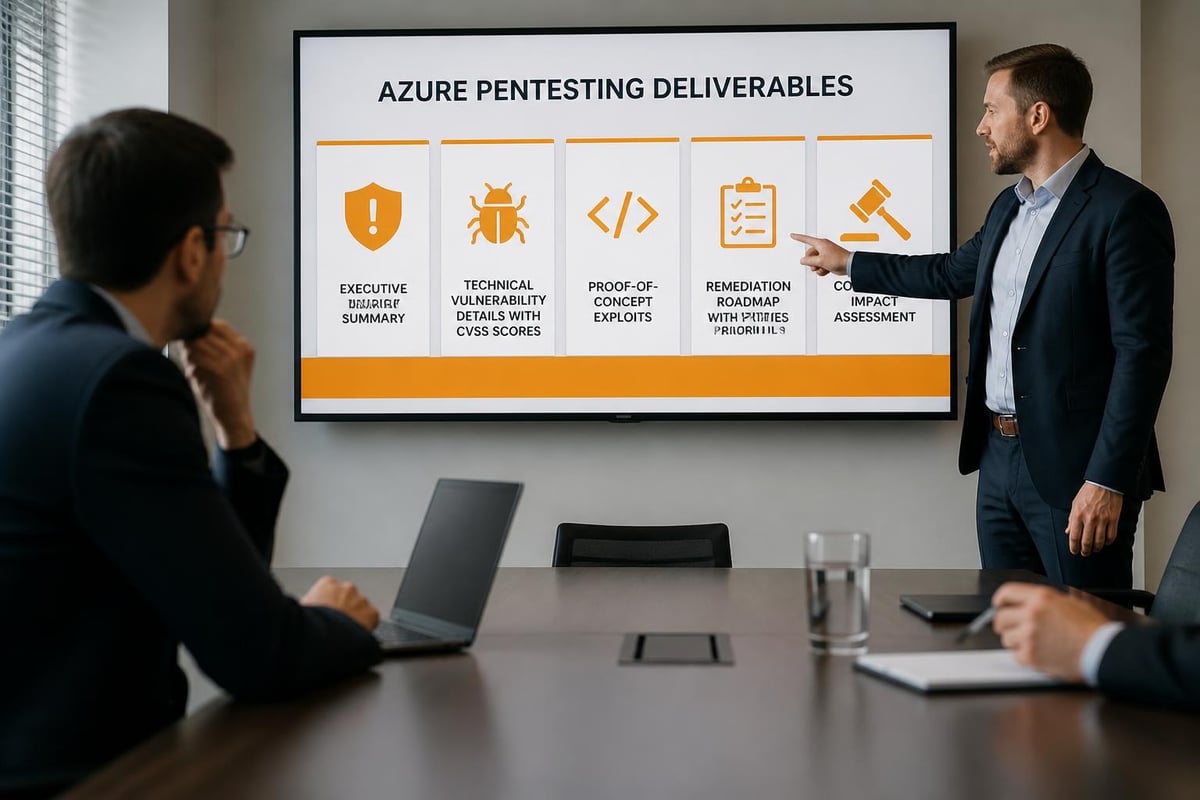
Comprehensive documentation transforms azure pentesting findings into actionable security improvements. Moreover, effective reports prioritise vulnerabilities based on risk, provide clear remediation guidance, and track progress over time.
Reports should include:
- Executive summary highlighting critical findings and business impact
- Detailed technical analysis of discovered vulnerabilities
- Step-by-step exploitation procedures demonstrating risk
- Prioritised remediation recommendations with timelines
- Compliance mapping showing how fixes address regulatory requirements
Advanced Azure Pentesting Considerations
As organisations mature their cloud security practices, azure pentesting must evolve to address sophisticated threats and complex architectures. Nevertheless, advanced techniques require specialised expertise and careful planning.
Multi-Cloud and Hybrid Environments
Many organisations operate hybrid infrastructures spanning Azure, on-premises datacentres, and potentially other cloud providers. Consequently, penetration tests must evaluate security across these interconnected environments. Furthermore, attackers often exploit trust relationships between cloud and on-premises systems to achieve their objectives.
Testing hybrid environments requires examining:
- Azure ExpressRoute and VPN security configurations
- Azure Arc management of on-premises resources
- Synchronisation mechanisms between Azure AD and Active Directory
- Cross-environment privilege escalation opportunities
Container and Kubernetes Security
Azure Kubernetes Service (AKS) deployments introduce additional complexity to security assessments. Moreover, container environments present unique attack surfaces through misconfigured registries, vulnerable images, and overly permissive service accounts. Therefore, azure pentesting should specifically evaluate container security postures.
Additionally, serverless computing through Azure Functions requires assessment of function-level permissions, API security, and event-driven attack vectors. These modern application architectures demand updated testing methodologies.
Automation and Continuous Testing
Traditional periodic penetration tests provide point-in-time security assessments. However, the rapid pace of cloud deployments necessitates continuous security validation. Furthermore, integrating automated security testing into DevSecOps pipelines enables earlier vulnerability detection.
Research into penetration testing methodologies demonstrates the value of combining manual expert analysis with automated scanning. Consequently, organisations should implement layered testing approaches that leverage both human expertise and automated tools.
Building an Azure Security Programme
Effective azure pentesting forms part of a comprehensive security strategy rather than existing as an isolated activity. Moreover, organisations must integrate penetration testing findings into broader risk management and security improvement processes.
Establishing Testing Cadence
Regular penetration testing schedules ensure consistent security validation. Nevertheless, testing frequency should reflect the organisation's risk profile, compliance requirements, and rate of infrastructure changes. Most organisations benefit from:
- Annual comprehensive penetration tests covering all Azure services
- Quarterly focused assessments of critical systems and recent deployments
- Continuous automated scanning for common misconfigurations
- Event-driven testing following significant architecture changes
Remediation and Validation
Identifying vulnerabilities represents only the beginning of the security improvement process. Furthermore, organisations must establish workflows for tracking remediation efforts, validating fixes, and preventing regression. Therefore, effective programmes include:
- Clear ownership assignment for each discovered vulnerability
- Risk-based prioritisation determining remediation timelines
- Retesting procedures confirming successful fixes
- Root cause analysis preventing similar issues
Building Internal Capabilities
Whilst external penetration testing firms provide valuable expertise, developing internal azure pentesting capabilities offers significant advantages. In addition, internal teams possess deeper organisational context and can conduct more frequent assessments. Moreover, organisations should invest in training security personnel on Azure-specific attack techniques and defensive strategies.
For businesses seeking to strengthen their cloud security posture whilst maintaining operational focus, understanding these technical requirements can feel overwhelming. Nevertheless, partnering with security-focused cloud providers can help bridge capability gaps. For instance, organisations can schedule a demonstration of all-in-one cloud solutions to understand how integrated security features support comprehensive protection strategies.
Emerging Trends and Future Considerations
The azure pentesting landscape continues evolving as both attackers and defenders develop new techniques. Moreover, understanding emerging trends helps organisations anticipate future security challenges.
AI-Assisted Penetration Testing
Artificial intelligence and machine learning increasingly augment penetration testing capabilities. Furthermore, these technologies enable more efficient vulnerability discovery and automated exploit development. Nevertheless, human expertise remains essential for contextual analysis and complex attack chain development.
Zero Trust Architecture Assessment
Azure deployments increasingly implement zero trust principles that eliminate implicit trust and verify every access request. Consequently, azure pentesting must evaluate the effectiveness of these controls. Therefore, tests should specifically target identity verification, least privilege enforcement, and micro-segmentation implementations.
Supply Chain Security
Third-party dependencies, open-source libraries, and managed services introduce supply chain risks into Azure environments. Moreover, attackers increasingly target software supply chains to compromise multiple organisations simultaneously. Hence, comprehensive azure pentesting should assess dependency security, code signing verification, and third-party access controls.
The sophistication of cloud-native threats demands equally sophisticated defensive measures. In addition, organisations must balance security investments with operational efficiency and business enablement. Furthermore, successful cloud security programmes integrate technical controls, process improvements, and cultural change.
Azure pentesting provides essential visibility into cloud security postures, enabling organisations to identify and remediate vulnerabilities before exploitation. Moreover, as businesses continue embracing cloud technologies, systematic security assessments become fundamental to maintaining trust and operational resilience. At vBoxx, we understand that robust security underpins reliable cloud services, which is why our infrastructure incorporates comprehensive protection measures alongside our commitment to privacy and sustainability. Therefore, whether you're evaluating your current cloud security or planning migration strategies, partnering with providers who prioritise security-first approaches ensures your digital infrastructure remains protected against evolving threats.