

The digital landscape of 2026 demands robust, secure, and compliant infrastructure solutions that can scale with business needs whilst maintaining strict data protection standards. Cloud and hosting technologies have evolved significantly, offering organisations sophisticated options that balance performance, security, and regulatory compliance. Moreover, as businesses increasingly recognise the importance of data sovereignty and environmental responsibility, the choice of cloud and hosting provider has become a strategic decision that impacts operations, legal compliance, and corporate sustainability goals. Therefore, understanding the fundamental differences between deployment models, service tiers, and compliance frameworks is essential for making informed infrastructure decisions.
Understanding Cloud and Hosting Fundamentals
Cloud and hosting services represent the foundation of modern digital infrastructure, yet the terminology often creates confusion among decision-makers. Furthermore, the distinction between traditional hosting and cloud computing extends beyond simple definitions to encompass architectural differences, scalability characteristics, and operational models.
Traditional hosting typically involves dedicated physical servers or virtual private servers (VPS) allocated to specific customers. In contrast, cloud computing leverages resource pooling, on-demand self-service, and rapid elasticity. According to the NIST definition of cloud computing, cloud services are characterised by five essential attributes: on-demand self-service, broad network access, resource pooling, rapid elasticity, and measured service.
Service Models in Cloud and Hosting
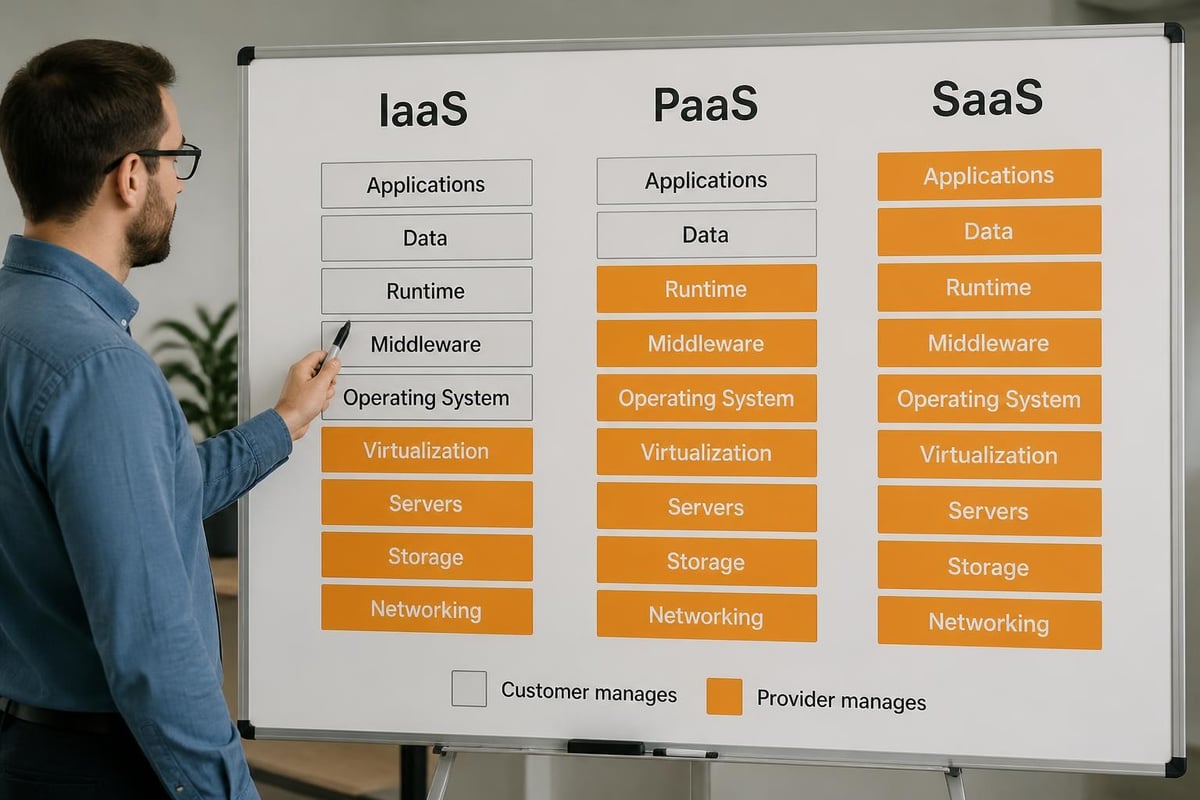
The cloud and hosting ecosystem encompasses three primary service models, each offering distinct levels of control and management responsibility:
- Infrastructure as a Service (IaaS): Provides virtualised computing resources including servers, storage, and networking
- Platform as a Service (PaaS): Delivers a complete development and deployment environment in the cloud
- Software as a Service (SaaS): Offers fully managed applications accessible via web browsers
| Service Model | Provider Manages | Customer Manages | Best For |
|---|---|---|---|
| IaaS | Hardware, virtualisation, storage, networking | OS, middleware, runtime, applications, data | Custom applications, full control requirements |
| PaaS | Everything up to runtime | Applications and data | Development teams, rapid deployment |
| SaaS | Entire stack | Configuration and user data | End-users, minimal IT overhead |
Nevertheless, many businesses benefit from hybrid approaches that combine multiple service models. Therefore, the choice depends on specific workload requirements, technical expertise, and compliance obligations.
Deployment Models and Infrastructure Choices
Beyond service models, cloud and hosting solutions differ in deployment architecture. These deployment patterns determine where infrastructure resides, who has access, and how resources are shared.
Public cloud environments offer shared infrastructure operated by third-party providers, delivering cost efficiency through economies of scale. Conversely, private cloud infrastructure is dedicated to a single organisation, providing enhanced control and security. Additionally, hybrid cloud architectures combine public and private elements, allowing workloads to move between environments based on security, performance, or cost requirements.
For organisations with specific compliance needs, community cloud models serve multiple organisations with shared concerns. Moreover, the 2025 CNCF Annual Survey indicates that hybrid and multi-cloud strategies have become dominant, with 87% of organisations using multiple cloud environments to avoid vendor lock-in and optimise workload placement.
Evaluating Infrastructure Location
Data residency has emerged as a critical consideration in cloud and hosting decisions, particularly for European businesses subject to GDPR requirements. Furthermore, the extraterritorial reach of legislation such as the US CLOUD Act creates compliance challenges when data resides in jurisdictions outside the European Economic Area.
Consequently, businesses prioritising data sovereignty increasingly select providers operating their own infrastructure within Europe. For instance, hosting infrastructure in ISO 27001-certified data centres within the Netherlands ensures both physical security and jurisdictional clarity. In addition, European hosting eliminates concerns about foreign surveillance laws compelling data disclosure.
The infrastructure choices organisations make directly impact compliance posture, latency characteristics, and disaster recovery capabilities. Therefore, evaluating data centre locations, certification standards, and jurisdictional frameworks should precede vendor selection.
Security Standards and Compliance Frameworks
Security in cloud and hosting environments operates on a shared responsibility model, where providers and customers divide security obligations. Nevertheless, understanding where provider responsibilities end and customer obligations begin remains a common source of confusion.
The Cloud Security Alliance's Cloud Controls Matrix provides a comprehensive framework mapping security controls across cloud service models. Moreover, this matrix helps organisations assess whether providers implement adequate technical, administrative, and physical safeguards.
Essential Security Certifications
Professional cloud and hosting providers demonstrate their commitment to security through independent audits and certifications:
- ISO 27001: Information security management system standard
- SOC 2 Type II: Service organisation controls for security, availability, and confidentiality
- TÜV audits: Independent verification of specific security controls
- GDPR compliance: Adherence to European data protection regulations
- eIDAS: Electronic identification and trust services for digital signatures
Furthermore, providers should offer transparency regarding their security practices, including encryption standards, access controls, and incident response procedures. In addition, businesses should verify that encryption applies both in transit (TLS/SSL) and at rest (AES-256 or equivalent).
| Security Layer | Provider Responsibility | Customer Responsibility |
|---|---|---|
| Physical security | Data centre access controls, environmental protections | Selecting appropriately certified facilities |
| Network security | Infrastructure firewalls, DDoS protection | Application-level security, access policies |
| Data encryption | Encryption capabilities, key management infrastructure | Implementing encryption, managing keys |
| Access management | Identity infrastructure, authentication systems | User provisioning, role assignments, MFA enforcement |
The ISO/IEC guidance on cloud security controls provides additional context on international standards applicable to cloud and hosting environments. Therefore, organisations should map their compliance requirements to provider certifications and capabilities before committing to specific platforms.

Performance Considerations and Workload Optimisation
Cloud and hosting performance depends on numerous factors including compute resources, storage architecture, network connectivity, and geographic distribution. Moreover, different workload types demand distinct infrastructure characteristics.
Compute-intensive workloads such as artificial intelligence, machine learning, and data analytics benefit from dedicated processing power and GPU acceleration. For example, Mac mini hosting on Apple M5 Pro and M6 hardware delivers exceptional performance for AI workloads, iOS development environments, and creative production tasks whilst maintaining full GDPR compliance in European data centres.
Conversely, storage-intensive applications require high-throughput storage systems with robust redundancy. Furthermore, applications serving geographically distributed users benefit from content delivery networks (CDN) and edge computing capabilities.
Measuring and Monitoring Performance
Establishing clear performance baselines and monitoring key metrics ensures cloud and hosting infrastructure meets business requirements:
- Latency: Response time between request and delivery
- Throughput: Data transfer capacity over network connections
- IOPS: Input/output operations per second for storage systems
- Availability: Percentage of time services remain accessible
- Error rates: Frequency of failed requests or transactions
Additionally, service level agreements (SLAs) should specify guaranteed uptime percentages, typically ranging from 99.9% to 99.99% for production environments. Nevertheless, businesses should understand that 99.9% availability permits approximately 8.76 hours of downtime annually, whilst 99.99% reduces this to 52.56 minutes.
The Uptime Institute's 2024 Capacity Trends and Cloud Survey reveals that organisations increasingly prioritise resilience and redundancy over raw performance metrics. Therefore, disaster recovery capabilities, backup systems, and failover mechanisms deserve equal consideration alongside performance specifications.
Cost Management and Resource Optimisation
Cloud and hosting costs can escalate rapidly without proper governance and monitoring. Moreover, the flexibility that makes cloud attractive also creates opportunities for wasteful spending on unused or oversized resources.
Fixed-cost hosting models such as dedicated servers or VPS offer predictable monthly expenses but lack elasticity. In contrast, consumption-based cloud pricing aligns costs with actual usage but requires vigilant monitoring to prevent budget overruns. Furthermore, reserved instances and committed use discounts can reduce cloud costs by 30-70% for predictable workloads.
Strategies for Cost Optimisation
Implementing cost management practices helps organisations maximise value from cloud and hosting investments:
- Right-sizing resources: Match instance types and storage tiers to workload requirements
- Automated scaling: Reduce capacity during low-demand periods
- Reserved capacity: Commit to long-term usage for discounted rates
- Storage lifecycle policies: Move infrequently accessed data to lower-cost tiers
- Monitoring and alerts: Track spending patterns and set budget thresholds
Additionally, businesses should evaluate total cost of ownership (TCO) rather than focusing solely on infrastructure expenses. Therefore, factor in administrative overhead, training requirements, migration costs, and opportunity costs when comparing cloud and hosting options.
Privacy and Data Protection in European Context
Data protection regulations fundamentally influence cloud and hosting decisions for European organisations. Furthermore, GDPR imposes strict requirements on data processing, storage location, and cross-border transfers.
European businesses must ensure their cloud and hosting providers offer data processing agreements (DPAs) that clearly define roles, responsibilities, and technical safeguards. Moreover, providers acting as data processors must implement appropriate security measures and restrict data access to authorised personnel only.
The extraterritorial reach of foreign surveillance legislation creates additional complexity. Consequently, selecting providers operating entirely within European jurisdiction eliminates risks associated with compelled data disclosure under laws such as the US CLOUD Act. In addition, European cloud storage solutions hosted exclusively in the Netherlands provide legal clarity and enhanced privacy protections.
Implementing Privacy by Design
Privacy-conscious cloud and hosting architectures incorporate protection mechanisms at every layer:
- Zero-knowledge encryption: Provider cannot access customer data
- End-to-end encryption: Data remains encrypted throughout transmission and storage
- Access logging: Comprehensive audit trails of data access
- Data minimisation: Collect and retain only necessary information
- Retention policies: Automated deletion after specified periods
Nevertheless, technical measures alone cannot ensure compliance. Therefore, organisations must also implement appropriate governance policies, staff training programmes, and regular privacy impact assessments. Furthermore, the data protection compliance framework should align technical controls with legal obligations and business requirements.

Sustainability and Green Hosting Practices
Environmental responsibility has become a critical factor in cloud and hosting decisions as organisations work towards carbon neutrality goals. Moreover, data centres consume approximately 1-2% of global electricity, making infrastructure choices environmentally significant.
Green hosting encompasses multiple dimensions including renewable energy procurement, energy-efficient hardware, cooling optimisation, and carbon offset programmes. Furthermore, modern data centres achieve Power Usage Effectiveness (PUE) ratios approaching 1.1, meaning only 10% additional energy beyond computing requirements is consumed for cooling and infrastructure.
Organisations committed to sustainability should evaluate providers based on:
- Renewable energy sources powering data centres
- Energy efficiency certifications and PUE metrics
- Hardware lifecycle management and recycling programmes
- Carbon reporting and offset initiatives
- Waste heat recovery systems
Additionally, green hosting practices extend beyond energy considerations to encompass responsible hardware disposal, minimising electronic waste, and selecting suppliers with strong environmental credentials. Therefore, sustainability should feature alongside security, performance, and cost in vendor evaluation frameworks.
Migration Strategies and Service Transitions
Moving workloads to new cloud and hosting environments requires careful planning to minimise disruption and ensure data integrity. Moreover, the complexity of migration projects often deters organisations from optimising their infrastructure, leading to technical debt accumulation.
Lift-and-shift migrations move applications to cloud infrastructure with minimal modifications, offering quick transitions but limited optimisation. Conversely, re-platforming involves modest changes to leverage cloud-native capabilities without complete redesign. Furthermore, refactoring rebuilds applications specifically for cloud architectures, maximising benefits but requiring substantial investment.
Migration Planning Essentials
Successful transitions to new cloud and hosting platforms follow structured methodologies:
- Discovery and assessment: Catalogue existing infrastructure, dependencies, and performance baselines
- Pilot projects: Validate approach with non-critical workloads
- Data migration: Transfer information using secure, verified methods
- Application cutover: Redirect traffic to new infrastructure
- Validation and optimisation: Confirm functionality and tune performance
- Decommissioning: Safely retire legacy systems
Additionally, engaging providers offering migration services eliminates common pitfalls and accelerates transitions. Nevertheless, organisations should maintain detailed documentation, backup copies, and rollback procedures throughout migration projects.
Emerging Trends Shaping Cloud and Hosting
The cloud and hosting landscape continues evolving rapidly as new technologies and methodologies emerge. Furthermore, understanding directional trends helps organisations make forward-looking infrastructure decisions that remain relevant beyond immediate requirements.
According to O'Reilly's Technology Trends for 2025, several patterns are reshaping how businesses approach cloud and hosting:
- AI integration: Machine learning capabilities embedded directly into infrastructure platforms
- Edge computing: Processing moved closer to data sources for reduced latency
- Serverless architecture: Abstraction of infrastructure management from developers
- Kubernetes dominance: Container orchestration as standard deployment model
- FinOps practices: Financial accountability integrated into technical operations
Moreover, the convergence of cloud and hosting with artificial intelligence creates new opportunities for intelligent automation, predictive scaling, and anomaly detection. Therefore, platforms incorporating AI-assisted search, document analysis, and workflow optimisation deliver enhanced productivity alongside infrastructure services.
Additionally, businesses should explore how integrated platforms combine multiple capabilities. For instance, solutions offering cloud storage, communication tools, and security features within unified environments simplify administration whilst improving user experience. Furthermore, consolidated platforms reduce integration complexity and vendor management overhead.
Vendor Selection and Due Diligence
Choosing cloud and hosting providers represents a strategic decision with long-term implications for security, compliance, performance, and cost. Moreover, vendor lock-in risks make thorough evaluation essential before committing to specific platforms.
Technical capabilities form the foundation of assessment, including service offerings, performance specifications, and integration options. Nevertheless, operational considerations such as support quality, SLA terms, and pricing transparency deserve equal attention. Furthermore, provider stability, financial health, and long-term viability affect infrastructure reliability.
Evaluation Criteria for Cloud and Hosting Providers
| Criterion | Key Questions | Validation Methods |
|---|---|---|
| Security | What certifications? How is encryption implemented? | Review audit reports, penetration test results |
| Compliance | Where is data stored? What legal jurisdiction applies? | Examine DPA terms, data centre locations |
| Performance | What SLA guarantees? How is redundancy implemented? | Request reference architectures, customer references |
| Support | What response times? Which channels available? | Test support responsiveness, review documentation quality |
| Pricing | What costs are included? How are overages handled? | Model scenarios, request detailed quote breakdowns |
Additionally, organisations should investigate provider transparency regarding incidents, maintenance schedules, and product roadmaps. Therefore, vendors willing to share detailed technical information and engage in substantive discussions typically demonstrate greater reliability than those relying solely on marketing materials.
For businesses seeking European providers emphasising privacy, security, and compliance, exploring platforms hosted entirely within ISO 27001-certified facilities offers jurisdictional clarity. Moreover, providers operating their own infrastructure rather than reselling services maintain greater control over security implementations and service quality.
Cloud and hosting decisions fundamentally shape business capabilities, security posture, and compliance outcomes in 2026. Therefore, organisations must carefully evaluate service models, deployment architectures, security certifications, and provider credentials to select infrastructure aligned with strategic objectives. vBoxx delivers secure, GDPR-compliant cloud and hosting solutions from ISO 27001-certified Dutch data centres, combining European data sovereignty with comprehensive services including cloud storage, communication platforms, password management, Mac hosting, and backup solutions. Furthermore, as a European provider outside US CLOUD Act jurisdiction, vBoxx offers the privacy protections, sustainability commitments, and expert support that modern businesses require for their digital infrastructure.