

The digital transformation sweeping across European businesses has fundamentally altered how organisations deploy, manage, and scale their software infrastructure. At the heart of this shift lies the cloud based application, a model that has moved from emerging technology to essential business infrastructure in remarkably short order. Furthermore, as companies face increasing pressure to operate efficiently whilst maintaining stringent data protection standards, understanding the architecture, benefits, and strategic considerations of cloud based applications has never been more critical. This comprehensive guide explores the essential elements of cloud computing for business decision-makers, technical teams, and stakeholders navigating the European digital landscape.
Understanding the Cloud Based Application Architecture
A cloud based application represents software that runs primarily on remote servers rather than on local devices, delivering functionality through internet connectivity. According to NIST's authoritative definition, cloud computing exhibits five essential characteristics: on-demand self-service, broad network access, resource pooling, rapid elasticity, and measured service. These properties distinguish true cloud applications from traditional software merely hosted on remote servers.
Core Components and Infrastructure Layers
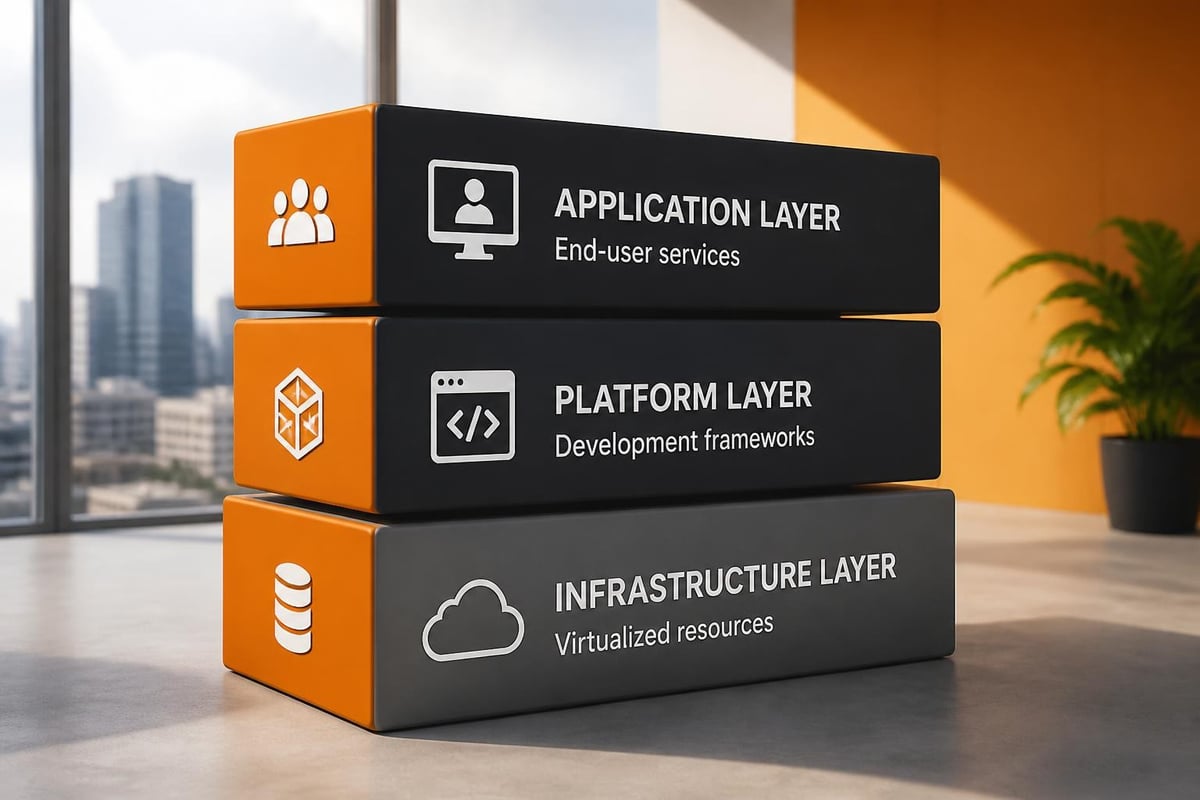
The infrastructure supporting cloud based applications typically comprises three fundamental layers working in concert. The infrastructure layer provides virtualised computing resources including processors, storage, and networking. Moreover, the platform layer offers development frameworks, databases, and middleware that simplify application deployment. Finally, the application layer delivers end-user functionality through web browsers or lightweight client applications.
Modern cloud based application architectures increasingly embrace microservices patterns rather than monolithic designs. This approach divides applications into small, independently deployable services that communicate through well-defined APIs. Consequently, development teams can update individual components without disrupting entire systems, accelerating innovation cycles whilst reducing deployment risks.
| Architecture Component | Traditional Application | Cloud Based Application |
|---|---|---|
| Infrastructure | Fixed, on-premises hardware | Elastic, virtualised resources |
| Deployment | Manual, scheduled releases | Automated, continuous delivery |
| Scaling | Vertical (bigger servers) | Horizontal (more instances) |
| Updates | Coordinated downtime windows | Rolling updates, zero downtime |
| Cost Model | Capital expenditure (CapEx) | Operational expenditure (OpEx) |
Deployment Models and Service Categories
Cloud based applications manifest across several distinct deployment models, each offering different balances between control, security, and operational overhead. Public clouds provide shared infrastructure accessible to multiple organisations, offering maximum scalability and minimal upfront investment. In contrast, private clouds dedicate infrastructure to a single organisation, delivering greater control over security and compliance requirements.
Hybrid and Multi-Cloud Strategies
Hybrid cloud architectures combine private and public cloud elements, allowing organisations to place sensitive workloads on private infrastructure whilst leveraging public cloud elasticity for less critical applications. Furthermore, multi-cloud strategies distribute workloads across multiple cloud providers, reducing vendor lock-in and improving resilience through geographic redundancy.
European businesses particularly favour hybrid approaches that maintain data sovereignty by keeping regulated data within specific jurisdictions. Therefore, organisations can satisfy GDPR requirements whilst still benefiting from cloud scalability and innovation.
The three primary service models for cloud based applications include:
- Software as a Service (SaaS): Complete applications delivered over the internet, requiring minimal technical management from users
- Platform as a Service (PaaS): Development environments providing frameworks, databases, and tools for building custom applications
- Infrastructure as a Service (IaaS): Virtualised computing resources allowing maximum flexibility and control over the software stack
Nevertheless, the boundaries between these categories increasingly blur as providers offer hybrid services combining elements from multiple models. This convergence reflects the maturation of cloud technologies and evolving customer requirements.
Security Considerations and Compliance Frameworks
Security remains the paramount concern for organisations evaluating cloud based applications, particularly within Europe's stringent regulatory environment. The OWASP Top Ten provides essential guidance on the most critical security risks facing web and cloud applications, including injection attacks, broken authentication, and sensitive data exposure.
Implementing Defence-in-Depth Strategies
Effective cloud security employs multiple overlapping layers of protection rather than relying on single controls. Encryption protects data both in transit and at rest, ensuring confidentiality even if underlying infrastructure faces compromise. Moreover, identity and access management systems enforce principle-of-least-privilege policies, granting users only the permissions necessary for their specific roles.
Network segmentation isolates different application components and tenant data, preventing lateral movement during security incidents. Additionally, continuous monitoring and logging provide visibility into application behaviour, enabling rapid detection of anomalies that might indicate security breaches or operational issues.
For businesses handling sensitive information, selecting providers operating ISO 27001-certified data centres ensures adherence to international information security standards. Furthermore, European providers outside the scope of extraterritorial legislation such as the US CLOUD Act offer enhanced privacy protections for regulated data.
Essential security controls for cloud based applications:
- Authentication and authorisation: Multi-factor authentication, role-based access control, and session management
- Data protection: Encryption at rest and in transit, secure key management, and data loss prevention
- Network security: Firewalls, intrusion detection systems, and DDoS mitigation
- Application security: Input validation, secure coding practices, and regular vulnerability assessments
- Operational security: Patch management, change control, and incident response procedures
Scalability Patterns and Performance Optimisation
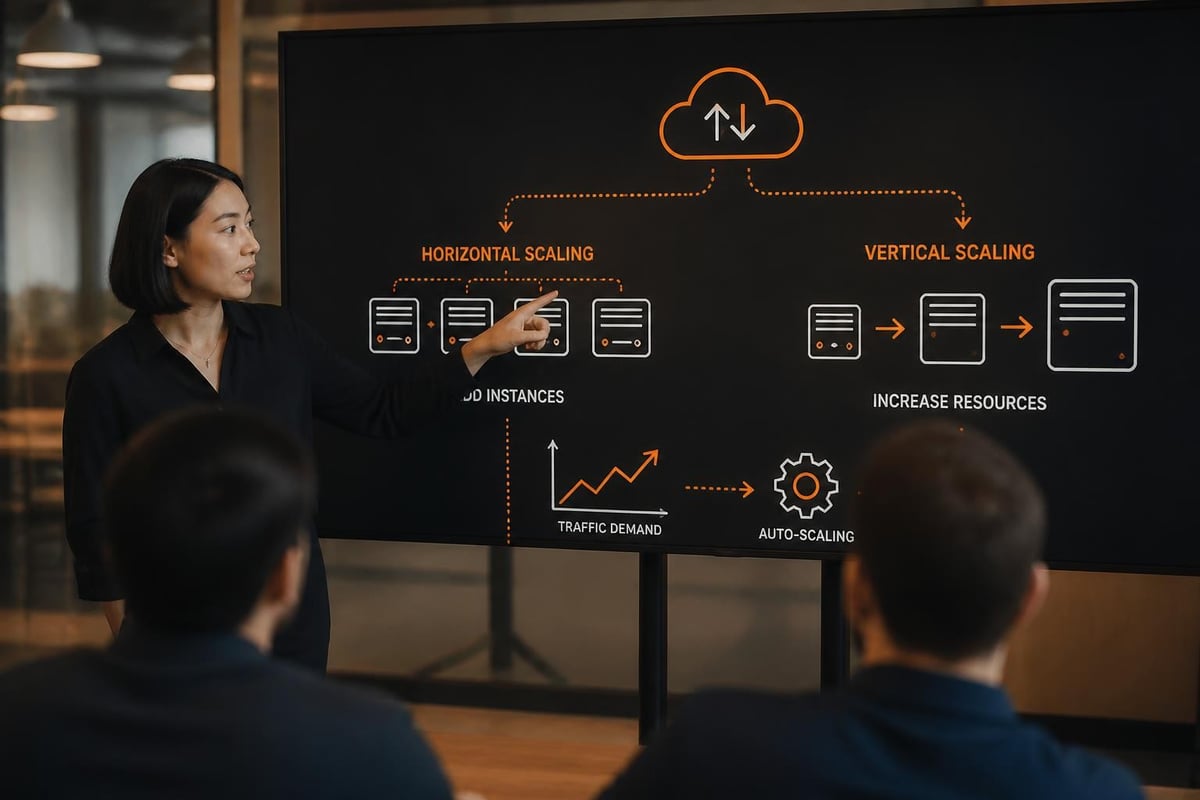
The ability to scale efficiently represents one of the most compelling advantages of cloud based applications. Horizontal scaling adds more instances of application components to handle increased load, whilst vertical scaling increases the resources allocated to existing instances. Therefore, cloud platforms enable organisations to match resource consumption precisely to demand, optimising both performance and costs.
Auto-Scaling and Load Balancing
Auto-scaling policies automatically adjust compute resources based on predefined metrics such as CPU utilisation, request rates, or custom business indicators. When traffic increases, the cloud based application provisions additional instances; conversely, it terminates excess capacity during quiet periods. This elasticity ensures consistent user experience without overprovisioning resources.
Load balancers distribute incoming requests across multiple application instances, preventing any single server from becoming overwhelmed. Moreover, health checks continuously monitor instance availability, automatically routing traffic away from failing components. Google Cloud's architectural guidance provides detailed patterns for implementing these resilience mechanisms.
| Scaling Dimension | Characteristics | Best Used For |
|---|---|---|
| Horizontal (scale-out) | Add more instances | Stateless workloads, high availability |
| Vertical (scale-up) | Increase instance size | Stateful applications, databases |
| Auto-scaling | Automatic resource adjustment | Variable traffic patterns |
| Scheduled scaling | Pre-planned capacity changes | Predictable demand cycles |
Performance optimisation extends beyond simple scaling to encompass caching strategies, content delivery networks, and database query optimisation. Caching frequently accessed data reduces latency and decreases load on backend systems. Furthermore, geographically distributed caches place content closer to end users, minimising network transit times for global audiences.
Development Methodologies and DevOps Integration
Cloud based applications thrive when organisations adopt modern development practices aligned with cloud-native principles. The Twelve-Factor App methodology provides a concise framework for building cloud-ready software, emphasising code portability, declarative configuration, and stateless processes. These principles enable applications to scale seamlessly across cloud environments whilst minimising operational complexity.
Continuous Integration and Continuous Deployment
CI/CD pipelines automate the journey from code commit to production deployment, reducing manual intervention and accelerating release cycles. Automated testing at multiple stages catches defects early, when they are least expensive to fix. Moreover, deployment automation ensures consistency across environments, eliminating configuration drift between development, staging, and production systems.
Containerisation technologies package applications with their dependencies into standardised units that run consistently across different cloud platforms. Therefore, development teams can build once and deploy anywhere, avoiding vendor lock-in whilst simplifying environment management. The CNCF's annual survey reveals widespread adoption of container orchestration platforms, confirming their status as foundational cloud infrastructure.
Key DevOps practices for cloud based applications include:
- Version control for all code and infrastructure definitions
- Automated testing covering unit, integration, and end-to-end scenarios
- Infrastructure as code enabling reproducible environment provisioning
- Monitoring and observability providing real-time application insights
- Progressive deployment strategies such as blue-green or canary releases
Communication and collaboration tools play a crucial role in distributed development teams building cloud based applications. For European organisations requiring GDPR-compliant platforms, vBoxxConnect offers integrated email, calendar, and video conferencing hosted entirely within the Netherlands, ensuring data remains under European jurisdiction whilst supporting seamless team coordination.
Cost Management and Financial Governance
The shift from capital expenditure to operational expenditure fundamentally changes how organisations budget for technology. Nevertheless, the pay-as-you-go model of cloud based applications introduces new challenges in cost prediction and control. Without proper governance, cloud spending can escalate rapidly as teams provision resources without considering financial implications.
Implementing FinOps Practices
Financial operations (FinOps) applies cross-functional collaboration to cloud cost management, bringing together finance, engineering, and business stakeholders. The FinOps Framework outlines principles for maximising cloud business value whilst maintaining financial accountability. Core practices include cost allocation, budget forecasting, and regular optimisation reviews.
Tagging strategies label cloud resources with metadata indicating project, department, environment, and cost centre. These tags enable detailed cost attribution, revealing which business units consume which resources. Furthermore, automated policies can enforce budget limits, preventing runaway spending before it impacts financial performance.
| Cost Optimisation Strategy | Potential Savings | Implementation Complexity |
|---|---|---|
| Right-sizing instances | 20-40% | Low |
| Reserved capacity purchasing | 30-60% | Medium |
| Spot/preemptible instances | 60-90% | High |
| Automated shutdown policies | 40-70% | Low |
| Storage lifecycle management | 30-50% | Medium |
Resource scheduling automatically terminates development and testing environments outside business hours, eliminating costs for unused capacity. Additionally, archiving infrequently accessed data to lower-cost storage tiers reduces ongoing expenses without sacrificing data availability. These tactical optimisations compound over time, significantly reducing total cost of ownership for cloud based applications.
Data Residency and Regulatory Compliance
European organisations face complex regulatory requirements governing where and how customer data may be processed. GDPR mandates strict controls over personal data, including requirements for data minimisation, purpose limitation, and individual rights to access and deletion. Therefore, cloud based applications handling European personal data must implement comprehensive compliance measures.
Selecting Compliant Infrastructure Providers
Data residency requirements often necessitate selecting cloud providers operating data centres within specific jurisdictions. Infrastructure location directly impacts legal obligations, as data stored in EU member states benefits from stronger privacy protections than data in third countries. Moreover, European cloud providers operating independently of foreign parent companies avoid extraterritorial legal conflicts that can compromise data protection.
Certifications and audit reports provide third-party validation of security and compliance controls. ISO 27001 certification demonstrates systematic information security management, whilst SOC 2 reports detail operational controls. Furthermore, industry-specific certifications such as NIS2 compliance for critical infrastructure operators may be required depending on business sector.

Compliance considerations for cloud based applications:
- Data location: Physical storage within required jurisdictions
- Access controls: Limiting data access to authorised personnel only
- Encryption: Protecting data confidentiality during storage and transmission
- Audit trails: Maintaining records of data access and modifications
- Data portability: Enabling export in standard formats
- Deletion capabilities: Permanent removal upon retention expiry
Edge Computing and Distributed Architectures
Whilst centralised cloud data centres provide enormous scale, certain applications benefit from processing data closer to where it is generated. Edge computing extends cloud based application architectures to network periphery, reducing latency and bandwidth consumption for time-sensitive workloads. Therefore, hybrid architectures combining centralised and edge processing deliver optimal performance for geographically distributed operations.
Designing for Edge-Native Patterns
The CNCF Edge Native whitepaper explores design behaviours enabling applications to operate effectively across cloud and edge environments. Key patterns include autonomous operation during connectivity interruptions, local data processing to minimise backhaul traffic, and synchronisation protocols maintaining consistency between distributed nodes.
Manufacturing facilities, retail locations, and IoT deployments particularly benefit from edge capabilities. Sensors generate massive volumes of data requiring real-time analysis; transmitting everything to centralised clouds becomes impractical due to bandwidth constraints and latency requirements. Moreover, edge processing enables continued operation even when network connectivity to central infrastructure fails.
Nevertheless, edge architectures introduce operational complexity requiring sophisticated deployment and management tooling. Container orchestration platforms designed for edge environments handle intermittent connectivity, resource constraints, and heterogeneous hardware. Furthermore, security models must account for physically accessible edge devices in potentially hostile environments.
Resilience Engineering and Disaster Recovery
High availability represents a core requirement for business-critical cloud based applications, as downtime directly impacts revenue, productivity, and customer satisfaction. Resilience engineering applies systematic approaches to minimising failure probability whilst limiting blast radius when failures inevitably occur. Therefore, robust architectures incorporate redundancy at multiple levels, from individual component failures to entire region outages.
Multi-Region Deployment Strategies
Distributing application components across multiple geographic regions protects against localised disasters affecting single data centre locations. Active-active configurations serve traffic from multiple regions simultaneously, providing both performance benefits and resilience. Conversely, active-passive designs maintain standby capacity activated only during primary region failures, reducing costs whilst still ensuring business continuity.
Database replication synchronises data across regions, enabling failover without data loss. Nevertheless, organisations must balance consistency requirements against replication lag; strongly consistent replication adds latency, whilst eventually consistent approaches risk brief inconsistencies during network partitions.
Resilience measures for cloud based applications include:
- Geographic redundancy across multiple data centres or regions
- Automated health monitoring with rapid failure detection
- Graceful degradation maintaining core functionality during partial outages
- Regular disaster recovery testing validating procedures and recovery time objectives
- Backup strategies protecting against data corruption and accidental deletion
Backup solutions ensure data recoverability even in catastrophic scenarios. For organisations using SaaS platforms such as Microsoft 365 or Google Workspace, dedicated backup services provide protection beyond native platform capabilities, safeguarding against accidental deletion, retention gaps, and ransomware attacks with independent copies stored in European data centres.
Performance Monitoring and Observability
Understanding application behaviour in production environments requires comprehensive monitoring spanning infrastructure metrics, application performance, and business outcomes. Observability extends beyond simple uptime monitoring to provide insight into internal system states through logs, metrics, and distributed traces. Consequently, operations teams can diagnose complex issues spanning multiple services and infrastructure layers.
Implementing Effective Monitoring Strategies
Metrics quantify application behaviour through numerical measurements collected over time. Response times, error rates, throughput, and resource utilisation provide essential performance indicators. Moreover, aggregating metrics across application instances reveals patterns invisible at individual component level, such as gradual degradation preceding complete failures.
Distributed tracing follows individual requests as they traverse multiple services, illuminating dependencies and identifying bottlenecks. When a user reports slow performance, traces reveal exactly which service calls contributed latency. Furthermore, correlation between traces, metrics, and logs enables rapid root cause analysis during incidents.
Alerting policies notify operations teams when metrics exceed acceptable thresholds, enabling proactive intervention before users experience degraded service. Nevertheless, effective alerting requires careful threshold tuning to avoid alert fatigue from excessive false positives. Therefore, successful monitoring balances sensitivity against specificity, focusing attention on genuinely actionable signals.
Recent research such as CloudNativeSim on arXiv explores modelling and simulation approaches for understanding cloud based application performance under various conditions. These techniques help architects predict behaviour before committing to specific designs, reducing costly rework from architectural missteps.
Cloud based applications have fundamentally transformed how European businesses deliver digital services, offering unprecedented scalability, resilience, and operational efficiency. Nevertheless, realising these benefits requires careful attention to security, compliance, cost management, and architectural design principles tailored to organisational requirements. For businesses seeking European cloud infrastructure emphasising data sovereignty, security, and GDPR compliance, vBoxx delivers comprehensive solutions including cloud storage, secure communication platforms, and managed hosting services, all operated from ISO 27001-certified data centres in the Netherlands with expert support and migration assistance to ensure smooth transitions.