

Distributed Denial of Service attacks have evolved significantly in recent years, and cloud infrastructure has become both a primary target and a critical line of defence. As businesses across Europe increasingly rely on cloud platforms for essential operations, understanding the nature of cloud DDoS threats and implementing robust protection measures has become a fundamental requirement rather than an optional security add-on. Furthermore, the sophistication of these attacks continues to grow, with threat actors leveraging vast botnets and exploiting vulnerabilities in internet-connected devices to overwhelm even well-protected systems.
Understanding Cloud DDoS Attack Mechanics
A cloud DDoS attack specifically targets cloud-based infrastructure, applications, or services with the intention of making them unavailable to legitimate users. Moreover, these attacks differ from traditional DDoS incidents because they exploit the unique characteristics of cloud environments, including shared resources, API endpoints, and distributed architectures.
The fundamental principle remains straightforward: attackers flood target systems with more traffic or requests than they can handle. Nevertheless, modern cloud DDoS attacks employ increasingly sophisticated techniques that go beyond simple volumetric floods.
Primary Attack Vectors in Cloud Environments
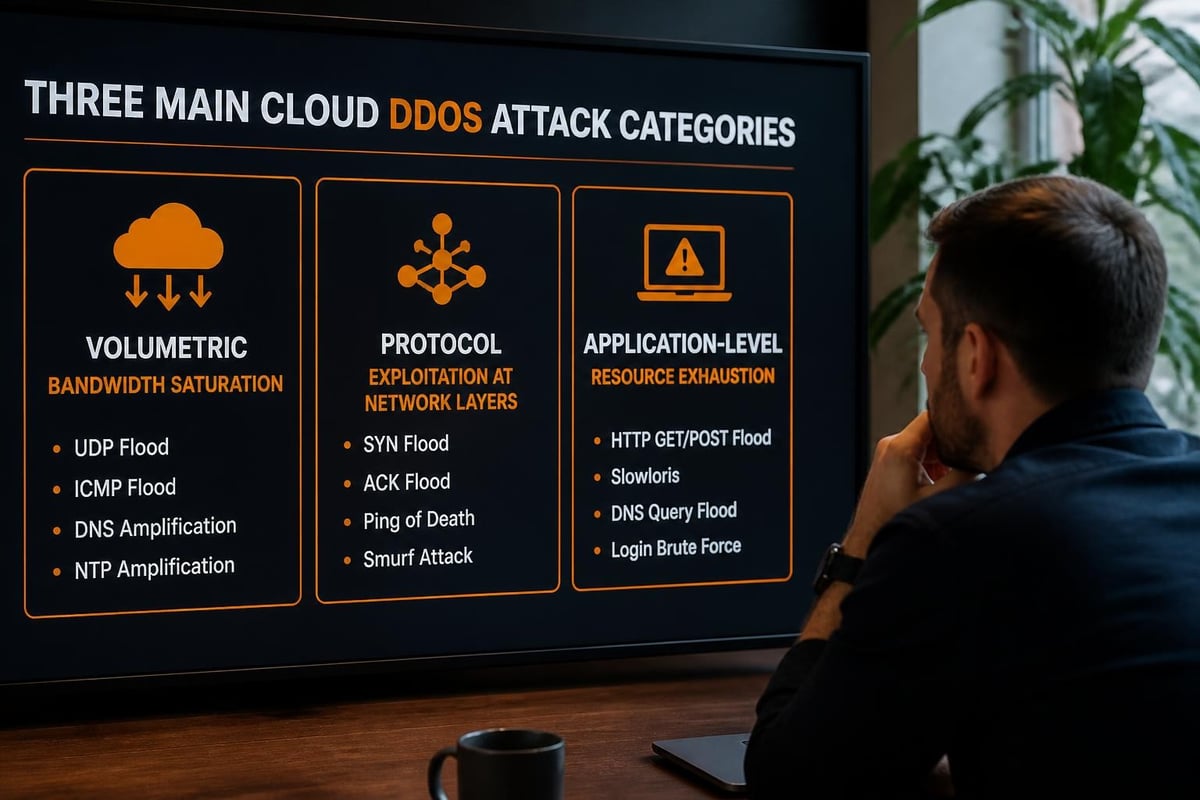
Cloud platforms face three main categories of DDoS attacks, each requiring different mitigation approaches:
- Volumetric attacks that saturate network bandwidth with massive amounts of traffic, measured in gigabits per second (Gbps)
- Protocol attacks that exploit weaknesses in layer 3 and layer 4 protocols, consuming server resources and intermediary equipment capacity
- Application-layer attacks that target web applications and APIs with requests designed to appear legitimate whilst exhausting computational resources
According to Cloudflare's DDoS Threat Report, attack volumes have continued their upward trajectory in 2024, with several incidents exceeding 1 Tbps. Furthermore, the report highlights a concerning trend towards more frequent, shorter-duration attacks that attempt to evade detection systems.
Why Cloud Infrastructure Attracts Attackers
Cloud platforms present attractive targets for several reasons. Therefore, understanding these motivations helps organisations anticipate and prepare for potential threats.
Firstly, cloud services often host multiple customers on shared infrastructure, creating opportunities for collateral damage that amplifies the impact of successful attacks. Additionally, the public-facing nature of cloud APIs and services provides easily discoverable entry points for reconnaissance and subsequent assault.
| Attack Motivation | Cloud-Specific Factor | Business Impact |
|---|---|---|
| Financial extortion | High-value targets with strong uptime requirements | Revenue loss, ransom demands |
| Competitive disruption | Concentrated customer bases on major platforms | Customer attrition, reputation damage |
| Political activism | Visibility and symbolic significance of cloud providers | Service interruption, PR crisis |
| Resource testing | Scalable infrastructure to gauge botnet capabilities | Unintended collateral damage |
Moreover, the ENISA Threat Landscape 2024 identifies DDoS as one of the top threats facing European organisations, with particular emphasis on attacks targeting critical infrastructure and essential services increasingly hosted in cloud environments.
Detection and Early Warning Systems
Identifying a cloud DDoS attack in its early stages significantly improves the effectiveness of mitigation efforts. Nevertheless, detection presents unique challenges in cloud environments where traffic patterns naturally fluctuate based on legitimate demand.
Baseline Traffic Analysis
Establishing normal traffic baselines is essential for distinguishing between legitimate surges and malicious activity. Furthermore, cloud environments require continuous monitoring across multiple dimensions:
- Request rates per endpoint and overall system
- Geographic distribution of incoming connections
- User-agent patterns and client fingerprints
- Protocol usage ratios and connection characteristics
- Resource consumption metrics (CPU, memory, bandwidth)
Modern detection systems employ machine learning algorithms to identify anomalies that deviate from established patterns. Therefore, organisations should implement monitoring solutions that adapt to changing business conditions, such as seasonal traffic variations or marketing campaigns that legitimately increase load.
The OWASP Denial of Service Cheat Sheet provides practical guidance on implementing application-level monitoring and rate limiting that complements network-layer detection mechanisms.
Real-Time Alert Configuration
Effective alerting systems balance sensitivity with specificity to avoid both missed attacks and false alarms. Additionally, alert thresholds should consider the specific characteristics of your cloud deployment and the criticality of different services.
Configure alerts for:
- Traffic volume exceeding baseline thresholds by defined percentages
- Sudden changes in error rates or failed authentication attempts
- Unusual patterns in request distribution across endpoints
- Resource utilisation approaching capacity limits
- Geographic traffic patterns that deviate from normal operations
Furthermore, integration between monitoring systems and incident response workflows ensures that alerts trigger appropriate actions rather than simply generating notifications that require manual interpretation.
Mitigation Strategies for European Businesses
Protecting against cloud DDoS attacks requires a layered approach that combines preventive measures, real-time defence mechanisms, and post-incident recovery capabilities. Moreover, European organisations must consider regulatory requirements and data sovereignty concerns when implementing protection strategies.
Infrastructure-Level Protections
Cloud architecture decisions fundamentally influence DDoS resilience. Therefore, designing systems with attack mitigation in mind from the outset proves more effective than retrofitting protections onto vulnerable deployments.
Network segmentation isolates critical services from public-facing components, limiting the blast radius of successful attacks. Additionally, implementing proper firewall rules and access controls reduces the attack surface available to threat actors.
Geographic distribution across multiple data centres provides redundancy and allows traffic to be rerouted away from affected regions during an attack. Nevertheless, European businesses should ensure that data protection compliance requirements are maintained when distributing infrastructure across borders.
Capacity planning with significant overhead allows systems to absorb moderate attack traffic without degradation. Furthermore, elastic scaling capabilities enable rapid resource allocation when attacks exceed normal capacity buffers.

Application-Level Defences
Application security measures complement infrastructure protections by addressing attacks that bypass network-level filtering. Moreover, these controls protect against low-and-slow attacks that may not trigger volumetric detection systems.
| Defence Mechanism | Function | Implementation Consideration |
|---|---|---|
| Rate limiting | Controls request frequency per client | Balance protection with legitimate user experience |
| CAPTCHA challenges | Distinguishes human users from bots | Deploy selectively to avoid usability impact |
| Request validation | Rejects malformed or suspicious input | Implement strict validation without breaking legitimate edge cases |
| Connection throttling | Limits concurrent connections per source | Configure appropriate thresholds for your application patterns |
The CISA guidance on DDoS attacks emphasises the importance of application hardening as a critical component of comprehensive DDoS defence strategies.
Furthermore, implementing strong authentication controls reduces the effectiveness of credential stuffing attacks that often accompany DDoS incidents. Solutions like vBoxxVault provide secure password management with zero-knowledge encryption, helping organisations maintain access control integrity even during attack conditions whilst ensuring GDPR compliance through European hosting infrastructure.
Content Delivery and Caching
Strategic use of caching and content delivery networks distributes load and filters malicious traffic before it reaches origin servers. Additionally, serving static content from edge locations reduces the computational burden on application servers.
Nevertheless, organisations should carefully evaluate CDN providers to ensure compliance with European data protection requirements. Therefore, businesses handling sensitive information may prefer solutions that keep data within EU jurisdiction rather than relying on global CDN providers subject to third-party legal frameworks.
European Regulatory and Compliance Considerations
Cloud DDoS protection strategies must align with the regulatory landscape governing European businesses. Moreover, compliance requirements influence both the selection of protective services and the implementation of mitigation measures.
GDPR Implications for DDoS Defence
DDoS mitigation services often process significant volumes of user data, including IP addresses, user-agent strings, and behavioural patterns. Therefore, organisations must ensure that protective measures comply with GDPR requirements for data processing, storage, and retention.
Key compliance considerations include:
- Legal basis for processing personal data during attack mitigation
- Data minimisation principles applied to traffic inspection and logging
- Processor agreements with third-party DDoS protection providers
- Cross-border transfers when using non-European mitigation services
- Incident notification requirements if attacks result in data breaches
Furthermore, the NETSCOUT DDoS Threat Intelligence Report documents numerous cases where DDoS attacks served as smokescreens for data exfiltration attempts, highlighting the importance of integrated security monitoring during incidents.
Data Sovereignty and Infrastructure Location
European businesses increasingly prioritise data sovereignty concerns when selecting cloud providers and security services. Additionally, hosting infrastructure within EU member states provides clearer legal frameworks and protection from extraterritorial data access demands.
Organisations operating European cloud infrastructure benefit from simplified compliance whilst maintaining resilience against DDoS threats. Moreover, ISO 27001-certified data centres demonstrate commitment to security management standards that complement DDoS protection measures.

Response Planning and Incident Management
Even with robust preventive measures, organisations must prepare for successful attacks that penetrate defensive layers. Therefore, documented response procedures and practiced incident management workflows prove essential when attacks occur.
Developing a DDoS Response Plan
Comprehensive response plans address detection, escalation, mitigation, communication, and recovery phases of DDoS incidents. Furthermore, plans should identify specific roles, responsibilities, and decision-making authorities to avoid confusion during high-pressure situations.
Essential plan components include:
- Detection criteria and thresholds that trigger incident declaration
- Escalation paths connecting technical teams, management, and external partners
- Mitigation procedures specifying which defensive measures to activate and in what sequence
- Communication templates for internal stakeholders, customers, and potentially regulatory authorities
- Recovery verification steps to confirm normal operations before standing down incident response
Moreover, regular testing through tabletop exercises and simulated attacks validates plan effectiveness and identifies improvement opportunities before real incidents occur.
Coordination with Service Providers
Cloud-based businesses typically rely on multiple service providers, each with different responsibilities during DDoS incidents. Therefore, clear communication channels and coordinated response procedures prevent gaps in protection and conflicting mitigation efforts.
The SANS Institute guidance on cloud workload security discusses the operational complexities of multi-provider environments and recommends establishing formal incident response coordination mechanisms before attacks occur.
Additionally, organisations should understand their providers' DDoS protection capabilities, limitations, and support availability. Furthermore, reviewing service level agreements ensures that contractual obligations align with business requirements for availability and response times.
Emerging Trends and Future Considerations
The cloud DDoS threat landscape continues to evolve as attackers develop new techniques and defenders implement more sophisticated protections. Nevertheless, several trends are shaping the future of cloud DDoS defence.
IoT Botnet Proliferation
Internet-connected devices, from security cameras to smart appliances, increasingly serve as DDoS attack infrastructure. Moreover, the academic research published in 'The Age of DDoScovery' highlights discrepancies between industry-reported and independently measured attack capabilities, suggesting that botnet capacity may exceed commonly cited figures.
Therefore, organisations should prepare for attacks leveraging millions of compromised devices capable of generating sustained, distributed traffic that evades simple geographic filtering.
AI-Powered Attack and Defence
Machine learning technologies are enhancing both attack sophistication and defensive capabilities. Furthermore, attackers employ AI to optimise traffic patterns that mimic legitimate behaviour whilst defenders use similar technologies to detect subtle anomalies indicative of emerging attacks.
This technological arms race requires continuous adaptation of detection algorithms and defensive strategies. Additionally, organisations should invest in security teams with expertise in both cloud architecture and machine learning technologies.
Regulatory Evolution
European cybersecurity regulations continue to develop, with potential implications for DDoS resilience requirements. Moreover, sector-specific regulations may impose mandatory protections or incident reporting obligations that influence how organisations approach DDoS defence.
Businesses should monitor regulatory developments and engage with consultancy services that understand the intersection of technical security measures and compliance requirements.
Building Organisational Resilience
Technical controls alone cannot provide complete protection against determined attackers. Therefore, organisational resilience requires combining technology, processes, and people into a coordinated defence posture.
Security Awareness and Training
Human factors significantly influence the effectiveness of DDoS defences. Furthermore, personnel across technical and business functions should understand basic DDoS concepts, their potential impacts, and their roles during incidents.
Training programmes should address:
- Recognising early warning signs of potential attacks
- Proper escalation procedures when anomalies are detected
- Communication protocols during incident response
- Post-incident review and lessons learned processes
Moreover, cross-functional exercises that involve technical staff, customer service teams, and executive leadership ensure coordinated responses when real attacks occur.
Continuous Improvement Through Post-Incident Analysis
Every DDoS incident, whether successfully mitigated or partially successful, provides valuable learning opportunities. Additionally, structured post-incident reviews identify both effective defensive measures and areas requiring improvement.
Analysis should examine:
- Attack characteristics and vectors employed
- Effectiveness of detection mechanisms and alert timing
- Mitigation measures activated and their impact
- Communication effectiveness with internal and external stakeholders
- Recovery procedures and time to normal operations
Furthermore, documenting lessons learned and updating response plans based on real-world experience creates a continuous improvement cycle that enhances resilience over time. Nevertheless, organisations should balance transparency about incidents with appropriate protection of sensitive security details that could inform future attackers.
Cloud DDoS attacks represent a persistent and evolving threat to European businesses relying on digital infrastructure for essential operations. Moreover, effective protection requires combining technical defences with organisational preparedness and regulatory compliance. vBoxx provides European businesses with secure, GDPR-compliant cloud infrastructure hosted in ISO 27001-certified data centres in the Netherlands, offering the resilience and sovereignty that modern DDoS defence strategies require whilst remaining outside the reach of extraterritorial data access frameworks.