Cloud-native environments are rapidly expanding, but so are the risks. In particular, recent reports show that cyberattacks on cloud platforms are becoming more sophisticated each year, with breach costs averaging $4.88 million globally in 2024.
Therefore, to stay secure, organisations must understand what makes a cloud native security platform effective. Moreover, as threats evolve and compliance pressures rise, choosing the right platform becomes increasingly critical for protecting digital assets.
In this context, this article reveals the seven essential features every cloud native security platform should provide by 2026. As a result, you’ll gain industry insights and practical guidance to help your business remain secure and future-ready.
The Importance of Cloud Native Security in 2026
The digital landscape is shifting rapidly, and the stakes for safeguarding cloud environments have never been higher. In particular, as organisations embrace new technologies, the need for a reliable cloud native security platform becomes a business-critical priority. Moreover, increasing threats and regulatory demands further elevate its importance. As a result, organisations must prioritise robust security strategies to protect their cloud environments.

Evolving Threat Landscape
Cloud-native environments have become prime targets for increasingly sophisticated cyberattacks. In particular, attackers are now leveraging automation, artificial intelligence, and advanced tactics to breach defences. As a result, it is essential that a cloud native security platform adapts just as quickly.
Moreover, according to recent reports, by 2029, 60% of enterprises lacking a unified CNAPP will face major challenges in maintaining cloud visibility, leaving critical gaps in their defences. In addition, the cost of a data breach has soared, with the global average reaching $4.88 million in 2024. Consequently, this figure underscores the financial impact companies can face if their cloud native security platform is not up to the challenge.
Furthermore, the complexity of multi-cloud and hybrid deployments adds additional risk. Specifically, each environment introduces unique vulnerabilities and configuration challenges that must be managed in real time. At the same time, regulatory frameworks such as GDPR and NIS2 are tightening, demanding stricter compliance and more robust controls.
Finally, recent statistics reveal just how prevalent breaches have become, with businesses worldwide experiencing a surge in cloud-related incidents. As a result, these trends confirm that investing in a comprehensive cloud native security platform is no longer optional.
Business Impact and Security Gaps
The consequences of poor cloud security extend far beyond financial losses. In particular, data loss, prolonged downtime, and reputational damage can cripple even the most resilient organisations. For this reason, a cloud native security platform must address these risks proactively in order to protect business continuity.
Moreover, encryption remains a significant gap for many organisations. For example, 17% of businesses do not encrypt half of their cloud data. As a result, this exposes sensitive information to potential leaks. At the same time, misconfigurations and shadow IT further increase vulnerability. Consequently, they open doors to unauthorised access and persistent threats.
Furthermore, to effectively counter these risks, integrated and automated solutions are critical. In particular, by reducing manual errors and enabling security to scale across dynamic environments, organisations can maintain stronger protection. However, without a holistic cloud native security platform, businesses may find themselves continually reacting to incidents rather than preventing them.
Finally, recent high-profile cloud breaches have clearly demonstrated the importance of unified monitoring and rapid response. As a result, the lessons learned from these events emphasise the need for continuous assessment, real-time alerting, and robust identity management. Ultimately, by prioritising these elements, organisations can bridge security gaps and build a future-ready defence posture.
7 Essential Cloud Native Security Platform Features for 2026
As cloud adoption accelerates globally, selecting the right cloud native security platform is mission-critical for protecting digital assets. In particular, in 2026, organisations cannot afford to rely on outdated or piecemeal tools. Instead, they require a unified solution that addresses the most pressing security challenges across diverse environments. As a result, adopting a comprehensive approach becomes essential.
Moreover, below, we break down the seven essential features that every robust cloud native security platform must provide. In addition, each feature supports seamless protection, compliance, and operational agility for businesses navigating modern cloud infrastructures. Consequently, organisations can strengthen their security posture while maintaining efficiency.

Unified Visibility and Continuous Monitoring
A leading cloud native security platform offers unified visibility across all cloud assets. Centralised dashboards provide real-time insight into workloads, containers, and serverless functions, ensuring no asset remains hidden.
Automated discovery tools map every asset in public, private, and hybrid clouds. Continuous posture assessment highlights misconfigurations and vulnerabilities, enabling proactive risk management. This is particularly important, as misconfigurations remain a top cause of breaches. According to cloud misconfiguration statistics, many organisations still struggle with cloud visibility and asset management.
These platforms integrate compliance reporting and audit trails, supporting regulatory requirements. For example, SentinelOne Singularity Cloud delivers unified control and accelerates incident response by reducing blind spots.
Key benefits include:
- Real-time monitoring and alerts
- Automated asset discovery
- Compliance-ready reporting
With these capabilities, organisations using a cloud native security platform can quickly identify threats, enforce policies, and maintain a strong security posture.
Automated Threat Detection & Response
Modern threats evolve rapidly, making automated detection and response a necessity. In particular, a cloud native security platform utilises AI and machine learning to detect both known and unknown attack patterns.
Moreover, behavioural analytics help spot anomalies and lateral movement within cloud environments. As a result, organisations gain earlier visibility into potential threats. In addition, automated incident response workflows mean threats are contained instantly, without waiting for manual intervention. Consequently, integration with SIEM and SOAR solutions ensures end-to-end automation and rapid remediation.
For example, Palo Alto Networks Prisma Cloud provides runtime protection and automated remediation. Therefore, it reduces the time threats linger in your environment.
Top capabilities include:
- AI/ML-based threat detection
- Automated playbooks for incident response
- Behavioural monitoring
By embedding these features, a cloud native security platform minimises manual workload, reduces dwell time, and ensures threats are swiftly neutralised.
Cloud Security Posture Management (CSPM)
Cloud security posture management is fundamental for maintaining compliance and reducing risks. In particular, a robust cloud native security platform continuously assesses cloud configurations against industry best practices, such as CIS benchmarks.
Moreover, automated remediation corrects risky settings and policy violations before they can be exploited. As a result, organisations can reduce exposure to potential threats. In addition, multi-cloud compliance checks (GDPR, HIPAA, PCI DSS, NIS2) are built-in, enabling organisations to meet regulatory demands with ease. Consequently, compliance management becomes more efficient and consistent.
Furthermore, customisable policies allow businesses to tailor security controls for different units or geographies. For example, Wiz CSPM offers proactive risk reduction and continuous compliance monitoring. Therefore, organisations can maintain a strong and adaptable security posture.
Core features include:
- Continuous configuration assessment
- Automated remediation
- Multi-cloud compliance reporting
A cloud native security platform with CSPM ensures organisations can adapt quickly to new threats, maintain compliance, and reduce their attack surface.
Identity and Access Management (IAM) Integration
Granular identity and access management is vital for preventing unauthorised access and insider threats. In particular, a cloud native security platform should enforce least privilege principles and integrate with leading identity providers like Azure AD and Okta.
Moreover, automated tools detect privilege escalations and orphaned accounts, supporting Zero Trust architectures. As a result, organisations can quickly identify and mitigate potential risks. For example, SentinelOne Identity Threat Detection and Response exemplifies these capabilities. Consequently, it identifies suspicious behaviour in real time and strengthens overall access security.
Key IAM features to look for:
- Granular access controls
- Seamless identity provider integration
- Automated detection of access anomalies
By embedding IAM integration, a cloud native security platform ensures only the right users have access to the right resources, significantly reducing risk.
DevSecOps & Shift-Left Security
To keep pace with agile development cycles, security must be embedded early in the software lifecycle. A modern cloud native security platform integrates with CI/CD pipelines, enabling early vulnerability detection.
Automated code scanning, such as SAST and DAST, analyses source code and infrastructure-as-code templates before deployment. Secret detection and management tools protect credentials in code repositories. Policy-as-code ensures consistent enforcement across environments.
Prisma Cloud provides developer-focused security tools, empowering teams to deliver secure code rapidly.
Essential DevSecOps features:
- Integration with CI/CD tools
- Automated scanning and secret management
- Policy-as-code enforcement
Embedding security into development pipelines, a cloud native security platform reduces vulnerabilities in production and accelerates delivery of secure applications.
Data Protection & Encryption
Protecting sensitive data is non-negotiable in today’s regulatory landscape. A cloud native security platform must offer end-to-end encryption for data at rest, in transit, and in use.
Automated discovery and classification of sensitive data ensure that critical assets are always protected. Data loss prevention (DLP) and tokenisation support compliance with privacy laws and industry regulations.
Aqua Security’s data protection capabilities demonstrate how effective encryption and DLP can safeguard business information.
Key data protection features:
- Comprehensive encryption
- Automated data classification
- DLP and tokenisation
With these tools, a cloud native security platform helps organisations meet compliance requirements and protect customer trust.
Attack Surface Management & Risk Prioritisation
As cloud environments grow, so does the attack surface. A cloud native security platform must continuously map both external and internal assets, identifying exposed resources and misconfigurations.
Automated risk prioritisation focuses resources on the most exploitable vulnerabilities, factoring in business impact. Integration with threat intelligence feeds provides contextual awareness, enabling proactive alerting for emerging risks.
Orca Security’s agentless attack path analysis exemplifies this approach, helping teams focus on what matters most.
Key attack surface management features:
- Continuous asset mapping
- Automated risk scoring
- Threat intelligence integration
By prioritising risks, a cloud native security platform ensures efficient use of security resources and reduces overall exposure.
Summary Table: 7 Essential Features
| Feature | Key Benefit | Example Solution |
|---|---|---|
| Unified Visibility & Monitoring | Reduces blind spots, speeds response | SentinelOne Singularity Cloud |
| Automated Threat Detection & Response | Minimises manual workload | Prisma Cloud |
| Cloud Security Posture Management | Ensures compliance, lowers risk | Wiz CSPM |
| Identity and Access Management | Prevents unauthorised access | SentinelOne Identity Threat Detection |
| DevSecOps & Shift-Left Security | Secure code delivery | Prisma Cloud |
| Data Protection & Encryption | Safeguards sensitive data | Aqua Security |
| Attack Surface Management & Prioritisation | Focuses on critical risks | Orca Security |
A cloud native security platform equipped with these features enables organisations to protect their digital infrastructure, comply with regulations, and innovate securely.
Key Trends Shaping Cloud Native Security Platforms
The cloud native security platform landscape is evolving quickly, shaped by emerging technology, regulatory shifts, and business priorities. Understanding the trends driving this evolution is essential for organisations aiming to stay secure and compliant in a dynamic digital world.

AI and Automation in Security
Artificial intelligence and automation are revolutionising every leading cloud native security platform. AI/ML technologies are now essential for predictive analytics, threat hunting, and rapid response. Security teams rely on automation to reduce manual effort and address threats at machine speed.
The surge in AI adoption also introduces new risks. According to AI-driven cloud security risks, the rapid integration of AI tools fuels new vulnerabilities. As a result, platforms must balance innovation with robust controls, ensuring intelligent automation enhances, rather than undermines, cloud native security platform effectiveness.
Integration and Interoperability
Modern enterprises deploy a wide mix of cloud services, applications, and security tools. A cloud native security platform must offer seamless integration through open APIs and support for third-party tools. This enables unified management and reduces operational friction.
Interoperability is vital for organisations seeking efficiency and scalability. By consolidating point solutions into a single cloud native security platform, businesses can centralise policy enforcement and reporting. This streamlines security operations while supporting rapid cloud adoption and digital transformation goals.
Compliance and Data Sovereignty
Regulatory requirements are growing more complex, particularly across international borders. A robust cloud native security platform must support compliance with standards such as GDPR, NIS2, and CCPA. Automated compliance reporting and region-specific controls are critical for businesses handling sensitive data.
Data sovereignty is also front of mind, with increasing demand for local data residency and privacy assurances. The right cloud native security platform enables organisations to meet both legal and customer expectations, ensuring data remains protected and compliant wherever it resides.
Sustainability and Green Cloud Security
Sustainability is becoming a core differentiator for cloud native security platform providers. The shift towards green hosting and energy-efficient data centres reduces environmental impact and aligns with corporate social responsibility goals.
Security features now extend to supporting sustainable operations, from optimised resource usage to eco-friendly certifications. Businesses choosing a cloud native security platform with green credentials benefit not only from robust protection but also demonstrate commitment to environmental stewardship, which can enhance their reputation and stakeholder trust.
How to Choose the Right Cloud Native Security Platform
Selecting the right cloud native security platform is a pivotal decision for any organisation aiming to safeguard its digital assets in 2026. The process involves careful analysis of your business requirements, technical capabilities, and long-term strategic goals. Below, we break down the key steps to guide your decision.
Assessing Organisational Needs
Begin by mapping your current and projected cloud architectures. Are you operating in a multi-cloud, hybrid, or solely on-premises environment? This understanding will shape the type of cloud native security platform that fits your landscape.
Evaluate your specific compliance obligations, such as GDPR, NIS2, or industry standards. Data residency and sovereignty are especially vital for European businesses. For deeper insight into these considerations, review the European cloud independence insights article.
Next, list your integration requirements. The platform should seamlessly connect with your existing tools, workflows, and identity management systems. This ensures the solution supports both your current operations and any future expansions.
Evaluating Platform Capabilities
Once needs are clear, focus on the capabilities of each cloud native security platform. Create a checklist of essential features: unified visibility, automated threat detection, IAM integration, compliance reporting, and scalability.
Assess support for automation and integration with DevSecOps pipelines. The platform should offer robust data protection, end-to-end encryption, and compliance features. For a closer look at practical security measures, see this guide on cloud server hosting security.
Examine vendor support and scalability options. Consider pricing models, ensuring transparency and alignment with your budget. Prioritise solutions that can grow alongside your business and adapt to evolving security needs.
Comparing Leading Solutions
When comparing options, leverage trusted sources like the Gartner Magic Quadrant and verified peer reviews. List top vendors and analyse their strengths, weaknesses, and unique offerings.
| Vendor | Approach | Agentless | Compliance | Notable Feature |
|---|---|---|---|---|
| SentinelOne | Unified platform | Yes | Strong | AI-driven threat response |
| Palo Alto | Integrated suite | Partial | Strong | Runtime protection |
| Wiz | CSPM focus | Yes | Strong | Proactive risk management |
| Orca Security | Agentless | Yes | Good | Attack path analysis |
| Aqua Security | Container security | Partial | Good | Data protection |
Consider agent-based versus agentless solutions, as each impacts deployment and visibility. Balance operational efficiency with security depth to ensure the platform meets your enterprise’s unique challenges.
Planning for Future Growth
Finally, select a cloud native security platform that can evolve with your organisation. The platform should support new technologies like containers, serverless computing, and AI-driven workloads.
Review the vendor’s roadmap for innovation and commitment to ongoing updates. Encourage a security-first culture by aligning training and processes with platform features and industry best practices.
Choosing wisely today ensures your security posture remains resilient and adaptable as the threat landscape and cloud technologies continue to advance.
vBoxx: Secure Cloud Solutions for Privacy-First Businesses
vBoxx stands out as a trusted European provider, specialising in secure hosting and cloud solutions built for privacy-first businesses. Their approach ensures every cloud native security platform requirement is addressed, from GDPR and NIS2 compliance to green hosting initiatives.
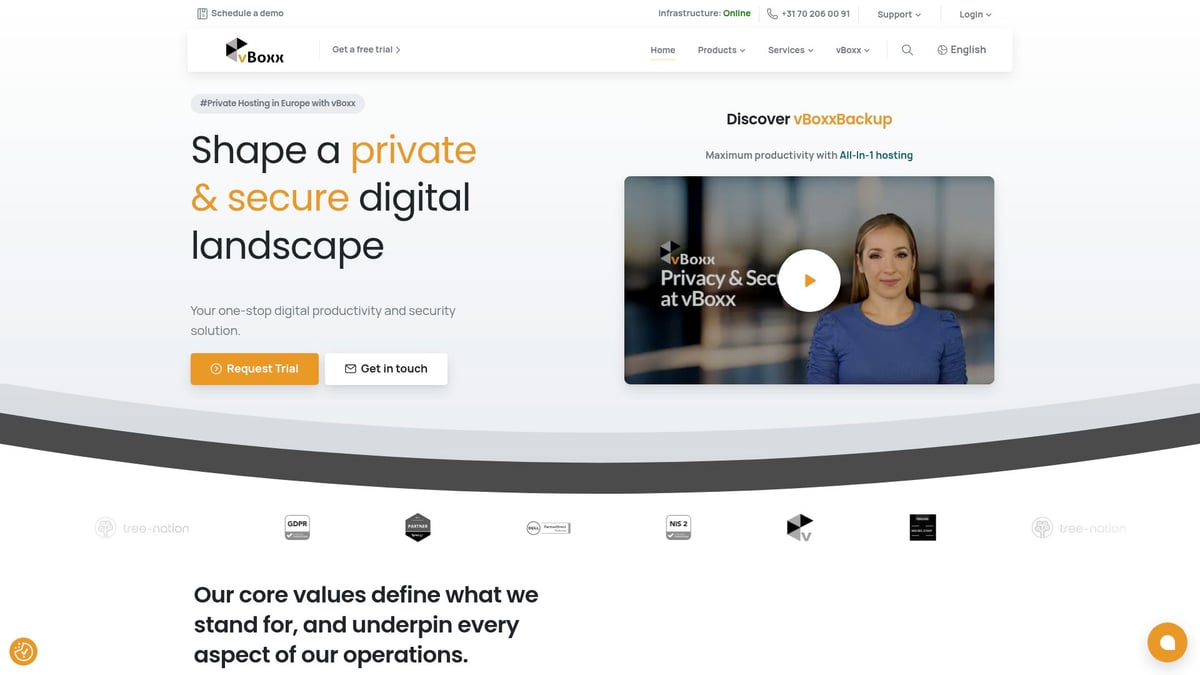
Offering secure cloud solutions overview, vBoxx delivers cloud storage, backups, virtual servers, secure email, and expert consultancy. ISO 27001-certified security and a focus on European data residency make vBoxx ideal for SMEs and organisations prioritising data privacy.
With flexible, scalable options and sustainable operations, vBoxx aligns closely with the essential features of a modern cloud native security platform, supporting integrated security, compliance, and environmental responsibility.
As we look ahead to 2026, staying secure in the cloud means embracing platforms that offer unified visibility, automated protection, and robust compliance—all while supporting sustainability. If you’re ready to see how these essential features come together in a real-world solution, why not experience them first-hand? At vBoxx, we’re passionate about helping you protect your data, ensure privacy, and meet evolving regulations with confidence. Let’s explore how a security-first, green cloud platform can support your business goals.
Schedule a demo
and discover the future of cloud native security for your organisation.