
Cloud VPS managed solutions are transforming how businesses approach digital infrastructure in 2026, with industry adoption expected to reach record highs. As technology becomes more complex, organisations increasingly rely on expert-managed platforms to stay secure, agile, and competitive.
In particular, this expert-driven guide demystifies cloud VPS managed hosting, offering up-to-date insights on the latest trends, must-have features, and proven strategies for decision-makers. Whether you are looking to understand managed cloud VPS, explore key benefits, select the right provider, or prepare for seamless migration, this guide is designed to help.
So, are you ready to unlock the power of cloud VPS managed solutions? Read on for actionable advice and future-focused perspectives.
Understanding Cloud VPS Managed Hosting in 2026
Cloud VPS managed hosting has become a cornerstone for businesses navigating the demands of modern digital infrastructure. As organisations face increasingly complex IT environments, the need for streamlined, expert-managed solutions has never been greater. In particular, in 2026, managed hosting is shaping how companies achieve scalability, performance, and security without requiring deep technical expertise.

What is Cloud VPS Managed Hosting?
Cloud VPS managed hosting combines the flexibility of virtual private servers with the ease of professional management. In particular, a cloud VPS is a virtual machine running on powerful, shared hardware, providing dedicated resources like CPU, RAM, and storage for each user.
Furthermore, the managed aspect means your provider handles setup, updates, security, and troubleshooting. As a result, this eliminates the technical burden for businesses, allowing them to focus on growth. For example, leading providers, such as FastComet, include features like NVMe SSD storage, DDoS protection, and cPanel/WHM for easy management as standard.
Ultimately, with cloud VPS managed hosting, companies access robust virtualisation, scalable cloud infrastructure, and reliable support in one package.
Key Differences: Managed vs Unmanaged VPS
The main distinction between managed and unmanaged VPS is who takes responsibility for daily operations. In particular, with cloud VPS managed services, the provider ensures updates, security patches, and troubleshooting, while unmanaged VPS places all tasks on the client.
As a result, managed solutions offer time-saving benefits, expert support, and enhanced security. For example, FastComet reports that 83% of support issues are resolved on the first contact, demonstrating the efficiency of managed help desks.
Meanwhile, unmanaged VPS may suit businesses with in-house IT teams and specific configurations. However, managed options are ideal for those seeking peace of mind, rapid deployment, and minimal downtime.
Why Businesses are Moving to Managed Cloud VPS in 2026
Businesses are increasingly adopting cloud VPS managed solutions to meet demands for scalability, high performance, and airtight security. In particular, according to VPS adoption trends in 2025, there is a clear shift from shared hosting to private and managed environments.
As a result, rapid provisioning, automated backups, and guaranteed uptime are now expected. Furthermore, companies benefit from easy resource scaling and proactive monitoring, which are vital for mission-critical applications.
Ultimately, as digital workloads grow and compliance requirements tighten, cloud VPS managed hosting delivers the agility and resilience businesses need in 2026.
Core Use Cases for Cloud VPS Managed Hosting
Cloud VPS managed hosting supports a wide range of business needs. Key use cases include:
- eCommerce platforms handling high transaction volumes
- SaaS applications with dynamic user bases
- Business websites demanding consistent uptime
- Application hosting for custom or legacy software
- Data-driven platforms requiring robust analytics
Managed hosting helps with GDPR and NIS2 compliance, especially for regulated industries. High-traffic WordPress sites and global content delivery networks also benefit from isolated resources and expert management.
Both SMEs and large enterprises find value in cloud VPS managed solutions for reliability, compliance, and growth.
Essential Features of a Modern Managed Cloud VPS
In 2026, the landscape for cloud VPS managed hosting is more dynamic than ever. In particular, businesses expect not only raw power and reliability but also robust security, automation, and hands-on support. As a result, selecting a provider without understanding these essential features could leave your organisation at a disadvantage. So, let’s break down the core elements that define a best-in-class cloud VPS managed solution today.

Performance and Scalability
Performance is at the heart of every cloud VPS managed environment. In particular, modern solutions rely on NVMe SSD storage, which delivers lightning-fast data access and lower latency compared to traditional SSDs. Furthermore, providers like FastComet offer multi-core AMD EPYC CPUs and dedicated RAM, ensuring each virtual server has the resources it needs.
Equally important, scalability is critical. For instance, vertical scaling lets you add more CPU or RAM to your instance, while horizontal scaling supports distributing workloads across multiple servers. As a result, FastComet’s plans range from 2–6 CPU cores and 4–16 GB RAM, making it easy to adapt as your needs grow. Ultimately, this ensures consistently high site speed and a seamless user experience, even during traffic spikes.
Security and Compliance
A modern cloud VPS managed service must deliver advanced security and compliance. In particular, leading platforms provide DDoS protection, hardware firewalls, and continuous malware scanning through solutions like Imunify360. As a result, these features are essential for defending against emerging threats in 2026.
Furthermore, compliance is no longer optional. Businesses face strict requirements under GDPR, ISO 27001, and NIS2. In addition, providers with daily malware scans, account isolation, and documented certifications help meet these demands. For example, this focus on regulation is vital for industries such as finance, healthcare, and eCommerce.
Automated Backups and Disaster Recovery
Reliable backups are a cornerstone of any cloud VPS managed solution. In particular, top providers perform daily or weekly automated backups, storing copies off-site for added safety. Furthermore, snapshot capabilities let you roll back changes instantly if needed.
For example, FastComet sets a benchmark with 30 daily offsite backups, ensuring data is always recoverable. As a result, automated disaster recovery minimises downtime and protects your business from accidental deletion, hardware failure, or cyber incidents. Ultimately, this approach underpins business continuity, which is non-negotiable in today’s digital economy.
User-Friendly Control Panels and Management Tools
Ease of use distinguishes a premium cloud VPS managed service. In particular, control panels like cPanel/WHM provide intuitive management of websites, email, and databases. Furthermore, one-click app installers simplify deployment, making it accessible for users with limited technical background.
In addition, dashboards allow real-time monitoring of resources, bandwidth, and security. For example, features like the WordPress Toolkit enable bulk updates and smart patching, reducing manual intervention. As a result, this combination empowers teams to manage complex infrastructures confidently without deep technical knowledge.
24/7 Expert Support and Service Level Guarantees
Continuous expert support is a defining feature of cloud VPS managed solutions. In particular, providers promise round-the-clock assistance through live chat, phone, and ticketing systems. For example, FastComet’s 83% first-contact resolution rate demonstrates the efficiency of well-trained support teams.
Furthermore, Service Level Agreements (SLAs) with 99.9% uptime commitments are standard. As a result, providers offer compensation if targets are missed, ensuring accountability. Ultimately, reliable support and strong SLAs give businesses peace of mind, knowing help is available whenever needed.
Step-by-Step Guide: Migrating to a Managed Cloud VPS
Migrating to a cloud vps managed solution is a strategic move that can transform your business performance, security, and scalability. A smooth migration requires careful planning at every stage, from initial assessment to post-migration optimisation. This guide breaks down each step, helping you navigate the journey to a modern cloud vps managed environment with confidence.

Pre-Migration Assessment and Planning
Every successful cloud vps managed migration begins with a thorough assessment. Start by evaluating your current infrastructure, including server resources, software dependencies, network requirements, and projected growth.
Create an inventory of all applications and data. Map out compliance needs, such as GDPR or industry-specific standards. Set clear migration goals—do you want to improve performance, boost security, or enable future scalability?
Use a checklist to ensure nothing is overlooked:
- Review current hosting environment
- List all critical applications and databases
- Identify compatibility and compliance requirements
- Set success criteria and a timeline
A well-structured plan minimises risks and prepares your team for a seamless transition to a cloud vps managed platform.
Selecting the Right Managed Cloud VPS Provider
Choosing a cloud vps managed provider is pivotal for long-term success. Compare providers based on performance (NVMe SSD storage, CPU/RAM), security (DDoS protection, firewalls), and support quality.
Evaluate compliance capabilities, ensuring the provider meets GDPR, NIS2, or other relevant standards. Consider the geographic location of data centres for latency and legal requirements.
Key evaluation criteria:
- Proven uptime and SLA guarantees
- 24/7 expert support channels
- Automated backup and disaster recovery options
- Scalable resources for future growth
Providers like FastComet, with a global network and transparent features, help ensure your cloud vps managed solution aligns with your business objectives.
Preparing Data and Applications for Migration
Preparation is essential for a successful cloud vps managed migration. Begin by backing up all critical data and configurations. Test application compatibility with the new environment, paying attention to software versions and dependencies.
Update DNS records and plan for propagation time. Address challenges such as legacy systems, custom code, or third-party integrations. Use staging environments to simulate the migration and identify potential issues.
Tips for preparation:
- Backup databases and files to secure locations
- Test restores to verify data integrity
- Review application logs for hidden errors
- Minimise downtime by scheduling migration during off-peak hours
Thorough preparation protects your business and ensures a smooth migration to cloud vps managed hosting.
Executing the Migration
The execution phase of moving to a cloud vps managed platform requires precision and support. Transfer data using secure channels, then install and configure applications on the new server. Coordinate DNS switching to minimise disruption.
Leverage automated tools and provider migration assistance for a seamless process. Monitor progress in real time, resolving any issues immediately. For example, businesses like Agrippa have benefited from managed support, reducing their migration workload and saving up to 70% in support hours, as detailed in How Agrippa Saved 70% in Support Hours.
A proactive approach and expert guidance ensure your cloud vps managed migration delivers immediate value.
Post-Migration Optimisation and Testing
Once your cloud VPS managed environment is live, in particular, focus on optimisation. Benchmark performance and conduct load testing to verify improvements. Furthermore, fine-tune security settings, configure backup schedules, and monitor uptime with real-time dashboards.
In addition, collect feedback from users to spot any post-migration issues. As a result, adjust resource allocations and configurations as business needs evolve. Moreover, document the entire process for future reference.
Ultimately, ongoing optimisation maximises the benefits of your cloud VPS managed solution, ensuring reliability and scalability for years to come.
Security, Compliance, and Data Protection in Managed Cloud VPS
In 2026, the security landscape for cloud vps managed solutions is more dynamic than ever. Businesses face increasing threats, stricter regulations, and rising expectations for uptime and data protection. Choosing a provider that excels in these areas is critical for maintaining trust and operational resilience.
Advanced Security Layers and Monitoring
Effective cloud VPS managed hosting starts with robust, multi-layered security. In particular, providers deploy firewalls, advanced malware scanning like Imunify360, and web application firewalls (WAF) to block threats before they reach your data. For example, FastComet’s solutions also include IP Reputation Guard to identify and stop suspicious traffic.
Furthermore, continuous monitoring is essential. Real-time dashboards track network activity, detect anomalies, and trigger automated incident response. As a result, this approach reduces the window for attackers and ensures rapid mitigation. Ultimately, leading providers report threat mitigation rates exceeding 95% for common attacks.
Key security features include:
- Proactive DDoS protection and traffic filtering
- Account isolation to prevent cross-site contamination
- Automated malware detection and removal
With these defences, cloud vps managed environments offer a secure foundation for critical business operations.
Data Privacy, GDPR, and NIS2 Compliance
Compliance is non-negotiable for cloud vps managed solutions serving European businesses. GDPR and NIS2 set strict requirements on data processing, storage, and breach notification. Providers must demonstrate ISO 27001 certification and offer data residency within the EU or UK.
Choosing a host that prioritises compliance reduces legal risk and supports business continuity. For deeper insight into the importance of European cloud infrastructure and regulatory alignment, see European Cloud Independence Explained.
Typical compliance measures:
- Transparent data processing agreements
- Regular audits and certification renewals
- Support for data subject rights and reporting
A cloud vps managed provider with proven compliance credentials gives decision-makers peace of mind.
Backup Strategies and Disaster Recovery Planning
Reliable backup and recovery processes are at the heart of every cloud vps managed service. Daily or weekly automated backups, off-site storage, and snapshot functionality protect data from loss or corruption. FastComet’s 30 daily offsite backups set a benchmark for resilience.
Best practices include:
- Scheduling frequent, automated backups
- Testing restore processes regularly
- Storing copies in physically separate locations
When disaster strikes, rapid recovery minimises downtime and safeguards business continuity. A robust backup strategy is a non-negotiable feature for any cloud vps managed environment.
Account Isolation and Multi-Tenancy Risks
Virtualisation in cloud VPS managed hosting relies on strong account isolation. In particular, technologies like CloudLinux create secure containers, ensuring that one compromised account cannot impact others. As a result, this sharply contrasts with shared hosting, where a single vulnerability can threaten all tenants.
Furthermore, risks of poor isolation include data leakage and lateral movement by attackers. In addition, by separating resources at the kernel level, cloud VPS managed providers deliver security comparable to dedicated environments.
Ultimately, secure multi-tenancy is a cornerstone of modern cloud VPS managed infrastructure. Consequently, businesses benefit from enhanced privacy, reduced attack surfaces, and greater confidence in their digital operations.
How to Choose the Best Managed Cloud VPS Provider in 2026
Selecting the ideal cloud vps managed provider is a critical step for businesses seeking high performance, security, and scalability. The market is evolving rapidly, with new demands shaping provider offerings. Below, we break down the essential criteria and strategies to help you make an informed decision in 2026.
Key Evaluation Criteria for Providers
When choosing a cloud vps managed provider, focus on features that drive business value. Look for robust performance, advanced security, responsive support, regulatory compliance, and seamless scalability. Transparent service level agreements (SLAs) and uptime guarantees are essential for reliability.
Consider bundled services such as free migration, SSL certificates, and CDN integration. Use provider comparison tables and checklists for clarity. According to VPS hosting market growth projections, the sector is set for significant expansion, making due diligence even more important.
Comparing Pricing Models and Value-Added Services
Understanding the pricing models for cloud vps managed solutions is vital for budgeting. Providers may offer resource-based, flat-rate, or add-on pricing structures. Evaluate the value of included extras such as daily backups, SSL certificates, CDN services, and free migrations.
Here is a quick comparison:
| Model | Includes Backups | SSL | CDN | Free Migration |
|---|---|---|---|---|
| Resource-based | Optional | Yes | Yes | Sometimes |
| Flat-rate | Yes | Yes | Yes | Often |
Calculate the total cost of ownership, factoring in all bundled services and potential add-ons.
Assessing Support Quality and Customer Satisfaction
Reliable support is a cornerstone of any cloud vps managed solution. Evaluate providers by their available support channels—live chat, ticketing, and phone—and their response times. User testimonials and satisfaction ratings offer valuable insights into real-world experiences.
Look for benchmarks such as an 83% first-contact resolution rate, which indicates proactive and effective assistance. Prioritise providers who maintain open communication and resolve issues quickly, ensuring minimal disruption to your business operations.
vBoxx: Secure European Managed VPS Solutions
vBoxx stands out as a European specialist in cloud vps managed hosting, focusing on security and compliance. Their core offerings include GDPR and NIS2 compliance, ISO 27001 certification, and a commitment to green hosting initiatives.
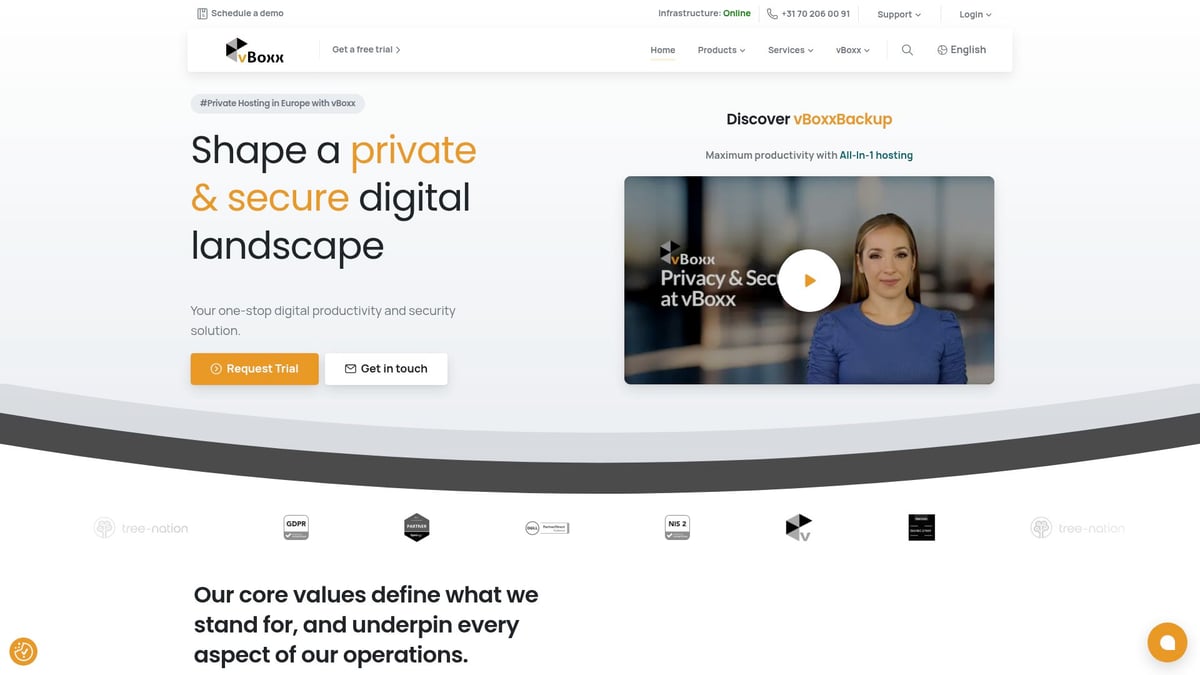
vBoxx provides expert consultancy for SMEs and enterprises, ensuring privacy and robust data protection. Their sustainable infrastructure appeals to businesses prioritising environmental responsibility. For more details or to start a free trial, visit their website and connect with their expert team.
Future Trends in Managed Cloud VPS Hosting
As technology accelerates into 2026, the landscape of cloud vps managed hosting is experiencing transformative shifts. Providers are integrating smarter, more adaptive solutions to meet evolving business demands. Below, we explore the most impactful trends shaping the future of the industry.
AI-Driven Optimisation and Automation
Artificial intelligence is rapidly redefining how cloud vps managed platforms operate. Providers now leverage AI for intelligent resource allocation, automatic scaling, and real-time threat detection. These advancements mean systems can anticipate traffic spikes, resolve bottlenecks, and mitigate risks without manual intervention.
AI-powered automation streamlines server maintenance and monitoring, freeing IT teams to focus on strategy rather than routine tasks. Predictive analytics identify potential issues before they impact performance. As a result, businesses benefit from increased uptime, optimised costs, and a more resilient infrastructure, making cloud vps managed solutions smarter and more reliable than ever.
Edge Computing and Global Data Distribution
Edge computing is emerging as a key driver for cloud vps managed hosting in 2026. By distributing resources across a global network of edge data centres, providers can deliver content closer to end users, dramatically reducing latency and improving redundancy.
This trend supports compliance with data sovereignty laws and enhances user experience for international audiences. According to industry insights, the hybrid cloud services market growth is accelerating, prompting vps buyers to prepare for a more connected and distributed future. Businesses using cloud vps managed solutions can now scale globally with confidence, maintaining performance and compliance.
Enhanced Compliance and Sustainability Standards
Compliance requirements are becoming more stringent, with regulations like GDPR, NIS2, and ISO standards shaping operational practices. Cloud vps managed hosting in 2026 is evolving to offer advanced compliance tools, robust auditing features, and data locality controls.
Sustainability is now a top priority for both providers and clients. Many operators are investing in green data centres, renewable energy, and carbon-neutral operations. This shift not only meets regulatory demands but also aligns with corporate social responsibility goals. Choosing a cloud vps managed provider with strong compliance and environmental credentials positions businesses for long-term success.
Evolving User Experience and Self-Service Tools
User experience is at the forefront of cloud vps managed innovation. Modern platforms are introducing intuitive control panels, advanced automation, and comprehensive self-service management options. These improvements empower non-technical users to deploy applications, monitor resources, and manage security settings with ease.
Features like 1-click app installers, WordPress Toolkit, and real-time dashboards are now standard. Such tools accelerate deployment and give businesses agility to adapt quickly to market changes. As cloud vps managed solutions become easier to use, organisations of all sizes can extract greater value from their hosting environment.
As you’ve seen, choosing the right managed Cloud VPS in 2026 means balancing top performance, airtight security, and sustainable digital practices—all while making sure your business stays future ready. If you’re ready to experience secure, compliant hosting with expert support and green credentials, why not discover it for yourself firsthand? You can explore how vBoxx’s managed solutions fit your needs and see the latest features in action. It’s the perfect way to move from research to real results.
Start a free trial