

The European Union has established itself as a global leader in data protection and digital sovereignty, therefore creating a unique landscape for cloud computing services. As a result, as businesses increasingly migrate their operations to the cloud, understanding the specific requirements, benefits, and challenges of EU cloud computing becomes essential for organisations seeking compliant, secure, and sustainable digital infrastructure. Moreover, the EU’s approach to cloud services differs significantly from other regions, placing emphasis not only on privacy rights and environmental responsibility, but also on technological independence, while simultaneously fostering innovation and competitiveness.
The Rise of Cloud Adoption Across Europe
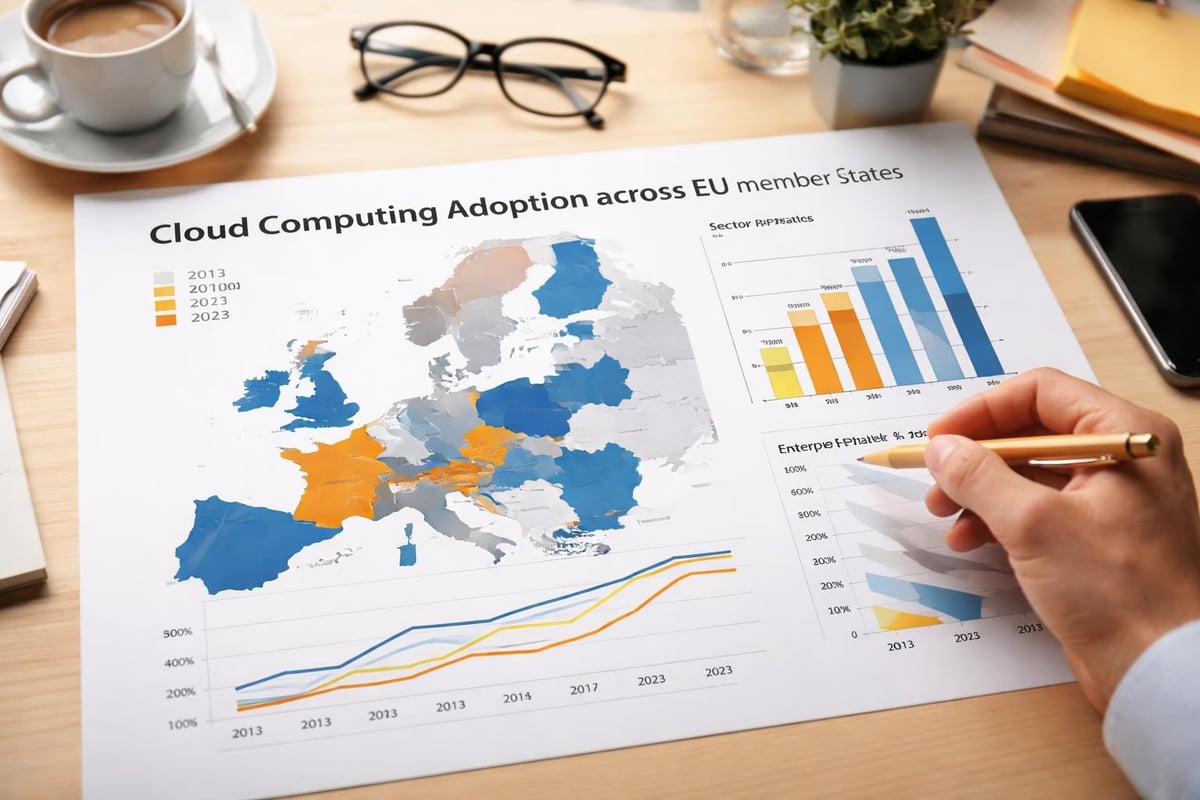
European enterprises have embraced cloud technologies at an unprecedented rate over the past decade. According to Eurostat’s latest findings, 45.2% of EU enterprises purchased cloud computing services in 2023, demonstrating the widespread acceptance of these solutions across various industries and company sizes. This represents a remarkable transformation in how businesses approach their IT infrastructure.
The growth trajectory has been particularly impressive. Cloud computing adoption has nearly tripled over the last ten years, reflecting both technological maturation and increased confidence in cloud service providers. This surge correlates directly with the EU’s Digital Decade strategy, which positions cloud infrastructure as fundamental to achieving digital transformation goals across member states.
Drivers Behind European Cloud Migration
Several factors have accelerated the shift towards eu cloud computing:
- Cost efficiency: Reduced capital expenditure on physical infrastructure and maintenance
- Scalability: Ability to adjust resources based on fluctuating business demands
- Remote work enablement: Supporting distributed teams and flexible working arrangements
- Digital transformation: Facilitating innovation through advanced cloud-native applications
- Competitive pressure: Keeping pace with market leaders already leveraging cloud advantages
Small and medium-sized enterprises have particularly benefited from cloud services, gaining access to enterprise-grade capabilities that would otherwise require substantial investment. This democratisation of technology has levelled the playing field across European markets.
Regulatory Framework and GDPR Compliance
The General Data Protection Regulation remains the cornerstone of EU cloud computing operations, as it sets stringent requirements for how personal data is collected, processed, and stored. Consequently, cloud service providers operating within the EU must demonstrate comprehensive compliance mechanisms, including data processing agreements, privacy impact assessments, and robust security measures. In addition, ongoing monitoring and regular audits help ensure that these requirements are consistently met.
Key Compliance Requirements
Data sovereignty stands as a primary concern for European businesses. Organisations must ensure that their data remains within EU jurisdiction or is transferred only to countries with adequate protection levels. This requirement has driven demand for cloud providers with data centres exclusively located within European borders.
The EU Cloud Code of Conduct has collaborated with the Cloud Security Alliance to harmonise GDPR compliance standards, creating clearer pathways for cloud service providers to demonstrate adherence to regulatory requirements. This collaboration provides businesses with greater confidence when selecting cloud partners.
| Compliance Aspect | Requirements | Business Impact |
|---|---|---|
| Data Location | EU or adequate countries only | Limits provider options |
| Processing Agreements | Detailed DPA required | Legal documentation burden |
| Subject Access Rights | Facilitate data portability | Technical implementation needs |
| Breach Notification | 72-hour reporting window | Incident response procedures |
| Privacy by Design | Built-in protection measures | Architecture considerations |
The European Data Protection Supervisor provides comprehensive guidelines for European institutions using cloud computing services, offering valuable frameworks that commercial organisations can adapt for their own compliance programmes.
Security Considerations in European Cloud Services
Security architecture forms the foundation of trustworthy EU cloud computing services. In particular, European businesses face sophisticated cyber threats, ranging from ransomware attacks to state-sponsored espionage, which means robust security measures are non-negotiable when selecting cloud providers. Moreover, implementing layered defenses, continuous monitoring, and incident response planning further ensures the resilience and reliability of cloud infrastructure.
Multi-Layered Security Approaches
Modern cloud security requires defence in depth, combining multiple protective layers:
- Infrastructure security: Physical data centre protection, network segmentation, and hardware security modules
- Access controls: Multi-factor authentication, role-based permissions, and privileged access management
- Data encryption: At-rest and in-transit encryption using industry-standard algorithms
- Monitoring and detection: Real-time threat intelligence, anomaly detection, and security information and event management
- Incident response: Predefined procedures, automated containment, and forensic capabilities
Businesses should prioritise providers offering transparent security practices, regular third-party audits, and certifications such as ISO 27001, SOC 2, or the EU-specific Cloud Security Certification Scheme currently under development.
Zero-trust architecture has emerged as best practice within eu cloud computing environments. This approach assumes no implicit trust, requiring continuous verification of all users, devices, and applications regardless of their location or network position.

Sustainable Cloud Computing and Green Hosting
Environmental sustainability has become integral to the European cloud computing narrative, driven by the EU’s ambitious climate targets and increasing corporate responsibility. The Climate Neutral Data Centre Pact represents industry commitment to achieving climate neutrality by 2030, setting measurable targets for energy efficiency and renewable energy usage.
Environmental Impact Metrics
| Sustainability Measure | Traditional Data Centre | Green Cloud Provider |
|---|---|---|
| Power Usage Effectiveness | 2.0-2.5 | 1.1-1.3 |
| Renewable Energy | 0-30% | 80-100% |
| Water Consumption | High | Minimised/eliminated |
| Waste Heat Recovery | Rare | Increasingly common |
| Carbon Offset Programs | Optional | Standard practice |
Green hosting practices extend beyond energy sources. Leading providers implement advanced cooling technologies, optimise server utilisation through virtualisation, and carefully select geographical locations to minimise environmental impact whilst maximising natural cooling opportunities.
Circular economy principles are increasingly applied to cloud infrastructure, with providers extending hardware lifecycles, refurbishing equipment, and ensuring responsible recycling of electronic waste. These practices align with broader EU initiatives promoting sustainable digital transformation.
Businesses selecting cloud providers should request detailed sustainability reports, including Power Usage Effectiveness ratios, renewable energy percentages, and carbon footprint calculations. Transparency in environmental metrics indicates genuine commitment rather than superficial greenwashing.
Contract Considerations and Service Level Agreements
Navigating cloud service agreements requires careful attention to legal and operational details. The European Commission provides guidance on cloud computing contracts, highlighting critical considerations for businesses entering cloud service relationships.
Essential Contract Elements
Service Level Agreements define the performance standards and guarantees that cloud providers commit to delivering. These typically cover availability percentages, response times, support availability, and compensation mechanisms for service failures.
- Availability guarantees: Minimum uptime percentages (typically 99.9% or higher)
- Performance metrics: Response times, processing speeds, and throughput rates
- Support tiers: Different service levels based on issue severity and business impact
- Compensation clauses: Service credits or refunds for SLA breaches
- Exit provisions: Data portability, migration assistance, and contract termination procedures
Data ownership and portability require explicit clarification. Contracts should unambiguously state that customers retain full ownership of their data and can extract it in standard formats without unreasonable delays or costs. This protection proves crucial if businesses need to change providers or bring services in-house.
Liability limitations often favour cloud providers, but businesses should negotiate reasonable caps that reflect the value of their data and potential business disruption. Professional legal review becomes essential for significant cloud deployments handling sensitive or business-critical information.
Strategic Cloud Deployment Models
European organisations can choose from various deployment models, each of which offers distinct advantages for different use cases within the EU cloud computing landscape. Specifically, the optimal choice depends on security requirements, regulatory constraints, budget considerations, and technical capabilities. Furthermore, evaluating trade-offs between public, private, and hybrid models helps organisations select the deployment strategy that best aligns with their operational and compliance needs.
Public, Private, and Hybrid Architectures
Public cloud services provide maximum cost efficiency and scalability, sharing infrastructure across multiple customers whilst maintaining logical separation. This model suits organisations with standard workloads and moderate security requirements, particularly when using EU-based public cloud regions.
Private cloud deployments offer dedicated infrastructure, either hosted by third-party providers or maintained internally. This approach benefits organisations with stringent security needs, specific compliance requirements, or predictable workloads justifying dedicated resources.
Hybrid cloud combines both models, allowing businesses to keep sensitive data in private environments whilst leveraging public cloud for less critical workloads. This flexibility supports gradual migration strategies and optimises cost-performance trade-offs.
- Assess workload characteristics and security classifications
- Evaluate compliance requirements for each data category
- Calculate total cost of ownership across deployment options
- Consider long-term scalability and flexibility needs
- Prototype with small-scale implementations before full migration

The European Open Science Cloud Initiative
The European Open Science Cloud represents a significant EU initiative developing cloud infrastructure specifically for research and scientific collaboration. This project demonstrates how eu cloud computing can serve specialised communities whilst advancing broader digital transformation objectives.
Supporting Research and Innovation
The initiative provides researchers with access to vast computational resources, data storage, and collaborative tools, accelerating scientific discovery across disciplines. By removing technical barriers, the European Open Science Cloud enables smaller institutions to participate in large-scale research projects previously accessible only to well-funded organisations.
This model offers valuable lessons for commercial cloud deployments, particularly regarding federated identity management, cross-border data sharing, and standardised metadata frameworks. Businesses operating in research-intensive sectors can leverage similar approaches to facilitate collaboration whilst maintaining security and compliance.
Interoperability and Vendor Lock-In Prevention
Avoiding vendor lock-in remains a strategic priority for European businesses adopting cloud services. The EU’s rolling plan for ICT standardisation addresses cloud and edge computing interoperability, promoting standards that enable portability across providers.
Standards and Open Technologies
Adopting open standards and avoiding proprietary technologies reduces dependency on single vendors:
- Containerisation: Docker, Kubernetes for application portability
- API standards: RESTful interfaces, OpenAPI specifications
- Data formats: JSON, XML, CSV for universal compatibility
- Authentication protocols: OAuth, SAML, OpenID Connect
- Infrastructure as Code: Terraform, Ansible for reproducible deployments
Multi-cloud strategies provide additional protection against vendor lock-in, distributing workloads across multiple providers. This approach requires additional management overhead but delivers resilience benefits and negotiating leverage with individual providers.
Businesses should regularly test their ability to migrate services between providers or on-premises environments, ensuring that contracts and technical architectures genuinely support portability rather than merely claiming it.
Edge Computing and Distributed Cloud Architecture
Edge computing represents the next evolution in eu cloud computing, bringing processing capabilities closer to data sources and end users. This architectural shift addresses latency requirements for real-time applications whilst reducing bandwidth costs and improving resilience through distributed processing.
Applications and Benefits
Manufacturing facilities deploy edge computing for industrial IoT applications, processing sensor data locally before aggregating insights in central cloud environments. Retail organisations use edge nodes to support point-of-sale systems, inventory management, and customer analytics even during connectivity disruptions.
Content delivery networks exemplify edge computing principles, caching frequently accessed data at geographically distributed locations to improve performance and user experience. European businesses serving international audiences particularly benefit from edge deployments across multiple EU member states.
| Use Case | Latency Requirement | Edge Suitability |
|---|---|---|
| Video Streaming | Medium | High |
| Industrial Automation | Very Low | Essential |
| Mobile Applications | Low-Medium | High |
| Data Analytics | Variable | Moderate |
| AI Inference | Low | High |
The convergence of cloud and edge computing creates powerful hybrid architectures, combining centralised intelligence and coordination with distributed execution and responsiveness. This model aligns well with EU priorities around digital sovereignty, as edge deployments inherently keep data processing within specific jurisdictions.
Backup, Disaster Recovery, and Business Continuity
Comprehensive backup strategies remain essential despite cloud infrastructure reliability. European businesses must implement robust disaster recovery plans addressing both technical failures and compliance requirements specific to eu cloud computing environments.
Recovery Objectives and Strategies
Recovery Point Objective defines the maximum acceptable data loss, measured in time. Financial services might require RPOs measured in seconds, whilst marketing content systems might tolerate hours. Recovery Time Objective specifies how quickly services must resume after disruption.
Cloud-based backup solutions offer advantages over traditional approaches:
- Automated scheduling reducing human error
- Geographic redundancy protecting against regional disasters
- Versioning enabling recovery from corruption or ransomware
- Encryption securing data throughout the backup lifecycle
- Testing capabilities facilitating regular recovery drills
Geo-redundant storage across multiple EU data centres provides resilience against facility-level failures whilst maintaining data sovereignty. Businesses should verify that backup locations comply with the same regulatory requirements as primary systems, avoiding inadvertent data transfers outside approved jurisdictions.
Regular testing proves crucial. Many organisations discover gaps in their disaster recovery plans only during actual emergencies. Quarterly or semi-annual recovery exercises validate procedures, identify weaknesses, and train staff in emergency protocols.
Migration Strategies and Change Management
Successfully transitioning to eu cloud computing requires careful planning, phased execution, and comprehensive change management. Rushed migrations frequently encounter technical issues, cost overruns, and user resistance that undermine anticipated benefits.
Phased Migration Approach
Assessment and planning forms the foundation, inventorying existing systems, identifying dependencies, and prioritising workloads based on business value and migration complexity. Low-risk applications should migrate first, building team experience and demonstrating value before tackling critical systems.
Pilot deployments validate technical approaches and uncover unexpected challenges in controlled environments. These trials should include representative workloads, realistic data volumes, and end-user participation to surface issues before full-scale migration.
Parallel operation reduces risk during cutover, running new cloud systems alongside existing infrastructure until confidence builds. This approach increases temporary costs but provides safety nets if problems emerge.
Staff training and communication throughout the migration process address the human factors that determine project success. Technical teams need cloud-specific skills, whilst end users require guidance on any workflow changes resulting from new infrastructure.
European cloud computing delivers powerful capabilities for businesses seeking secure, compliant, and sustainable digital infrastructure, provided organisations carefully navigate the regulatory landscape and select providers aligned with EU values. As adoption continues accelerating across member states, choosing the right cloud partner becomes increasingly critical for long-term success. vBoxx specialises in secure hosting and cloud solutions designed specifically for European businesses, combining robust data protection, green hosting practices, and comprehensive support to help organisations confidently embrace cloud technologies whilst maintaining full compliance with EU regulations.