Data breaches and compliance violations pose significant threats to modern businesses, particularly those operating within European markets where regulatory scrutiny continues to intensify. Furthermore, organisations increasingly rely on cloud infrastructure to store and process vast quantities of sensitive information, making robust protection mechanisms essential. Google Cloud Platform’s Data Loss Prevention (DLP) service offers comprehensive capabilities for discovering, classifying, and safeguarding sensitive data across diverse cloud environments. Therefore, understanding how to leverage gcp data loss prevention effectively has become crucial for businesses seeking to maintain compliance whilst protecting their customers’ privacy.
Understanding GCP Data Loss Prevention Architecture
GCP data loss prevention functions as an intelligent scanning and protection service that identifies sensitive information within your cloud infrastructure. Moreover, the platform employs advanced pattern matching and machine learning algorithms to detect over 120 predefined sensitive data types, including personally identifiable information, financial records, and healthcare data.
The architecture operates through several key components that work together seamlessly:
- Detection engine analyses content across multiple data sources simultaneously
- Classification system categorises discovered sensitive data according to predefined or custom rules
- Transformation layer applies de-identification techniques to protect sensitive information
- Reporting mechanisms provide detailed insights into data discovery and protection activities
In addition, the service integrates natively with Google Cloud Storage, BigQuery, Cloud SQL, and other GCP services, enabling comprehensive visibility across your entire cloud environment. Nevertheless, it can also scan content from external sources through API integrations, making it suitable for hybrid and multi-cloud deployments.

InfoTypes and Detection Capabilities
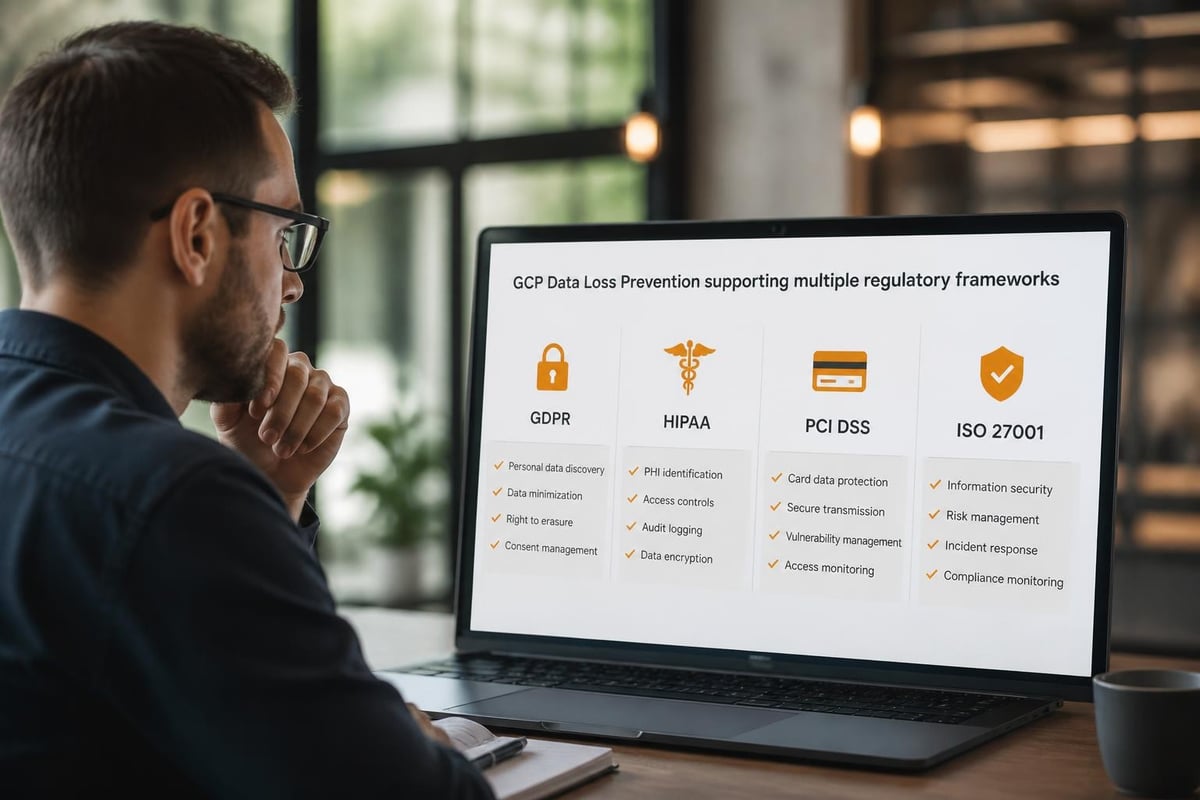
The foundation of gcp data loss prevention lies in its extensive library of InfoTypes, which are predefined detectors for specific types of sensitive information. Furthermore, these predefined InfoTypes cover regulatory requirements across multiple jurisdictions, including GDPR, HIPAA, and PCI DSS.
| InfoType Category | Examples | Use Cases |
|---|---|---|
| Personal Information | Names, addresses, passport numbers | GDPR compliance, customer data protection |
| Financial Data | Credit cards, bank accounts, IBAN | PCI DSS compliance, transaction security |
| Credentials | API keys, passwords, authentication tokens | Security audits, credential exposure prevention |
| Healthcare | Medical record numbers, NHS numbers | HIPAA compliance, patient privacy |
Moreover, businesses can create custom InfoTypes tailored to their specific data structures and industry requirements. This flexibility ensures that organisations can protect proprietary or industry-specific sensitive information that may not fall within standard categories. Therefore, companies handling specialised data formats benefit from granular control over detection parameters.
Implementing Data Discovery and Classification
Implementing effective data discovery requires strategic planning and systematic execution. In addition, organisations must balance thoroughness with operational efficiency to avoid overwhelming their infrastructure with continuous scanning operations.
Setting Up Inspection Jobs
The inspection functionality enables automated scanning of various storage systems, including Cloud Storage buckets, BigQuery tables, and Datastore entities. Furthermore, inspection jobs can be configured to run on schedules, ensuring continuous monitoring of new and modified data.
Creating effective inspection workflows involves several critical steps:
- Define your data inventory by cataloguing all storage locations containing potentially sensitive information
- Configure sampling parameters to balance scan coverage with performance requirements
- Establish inspection templates that specify which InfoTypes to detect and sensitivity thresholds
- Implement job triggers to automate recurring scans based on time intervals or data modifications
- Review findings systematically through the Security Command Centre or custom reporting dashboards
Nevertheless, organisations must consider the computational costs associated with large-scale scanning operations. Therefore, implementing targeted scans focused on high-risk data repositories often provides better return on investment than indiscriminate scanning of all cloud resources.
Automated Protection with Job Triggers
Creating job triggers enables proactive data protection by automatically scanning new content as it enters your cloud environment. Moreover, these triggers can be configured to execute specific actions when sensitive data is detected, such as applying de-identification transformations or generating compliance alerts.
For businesses managing substantial data volumes, automation becomes essential rather than optional. In addition, job triggers reduce the manual overhead associated with data governance whilst ensuring consistent application of protection policies across all data sources.
De-identification Techniques and Transformations
Once sensitive data has been identified through gcp data loss prevention scans, organisations must determine appropriate protection strategies. Furthermore, the platform offers multiple de-identification methods that balance data utility with privacy protection requirements.
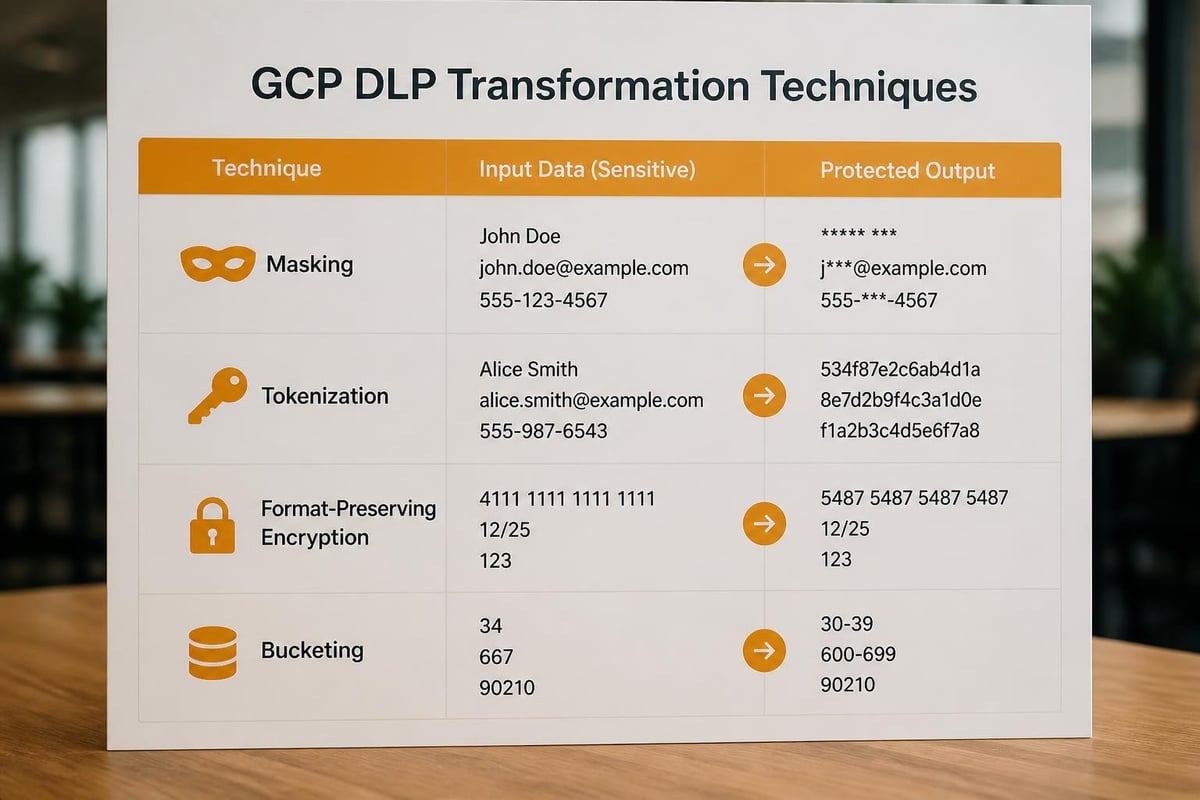
Transformation Methods Comparison
Different transformation techniques suit different business scenarios and compliance requirements. Therefore, selecting the appropriate method requires understanding both technical capabilities and regulatory obligations.
Masking and redaction completely remove or obscure sensitive information, rendering it unreadable. Moreover, this approach provides the strongest privacy protection but eliminates data utility for analytics purposes. Nevertheless, it remains ideal for scenarios where sensitive fields serve no legitimate business purpose after initial processing.
Tokenization replaces sensitive values with surrogate identifiers whilst maintaining a secure mapping table. In addition, this reversible transformation enables authorised users to recover original values when necessary. Furthermore, tokenization preserves data relationships and statistical properties, making it suitable for testing environments and analytics workflows.
Format-preserving encryption transforms data whilst maintaining its original format and structure. Therefore, encrypted credit card numbers still appear as 16-digit sequences, ensuring compatibility with legacy systems that validate field formats.
The transformation reference guide provides comprehensive details on implementing each technique effectively. Moreover, organisations can combine multiple transformations within a single de-identification template to address complex requirements.
Bucketing and Generalisation
For analytical purposes, bucketing generalises sensitive numeric or date values into ranges rather than completely masking them. Furthermore, this technique preserves statistical utility whilst reducing re-identification risks. For instance, specific ages might be grouped into decade ranges (20-29, 30-39), maintaining demographic insights without exposing individual birthdates.
Similarly, geographic generalisation can transform precise addresses into broader regions, enabling location-based analysis whilst protecting personal privacy. In addition, these techniques align well with GDPR’s data minimisation principles by collecting and retaining only the level of detail necessary for legitimate purposes.
Integration Strategies for European Businesses
European organisations face unique considerations when implementing gcp data loss prevention, particularly regarding data residency and regulatory compliance. Furthermore, the platform’s flexibility enables deployment patterns that satisfy stringent European privacy requirements.
Data Residency and Sovereignty
GCP allows organisations to specify geographic regions for data processing and storage, ensuring compliance with data localisation requirements. Moreover, European businesses can configure DLP operations to process sensitive data exclusively within EU regions, addressing sovereignty concerns.
Nevertheless, organisations must carefully review their entire data processing chain, including:
- Primary storage locations for sensitive data
- DLP inspection job processing regions
- Transformation result storage locations
- Audit log retention regions
In addition, maintaining comprehensive documentation of data flows becomes essential for demonstrating compliance during regulatory audits. Therefore, businesses should implement robust data mapping practices alongside their DLP deployment.
Complementary Security Measures
Whilst gcp data loss prevention provides powerful scanning and protection capabilities, it functions most effectively as part of a comprehensive security strategy. Furthermore, European businesses should consider integrating DLP with additional protective measures to create defence-in-depth architectures.
For instance, organisations can combine GCP DLP with encrypted cloud storage solutions to ensure data remains protected both at rest and during processing. Moreover, implementing end-to-end encryption alongside DLP scanning provides assurance that sensitive information remains secure throughout its lifecycle.
Similarly, businesses handling particularly sensitive data might benefit from exploring secure online storage with encryption approaches that complement cloud-native DLP capabilities. In addition, these layered security approaches align with regulatory expectations for proportionate data protection measures.
Compliance Monitoring and Reporting
Effective compliance programmes require continuous monitoring and comprehensive reporting capabilities. Furthermore, gcp data loss prevention provides extensive metrics and audit trails that demonstrate ongoing adherence to regulatory requirements.
Building Compliance Dashboards
Organisations should establish centralised dashboards that aggregate DLP findings across all cloud resources. Moreover, these dashboards should track key metrics including:
| Metric Category | Key Indicators | Compliance Value |
|---|---|---|
| Discovery Coverage | Percentage of data sources scanned, scan frequency | Demonstrates due diligence |
| Finding Trends | Volume of sensitive data detected over time | Identifies emerging risks |
| Protection Actions | Number of de-identification operations applied | Shows proactive risk mitigation |
| Policy Violations | Instances of sensitive data in unauthorised locations | Highlights control gaps |
In addition, automated alerting mechanisms should notify security teams when critical thresholds are exceeded or high-risk data exposures are detected. Therefore, organisations can respond rapidly to potential compliance violations before they escalate into reportable breaches.
Audit Trail Management
Maintaining detailed audit logs of all DLP activities provides essential evidence during regulatory examinations. Furthermore, these logs should capture who accessed sensitive data, what transformations were applied, and when protection measures were implemented.
Nevertheless, organisations must balance log retention with storage costs and privacy considerations. Therefore, implementing log retention policies that align with regulatory requirements whilst minimising unnecessary data accumulation becomes crucial.
Practical Implementation Considerations
Successfully deploying gcp data loss prevention requires addressing several practical challenges that commonly arise during implementation. Moreover, learning from typical pitfalls enables organisations to accelerate their deployment timelines whilst avoiding costly mistakes.
Performance Optimisation Strategies
Large-scale DLP operations can consume significant computational resources and generate substantial costs. Furthermore, organisations must implement optimisation strategies to maintain operational efficiency:
- Implement sampling for initial discovery phases rather than scanning entire datasets
- Schedule intensive scans during off-peak hours to minimise impact on production workloads
- Use targeted scanning focused on high-risk data repositories rather than blanket approaches
- Configure appropriate sensitivity thresholds to reduce false positive rates and investigation overhead
In addition, monitoring scan performance metrics enables continuous refinement of detection strategies. Therefore, organisations should establish baseline performance expectations and track variations over time.
Custom InfoType Development
Whilst the extensive library of predefined detectors covers many scenarios, businesses often require custom InfoTypes for proprietary data formats. Moreover, developing effective custom detectors requires understanding regular expression patterns, contextual validators, and confidence scoring mechanisms.
For instance, a business might need to detect internal employee identifiers, proprietary product codes, or specialised financial instruments unique to their industry. Furthermore, the official documentation provides comprehensive guidance on creating these custom detection patterns.
Nevertheless, organisations should validate custom InfoTypes thoroughly before deploying them in production environments. Therefore, testing against representative datasets helps ensure appropriate detection accuracy without excessive false positives.
Organisational Governance and Policy Management
Technical implementation represents only one aspect of successful data protection programmes. Furthermore, organisations must establish governance frameworks that define how DLP capabilities are managed, who has authority to configure policies, and how findings are addressed.
Role-Based Access Control
Implementing appropriate access controls ensures that only authorised personnel can configure DLP policies or view sensitive findings. Moreover, organisations should segregate responsibilities between different teams:
- Security teams configure global policies and review high-risk findings
- Data governance teams establish classification schemes and retention requirements
- Application teams implement de-identification transformations within specific systems
- Compliance teams review audit reports and prepare regulatory documentation
In addition, regular access reviews ensure that permissions remain appropriate as personnel change roles or leave the organisation. Therefore, integrating DLP access management with broader identity governance programmes provides consistency across security tools.
Policy Lifecycle Management
DLP policies require regular review and updating to remain effective as business requirements evolve and new data types emerge. Furthermore, organisations should establish formal change management processes that govern policy modifications:
- Propose changes through documented requests that justify business needs
- Review impact by analysing how modifications affect existing data and processes
- Test in non-production environments before deploying to production systems
- Deploy gradually using phased rollouts to identify unexpected consequences
- Monitor outcomes to verify that changes achieve intended objectives without adverse effects
Moreover, maintaining version control for policy configurations enables rapid rollback if problems arise. Therefore, treating DLP policies as code and applying software development best practices improves reliability and auditability.
Training and Awareness Programmes
Technology alone cannot ensure effective data protection without knowledgeable personnel who understand both capabilities and limitations. Furthermore, organisations should invest in comprehensive training programmes that equip teams with necessary skills.
For businesses new to cloud-based data protection, exploring guided demonstrations can accelerate understanding of integrated security solutions. In addition, seeing how different protection mechanisms work together provides valuable context for DLP implementation decisions. For instance, a comprehensive demonstration of cloud security tools can help teams understand how various protection layers complement each other.
Moreover, ongoing education ensures that personnel remain current with evolving capabilities and emerging threats. Therefore, establishing regular training sessions, certification programmes, and knowledge-sharing forums builds organisational competency over time.
Building Internal Expertise
Developing internal expertise reduces reliance on external consultants whilst improving response times for configuration changes and incident investigations. Furthermore, organisations should identify personnel with aptitude for data protection work and provide them with opportunities to develop specialised skills.
Nevertheless, maintaining expertise requires ongoing investment as platforms evolve and new features are introduced. Therefore, budgeting for continuous professional development ensures that internal teams remain capable of managing increasingly sophisticated protection requirements.
Implementing robust data protection measures has become non-negotiable for businesses operating in today’s regulatory environment, and gcp data loss prevention provides powerful capabilities for identifying and safeguarding sensitive information across cloud infrastructure. Nevertheless, achieving optimal results requires combining technical tools with comprehensive governance frameworks and skilled personnel. At vBoxx, we understand the complexities European businesses face when balancing security, compliance, and operational efficiency, which is why our secure cloud solutions emphasise privacy, encryption, and sustainable infrastructure that complement your data protection strategy.