
The landscape of artificial intelligence deployment has shifted dramatically in 2026, with businesses increasingly seeking alternatives to cloud-based AI solutions. In particular, the Mac Mini has emerged as a compelling option for organisations wanting to run local large language models (LLMs) whilst maintaining complete control over their data. As a result, businesses can reduce their dependence on external cloud providers and retain greater ownership of sensitive information.
Furthermore, this approach addresses growing concerns about data privacy, compliance requirements, and the recurring costs associated with cloud-based AI services. In addition, local deployment can provide more predictable operating costs and lower latency for certain workloads. Moreover, the latest Apple Silicon processors have made on-device AI processing not just feasible, but genuinely competitive with traditional server-based solutions. Consequently, organisations can deploy powerful AI capabilities in a compact, energy-efficient, and cost-effective environment.
Understanding the Mac Mini for Local LLM Deployment
The Mac Mini represents a paradigm shift in how businesses can approach artificial intelligence infrastructure. Indeed, its compact design and powerful processing capabilities challenge traditional assumptions about AI deployment. Nevertheless, understanding its capabilities requires examining both the hardware specifications and the practical implications for enterprise use. Furthermore, organisations must evaluate how these features align with their performance, security, and scalability requirements. As a result, a thorough assessment can help businesses determine whether the Mac Mini is a suitable platform for their AI initiatives.
Hardware Architecture and AI Processing
Apple’s M-series chips incorporate specialised components designed specifically for machine learning workloads. The Neural Engine handles matrix operations efficiently, whilst the unified memory architecture eliminates traditional bottlenecks between CPU, GPU, and RAM. Therefore, the Mac Mini can process LLM inference requests with remarkable speed despite its compact form factor.
Key specifications that matter for LLM performance include:
- Unified memory capacity (16GB to 128GB configurations available)
- Neural Engine core count (16-core standard across M4 models)
- GPU core variations (10-core to 32-core options)
- Memory bandwidth exceeding 400GB/s on higher-end models
- Thermal management designed for sustained workloads
In addition, the comparative study of local LLM runtimes on Apple Silicon demonstrates that properly configured systems can achieve impressive tokens-per-second rates. Furthermore, these performance metrics translate directly into practical business applications such as document analysis, customer service automation, and code generation.

Memory Requirements and Model Selection
Choosing the appropriate Mac Mini for local LLM deployment depends heavily on understanding memory requirements for different model sizes. Moreover, this decision significantly impacts both initial investment and long-term capabilities.
| Model Size | Parameters | Minimum RAM | Recommended RAM | Typical Use Cases |
|---|---|---|---|---|
| Small | 3-7B | 16GB | 24GB | Quick queries, basic automation |
| Medium | 13-15B | 32GB | 48GB | Document processing, coding assistance |
| Large | 30-34B | 64GB | 96GB | Complex analysis, multi-turn conversations |
| Extra Large | 70B+ | 128GB | 128GB+ | Enterprise-grade applications, research |
Therefore, businesses must carefully assess their specific requirements before committing to a configuration. Nevertheless, the unified memory architecture means that RAM investments benefit all system components simultaneously, making higher-memory configurations particularly cost-effective for AI workloads.
Practical Implementation Strategies
Successfully deploying a Mac Mini for local LLM requires more than simply purchasing hardware. Furthermore, the implementation approach determines both performance outcomes and operational efficiency.
Software Stack and Runtime Selection
Multiple runtime environments exist for running LLMs on Apple Silicon, each offering distinct advantages. Consequently, selecting the appropriate software stack depends on technical expertise, model compatibility, and integration requirements.
- Ollama provides the most straightforward installation process with automated model management
- llama.cpp offers maximum performance optimisation and customisation options
- MLX delivers native Apple Silicon integration with excellent energy efficiency
- LM Studio presents a user-friendly interface ideal for non-technical users
- LocalAI enables OpenAI-compatible API endpoints for seamless integration
Moreover, the choice of runtime affects not only performance but also maintenance requirements and update procedures. In addition, some runtimes offer superior quantisation techniques that allow larger models to run on systems with limited memory.
Network Integration and Security
Deploying LLMs locally within business infrastructure requires careful network planning. Nevertheless, this approach offers significant security advantages compared to cloud-based alternatives.
Organisations can configure the Mac Mini for local LLM as a network-accessible service whilst maintaining complete data sovereignty. Furthermore, all inference requests remain within the corporate network, ensuring sensitive information never leaves the organisation’s control. This approach particularly benefits industries with strict compliance requirements such as healthcare, legal services, and financial institutions.
Essential security considerations include:
- Network segmentation to isolate AI processing
- Access control through authentication mechanisms
- Audit logging for compliance documentation
- Encrypted communication channels
- Regular security updates and patch management
Therefore, businesses gain the benefits of advanced AI capabilities without compromising their security posture. In addition, this architecture aligns perfectly with zero-trust security models increasingly adopted by forward-thinking organisations.

Cost Analysis and Business Justification
Understanding the financial implications of Mac Mini for local LLM deployment requires examining both direct and indirect costs. Moreover, comparing these expenses against cloud-based alternatives reveals compelling economic advantages for many use cases.
Initial Investment versus Ongoing Expenses
The upfront cost of a Mac Mini configured for LLM workloads ranges from approximately £1,200 to £3,500 depending on specifications. Nevertheless, this one-time investment contrasts sharply with the recurring monthly fees associated with cloud AI services.
| Expense Category | Mac Mini (Local) | Cloud AI Service | 3-Year Total Comparison |
|---|---|---|---|
| Hardware/Setup | £2,400 | £0 | Local: £2,400 |
| Monthly Service | £0 | £450 | Cloud: £16,200 |
| Electricity (est.) | £15/month | Included | Local: £540 |
| Maintenance | £100/year | Included | Local: £300 |
| Total 3-Year Cost | £3,240 | £16,200 | Savings: £12,960 |
Furthermore, these calculations assume moderate usage patterns. Businesses with intensive AI requirements see even more dramatic cost differences. Therefore, the return on investment typically occurs within the first six to nine months of operation.
Performance Economics and Scalability
Recent market dynamics have highlighted the growing demand for on-device AI processing. In fact, Mac Mini and Mac Studio shortages demonstrate how businesses are voting with their budgets for local solutions. Moreover, this trend suggests that early adopters gain competitive advantages through immediate deployment capabilities.
Scalability considerations differ significantly from traditional cloud approaches. Nevertheless, horizontal scaling through multiple Mac Minis offers flexibility for growing organisations. In addition, this approach provides redundancy and load balancing capabilities whilst maintaining data sovereignty.
Businesses exploring broader infrastructure improvements might consider how local AI deployment fits within comprehensive digital strategies. For instance, organisations examining cloud and server options can integrate local LLM processing alongside secure cloud storage for complementary workloads.
Model Selection and Performance Optimisation
Choosing appropriate models and optimising their performance determines the practical success of Mac Mini for local LLM implementations. Furthermore, understanding the relationship between model architecture and hardware capabilities enables informed decision-making.
Recommended Models by Hardware Configuration
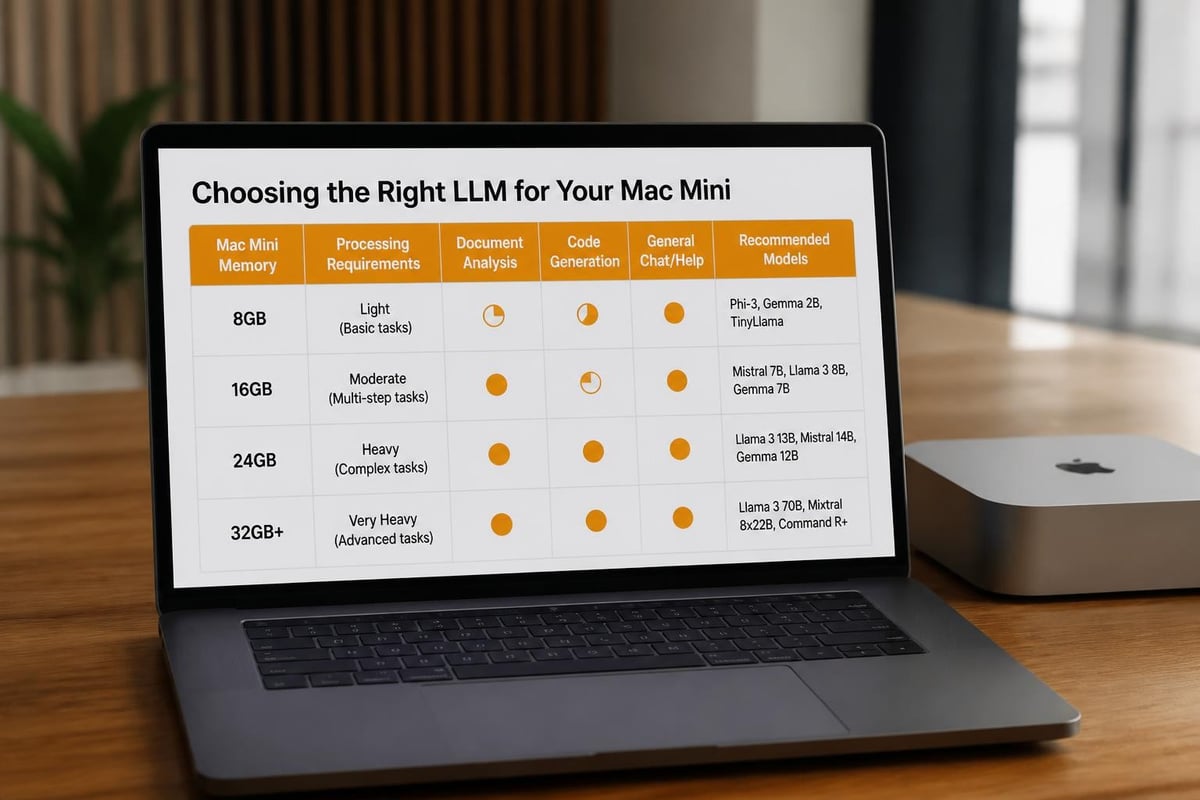
Different Mac Mini configurations support varying model sizes effectively. Therefore, matching hardware to intended use cases ensures optimal performance and user satisfaction.
16GB unified memory configurations:
- Llama 3.2 3B (excellent for basic tasks)
- Phi-3 Mini (outstanding performance-to-size ratio)
- Mistral 7B (quantised to 4-bit)
32GB to 64GB configurations:
- Llama 3.1 13B (versatile general-purpose model)
- Mixtral 8x7B (powerful mixture-of-experts architecture)
- Command-R 35B (exceptional instruction-following)
128GB configurations:
- Llama 3.1 70B (enterprise-grade performance)
- Qwen 2.5 72B (multilingual excellence)
- DeepSeek-V2 (research-level capabilities)
Moreover, performance benchmarks for Mac Mini models in 2026 provide valuable insights into real-world inference speeds. Nevertheless, individual results vary based on prompt complexity and concurrent workload demands.
Quantisation and Optimisation Techniques
Quantisation reduces model size and memory requirements whilst maintaining acceptable accuracy levels. Furthermore, modern quantisation techniques have advanced significantly, enabling larger models to run on modest hardware configurations.
- 4-bit quantisation typically provides the best balance between size and quality
- 5-bit and 6-bit options offer incremental quality improvements with larger memory footprints
- 8-bit quantisation preserves near-original quality for critical applications
- Mixed-precision techniques optimise different model layers independently
Therefore, businesses can run models that would theoretically require twice their available memory through intelligent quantisation strategies. In addition, these techniques often improve inference speed by reducing memory bandwidth requirements.
Enterprise Use Cases and Applications
Understanding practical applications helps businesses justify Mac Mini for local LLM investments. Moreover, specific use cases demonstrate how on-device AI processing solves real-world challenges.
Document Processing and Analysis
Legal firms, healthcare providers, and financial institutions process enormous volumes of confidential documents daily. Nevertheless, sending this information to external AI services creates unacceptable security and compliance risks.
Local LLM deployment enables:
- Contract review and clause extraction
- Medical record summarisation
- Financial report analysis
- Regulatory compliance checking
- Automated document classification
Furthermore, processing speeds on properly configured Mac Minis often exceed cloud-based alternatives due to eliminated network latency. Therefore, organisations achieve both security and performance improvements simultaneously.
Development and Code Assistance
Software development teams benefit tremendously from local AI assistance. Moreover, keeping proprietary code within corporate infrastructure addresses intellectual property concerns whilst providing valuable productivity enhancements.
Development workflow improvements include:
- Code completion and suggestion
- Bug detection and security vulnerability scanning
- Documentation generation
- Code review assistance
- Architecture planning support
In addition, developers can fine-tune models on internal codebases without exposing proprietary implementations to external services. This capability becomes increasingly valuable as organisations build competitive advantages through unique software implementations.
Businesses requiring robust infrastructure to support development teams might explore how cloud server hosting complements local AI processing for comprehensive development environments.
Customer Service Automation
Customer service represents another compelling use case for Mac Mini for local LLM deployment. Nevertheless, this application requires careful implementation to ensure quality interactions.
Organisations can deploy local LLMs for:
- Initial query triage and routing
- FAQ responses and information retrieval
- Ticket summarisation and categorisation
- Internal knowledge base queries
- Multi-language customer support
Therefore, businesses reduce response times whilst maintaining complete control over customer interaction data. Furthermore, the ability to customise responses based on company-specific information improves customer satisfaction compared to generic cloud-based chatbots.
Infrastructure Integration and Management
Successfully integrating Mac Mini for local LLM into existing business infrastructure requires thoughtful planning. Moreover, proper management ensures reliable operation and maximises return on investment.
Physical Deployment Considerations
Despite its compact size, the Mac Mini requires appropriate environmental conditions for optimal performance. Furthermore, planning physical deployment prevents thermal issues and ensures accessibility for maintenance.
Key deployment factors include:
- Adequate ventilation and cooling
- Uninterruptible power supply (UPS) protection
- Secure physical access controls
- Network connectivity (gigabit Ethernet recommended)
- Remote management capabilities
In addition, organisations running multiple units benefit from rack-mounting solutions specifically designed for Mac Mini hardware. Therefore, data centre integration becomes straightforward despite the consumer-oriented form factor.
Monitoring and Maintenance Protocols
Establishing monitoring procedures ensures consistent performance and identifies issues before they impact operations. Nevertheless, the macOS platform provides robust built-in tools complemented by third-party solutions.
- Performance monitoring tracks CPU, GPU, and Neural Engine utilisation
- Memory pressure analysis identifies potential bottlenecks
- Temperature monitoring prevents thermal throttling
- Network traffic analysis ensures appropriate bandwidth allocation
- Model performance metrics measure inference speed and accuracy
Moreover, automated alerting systems notify administrators of anomalous conditions requiring attention. Therefore, proactive management prevents unexpected downtime and maintains service quality.
Organisations seeking comprehensive infrastructure management might benefit from exploring professional services. For instance, scheduling a demonstration of integrated solutions can reveal how local AI deployment fits within broader digital transformation initiatives.
Future-Proofing and Upgrade Pathways
Technology investments must consider longevity and upgrade possibilities. Furthermore, understanding the Mac Mini’s position within Apple’s product ecosystem informs strategic planning.
Hardware Lifecycle Expectations
Apple typically supports Mac hardware with operating system updates for approximately seven years. Nevertheless, AI workload requirements evolve rapidly, potentially necessitating earlier upgrades for performance rather than compatibility reasons.
The current M4 generation offers substantial headroom for future model improvements. Moreover, the buying guide for Mac Mini configurations emphasises choosing maximum memory at purchase since RAM cannot be upgraded post-purchase.
Upgrade considerations for Mac Mini for local LLM deployment:
| Upgrade Path | Timeline | Considerations |
|---|---|---|
| Software updates | Continuous | Free, improves performance and security |
| Model optimisation | Quarterly | Better quantisation and runtime improvements |
| Additional units | As needed | Horizontal scaling for increased capacity |
| Hardware replacement | 3-5 years | New generations offer substantial improvements |
Therefore, organisations benefit from conservative initial specifications whilst planning for eventual hardware refreshes. In addition, the robust resale market for Mac hardware helps offset upgrade costs.
Emerging Technologies and Compatibility
The rapid advancement of LLM technology presents both opportunities and challenges. Nevertheless, the Mac Mini’s architecture positions it well for emerging developments.
Future compatibility factors include:
- Multi-modal models incorporating vision and audio
- Improved quantisation techniques reducing memory requirements
- Enhanced Neural Engine capabilities in subsequent chip generations
- Better integration with Apple’s ecosystem services
- Expanded model availability optimised for Apple Silicon
Furthermore, the active development community ensures continued software improvements even as hardware capabilities expand. Therefore, investing in Mac Mini for local LLM represents a forward-looking strategy aligned with industry trends toward on-device AI processing.
The Mac Mini for local LLM deployment offers businesses a compelling alternative to cloud-based AI services, combining data sovereignty, cost efficiency, and impressive performance in a compact package. Moreover, as organisations increasingly prioritise security and compliance, local AI processing becomes not just preferable but essential for many applications. When your business requires secure infrastructure that complements local AI deployments, vBoxx provides enterprise-grade cloud services, virtual servers, and consultancy to build comprehensive digital solutions that prioritise both performance and privacy.