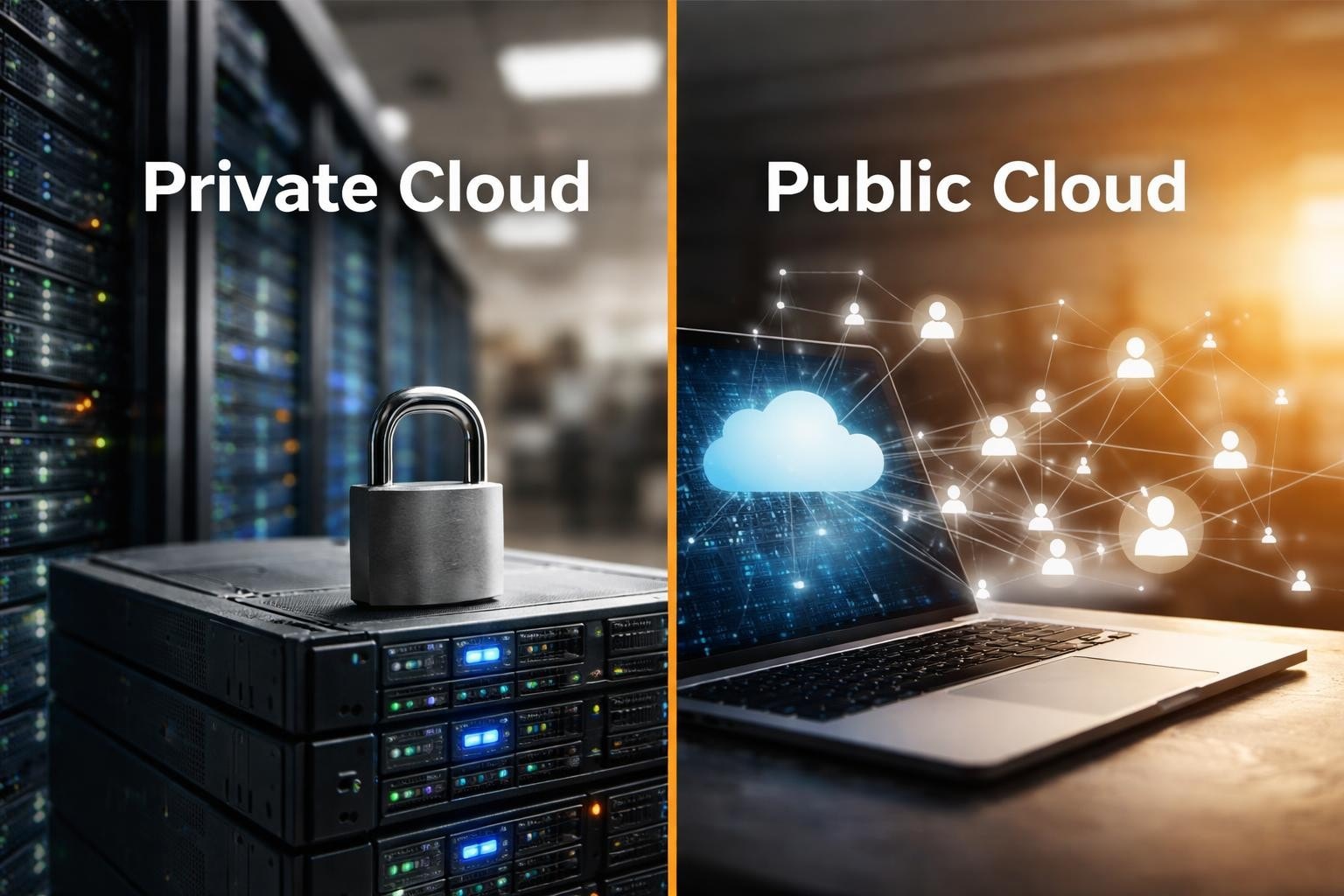

Choosing the right cloud infrastructure represents one of the most significant technology decisions organisations face today. In this context, the private cloud vs public cloud debate continues to dominate boardroom discussions as businesses evaluate their digital transformation strategies. In particular, understanding these two fundamental deployment models helps determine which approach aligns best with operational requirements, security priorities, and budget constraints. While both options deliver substantial advantages, they serve distinctly different purposes depending on workload characteristics, compliance obligations, and organisational maturity. Therefore, making the right choice requires careful evaluation of these factors.
Understanding Cloud Deployment Models
Cloud computing has transformed how businesses access and manage IT resources. Rather than maintaining physical servers on-premises, organisations now leverage virtualised infrastructure delivered through various deployment models.
A public cloud operates as a multi-tenant environment where resources are shared amongst numerous customers. Providers like Microsoft Azure, Amazon Web Services, and Google Cloud Platform manage the infrastructure whilst organisations rent computing power, storage, and services on demand. This shared responsibility model reduces capital expenditure significantly.
Conversely, a private cloud delivers dedicated infrastructure exclusively for a single organisation. Whether hosted on-premises or managed by a third-party provider, these environments offer complete control over hardware, networking, and security configurations. The resources never mix with other customers’ workloads.
Key Architectural Differences
The fundamental distinction in the private cloud vs public cloud comparison lies in resource allocation and ownership structures.
| Feature | Public Cloud | Private Cloud |
|---|---|---|
| Infrastructure Ownership | Service provider | Organisation or dedicated host |
| Resource Sharing | Multi-tenant | Single-tenant |
| Access | Internet-based | Can be restricted to internal networks |
| Customisation | Limited to provider offerings | Extensive configuration options |
| Scalability | Nearly unlimited | Constrained by dedicated resources |
Public clouds excel at delivering standardised services with rapid provisioning. Businesses access pre-configured virtual machines, databases, and application platforms within minutes. This speed comes from sharing massive resource pools across thousands of customers.
Private clouds prioritise customisation and control. IT teams configure hardware specifications, networking protocols, and security policies to exact requirements. This flexibility supports unique workloads that cannot function within public cloud constraints.

Security and Compliance Considerations
Security requirements often drive the private cloud vs public cloud decision-making process. In particular, while both models implement robust protection mechanisms, they approach security through different philosophies.
On the one hand, public cloud providers invest billions in security infrastructure, employing specialist teams to monitor threats continuously. In this model, their shared responsibility framework protects the underlying infrastructure, while customers secure their applications and data. As a result, this arrangement works effectively for most workloads, particularly when proper configuration management is maintained.
On the other hand, private clouds deliver enhanced control over security implementations. Specifically, organisations determine precisely which security tools, encryption standards, and access controls protect their data. Consequently, this granular control proves essential for highly regulated industries, where strict compliance and data governance requirements must be met.
Regulatory and Data Sovereignty Requirements
Compliance obligations significantly influence cloud deployment choices. Financial services, healthcare providers, and government agencies face stringent regulations governing data location, access controls, and audit capabilities.
Private clouds simplify compliance by maintaining complete data sovereignty. Organisations know exactly where information resides and who can access it. This transparency streamlines audit processes and regulatory reporting requirements. CrowdStrike’s analysis of public cloud vs private cloud security emphasises these compliance considerations.
- GDPR compliance: Private clouds enable strict data residency controls
- HIPAA requirements: Dedicated infrastructure simplifies healthcare data protection
- Financial regulations: Complete audit trails and access controls support compliance
- Government security standards: Private deployments meet stringent classification requirements
Public clouds have matured significantly in addressing compliance needs. Major providers offer region-specific data centres, compliance certifications, and specialised services for regulated industries. However, shared infrastructure still raises concerns for organisations with the most stringent requirements.
Performance and Workload Optimisation
Performance characteristics differ substantially between deployment models. The private cloud vs public cloud comparison reveals distinct advantages depending on application requirements and usage patterns.
Network Latency and Bandwidth
Private clouds excel at supporting latency-sensitive applications. In particular, resources residing within dedicated infrastructure or on-premises data centres deliver consistent, predictable performance. Moreover, internal networking eliminates internet-based bottlenecks, which is crucial for real-time processing and high-frequency transactions.
In contrast, public clouds introduce variable latency depending on geographical distance, internet connectivity quality, and network congestion. While providers maintain excellent backbone infrastructure, organisations cannot control every network segment between users and cloud resources. As a result, performance can fluctuate under certain conditions.
Furthermore, bandwidth considerations also affect the private cloud vs public cloud equation. Specifically, private deployments avoid data egress charges when transferring information between systems. On the other hand, public clouds typically charge for outbound data transfer, thereby potentially creating unexpected costs for data-intensive workloads. Consequently, organisations must carefully evaluate usage patterns when estimating total cost.
Resource Predictability
Performance consistency represents another critical distinction. Private clouds deliver predictable resource availability because infrastructure serves a single tenant. Computing power, memory, and storage remain dedicated regardless of other activities.
Public clouds leverage resource pooling to maximise efficiency. Whilst providers implement safeguards against “noisy neighbour” scenarios, shared infrastructure introduces variability. Applications experiencing sudden demand spikes might encounter temporary resource constraints.
| Performance Factor | Public Cloud | Private Cloud |
|---|---|---|
| Latency | Variable, internet-dependent | Consistent, dedicated networks |
| Bandwidth | Excellent, with egress costs | No transfer charges internally |
| Resource Availability | Typically abundant, shared | Guaranteed, dedicated |
| Burst Capacity | Nearly unlimited | Limited to provisioned resources |
Cost Structures and Financial Implications
Financial considerations profoundly influence the private cloud vs public cloud selection process. In particular, each model presents distinct cost profiles that favour different business scenarios.
On the one hand, public clouds operate on operational expenditure models. In this case, organisations pay only for consumed resources, thereby eliminating capital investment in hardware. As a result, this consumption-based pricing delivers exceptional financial flexibility, particularly for variable workloads or organisations seeking to minimise upfront investment.
Moreover, monthly public cloud bills fluctuate based on actual usage. For example, scaling resources up during peak periods and down during quiet times helps optimise costs. However, sustained high utilisation can make public clouds more expensive compared to dedicated infrastructure. Consequently, organisations must carefully analyse long-term usage patterns when evaluating total cost efficiency.
Total Cost of Ownership Analysis
Private clouds require substantial capital expenditure for hardware, facilities, and networking equipment. Organisations invest in servers, storage arrays, networking gear, and potentially building infrastructure before deploying the first workload.
Operational costs include:
- Hardware maintenance and refreshes every 3-5 years
- Skilled personnel to manage infrastructure
- Power and cooling for data centre operations
- Software licensing for virtualisation and management tools
- Physical security and facility management
Despite higher initial investment, private clouds can deliver lower long-term costs for predictable, sustained workloads. TechTarget’s comparison of public and private cloud benefits explores these financial trade-offs in depth.
The private cloud vs public cloud cost equation shifts dramatically based on utilisation patterns. Stable workloads running continuously favour private infrastructure economics. Variable, unpredictable workloads benefit from public cloud’s consumption pricing.

Scalability and Flexibility Requirements
Scalability represents a defining characteristic in the private cloud vs public cloud discussion. How quickly and extensively organisations need to adjust resources significantly impacts the optimal deployment choice.
Elastic Scaling Capabilities
Public clouds provide virtually limitless scalability. Businesses can provision thousands of servers within minutes, responding instantly to traffic spikes or computational demands. This elasticity proves invaluable for:
- Seasonal businesses experiencing predictable demand fluctuations
- Startups with uncertain growth trajectories
- Development and testing environments requiring temporary resources
- Big data analytics projects needing massive parallel processing
Private clouds offer controlled scalability within dedicated resource limits. Expanding capacity requires procuring additional hardware, which introduces lead times. However, organisations benefit from guaranteed resource availability without competing for shared infrastructure.
Global Distribution and Edge Computing
Geographic reach distinguishes public cloud advantages. Major providers operate data centres across dozens of regions worldwide, enabling organisations to deploy applications near customers globally. This distribution reduces latency and supports compliance with data residency requirements.
Private clouds typically concentrate in one or few locations unless organisations invest in multiple data centres. Building global private infrastructure requires substantial capital and operational complexity. IBM’s explanation of cloud deployment models discusses geographic considerations extensively.
Hybrid and Multi-Cloud Strategies
The private cloud vs public cloud debate increasingly evolves beyond binary choices. In fact, many organisations adopt hybrid approaches, thereby combining both deployment models strategically.
In this context, hybrid cloud architectures place sensitive workloads in private environments, while simultaneously leveraging public cloud for suitable applications. As a result, this balanced approach optimises security, performance, and cost simultaneously. Moreover, it provides the flexibility to adapt infrastructure as business needs evolve.
Strategic Workload Placement
Effective hybrid strategies require careful workload assessment:
- Private cloud candidates: Legacy applications, regulated data, latency-sensitive systems, predictable workloads
- Public cloud candidates: Variable workloads, development environments, customer-facing applications, big data processing
Integration between environments presents technical challenges. Organisations need robust networking, identity management, and orchestration tools ensuring seamless operation across deployment models. Aqua Security’s guide to choosing between cloud models provides practical selection frameworks.
For businesses seeking expert guidance navigating these complex decisions, a comprehensive evaluation of requirements proves essential. vBoxx offers demonstration sessions providing personalised insights into secure cloud solutions tailored to specific organisational needs, including private hosting options and migration strategies.
Management Complexity and Operational Requirements
Operational overhead differs substantially in the private cloud vs public cloud comparison. Management responsibilities directly impact staffing requirements, skill sets, and ongoing maintenance burdens.
Infrastructure Administration
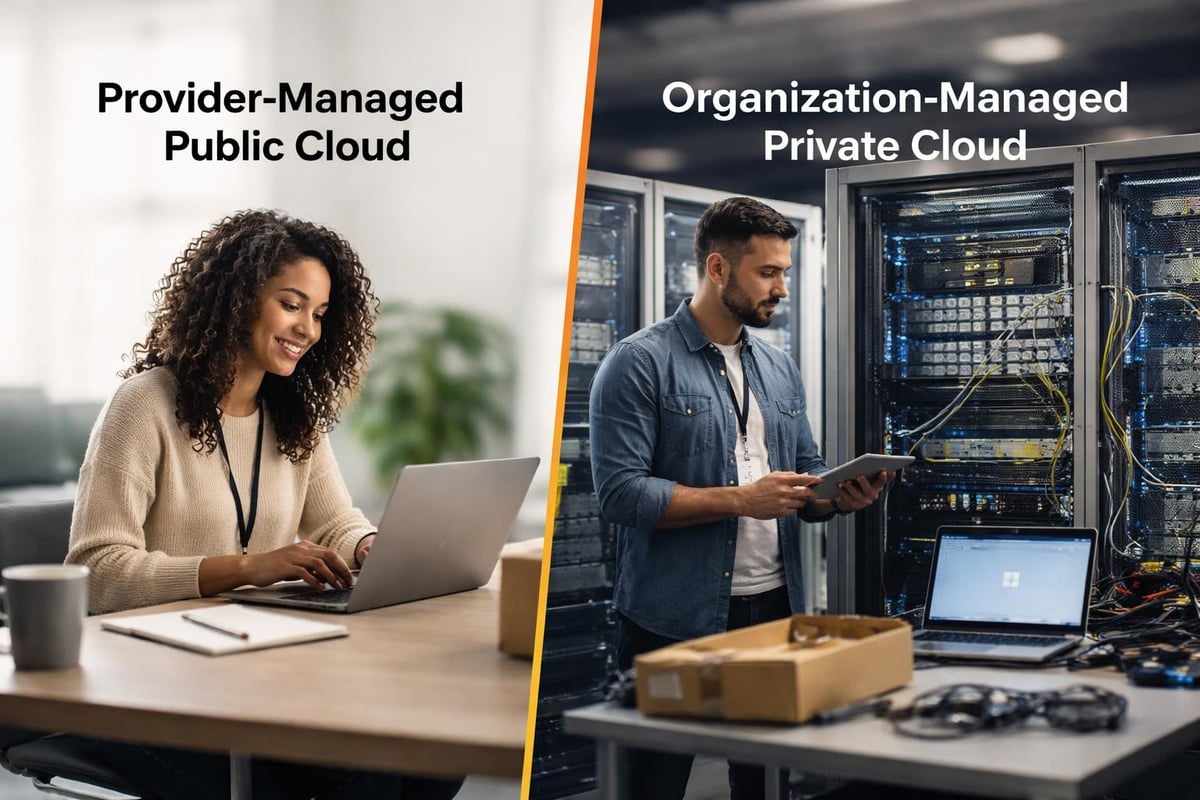
Public clouds abstract infrastructure management entirely. Providers handle hardware maintenance, network operations, facility management, and underlying platform updates. IT teams focus on application deployment, configuration, and optimisation rather than infrastructure concerns.
This managed approach reduces operational complexity significantly. Small teams can support sophisticated cloud deployments without specialised hardware expertise. However, organisations must develop new skills around cloud-native architectures, automation, and provider-specific tools.
Private clouds demand comprehensive infrastructure management capabilities:
- Hardware lifecycle management including procurement and decommissioning
- Operating system patching and security updates
- Network configuration and troubleshooting
- Storage capacity planning and optimisation
- Disaster recovery and business continuity planning
Organisations require skilled personnel across multiple disciplines. System administrators, network engineers, storage specialists, and security professionals all contribute to private cloud operations.
Automation and Orchestration
Both deployment models benefit from automation, yet implementation approaches differ. Public clouds provide extensive APIs, infrastructure-as-code tools, and managed services streamlining automation. Platforms like Terraform, CloudFormation, and Azure Resource Manager enable declarative infrastructure provisioning.
Private clouds require organisations to build automation frameworks independently. Whilst tools like Ansible, Puppet, and Chef support automation, implementation demands significant upfront investment and ongoing maintenance. Teradata’s analysis of public versus private cloud deployments examines operational considerations thoroughly.
Data Control and Vendor Lock-in Concerns
Data sovereignty and vendor dependencies represent critical strategic considerations in the private cloud vs public cloud evaluation. These factors influence long-term flexibility and organisational autonomy.
Data Ownership and Portability
Private clouds maintain absolute data control. Organisations own the hardware storing their information and manage every aspect of data lifecycle. This complete control simplifies data retrieval, migration, and disposal processes whilst ensuring compliance with internal policies.
Public clouds introduce shared responsibility for data management. Whilst organisations own their data legally, it resides on provider infrastructure. Extracting large datasets can incur substantial egress costs and technical complexity.
Vendor lock-in risks vary between models. Public cloud services often utilise proprietary APIs, managed services, and platform-specific features that complicate migration to alternative providers. Deeply integrated applications become difficult to relocate without significant re-engineering.
Strategic Independence
Private clouds deliver maximum strategic independence. Organisations control technology choices, upgrade schedules, and architectural decisions without provider constraints. This autonomy supports long-term stability and predictable operational costs.
However, independence comes with responsibility. Organisations must maintain currency with technology evolution, security threats, and industry best practices independently. DigitalOcean’s resource on private versus public cloud services explores these strategic trade-offs comprehensively.
Industry-Specific Considerations
Different sectors prioritise various aspects of the private cloud vs public cloud equation based on unique operational requirements and regulatory landscapes.
Financial services institutions often favour private clouds for core banking systems, trading platforms, and customer data repositories. Regulatory scrutiny, latency requirements, and security concerns drive these decisions. Public clouds support less sensitive workloads like customer portals and analytics platforms.
Healthcare organisations balance similar considerations. Patient records and clinical systems frequently reside in private environments ensuring HIPAA compliance and data protection. Public clouds host research initiatives, administrative systems, and patient engagement applications.
| Industry | Private Cloud Use Cases | Public Cloud Use Cases |
|---|---|---|
| Financial Services | Core banking, trading systems, customer data | Analytics, customer portals, development |
| Healthcare | Patient records, clinical systems | Research, administration, engagement apps |
| Government | Classified data, sensitive operations | Public services, citizen engagement |
| Retail | Payment processing, inventory systems | E-commerce, marketing, analytics |
| Manufacturing | Production control, proprietary designs | Supply chain, customer relationship management |
Government agencies implement private clouds for classified information and sensitive operations whilst leveraging public clouds for citizen-facing services and non-sensitive administrative functions. Mendix’s exploration of private versus public cloud differences discusses industry-specific deployment patterns.
Manufacturing firms protect intellectual property and production control systems within private infrastructure. Public clouds support supply chain management, customer engagement, and business analytics where data sensitivity allows.
Environmental and Sustainability Factors
Sustainability considerations increasingly influence the private cloud vs public cloud decision-making process as organisations prioritise environmental responsibility.
Energy Efficiency and Carbon Footprint
Public cloud providers achieve remarkable energy efficiency through massive scale and optimised operations. Hyperscale data centres utilise advanced cooling technologies, renewable energy sources, and hardware efficiency that individual organisations rarely match. This efficiency translates to lower carbon footprints per workload.
Google, Microsoft, and Amazon have committed to carbon neutrality or renewable energy targets. Leveraging their infrastructure helps organisations reduce environmental impact without direct investment in green technology.
Private clouds require organisations to address sustainability independently. On-premises data centres consume substantial power for servers and cooling systems. Achieving efficiency comparable to hyperscale providers demands significant investment in infrastructure modernisation and renewable energy procurement.
However, private clouds offer potential advantages through precise workload optimisation. Organisations can implement aggressive power management, consolidate workloads efficiently, and eliminate resource overprovisioning common in shared environments. For businesses prioritising sustainable operations, selecting providers with demonstrated environmental commitments becomes essential. Exploring comprehensive cloud solution providers who emphasise green hosting practices supports both operational and environmental objectives.
Making the Right Choice for Your Organisation
Determining the optimal approach in the private cloud vs public cloud decision requires comprehensive evaluation of multiple factors. No universal answer exists because organisational contexts vary dramatically.
Begin by assessing workload characteristics systematically. Identify applications requiring dedicated resources, regulatory compliance, or consistent performance. Evaluate which systems tolerate multi-tenant environments and benefit from elastic scaling.
Decision Framework
Consider these critical evaluation criteria:
- Security and compliance requirements: Regulatory obligations and data sensitivity levels
- Performance demands: Latency tolerance, throughput requirements, and consistency needs
- Budget constraints: Capital availability, operational expenditure preferences, and total cost models
- Technical capabilities: Internal expertise, staffing levels, and operational maturity
- Growth projections: Scalability requirements and expansion timelines
- Strategic priorities: Vendor independence, customisation needs, and long-term flexibility
Many organisations discover that hybrid approaches deliver optimal outcomes. Strategic workload placement across deployment models balances competing priorities effectively. Critical systems reside in private infrastructure whilst suitable workloads leverage public cloud economics and scalability.
The private cloud vs public cloud landscape continues evolving rapidly. Public providers enhance security, compliance, and customisation capabilities whilst private cloud technologies improve automation and operational efficiency. Staying informed about industry developments ensures decisions remain aligned with current capabilities rather than outdated perceptions.
Selecting between private and public cloud infrastructure fundamentally depends on aligning technology choices with business objectives, regulatory requirements, and operational capabilities. Both deployment models offer substantial value when matched appropriately to organisational needs. If you’re evaluating secure cloud solutions that prioritise data protection whilst supporting business growth, vBoxx delivers tailored infrastructure designed for organisations demanding robust security, operational flexibility, and sustainable hosting practices. Our team helps businesses navigate these complex decisions whilst implementing solutions that balance performance, compliance, and cost-effectiveness.