

Businesses today face an unprecedented challenge: protecting sensitive data whilst maintaining seamless collaboration across distributed teams. Secure cloud storage services have evolved from simple file repositories into sophisticated platforms that combine encryption, compliance frameworks, and access controls to safeguard corporate information. Furthermore, as cyber threats grow more sophisticated and regulatory requirements tighten, organisations must carefully evaluate their storage providers to ensure data remains protected against both external attacks and unauthorised internal access. This comprehensive guide explores the essential features, compliance considerations, and architectural principles that define truly secure cloud storage in 2026.
Understanding Modern Encryption Standards
Encryption forms the foundation of any secure cloud storage service, yet not all encryption implementations offer equal protection. Modern platforms employ multiple layers of cryptographic security to protect data throughout its lifecycle.
Encryption at Rest and in Transit
At-rest encryption protects files stored on physical servers, typically using AES-256 (Advanced Encryption Standard with 256-bit keys). This standard has become the industry baseline, providing robust protection against unauthorised physical access to storage infrastructure. Nevertheless, encryption at rest alone cannot protect data as it travels across networks.
In-transit encryption secures data moving between your device and cloud servers using TLS (Transport Layer Security) protocols. Therefore, even if network traffic is intercepted, the encrypted payload remains unreadable without proper decryption keys. According to ENISA’s implementation guidance on security measures, organisations should verify that both encryption types meet current cryptographic standards and that deprecated protocols (such as TLS 1.0 and 1.1) are disabled.
Zero-Knowledge Encryption Architecture
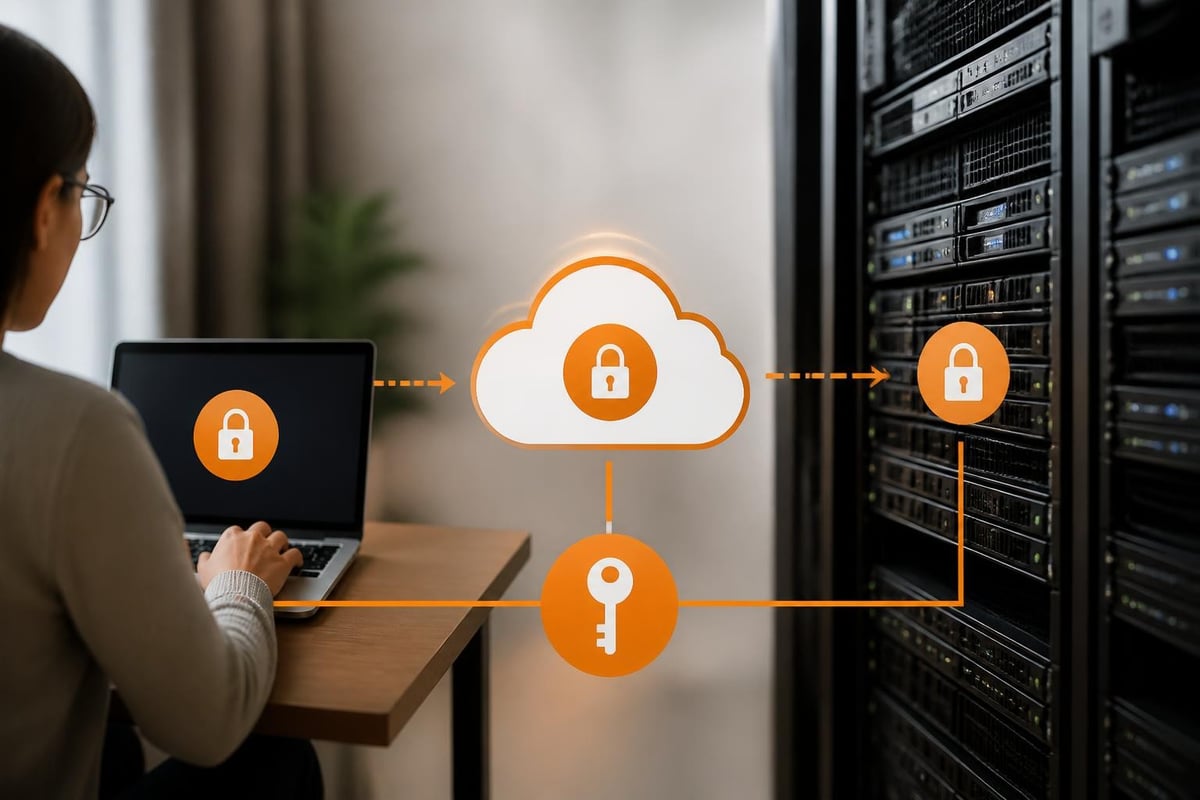
The most secure cloud storage services implement zero-knowledge encryption, wherein the provider cannot access your unencrypted data. In this model, encryption and decryption occur exclusively on the client side using keys that never reach the provider's servers.
Moreover, zero-knowledge architecture ensures that even if a provider receives a legal request for data, they can only provide encrypted files that are useless without the customer's private keys. This approach significantly reduces risks associated with insider threats, government surveillance, and provider-level security breaches.
Key considerations for zero-knowledge systems include:
- Client-side key generation and management
- Secure key recovery mechanisms for account access
- Password-based key derivation functions (KDFs) such as PBKDF2 or Argon2
- Multi-factor authentication to protect master passwords
Furthermore, NIST’s guidance on key management provides detailed recommendations for organisations implementing cryptographic systems, covering key generation, distribution, storage, and destruction across the entire key lifecycle.
Compliance and Data Sovereignty
Regulatory compliance represents a critical dimension of secure cloud storage services, particularly for European businesses navigating GDPR requirements and data residency regulations.
GDPR and European Data Protection
The General Data Protection Regulation imposes strict obligations on organisations processing personal data of EU residents. Therefore, cloud storage providers must demonstrate comprehensive compliance through technical and organisational measures.
Essential GDPR compliance features include:
- Data Processing Agreements (DPAs) that clearly define processor responsibilities
- Data subject rights fulfilment mechanisms for access, rectification, and erasure requests
- Breach notification procedures aligned with the 72-hour reporting requirement
- Privacy by design principles embedded in platform architecture
- Data minimisation controls that limit collection to necessary information
In addition, businesses must consider where their data physically resides. The US CLOUD Act (Clarifying Lawful Overseas Use of Data Act) grants American law enforcement agencies the right to compel US-based providers to produce data stored anywhere globally, regardless of local privacy laws. Consequently, many European organisations prefer providers operating exclusively within EU jurisdictions, thereby ensuring data remains subject solely to European legal frameworks.
Industry-Specific Certifications
Beyond GDPR, secure cloud storage services should maintain third-party certifications that validate their security controls. The ISO 27001 standard provides a comprehensive framework for information security management systems (ISMS), covering risk assessment, asset management, access control, and incident response.
| Certification | Focus Area | Relevance to Cloud Storage |
|---|---|---|
| ISO 27001 | Information Security Management | Comprehensive security controls and processes |
| ISO 27017 | Cloud Security | Cloud-specific security guidance and controls |
| ISO 27018 | Cloud Privacy | Protection of personally identifiable information |
| SOC 2 Type II | Service Organisation Controls | Operational security over extended period |
| TÜV Audit | Independent Security Review | Third-party validation of security claims |
Nevertheless, certifications alone do not guarantee security. Organisations should review audit reports, penetration test results, and security documentation to verify that certified controls are properly implemented and maintained.
Access Control and Identity Management
Protecting data requires more than encryption. Furthermore, robust access controls ensure that only authorised individuals can view, modify, or share sensitive files within secure cloud storage services.
Role-Based Access Control (RBAC)
RBAC systems assign permissions based on user roles within the organisation rather than individual identities. This approach simplifies administration whilst reducing the risk of excessive privileges.
Typical roles in business cloud storage include:
- Owner – Full control over files, folders, and sharing permissions
- Editor – Can modify content but cannot change sharing settings
- Commenter – Can add comments and suggestions without editing
- Viewer – Read-only access without download or sharing rights
- Custom roles – Granular permissions tailored to specific business needs
Moreover, effective RBAC implementations include automated provisioning and de-provisioning workflows that adjust access rights when employees join, change roles, or leave the organisation. This automation reduces the risk of orphaned accounts maintaining unnecessary access to sensitive data.
Multi-Factor Authentication and Conditional Access
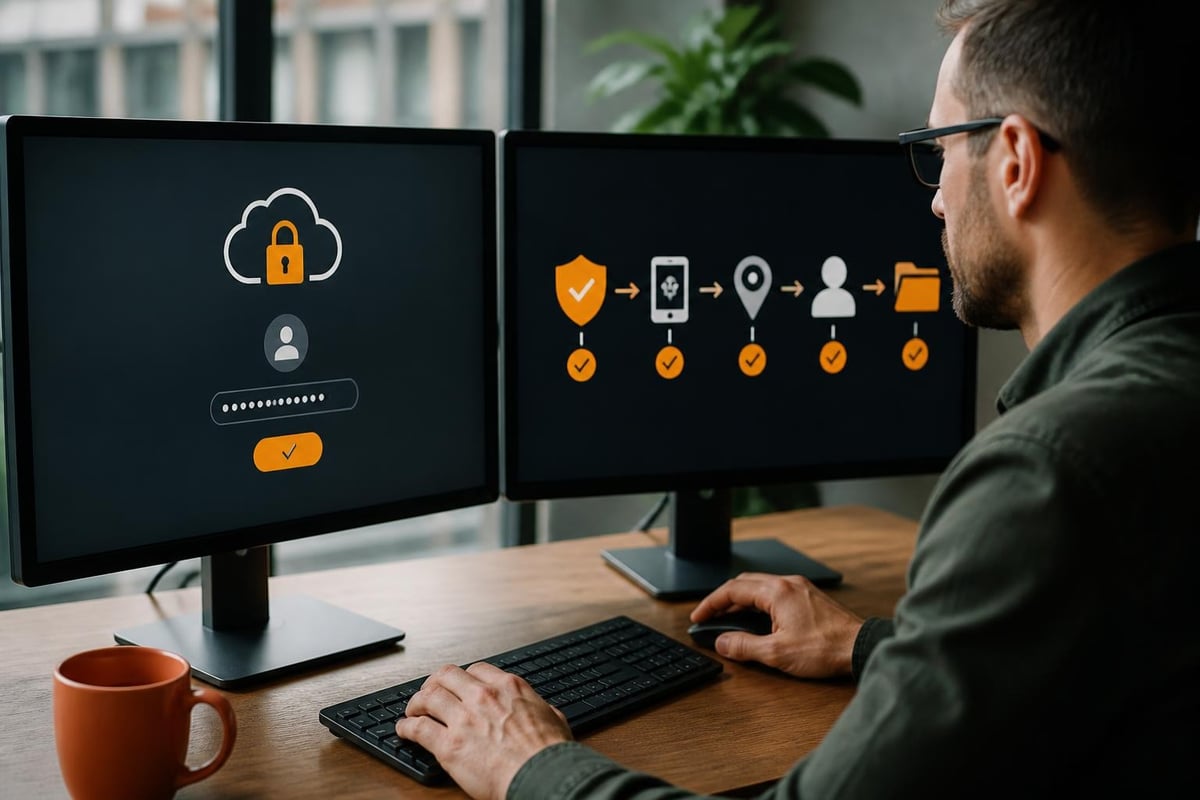
Multi-factor authentication (MFA) adds a critical security layer beyond passwords. Therefore, secure cloud storage services should support multiple MFA methods, including authenticator apps, hardware tokens, and biometric verification.
Conditional access policies extend MFA by applying context-aware security rules. In addition to authentication factors, these policies consider:
- Geographic location of access attempts
- Device security posture and compliance status
- Network origin (corporate network versus public Wi-Fi)
- Time of access and deviation from normal patterns
- Risk scores based on behavioural analytics
Furthermore, NIST’s Zero Trust Architecture guidance emphasises continuous verification rather than implicit trust, advocating for dynamic access decisions based on real-time risk assessment. This approach aligns particularly well with cloud storage environments where users access data from diverse locations and devices.
Threat Landscape and Protection Mechanisms
Understanding current threats helps organisations select secure cloud storage services with appropriate defensive capabilities. According to the ENISA Threat Landscape 2024, cloud-targeted attacks have increased significantly, with ransomware, data exfiltration, and misconfiguration exploitation among the most prevalent vectors.
Ransomware and Data Recovery
Ransomware attacks targeting cloud storage attempt to encrypt files and demand payment for decryption keys. Nevertheless, secure cloud storage services mitigate these risks through several mechanisms:
- Versioning that maintains multiple file versions, allowing rollback to pre-encryption states
- Immutable backups stored separately from primary data
- Suspicious activity detection that identifies unusual encryption or deletion patterns
- Rate limiting on file modifications to slow automated encryption attempts
- Offline recovery points isolated from network-accessible storage
In addition, organisations should implement the 3-2-1 backup rule: maintain three copies of data on two different media types with one copy stored offsite. Therefore, even if ransomware compromises primary cloud storage, offline backups ensure business continuity.
Misconfiguration and Exposure Prevention
The OWASP Web Security Testing Guide on cloud storage highlights that misconfigured storage buckets remain a leading cause of data breaches. Publicly exposed buckets have leaked billions of records, often because default permissions were too permissive or administrators misunderstood access control models.
Critical configuration controls include:
- Default-deny policies that require explicit permission grants
- Public access blocking at the organisational level
- Bucket policy review tools that flag overly permissive rules
- Automated configuration scanning to detect drift from security baselines
- Audit logging of all permission changes and access attempts
Moreover, secure cloud storage services should provide clear visibility into sharing settings, highlighting files or folders accessible to external users. Furthermore, administrators need alerts when permissions change in ways that increase exposure risk.
Advanced Security Features
Beyond fundamental protections, leading secure cloud storage services offer advanced capabilities that address sophisticated threats and compliance requirements.
Data Loss Prevention (DLP)
DLP technologies scan stored and shared files to detect sensitive information such as credit card numbers, national identification numbers, or confidential project data. Therefore, organisations can enforce policies that prevent unauthorised sharing of protected information.
DLP capabilities typically include:
- Content inspection using regular expressions and machine learning
- Policy enforcement that blocks sharing or applies encryption
- Watermarking and document tracking
- Classification labels that follow files across systems
- Incident reporting and workflow automation
In addition, integration with email and collaboration platforms extends DLP protection across the entire information ecosystem, ensuring consistent policy application regardless of where data resides or travels.
AI-Assisted Security and Search
Artificial intelligence enhances both security and usability in modern cloud storage platforms. AI-powered systems can identify anomalous access patterns, predict potential security incidents, and automate response actions.
Furthermore, AI-assisted search capabilities allow users to locate documents using natural language queries, semantic understanding, and content summarisation. For example, vBoxxCloud combines full-text search with semantic AI that understands document context, enabling users to ask questions about their stored files and receive relevant extracts and summaries whilst maintaining encryption and privacy standards.
Nevertheless, AI features should be implemented with privacy safeguards that prevent unauthorised model training on customer data and ensure processing occurs within trusted environments.
Audit Trails and Forensic Capabilities
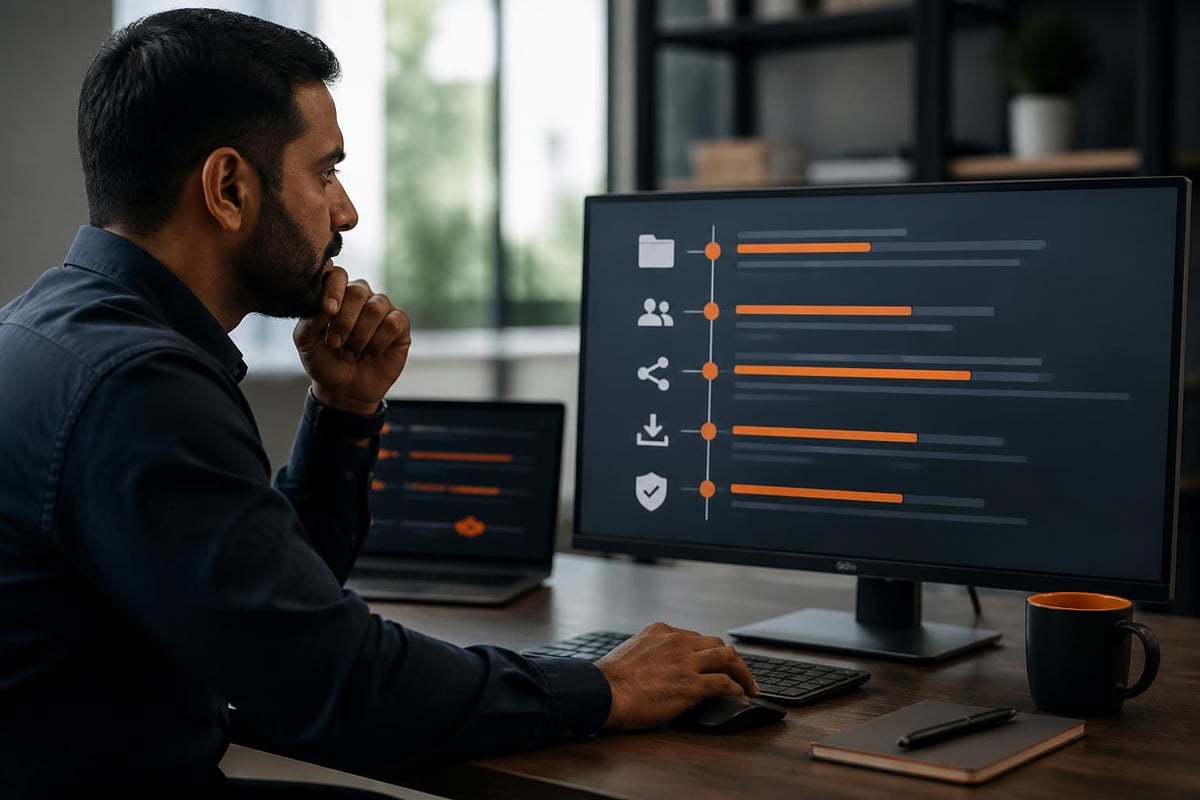
Comprehensive audit logging provides visibility into all file operations, user actions, and permission changes. Therefore, organisations can investigate security incidents, demonstrate compliance, and identify unauthorised activities.
| Audit Event Type | Information Captured | Security Value |
|---|---|---|
| File Access | User, timestamp, IP address, file path | Detect unauthorised viewing |
| Permission Changes | Changed by, affected user/folder, old/new permissions | Track privilege escalation |
| Sharing Actions | Sharer, recipient, link type, expiration | Monitor external exposure |
| Downloads | User, file, location, device | Identify potential data exfiltration |
| Authentication | Success/failure, MFA status, location | Detect credential compromise |
Moreover, secure cloud storage services should retain audit logs for extended periods (typically 90 days to one year) and protect them from tampering through cryptographic signatures or write-once storage. In addition, integration with Security Information and Event Management (SIEM) systems enables correlation of cloud storage events with broader security telemetry.
Infrastructure and Operational Security
The physical and operational security of data centre infrastructure significantly impacts the overall security posture of cloud storage services.
Data Centre Certifications and Standards
Secure cloud storage services operate from facilities that meet stringent physical security standards. ISO 27001 certification extends beyond information systems to encompass physical access controls, environmental protections, and operational procedures.
Critical infrastructure elements include:
- Biometric access control and video surveillance
- Redundant power supplies and cooling systems
- Fire suppression and environmental monitoring
- Physical separation of customer data
- Secure hardware disposal and decommissioning procedures
Furthermore, organisations should verify the geographic location of data centres, particularly regarding jurisdiction and disaster recovery capabilities. European businesses increasingly prefer providers operating exclusively within EU member states, thereby ensuring compliance with data residency requirements and avoiding exposure to extraterritorial legal frameworks.
Network Security and DDoS Protection
Network-layer security protects against distributed denial-of-service (DDoS) attacks, man-in-the-middle interception, and other network-based threats. Therefore, secure cloud storage services implement multiple defensive layers:
- Firewalls that filter malicious traffic based on signatures and behavioural analysis
- Intrusion detection and prevention systems (IDS/IPS) monitoring for attack patterns
- DDoS mitigation using traffic scrubbing and anycast routing
- Network segmentation isolating storage infrastructure from management networks
- VPN and private connectivity options for enhanced isolation
In addition, providers should demonstrate regular security testing through penetration tests, vulnerability assessments, and red team exercises. Moreover, Microsoft’s guidance on securing Azure Storage illustrates industry practices for network restrictions, private endpoints, and defence-in-depth approaches applicable across cloud platforms.
Business Continuity and Disaster Recovery
Secure cloud storage services must ensure data availability even during infrastructure failures, natural disasters, or security incidents. Therefore, comprehensive business continuity planning is essential.
Geographic Redundancy and Replication
Data replication across multiple geographic locations protects against site-level failures. Nevertheless, organisations must balance redundancy requirements with data sovereignty concerns.
Replication strategies include:
- Synchronous replication for zero data loss but limited geographic distance
- Asynchronous replication allowing greater distance with minimal lag
- Multi-region storage distributing data across independent failure domains
- Cross-border replication controls respecting data residency requirements
Furthermore, replication configurations should align with recovery time objectives (RTO) and recovery point objectives (RPO), ensuring that failover capabilities meet business continuity requirements.
Backup and Recovery Procedures
Beyond replication, independent backup systems provide protection against logical corruption, ransomware, and accidental deletion. Therefore, secure cloud storage services should offer automated backup scheduling, point-in-time recovery, and granular restoration capabilities.
Moreover, organisations using Software-as-a-Service platforms such as Microsoft 365 or Google Workspace often mistakenly assume that built-in retention features provide adequate backup protection. Nevertheless, these platforms have limitations regarding retention periods, recovery granularity, and protection against malicious deletion. Consequently, dedicated cloud-to-cloud backup services add an essential protection layer.
Privacy-Enhanced Technologies
Emerging technologies address advanced privacy requirements whilst maintaining functionality and performance in secure cloud storage services.
Confidential Computing and Trusted Execution
Confidential computing protects data during processing using hardware-based trusted execution environments (TEEs). According to research on confidential computing for cloud environments, these technologies enable computation on encrypted data without exposing plaintext to the cloud provider or system administrators.
Confidential computing applications for cloud storage include:
- Encrypted search indexing that never exposes file contents
- Secure sharing workflows that maintain end-to-end encryption
- Privacy-preserving analytics on stored data
- Protected AI model inference without data exposure
Nevertheless, confidential computing remains an emerging field with implementation challenges around performance, key management, and attestation verification. Furthermore, organisations should evaluate whether the complexity and overhead justify the enhanced privacy protections for their specific use cases.
Homomorphic Encryption and Secure Multiparty Computation
Homomorphic encryption allows mathematical operations on encrypted data, producing encrypted results that decrypt to the correct answer. Similarly, secure multiparty computation enables collaborative analysis across organisations without revealing underlying data.
These technologies hold promise for scenarios requiring privacy-preserving data sharing, such as collaborative research, supply chain analytics, and regulatory reporting. Nevertheless, practical implementations currently face performance limitations that restrict their applicability to specific, high-value use cases rather than general-purpose cloud storage operations.
Integration and Ecosystem Considerations
Secure cloud storage services must integrate seamlessly with existing business applications, authentication systems, and workflows to ensure adoption and maintain productivity.
Directory Services and Single Sign-On
Integration with corporate identity providers through protocols such as SAML, OAuth, and OpenID Connect enables centralised authentication management. Therefore, users access cloud storage using their existing corporate credentials rather than separate passwords.
Identity integration benefits include:
- Reduced password fatigue and credential reuse
- Centralised provisioning and de-provisioning workflows
- Consistent MFA policies across applications
- Streamlined user experience and adoption
- Simplified compliance auditing
Furthermore, organisations should verify that cloud storage providers support their preferred identity platforms and offer flexible attribute mapping for role assignment and access policies.
API Security and Developer Access
Application programming interfaces (APIs) enable automation, custom integrations, and application development using secure cloud storage services. Nevertheless, API security requires careful attention to prevent unauthorised access and data leakage.
API security best practices include:
- OAuth 2.0 tokens with limited scopes and expiration
- Rate limiting to prevent abuse and enumeration attacks
- API key rotation and lifecycle management
- Request signing to verify authenticity and prevent tampering
- Audit logging of all API operations and access patterns
Moreover, developers should follow the principle of least privilege when requesting API permissions, limiting scopes to only the operations and data required for their specific integration.
Evaluating Secure Cloud Storage Providers
Selecting the right secure cloud storage service requires systematic evaluation across technical, compliance, and operational dimensions.
Security Questionnaires and Due Diligence
Organisations should develop comprehensive security questionnaires covering encryption standards, access controls, incident response procedures, and compliance certifications. Furthermore, vendors should provide detailed answers with supporting documentation rather than generic marketing responses.
Critical evaluation areas include:
- Encryption implementation details and key management architecture
- Data centre locations and third-party certifications
- Incident response procedures and historical breach disclosures
- Compliance attestations and audit reports (SOC 2, ISO 27001)
- Data portability and vendor lock-in considerations
- Service level agreements for availability and support response
- Privacy policies and data processing agreements
In addition, the SANS Institute’s multicloud security survey provides insights into operational practices and common challenges when securing cloud storage across multiple providers, highlighting the importance of consistent security controls regardless of platform.
Proof of Concept and Testing
Before committing to a provider, organisations should conduct proof-of-concept deployments that validate security features, integration capabilities, and user experience. Therefore, testing should include:
- Authentication and authorisation workflow verification
- File sharing and collaboration scenario testing
- Recovery procedures and backup restoration
- Performance measurement under realistic loads
- Administrative interface evaluation and automation capabilities
Moreover, involving end users during testing ensures that security controls do not create friction that drives shadow IT adoption of less secure alternatives.
Secure cloud storage services protect business-critical data through multi-layered encryption, robust access controls, and comprehensive compliance frameworks whilst maintaining the collaboration capabilities modern organisations require. As regulatory requirements intensify and cyber threats evolve, selecting a provider that prioritises security, privacy, and European data sovereignty becomes increasingly essential. vBoxx delivers enterprise-grade cloud storage, communication, and security solutions from ISO 27001-certified data centres in the Netherlands, combining GDPR compliance with advanced features such as eIDAS-compliant e-signing and AI-assisted search, all whilst operating outside the reach of the US CLOUD Act to ensure your data remains protected under European jurisdiction.