
European businesses increasingly require dedicated Apple infrastructure for iOS development, creative workflows and macOS applications whilst maintaining full compliance with data protection regulations. Mac mini hosting in Europe addresses this need by combining Apple’s powerful hardware with the strict privacy standards, data residency guarantees and regulatory frameworks that define the European digital landscape. Furthermore, hosting Mac minis within European data centers ensures that organisations can leverage native macOS environments without compromising on security or falling under the jurisdiction of foreign legislation such as the US CLOUD Act.
Why European Businesses Choose Mac Mini Hosting
The decision to opt for mac mini hosting in Europe stems from several strategic considerations that go beyond simple hardware preferences. Organisations operating within the European Union must navigate complex compliance requirements, particularly concerning data protection and cybersecurity. Moreover, the rise of remote development teams and cloud-based creative workflows has created demand for always-available macOS environments that can be accessed securely from anywhere.
Data Sovereignty and GDPR Compliance
European data protection law mandates strict controls over where personal data is processed and stored. The General Data Protection Regulation requires that businesses implement appropriate technical and organisational measures to protect personal information. Therefore, hosting Mac minis in ISO 27001-certified European data centers ensures that all data processing occurs within EU jurisdiction, eliminating concerns about cross-border data transfers or foreign government access requests.
In addition, European providers operating their own infrastructure can offer guarantees that American cloud giants cannot match. When your Mac mini hosting runs in the Netherlands, Germany or other EU member states, you benefit from explicit GDPR protections without the complications of international data transfer agreements or adequacy decisions.

Build and Test Environments for iOS Development
Development teams building applications for iOS, iPadOS and macOS require native Apple hardware to compile code, run automated tests and deploy to the App Store. Nevertheless, maintaining physical Mac infrastructure in-house presents challenges: hardware costs, physical space requirements, power consumption and the need for redundant systems to ensure continuous integration pipelines remain operational.
Mac mini hosting in Europe solves these pain points by providing dedicated Apple M4 or M1 hardware in professionally managed data centers. Developers can configure automated deployment workflows using Fastlane, integrate with Jenkins or GitLab CI/CD pipelines, and run simultaneous build jobs across multiple Mac minis without worrying about hardware maintenance or network connectivity.
Furthermore, remote-managed Mac infrastructure aligns perfectly with distributed development teams. Engineers in London, Berlin and Amsterdam can all access the same hosted Mac environment with low latency and high availability, whilst build artefacts and test results remain within European jurisdiction.
Technical Specifications and Performance Considerations
Selecting the right Mac mini hosting configuration requires understanding your workload characteristics and performance requirements. The latest Apple M4 chips deliver exceptional single-core and multi-core performance, making them suitable for demanding compilation tasks, video rendering and machine learning workloads.
Hardware Options and Scalability
| Component | Entry Configuration | Performance Configuration | Pro Configuration |
|---|---|---|---|
| Processor | Apple M4 (10-core) | Apple M4 Pro (12-core) | Apple M4 Max (16-core) |
| Memory | 16 GB unified | 32 GB unified | 64 GB unified |
| Storage | 512 GB SSD | 1 TB SSD | 2 TB SSD |
| Network | 1 Gbps shared | 1 Gbps dedicated | 10 Gbps dedicated |
Most iOS build workloads perform excellently on the entry configuration, whilst video production teams benefit from the additional GPU cores and memory bandwidth available in Pro and Max variants. In addition, storage requirements vary significantly depending on whether you maintain local build caches, store media assets or run virtualisation workloads.
Network Architecture and Connectivity
European data centers typically offer excellent connectivity to major internet exchanges and international backbones. Therefore, hosted Mac minis can deliver sub-10ms latency to users across Western Europe and sub-50ms to most of the continent. Screen-sharing protocols such as Apple Remote Desktop and VNC perform smoothly over these connections, enabling responsive remote administration.
Moreover, private networking options allow Mac minis to communicate securely with other infrastructure components:
- VPN tunnels connecting hosted Macs to your office network
- Virtual private clouds isolating Mac infrastructure from public internet
- Direct fibre connections for organisations with nearby data center presence
- IPv6 addressing for modern network architecture and improved routing
Regulatory Framework and Security Standards
Operating hosting infrastructure within the European Union requires compliance with multiple regulatory frameworks that protect both providers and customers. The NIS2 Directive establishes cybersecurity requirements for digital infrastructure providers, whilst sector-specific regulations may impose additional obligations.

ISO 27001 and Information Security Management
ISO 27001 certification demonstrates that a hosting provider has implemented comprehensive information security management systems. Furthermore, this internationally recognised standard requires regular audits, risk assessments and continuous improvement processes that directly benefit customers hosting sensitive workloads.
When evaluating mac mini hosting in Europe, verify that your provider holds current ISO 27001 certification for the specific data centers housing your equipment. In addition, ask about their incident response procedures, backup policies and disaster recovery capabilities. ENISA guidance provides valuable frameworks for assessing cloud security controls.
Payment Card Industry Compliance
Development teams building e-commerce applications or payment processing systems must consider PCI DSS requirements. Although Mac minis themselves typically don’t process payment card data directly, they may compile applications that do or access systems containing cardholder information. Therefore, understanding the hosting provider’s PCI compliance status becomes essential for organisations operating in regulated industries.
Use Cases Driving Mac Mini Adoption
European organisations deploy mac mini hosting in Europe for diverse purposes, each with specific technical requirements and business drivers. Nevertheless, certain patterns emerge across industries and company sizes.
Mobile Application Development
iOS and macOS development represents the most common use case for hosted Mac infrastructure:
- Continuous integration pipelines that automatically build and test every code commit
- App Store deployment using automated signing and upload workflows
- Simulator farms running parallel UI tests across multiple iOS versions
- Beta distribution through TestFlight with automated screenshot generation
- Code signing operations requiring access to Apple Developer certificates
Development agencies frequently provision one Mac mini per major client project, ensuring isolated build environments and dedicated resources. Moreover, this approach simplifies billing and resource allocation whilst maintaining security boundaries between customer codebases.
Creative and Media Production
Video production companies, design studios and animation houses leverage Mac hosting for rendering, transcoding and collaborative workflows. Additionally, applications such as Final Cut Pro, Logic Pro and Adobe Creative Suite run natively on macOS, making hosted Mac minis an ideal solution for remote creative teams.
| Workflow Type | Typical Configuration | Key Benefits |
|---|---|---|
| Video editing | M4 Max, 64GB RAM | GPU acceleration, ProRes rendering |
| Audio production | M4 Pro, 32GB RAM | Low-latency processing, plugin compatibility |
| Graphic design | M4, 24GB RAM | Colour accuracy, Creative Cloud integration |
| 3D rendering | Multiple M4 Max | Distributed rendering, cost-effective scaling |
Virtualisation and Development Environments
Apple’s Virtualization framework enables running macOS virtual machines on Apple silicon hardware. Consequently, a single hosted Mac mini can provide multiple isolated macOS environments for testing, development or demonstration purposes. Furthermore, this capability proves valuable for:
- Testing applications across different macOS versions simultaneously
- Providing temporary development environments for contractors
- Running legacy macOS software in isolated containers
- Creating reproducible build environments with snapshot capabilities
Infrastructure Management and Administration
Operating hosted Mac infrastructure requires different approaches compared to traditional Linux or Windows servers. Therefore, understanding macOS-specific management tools and practices ensures smooth operations and optimal resource utilisation.
Remote Device Management
Apple provides comprehensive deployment and device management frameworks designed for enterprise macOS administration. Mobile Device Management (MDM) solutions enable centralised configuration, software deployment and security policy enforcement across hosted Mac minis.
In addition, Zero-touch deployment capabilities allow new Mac minis to automatically enroll in your management system upon first boot. This automation reduces provisioning time and ensures consistent security baselines across your hosted infrastructure.
Monitoring and Performance Optimisation
Effective monitoring of mac mini hosting in Europe requires tools that understand macOS-specific metrics and behaviours:
- System resource utilisation tracking CPU, memory, disk I/O and network bandwidth
- Build pipeline metrics measuring compilation times, test execution duration and deployment frequency
- Application performance monitoring background processes, daemon health and service availability
- Security events logging authentication attempts, system changes and network connections
Moreover, integration with European-hosted monitoring platforms ensures that performance data and logs remain within GDPR-compliant infrastructure. Solutions such as vBoxxCloud provide secure storage for logs and monitoring data with full audit trails and European data residency guarantees.
Cost Considerations and Pricing Models
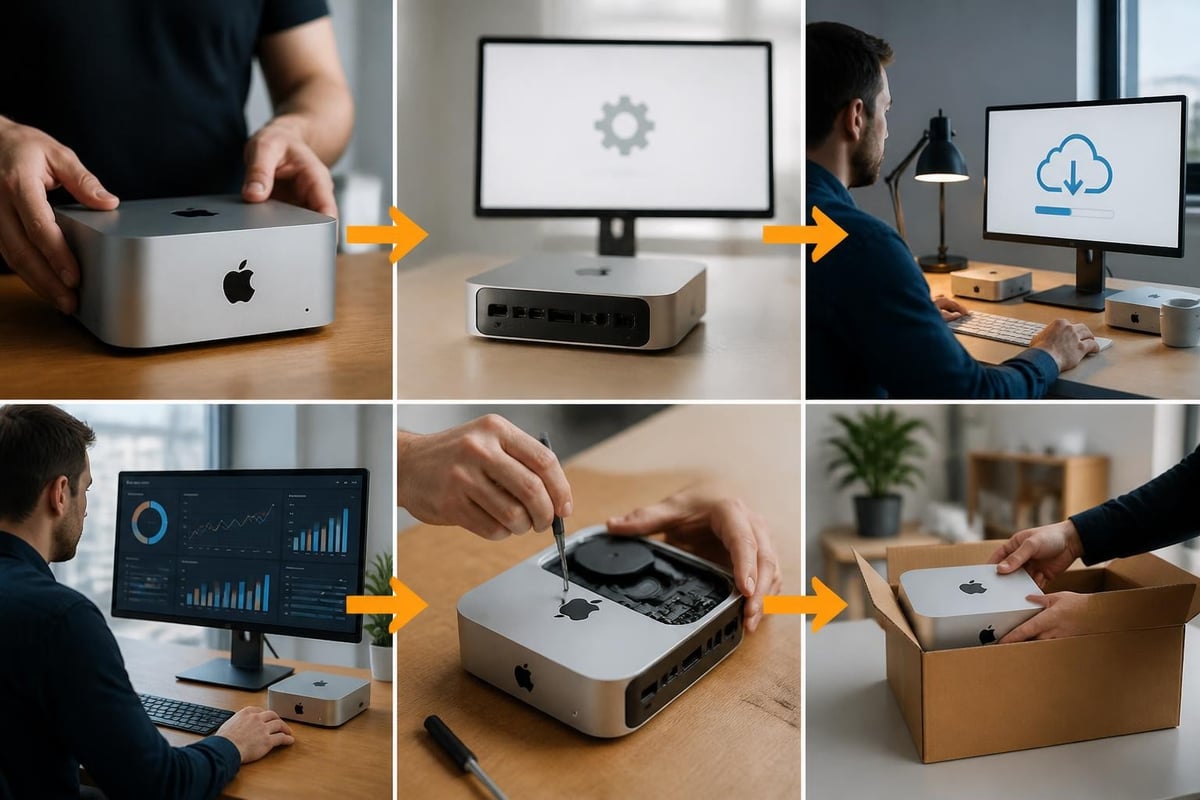
Understanding the total cost of ownership for mac mini hosting in Europe requires evaluating both direct hosting fees and associated operational expenses. Furthermore, comparing self-managed infrastructure against hosted solutions reveals significant differences in capital expenditure, operational complexity and scaling flexibility.
Pricing Structure Comparison
| Cost Component | On-Premises | Colocation | Managed Hosting |
|---|---|---|---|
| Hardware purchase | €800-2,500 | €800-2,500 | €0 (included) |
| Monthly facility | €0 | €50-150 | €80-300 |
| Power & cooling | Variable | €20-50 | Included |
| Network bandwidth | Business line | €30-100 | Included |
| Maintenance & support | Internal time | Internal time | Included |
| Total 3-year TCO | €1,200+ | €5,000+ | €3,500-11,000 |
Nevertheless, these figures don’t capture opportunity costs. Internal IT teams managing on-premises Mac infrastructure spend time on hardware maintenance, network troubleshooting and facility management that could otherwise focus on strategic initiatives. Therefore, managed hosting often delivers better value despite higher nominal costs.
Scaling Economics
Mac mini hosting in Europe offers linear scaling characteristics that simplify capacity planning. Adding another Mac mini to your hosted environment incurs predictable monthly costs without requiring office space renovations, electrical upgrades or network infrastructure changes. In addition, monthly billing cycles enable organisations to align hosting costs with project revenues or seasonal demand patterns.
Data Center Selection Within Europe
Geographical location within Europe affects latency, regulatory compliance and operational resilience. Moreover, different EU member states offer varying benefits regarding renewable energy availability, connectivity to international networks and political stability.
Netherlands Data Center Advantages
The Netherlands has emerged as a premier location for European hosting infrastructure. Amsterdam’s internet exchange (AMS-IX) ranks among the world’s largest, providing exceptional connectivity to global networks. Furthermore, Dutch data centers benefit from:
- Stable political and regulatory environment
- Abundant renewable energy from wind and solar
- Proximity to major European business centers
- Strong legal protections for data privacy
- Advanced physical security standards
Sustainability and Green Hosting
European hosting providers increasingly emphasise renewable energy and carbon neutrality. Data centers in the Netherlands, Germany and Scandinavia frequently achieve Power Usage Effectiveness (PUE) ratios below 1.2 through advanced cooling systems and renewable electricity procurement. Additionally, modern data center design focuses on waste heat recovery and free cooling techniques that minimise environmental impact.
Organisations committed to sustainability can therefore select mac mini hosting in Europe based partly on the hosting provider’s environmental credentials. Furthermore, European data residency aligns with corporate social responsibility goals by supporting local economies and reducing the carbon footprint associated with international data transfers.
Migration and Onboarding Process
Transitioning to hosted Mac infrastructure requires careful planning to minimise disruption to development workflows and production systems. Nevertheless, systematic migration approaches enable organisations to move from on-premises or other hosting environments with minimal downtime.
Pre-Migration Assessment
Before initiating a migration to mac mini hosting in Europe, document your current environment thoroughly:
- Inventory existing Mac hardware including specifications, operating system versions and installed software
- Map network dependencies identifying connections to internal systems, databases and external services
- Catalogue build configurations documenting compiler settings, signing certificates and deployment scripts
- Review security requirements listing firewall rules, VPN configurations and access control policies
- Estimate data volumes measuring project repositories, build artifacts and cached dependencies
This assessment reveals potential challenges and informs the migration timeline. Moreover, it provides baseline performance metrics against which to compare the hosted environment.
Implementation Strategy
Successful migrations typically follow a phased approach rather than attempting wholesale infrastructure replacement:
- Pilot phase migrating a single non-critical project to validate configurations and workflows
- Parallel operation running both on-premises and hosted environments during transition
- Incremental migration moving projects systematically with validation at each step
- Production cutover switching primary build infrastructure to hosted Mac minis
- Decommissioning retiring on-premises hardware once migration completes successfully
Furthermore, providers offering free migration services can accelerate this process by handling technical details, troubleshooting connectivity issues and optimising configurations for the hosted environment. vBoxx Mac Hosting includes expert migration support to ensure smooth transitions from existing infrastructure.
Security Best Practices for Hosted Macs
Operating Mac infrastructure in shared data center facilities requires implementing comprehensive security controls that protect your systems, data and credentials. Therefore, layered security approaches combine physical, network and application-level protections.
Access Control and Authentication
Restricting who can connect to your hosted Mac minis represents the first line of defense:
- SSH key-based authentication eliminating password-based login vulnerabilities
- Multi-factor authentication requiring additional verification beyond credentials
- VPN-only access blocking direct internet connectivity to administrative interfaces
- IP allowlisting permitting connections exclusively from known network addresses
- Bastion hosts channeling all administrative access through hardened jump servers
In addition, credential management becomes critical when multiple team members require access. Password managers such as vBoxxVault provide secure sharing of SSH keys, API tokens and service credentials whilst maintaining audit logs of access and maintaining GDPR compliance through European hosting.
Data Protection and Encryption
Sensitive source code, build artifacts and credentials stored on hosted Mac minis require protection both at rest and in transit:
- Full-disk encryption using FileVault 2 on all storage volumes
- TLS/SSL for all network communications including screen sharing and file transfers
- Encrypted backups stored in geographically separate European data centers
- Secrets management using encrypted vaults rather than plaintext configuration files
Moreover, organisations handling particularly sensitive data can implement additional controls such as hardware security modules for code signing operations or air-gapped environments for production deployment processes.
Future Developments in European Mac Hosting
The market for mac mini hosting in Europe continues evolving as Apple releases new hardware, European regulations develop and customer requirements become more sophisticated. Nevertheless, certain trends appear likely to shape the industry over coming years.
Apple Silicon Performance Improvements
Apple’s transition to custom silicon has delivered dramatic performance improvements with each hardware generation. The M4 chip introduced in 2024 provides approximately 25% faster CPU performance and 40% faster GPU performance compared to M1, whilst maintaining similar power consumption. Therefore, organisations can expect continued performance gains without corresponding increases in hosting costs or power requirements.
Furthermore, advances in unified memory architecture enable Mac minis to handle larger datasets and more complex workloads without expensive memory upgrades. This trend benefits both development workflows and creative applications that previously required Mac Pro or Mac Studio hardware.
Regulatory Evolution and Data Sovereignty
European policymakers continue developing digital sovereignty frameworks that influence hosting decisions. The Data Act and related initiatives aim to strengthen European data independence and reduce reliance on non-European technology providers. Consequently, demand for genuinely European hosting solutions will likely increase as organisations seek to align with evolving policy priorities.
In addition, sector-specific regulations in finance, healthcare and government create opportunities for specialised mac mini hosting in Europe that addresses particular compliance requirements. Providers offering pre-certified configurations or industry-specific security controls can simplify compliance for organisations operating in regulated sectors.
Hosting Mac infrastructure in European data centers combines the performance and ecosystem benefits of Apple hardware with the privacy protections, regulatory compliance and data sovereignty guarantees that European organisations require. Whether supporting iOS development teams, creative workflows or macOS applications, choosing providers with ISO-certified facilities and genuine European operations ensures your infrastructure aligns with GDPR obligations whilst delivering reliable, high-performance computing resources. vBoxx operates Mac mini hosting on Apple M4 hardware in ISO 27001-certified Dutch data centers, combining expert support with monthly flexibility and comprehensive business cloud solutions for organisations prioritising security and European data residency.