

Managed cloud computing is an arrangement in which a specialist provider designs, runs, secures and optimises your cloud environment on your behalf, so that your own team can concentrate on its core work instead of on servers, patches and monitoring. For European businesses, the model carries an additional dimension, because the choice of provider also determines where data is stored, which laws apply to it and how easily it can be moved later. Therefore, this guide explains what the service covers, how it differs from unmanaged hosting, and how to select a provider that fits European regulatory expectations.
What Are Managed Cloud Services?
Managed cloud services are outsourced operations for cloud infrastructure, in which a provider takes responsibility for day-to-day administration, security, backup, monitoring and performance tuning under a defined service agreement. In other words, you consume a working environment rather than raw resources that you must assemble and maintain yourself.
The scope varies between providers, but most agreements include the following elements:
- Infrastructure management: provisioning, scaling and maintaining virtual or dedicated servers and storage.
- Security operations: patching, firewall configuration, vulnerability scanning and incident response.
- Backup and recovery: scheduled backups, tested restores and disaster recovery planning.
- Monitoring and support: round-the-clock observation of availability and performance, with agreed response times.
- Optimisation: capacity planning and cost control, so that you pay for what you actually need.
In addition, many European providers bundle migration assistance and consultancy, which reduces the effort required to move existing workloads.
Why European Businesses Are Adopting It
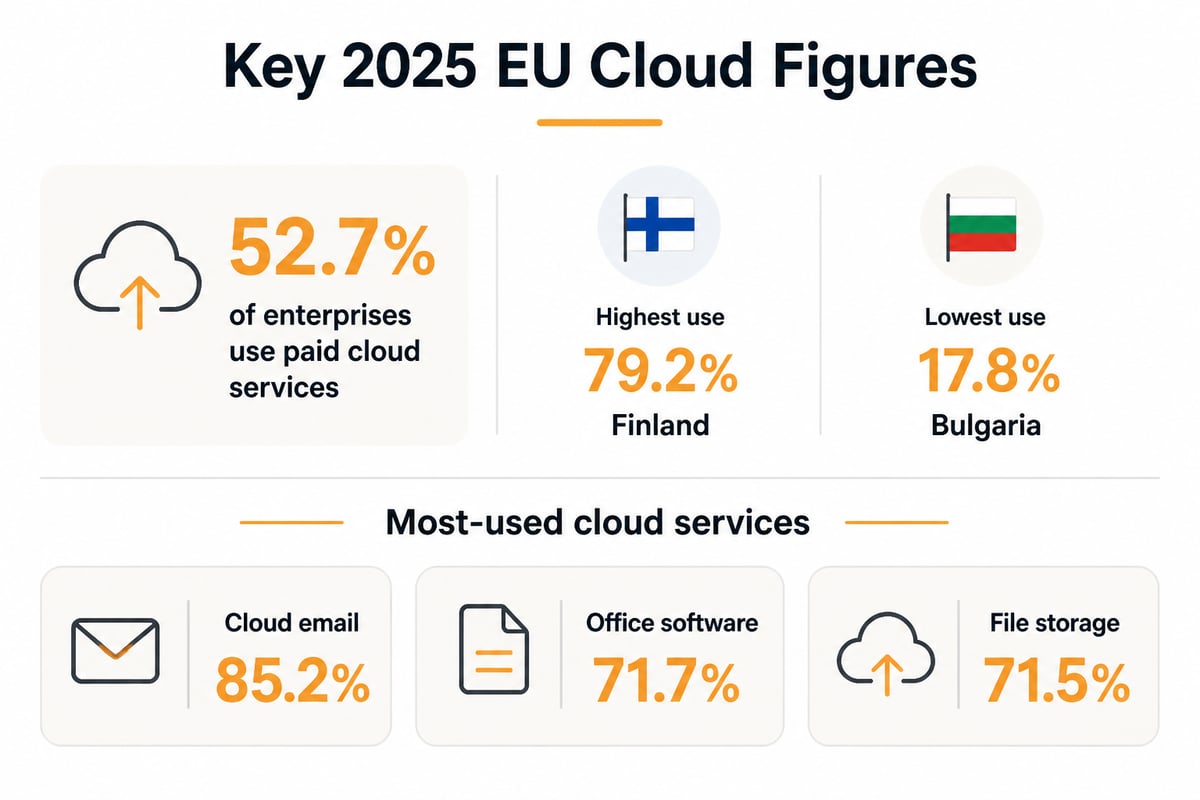
European firms are adopting managed cloud computing because cloud use is now mainstream and the operational burden of running it internally continues to grow. According to Eurostat, 52.7% of EU enterprises used paid cloud computing services in 2025, an increase of 7.4 percentage points compared with 2023. Consequently, the question for most organisations is no longer whether to use the cloud, but who should operate it.
Adoption is far from uniform. The same Eurostat data shows that Finland led with 79.2% of enterprises using paid cloud services, whereas Bulgaria recorded the lowest figure at 17.8%. Nevertheless, the direction of travel is consistent across the Union, and smaller firms in lower-adoption countries often benefit most from a provider that supplies the expertise they lack.
The kinds of workloads moving to the cloud also explain the demand for managed support. Among EU enterprises using paid cloud services in 2025, 85.2% used cloud email, 71.7% used office software and 71.5% used file storage, according to Eurostat. These are business-critical functions, so downtime or a data incident has an immediate commercial effect. For broader context on the types of services businesses adopt, Eurostat's enterprise digitalisation statistics are a useful reference.
Managed vs Unmanaged Cloud: What Actually Changes
The difference between managed and unmanaged cloud lies in who carries operational responsibility: with an unmanaged service you receive resources and administer everything yourself, while a managed service transfers that administration to the provider. Both models can run on identical hardware, so the distinction is about labour, accountability and risk rather than technology.
| Aspect | Unmanaged cloud | Managed cloud |
|---|---|---|
| Server administration | Your team | Provider |
| Security patching | Your responsibility | Included in the agreement |
| Backup and recovery | Configured by you | Provided and tested by provider |
| Monitoring | Self-built or third-party tools | Continuous, with response times |
| Required skills | In-house system administrators | Minimal; provider supplies them |
| Cost profile | Lower fees, higher staffing cost | Higher fees, predictable total cost |
Unmanaged hosting suits organisations with a capable infrastructure team and a need for complete control. Conversely, managed cloud suits those who prefer predictable operations, particularly when no dedicated administrator is employed. For a closer look at the managed virtual server model, vBoxx explains the details in its article on cloud VPS managed.
The Five Pillars of Cloud Computing
The five pillars of cloud computing are the characteristics defined by the US National Institute of Standards and Technology (NIST) that distinguish genuine cloud services from conventional hosting: on-demand self-service, broad network access, resource pooling, rapid elasticity and measured service. They give buyers a practical checklist for evaluating any provider's claims.
- On-demand self-service: you can provision capacity without contacting a salesperson each time.
- Broad network access: services are reachable from standard devices over the network.
- Resource pooling: the provider shares physical resources among customers while keeping their data separated.
- Rapid elasticity: capacity can expand or contract quickly in line with demand.
- Measured service: usage is metered, so billing reflects actual consumption.
A managed provider adds a sixth consideration that is not part of the NIST model but matters in practice: accountable operations. In other words, someone is contractually responsible when something fails.
Security and Compliance Under European Law
Security in managed cloud computing is shared between customer and provider, and European law increasingly requires that the division of duties is documented. The General Data Protection Regulation governs personal data, while the NIS2 Directive raises the cybersecurity obligations of essential and important entities across many sectors.
The supervisory landscape is becoming more concrete. ENISA's 2025 technical guidance supports the implementation of cybersecurity measures for sectors that include cloud computing providers, managed service providers and managed security service providers. As a result, a managed provider can itself fall within regulatory scope, and customers are entitled to ask how the provider meets those duties.
Security tooling is already widespread among cloud users. Eurostat reports that a majority of EU enterprises using paid cloud services employed security software applications in the cloud in 2025, as stated in its news release. Even so, tools alone do not satisfy a regulator, and documented processes, audit trails and certifications carry equal weight. vBoxx has examined this topic further in its guides to managed cloud security and data protection in cloud computing.
Jurisdiction and the US CLOUD Act
Where a provider is headquartered matters as much as where its servers stand. A company subject to United States jurisdiction may be compelled to disclose data under the CLOUD Act, even when that data sits in a European data centre. Therefore, businesses handling sensitive client, financial or health information often prefer a European provider that operates its own infrastructure and falls outside that legal reach.
What to Look For in a Managed Cloud Provider
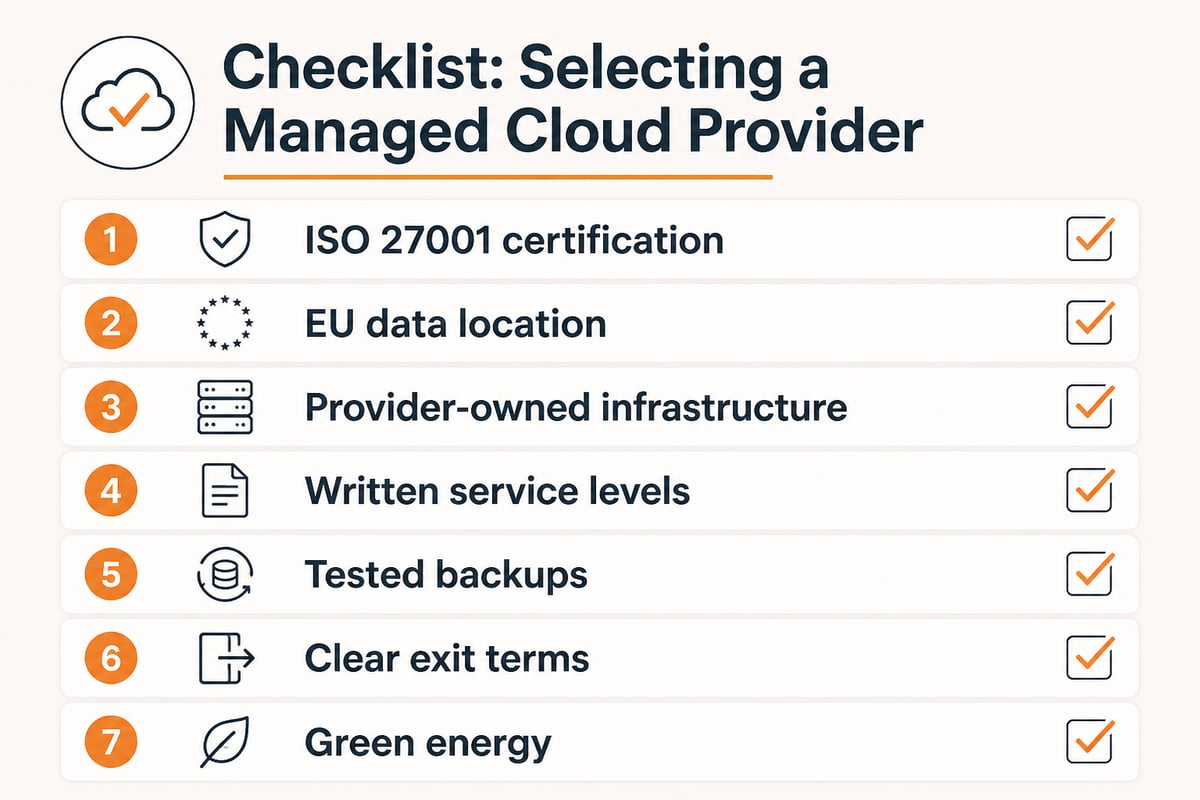
The right managed cloud provider combines verifiable certifications, transparent contract terms, clear data location and a support model that matches your working hours. Use the following criteria when comparing candidates.
- Certifications: ISO 27001 certification for the data centres and the provider's own processes.
- Data location and ownership: a stated country of storage, and infrastructure operated by the provider rather than resold from a third party.
- Service levels: guaranteed uptime, response times and escalation paths written into the contract.
- Backup practice: retention periods, restore testing and coverage for SaaS data such as Microsoft 365 and Google Workspace.
- Exit terms: a clear route for retrieving your data and moving elsewhere.
- Sustainability: renewable energy use and efficient hardware, which increasingly feature in procurement policies.
The provider's size should match your own. A large global platform may offer breadth, yet a regional specialist often provides faster, more personal support. For help with the selection process itself, vBoxx covers it in its overview of cloud computing suppliers.
Avoiding Lock-In: The EU Data Act and Switching Rights
Vendor lock-in is one of the main risks of outsourcing cloud operations, and the EU Data Act now gives customers statutory switching rights that strengthen their negotiating position. The cloud-switching provisions became applicable on 12 September 2025, requiring measures to reduce obstacles to switching data-processing services, according to Alston & Bird.
The practical mechanics are significant. Under the Data Act, providers must support switching within a transitional period, following a notice period, as described in the same legal analysis. In addition, the rules cover moving data to another provider, as McCann FitzGerald explains.
What does this mean in practice? Before signing, ask the provider to describe its export formats, its switching procedure and any charges that apply. Nevertheless, regulation is only a safety net, and a well-designed exit plan is still the better protection. Keep an independent copy of critical data, document your configurations and prefer open standards wherever possible.
Typical Use Cases for Small and Mid-Sized Businesses
Managed cloud computing is most valuable where a business depends on a service continuously but has no dedicated infrastructure staff. Several scenarios recur among European small and mid-sized firms.
Secure document handling
Professional services firms, accountants and legal practices exchange sensitive files daily. A managed platform with encrypted storage, version history and audit trails protects those files while keeping collaboration simple. Digital signing adds further value, provided it meets the eIDAS standard for legal validity across the Union. For example, vBoxxCloud offers GDPR-compliant business storage with 256-bit AES encryption, held in European data centres and not subject to the US CLOUD Act, together with eIDAS-compliant e-signing and AI-assisted document search.
Backup of software-as-a-service data
Many organisations assume that Microsoft 365 or Google Workspace data is fully protected by the software vendor. In reality, the vendor secures the platform, whereas the customer remains responsible for the data. Therefore, an independent backup managed by a third party is a sensible safeguard against accidental deletion, ransomware and account compromise.
Application and server hosting
Businesses running line-of-business software, websites or development environments often need virtual or dedicated servers with managed administration. In addition, specialised workloads such as Apple build pipelines may require dedicated hardware, which a provider can host and maintain for you. Related guidance on infrastructure choices appears in vBoxx's article on hosting and cloud computing.
Supporting systems around the cloud
A managed environment rarely stands alone. Firms frequently pair it with business applications and IT support, such as CRM platforms configured by specialists like capeMBX Consulting for Salesforce, or hardware leasing and IT consultancy services such as those from REDCHIP IT SOLUTIONS. Consequently, interoperability and clear data-processing agreements across all these suppliers deserve attention from the outset.
Cost Considerations and Governance
The cost of managed cloud computing should be measured as total cost of ownership rather than as a monthly invoice. A managed fee is typically higher than an unmanaged rate, but it replaces salaries, tooling, training and out-of-hours cover that an in-house team would otherwise require.
When building a business case, include these items:
- Licence and resource fees for storage, compute and software.
- Management fees for administration, monitoring and support.
- Migration costs, which some providers waive or reduce.
- Compliance costs, such as audits, documentation and data processing agreements.
- Exit costs, including data export and any early termination terms.
Governance matters as much as price. Assign an internal owner for the relationship, review service reports regularly and test restores at least annually. Confirm in writing which party handles each security task, since ambiguity in a shared-responsibility model is where incidents tend to arise. For a wider overview of the field, the Eurostat digitalisation publication compares digital adoption across EU businesses.

FAQ
What is an MSP example?
A managed service provider (MSP) is a company that runs part of your IT on a contractual basis, such as a firm that administers your servers, backups and security around the clock. A European hosting company that operates cloud servers and monitors them for clients is a typical example.
What is the purpose of cloud hosting?
Cloud hosting delivers websites, applications and data from a pool of connected servers instead of a single machine. The purpose is resilience and flexibility, since capacity can be adjusted to demand and a hardware failure does not take the service offline.
How long does a migration to a managed cloud usually take?
The duration depends on data volume, application complexity and the amount of preparation done beforehand. Simple file and email migrations can be completed within days, whereas complex server environments may need several weeks of planning, testing and phased cut-over.
Begin by listing your five most business-critical systems and noting where each is stored, who administers it and how quickly you could restore it, because that inventory shows where managed support would reduce risk fastest. From there, vBoxx can help you act on the findings, offering consultancy, maintenance and free migration services on infrastructure that it runs itself in ISO 27001-certified Dutch data centres. To see how a European-hosted workspace looks in practice, explore vBoxxCloud and discuss your requirements with the team.